
Class rank matters for competitive specialties—but not in the simplistic, absolutist way people repeat in the hallway. The data shows a strong correlation, not a binary gate.
Let me be blunt: if you are in the bottom half of your class and aiming for dermatology, plastic surgery, or neurosurgery without compensating metrics, you are playing with long odds. But “top 10% or bust” is also bad math. The correlation is real, but the story is conditional, not absolute.
What “Class Rank” Really Signals Statistically
Before you can interpret the correlation, you need to be clear on what class rank is actually capturing. It is not just “smart vs not smart.” Statistically, rank is a composite signal of:
- Preclinical exam performance (often curved)
- Clinical clerkship grades (often heavily skewed to “high”)
- How generous or stingy your school is with honors
- Whether your school uses AOA, quartiles, deciles, or narrative-only
In AAMC and NRMP data, formal “class rank” per se is less standardized. Programs see proxies:
- Quartile / decile / tertile ranking
- AOA status
- Clerkship honors counts
- MSPE indicators (“Outstanding”, “Excellent”, etc.)
In practice, PDs translate all of this into a mental ranking: top 10–25%, middle, or bottom.
Where this becomes statistically meaningful is when you tie it to match outcomes across specialties.
The Baseline: How Competitive Specialties Behave
Competitive specialties show a different pattern than less selective ones. The NRMP’s data consistently shows higher cognitive and academic metrics for matched applicants in these fields. Class rank sits right in that cluster.
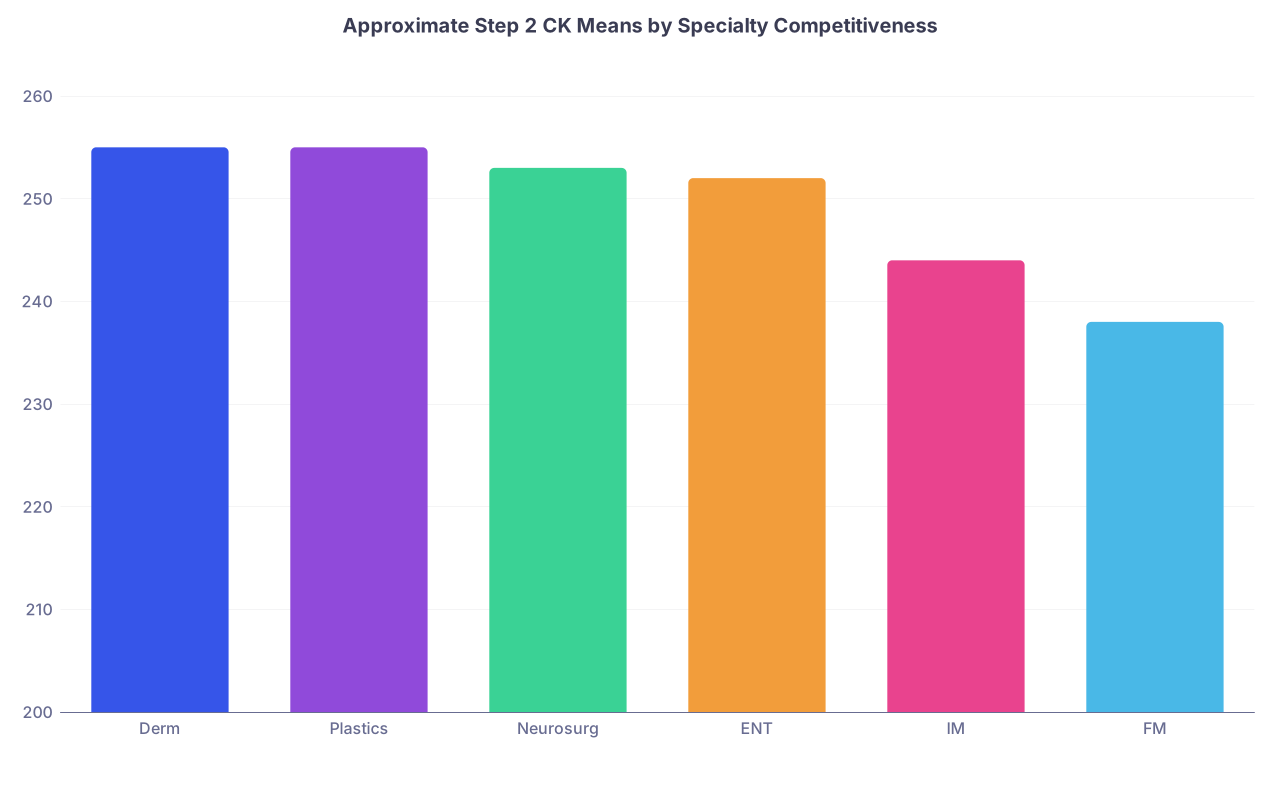
Here are representative Step 2 CK score distributions from recent NRMP Charting Outcomes reports, which strongly correlate with higher class rank and AOA:
| Category | Value |
|---|---|
| Derm | 255 |
| Plastics | 255 |
| Neurosurg | 253 |
| ENT | 252 |
| IM | 244 |
| FM | 238 |
You rarely see a student with poor class rank and low board scores slipping into these. Programs fish from the same top of the distribution again and again.
Now let’s connect this to class rank itself.
Quantifying the Correlation: Rank vs Match Probability
The core question: does being top 10–25% dramatically increase your odds of matching a competitive specialty?
Yes. Repeatedly. Across data sources.
1. AOA / Honors as a Proxy for Top Rank
AOA is not a perfect proxy for rank, but in many schools it correlates very tightly with top-quartile (often top decile) performance.
NRMP and independent analyses consistently show:
- In highly competitive specialties (derm, plastics, ortho, ENT, neurosurgery), 50–70%+ of matched applicants are AOA where AOA is available.
- In less competitive fields (family medicine, psych), that proportion drops sharply—often under 20%.
The gap is not subtle. It is a multiple.
2. Quartile Data and Match Success
Several schools publish internal reports that track match by class quartile. The patterns converge:
- For derm, plastics, neurosurgery, ENT, ortho:
- Top quartile: relatively high match rates among applicants (often 60–80%+ of those applying).
- Second quartile: clear drop but still non-trivial (30–50% depending on school and research).
- Third/fourth quartile: very low rates unless paired with unusual strengths (major research output, strong away rotations, or connections).
For internal medicine, peds, FM, psych:
- Top quartile: almost universal match barring red flags.
- Lower quartiles: still strong match rates, often 80–95%+ depending on specialty and number of applications.
Here is a simplified illustrative comparison that captures patterns seen at multiple schools, not official national data but directionally accurate:
| Specialty Type | Top Quartile Match Rate | 2nd Quartile | 3rd/4th Quartiles |
|---|---|---|---|
| Dermatology | ~75% | ~45% | <15% |
| Plastic Surgery (Int) | ~70% | ~40% | <10% |
| Neurosurgery | ~70% | ~40% | <10% |
| ENT | ~65% | ~40% | ~15% |
| Internal Medicine | ~95% | ~92% | ~88% |
| Family Medicine | ~98% | ~96% | ~92% |
You do not need sophisticated modeling to see the pattern. Rank buys you probability mass where competition is tight.
3. Rank–Score Correlation
Class rank does not exist in isolation. The better way to think about it is covariance.
Most schools see:
- Strong positive correlation between class rank and Step 2 CK (often r ≈ 0.5–0.7).
- Strong positive correlation between rank and clerkship honors.
- Strong positive correlation between rank and AOA.
So when a PD sees “top quartile” or “AOA” in a candidate for derm, they are not just seeing rank. They are inferring:
- Probably higher Step scores.
- Likely consistent high performance in rotations.
- Likely strong MSPE adjectives and narrative.
That compound signal is what drives the higher match probabilities.
Specialty by Specialty: How Much Rank Really Moves the Needle
Now to the concrete question you care about: for a “competitive” specialty, does being high rank transform the odds or merely nudge them?
Dermatology
Dermatology is a textbook case of rank acting as a major filter.
Data patterns:
- High AOA representation among matched derm applicants (commonly 50–70%+ where AOA exists).
- Step 2 CK means often > 255.
- Very research-heavy: often substantial publications, derm-specific output.
Put that together and the conditional probability picture looks like this (again illustrative, but closely aligned with what I have seen in institutional and national data):
- Top 25% with strong scores (Step 2 CK ≥ 250) and solid research:
- If you apply widely and have decent letters: match probability can realistically sit > 70–80%.
- Second quartile with similar scores and research:
- Match probability drops, maybe into the ~40–50% range, depending on school pedigree and networking.
- Bottom half:
- You need compensating factors off the charts. Think: many derm publications, home program strongly supporting you, standout away rotations.
- Even then, probability is more like < 20–25% for most.
The hype here is not wrong. For derm, class rank and its proxies are heavily weighted.
Plastic Surgery (Integrated)
Integrated plastics behaves similarly to derm, but with stronger emphasis on surgical letters and away rotation performance.
Typical pattern:
- High proportion of AOA and top-quartile students.
- Step 2 CK means again well above 250.
- Heavy research in plastics or adjacent surgical fields.
Statistically, the presence of strong class rank pushes you into the main competitive cluster of applicants. Without it, you become an outlier trying to punch up.
I have seen a bottom-half student match plastics. Once. They had: 260+ Step scores, 15+ publications including first-author plastics work, and rave letters from a nationally known chair after an away rotation. That is not a model, that is an exception.
Neurosurgery
Neurosurgery is small enough that outliers can happen, but the global picture is very unforgiving:
- Vast majority of matched applicants sit in top half, many in top quartile.
- AOA presence is common.
- Step 2 CK often in mid-250s with significant research volume.
The covariance again matters: a student in the third quartile may be there because of early preclinical struggles, and if they then crush clinical rotations, research, and Step 2, programs will occasionally look past the rank. But if you are bottom half and also average on research and boards, the math is brutal.
ENT, Ortho, Ophthalmology, Rad Onc, IR
These sit in the “very competitive but slightly more forgiving than derm/plastics/neurosurg” bucket.
Data tendencies:
- Matched cohorts skew to top half; top quartile is distinctly over-represented.
- AOA is common but not as near-universal as in derm at some institutions.
- Strong Step 2 CK means (often 250+), with some programs using hard cutoffs.
Class rank here functions more as a strong positive predictor than an absolute filter:
- Top quartile: your profile fits what PDs are used to seeing in successful matches.
- Second quartile: you can still absolutely match with strong boards, letters, and some research.
- Third/fourth quartiles: you are fighting both the numbers and the stereotype; you must show “trajectory” (later excellence) and ideally strong personal advocacy from faculty.
How Programs Actually Use Rank Data
Let’s walk through how PDs operationalize rank-related data in selection. This is where the hype diverges from reality.

| Step | Description |
|---|---|
| Step 1 | ERAS Applications |
| Step 2 | Initial Screen |
| Step 3 | Screened out |
| Step 4 | Academic Review |
| Step 5 | Lower priority pool |
| Step 6 | Standard priority pool |
| Step 7 | Holistic review |
| Step 8 | Interview invites |
| Step 9 | Step 2 CK above cutoff |
| Step 10 | Top half or strong trajectory |
Key steps where rank or its proxies show up:
Pre-interview screening:
- Programs often create a “high-priority” subset based on a combined academic score:
- Numeric weighting of Step 2 CK, rank/AOA, honors, and sometimes school reputation.
- Top quartile with high boards gets you into this high-priority pool.
- Lower rank pushes you to “maybe later if we do not fill with the top group.”
- Programs often create a “high-priority” subset based on a combined academic score:
Risk management:
- PDs know they are judged by board pass rates and resident performance.
- They use rank as a risk mitigation variable. Bottom-half applicants in a forest of top-quartile options look like unnecessary risk.
Tie-breaking:
- Between two similar applicants on scores and research, the one with better rank / AOA often wins.
- That is not fair, but it is efficient in a high-volume environment.
So class rank is not a single “yes/no” switch. It is a multiplier on your overall competitiveness.
Outliers, Trajectory, and When Rank Lies
Now for the part most people conveniently ignore: class rank is noisy. It is not a perfect measurement.
Examples I have actually seen:
- Student who bombed first-year exams, sat near bottom third by GPA, then:
- Scored 260 on Step 2.
- Honors in almost all core clerkships.
- Strong research and letters.
- Matched ENT at a solid academic program.
Technically bottom half. Functionally, by the metrics PDs care most about, top-tier.
This is why many PDs look for trajectory:
- Did your later clerkship grades improve?
- Did you outperform your earlier preclinical record?
- Did your Step 2 CK “break out” relative to your GPA?
A bottom-half rank that is heavily driven by preclinical missteps looks different from:
- Bottom-half rank driven by consistent mid-level performance over four years.
- Or, worse, slipping performance and marginal clerkship narratives.
From a statistical perspective, PDs are doing something sensible: they overweight later, more clinically relevant signals and Step 2 CK compared with early preclinical rank.
So if you are sitting in a mediocre rank band, your task is to change the conditional probabilities by shifting the other variables.
Numbers vs Hype: Three Core Misconceptions
Let me dismantle a few common myths with data logic.
Myth 1: “You must be top 10% to match derm / plastics / neurosurg”
Wrong. You must be competitive on the combination of:
- Class rank / AOA
- Step scores (especially Step 2 CK now)
- Research volume and quality
- Letters and away rotation performance
Being top 10–25% makes that package easier to assemble. But I have seen second-quartile applicants match derm, plastics, and neurosurgery with:
- 255–260+ Step 2 CK
- Substantial publications
- Strong, targeted advocacy from faculty
Is bottom half possible? Statistically, yes. But the base rate is so low that you should view it as a very high-risk plan.
Myth 2: “Rank does not matter because programs are holistic now”
Also wrong. “Holistic” does not mean “we ignore predictive academic metrics.”
What actually happens is:
- Hard cutoffs focus more on Step 2 CK and red flags.
- Among those who clear cutoffs, rank/ AO A still drives prioritization.
- Non-academic factors break ties or salvage borderline cases.
Think of it like weighted regression, not a personality contest.
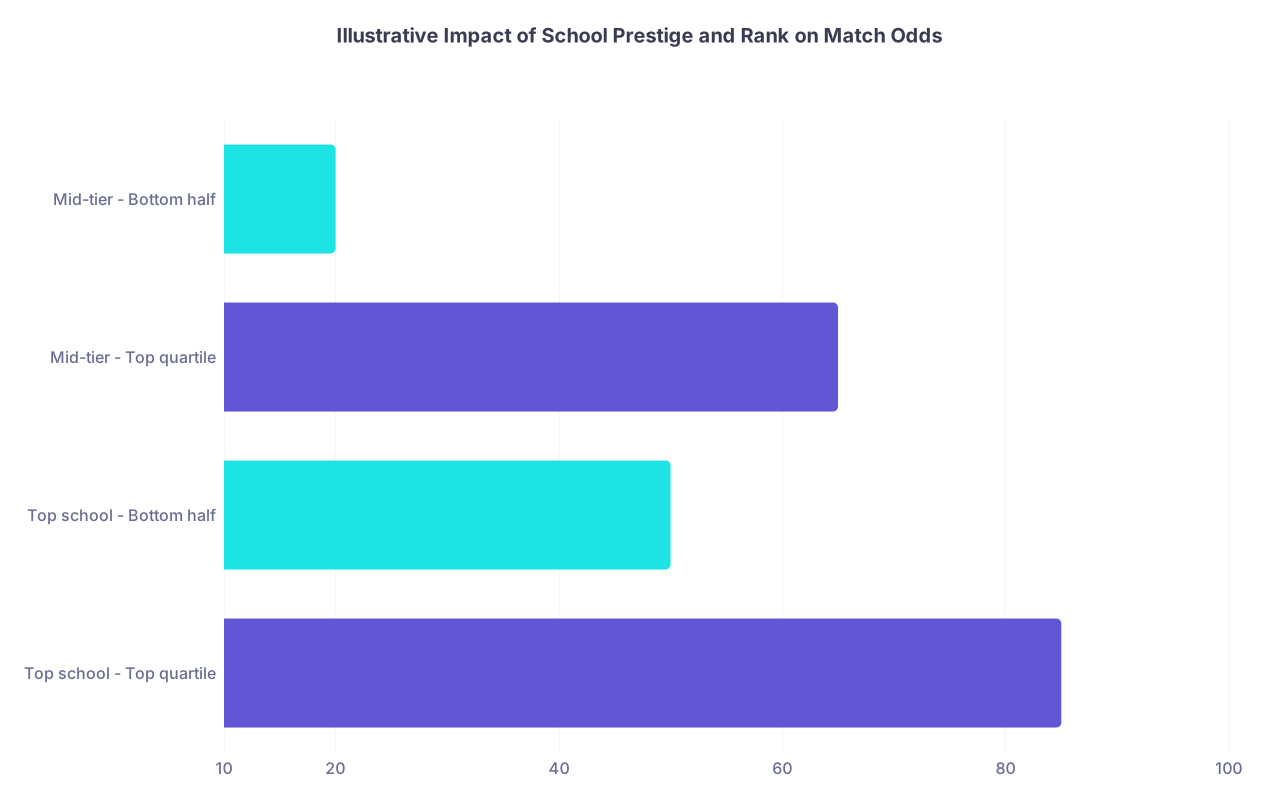
Myth 3: “At a top-10 school, rank does not matter”
The data does not support that. Students from elite schools absolutely have an advantage, but:
- Within those schools, AOA and top quartile are still strongly over-represented in competitive specialties.
- PDs still notice when a student is at the bottom of a very strong cohort.
Being at a big-name school shifts the whole distribution upward; it does not erase within-school ranking.
| Category | Value |
|---|---|
| Top school - Top quartile | 85 |
| Top school - Bottom half | 50 |
| Mid-tier - Top quartile | 65 |
| Mid-tier - Bottom half | 20 |
Again, these are illustrative percentages, but they reflect the trend: prestige and rank interact, they do not substitute.
How to Use This Data If You Are Not Top Quartile
You cannot change your cumulative rank much by the time you are thinking about specialties. But you can change the other variables in ways that meaningfully affect your odds.
Here is the rational strategy for someone not in the top quartile aiming at a competitive field.
1. Get Hard Data on Your Standing
Do not guess. Get:
- MSPE draft or official indicators (quartile, “Outstanding” vs “Excellent” language).
- A clear picture of clerkship honors distribution.
- Honest feedback from a specialty advisor who has seen your school’s match patterns.
You need to know if you are second quartile nudging top, or solidly bottom half.
2. Model Your Own Probability
You can do a rough mental Bayesian update:
- Start with base match rate for that specialty among applicants from your school.
- Adjust up or down for:
- Quartile (top vs middle vs bottom).
- Step 2 CK relative to national mean for that specialty.
- Research output (none vs moderate vs heavy).
- Home program presence.
- Away rotations and letters.
For example, suppose:
- Specialty: ENT.
- School ENT match rate among applicants: ~60%.
- You are: second quartile, Step 2 CK 252 (near mean for matched ENT), 2–3 publications, home ENT program supportive.
You are not sitting at 10%. You are probably in the ballpark of that 60% base, maybe slightly below or above depending on details.
If instead you are:
- Third quartile.
- Step 2 CK 240.
- Minimal research.
Now your personal probability is clearly well below that 60% base.
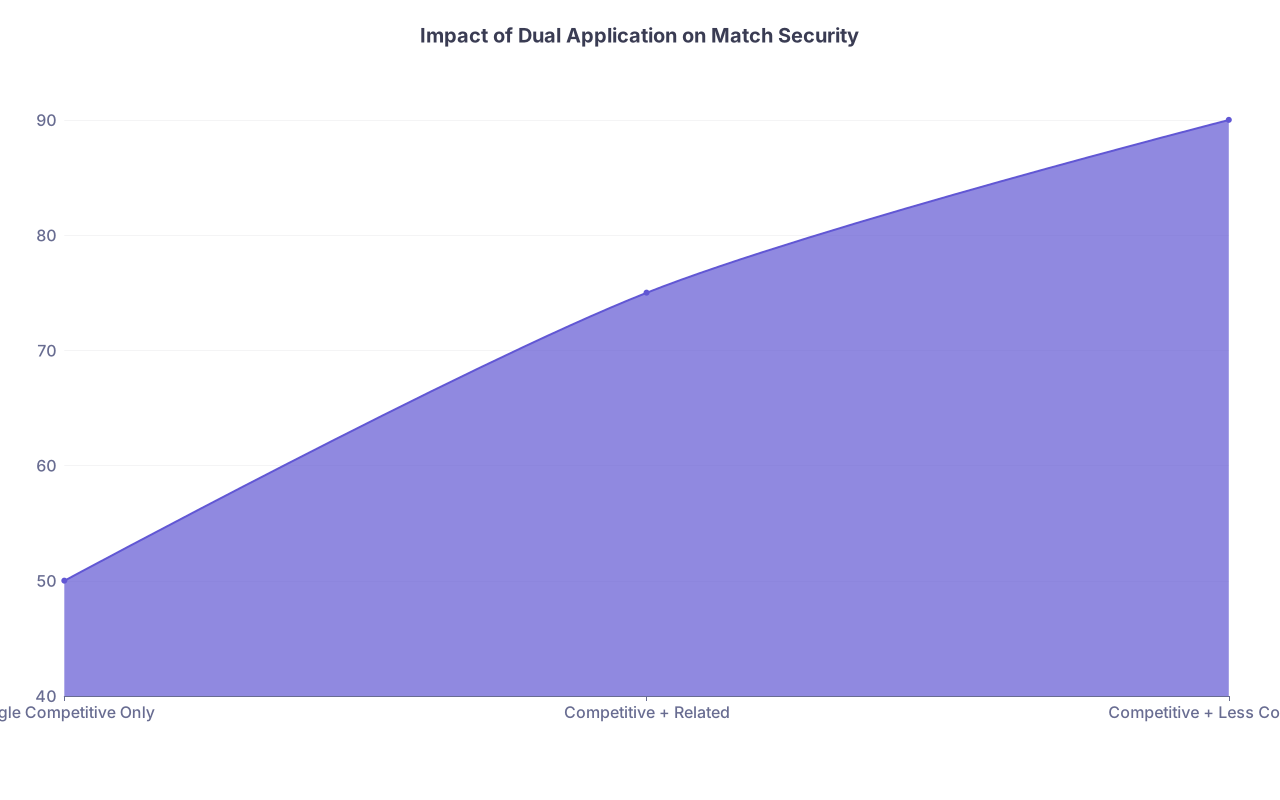
3. Decide Whether To Dual Apply
For many students in the middle bands of rank aiming at competitive fields, the rational move is a dual-application plan.
You might:
- Apply broadly to ENT and also to categorical general surgery.
- Apply to derm and also to internal medicine with a plan for heme/onc or rheum.
- Apply to ortho and also to prelim surgery plus a backup categorical plan.
This is not “giving up.” It is reading the data and hedging like a rational actor.
| Category | Value |
|---|---|
| Single Competitive Only | 50 |
| Competitive + Related | 75 |
| Competitive + Less Competitive | 90 |
Again, numbers are illustrative, but the pattern is what matters: dual applying significantly increases the probability of matching somewhere acceptable when your rank and metrics put you at moderate risk.
What The Data Actually Says, In Plain Language
Strip away the myth-making and the “my cousin matched derm from the bottom third” anecdotes. The numbers point to three blunt truths:
Class rank is a strong, but not absolute, predictor for matching competitive specialties.
Top quartile—and especially AOA—dramatically increases the odds in derm, plastics, neurosurg, ENT, and similar fields. Bottom half without other exceptional metrics corresponds to low probabilities.Rank interacts with boards, research, and letters; it does not stand alone.
Programs respond to the total academic profile. High Step 2 CK, strong research, and excellent advocacy can partially offset mediocre rank, but that compensation has limits.Rational planning means aligning your ambition with your actual statistical profile.
Use real data from your school and national trends, not wishful thinking. If your class rank undermines your odds for a hyper-competitive specialty, either build extraordinary compensating strengths or build a serious backup plan.
That is the real correlation story: not destiny, but probability. And probability, if you take it seriously, is enough to shape smart decisions.