
The fear of picking the “wrong” specialty is more paralyzing than the competitiveness of either specialty.
That’s the part nobody tells you. They warn you about Step scores and research and away rotations. They don’t warn you about lying awake at 2am thinking, “If I choose wrong, I will ruin the next 40 years of my life.”
If you love two competitive specialties, you’re not just making a career choice. In your head, you’re picking a personality, a social circle, a lifestyle, a version of yourself you’re going to be stuck with. Forever. No pressure, right?
Let me be blunt: the way most students try to solve this problem is backwards. They ask, “How do I figure out which specialty I like more?” when the real question is, “How do I make a decision I can live with, in a system that doesn’t give guarantees, between two paths I might both love and hate at different times?”
The Terrifying Part You’re Afraid to Say Out Loud
You’re not just thinking, “What if I choose wrong?”
You’re thinking things like:
- “If I pick dermatology over plastic surgery (or ortho vs ENT, EM vs anesthesia, whatever your two are), I’m shutting a door I’ll never open again.”
- “I don’t just want to match. I want to match into the right thing—and what if the ‘right thing’ wants me less than the other option?”
- “If I go all in on one and don’t match, I’ll have to scramble into something I don’t want, and everyone will know I failed.”
- “If I try to play both sides, both specialties will think I’m not committed enough and I’ll tank my chances in both.”
You end up in this awful no-man’s-land: too scared to commit, too scared not to.
And behind all of that is the quiet, ugly fear: “What if I am not as competitive as I think I am… and I only find out when the rejection emails hit?”
Here’s the uncomfortable truth: the system is not built to make this easy. ERAS and NRMP are logistics platforms, not emotional support systems. They force you to turn a very human, messy decision into checkboxes, letters, and a rank list.
But there’s a way through this that doesn’t require being absolutely certain. You won’t get certainty. You’ll get “good enough, and I can live with it.”
That’s the real win.
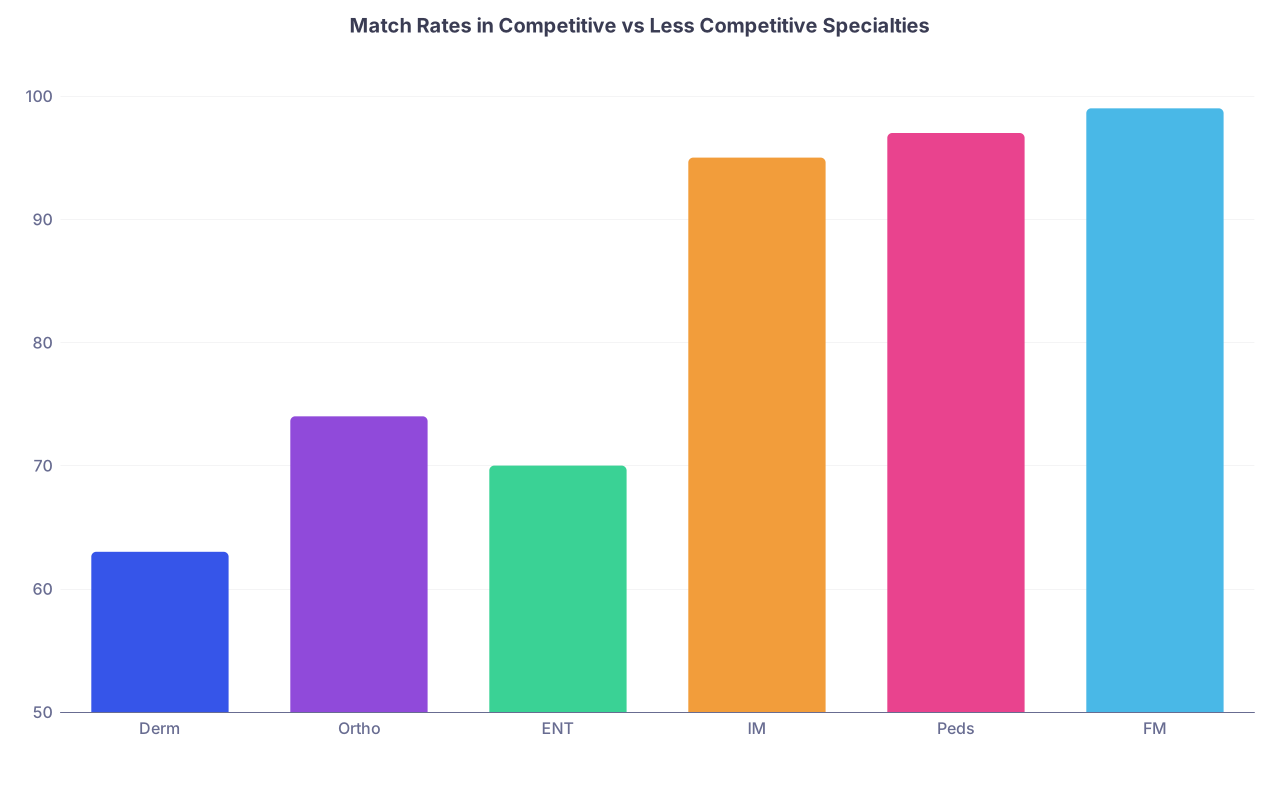
| Category | Value |
|---|---|
| Derm | 63 |
| Ortho | 74 |
| ENT | 70 |
| IM | 95 |
| Peds | 97 |
| FM | 99 |
(Example US MD match rates, approximate; point is the gap, not the exact numbers.)
Step One: Admit That Either Choice Will Have Regrets
Everyone tries to find the path with “no regrets.” That doesn’t exist.
I’ve seen derm residents who miss the camaraderie and adrenaline of their surgery prelim year. I’ve seen ortho residents look longingly at the chill derm clinic down the hall when they’re post-call and covered in sweat. I’ve seen EM folks wonder if they should’ve gone anesthesia when the third 2am drunk trauma rolls in.
You are going to have “what if” moments no matter what you choose. That doesn’t mean you chose wrong. It means you’re human and you gave up something real to get something else real.
What actually matters is:
- Can you tolerate the downsides of this specialty?
- Can you see yourself being “okay” even on an average-to-bad day in this field?
- Can you respect your reasons for choosing it when you’re exhausted and questioning everything?
The goal isn’t “no doubt.” The goal is “defensible to myself when I’m brutally honest.”
If both specialties pass that test, then you aren’t choosing between “right and wrong.” You’re choosing between “two different good-but-imperfect lives.”
Weirdly, that makes it harder emotionally. But it also means you’re not on a cliff edge. It’s more like a fork in the road.
Step Two: Stop Asking “Which Do I Love More?” and Ask Better Questions
“Which do I love more?” is a trap. It assumes:
- You’ve had equal, high-quality exposure to both.
- Love is stable and won’t change with more responsibility.
- Your current emotional intensity is a reliable predictor of long-term fit.
All of that is shaky.
Instead, start interrogating the boring stuff. The stuff that actually wears you down or holds you up when the novelty fades.
Here are questions that actually separate specialties:
- On your most tiring day, which type of work would you rather be stuck doing?
- Which patient population do you feel less emotionally drained by?
- How do you feel about call in each field—really? Nights, weekends, holidays. Be specific.
- Which procedures/clinic tasks do you find tolerable, not just exciting? (Honeymoon-phase excitement is cheap.)
- In which specialty’s residency can you realistically see yourself not completely breaking down?
Imagine it’s PGY-3. You’re post-call, you haven’t eaten properly in 18 hours, you’re behind on notes. Now drop yourself into each specialty’s typical day.
Not the highlight reel. The grind.
For example: say your two are dermatology and orthopedic surgery.
- Derm “bad” day: backlog of patients, complex rashes you can’t fully diagnose in 15 minutes, cosmetic patient upset about tiny imperfections, lots of biopsies and small procedures, EMR fights.
- Ortho “bad” day: cases running late, another hip fracture rolls in at 4pm, you’re consented for a 2am case, the EMR is a disaster, the attending is short-tempered, and you still have consults to see.
Neither is glamorous when you’re wiped. But one may feel less wrong. That matters.
If your two are, say, EM vs anesthesia:
- EM “bad” day: boarding, hallway patients, endless social chaos, no beds, agitated patients, constant interruptions, decision fatigue.
- Anesthesia “bad” day: cases stacking, surgeon pressuring you, complex airways, limited breaks, a lot of time in the OR with minimal direct “ownership” after handoff.
You don’t pick the one that sounds “objectively better.” You pick the one whose worst days you can stomach.
Step Three: Be Honest About Competitiveness and Risk Tolerance
We have to talk about the numbers. Not to scare you, but because pretending they don’t matter just makes the anxiety worse.
If you’re loving two competitive specialties—say derm and plastics, or ortho and ENT—there are a few uncomfortable realities:
- Both are riskier than IM, peds, FM, psych, etc.
- Doing a scattered application with 20 derm and 20 plastics and weak signal of commitment to either is dangerous.
- Your actual competitiveness (Step scores, class rank, research, letters) constrains your options whether you want it to or not.
You can’t “manifest” your way around program statistics.
| Factor | Specialty A (More Competitive) | Specialty B (Still Competitive) |
|---|---|---|
| Step 2 target avg | 255+ | 245–250 |
| Research expectation | 5+ pubs/abstracts | 2–3 solid experiences |
| Aways commonly done | 2–3 | 1–2 |
| Home program needed | Strongly helps | Helpful but not essential |
If your current profile is clearly stronger for one than the other, you have three choices:
- Accept the higher risk and go all in on the more competitive one.
- Decide you want a high probability of matching somewhere and lean into the slightly less competitive one.
- Build a real, not fake, dual strategy (this is hard and most people do it badly).
Let me be harsh: dual-applying to two very competitive specialties where neither side sees you as fully committed is one of the most common ways to end up unmatched. Programs are not stupid. If your CV screams “half-derm, half-plastics,” both might think, “We’re the backup.”
That said, sometimes a genuine dual strategy makes sense: e.g., rad onc + IM, EM + IM, anesthesia + prelim medicine, etc. But derm + plastics, ortho + ENT, neurosurg + plastics… that’s playing chicken with fate.
So ask yourself:
- Am I okay with a higher chance of not matching this year if it means taking my one shot at my dream specialty?
- Or is my main fear not matching at all, to the point that I would rather slightly “downgrade” to a specialty where my odds are better?
Neither answer is right or wrong. But pretending you’re comfortable with risk when you’re not? That’s how you end up shattered on Match Day.
Step Four: Reality-Testing Your Identity Stories
A lot of the angst isn’t about the actual work. It’s about who you think you’ll be if you pick one path over the other.
“I’m more of a derm person. But I love the intensity of surgery and I don’t want people to think I chose the cush life.”
“If I pick ortho, will everyone assume I’m the cliché jock bro? If I pick ENT, will they think I couldn’t hack ortho?”
“If I pick EM, am I signing up to be that burned-out doc complaining in the break room at 3am?”
These are identity questions dressed up as career questions.
You’ve probably seen the stereotypes in action. The derm squad with great hair and perfect notes. The ortho bros with huge shoulders and bigger AO sets. The EM crew in Allbirds talking about travel and side gigs. It’s not all wrong. But it’s not entirely right either.
I’ve met introverted, bookish orthopods. I’ve met intense, research-heavy derm folks who live in the lab. I’ve met EM attendings who work 0.8 FTE and spend their time raising kids or doing global health.
If you find yourself thinking, “I can’t be that kind of person,” pause. Whose voice is that? Your classmates’? Your family’s? Some random attending who made a snarky comment?
You’re allowed to choose the specialty that fits your actual nervous system, not the one that matches the persona you thought you were supposed to play.
Step Five: Designing a “No Regrets” Process, Not a Perfect Outcome
You can’t guarantee the outcome. You can control the process by which you decide. That’s what lets you live with it later, even if it hurts.
Here’s how you build a decision process you won’t hate yourself for:
Deliberate exposure. Seek as much real-world, high-quality time in both specialties as your schedule allows—electives, shadowing, even just hanging out in their workrooms and listening. Not just one magical day where they gave you all the cool cases.
Candid conversations. Ask residents in each field, “What sucks about this specialty that people don’t talk about until you’re in it?” Then shut up and listen. Take notes after the conversation, not during, so you don’t turn it into interrogation.
Write the “Regret Letter.” This sounds dramatic, but it works. On two separate days, when you’re relatively calm, write:
- “If I pick Specialty A and later regret it, the reasons will probably be…”
- “If I pick Specialty B and later regret it, the reasons will probably be…”
Don’t censor. Don’t make it pretty. Just brain-dump.
Ask Future You, not Present You. Think about yourself at 45. Maybe kids, maybe not. Aging parents. Your back hurts more. What kind of call schedule do you actually tolerate then? What physical demands? What income volatility?
Decide your “hard no.” It’s often easier to identify what you definitely can’t live with than to pick what you “love most.” Maybe that’s overnight trauma call past age 40. Or maybe it’s highly anxious cosmetic patients. Or sitting in a dark room reading imaging all day. Whatever it is, name it.
If you go through that kind of process and then choose—your brain has a much harder time later saying, “You were impulsive and stupid.” Instead, even if it hurts, you can say, “I made the best call with what I knew then.”
That matters.

| Step | Description |
|---|---|
| Step 1 | Two specialties you love |
| Step 2 | Real exposure to both |
| Step 3 | Honest talks with residents |
| Step 4 | Write regret letters |
| Step 5 | Assess competitiveness and risk |
| Step 6 | All in on one specialty |
| Step 7 | Careful, coherent dual plan |
| Step 8 | Build strong, consistent application |
| Step 9 | Pick one or dual apply? |
Step Six: If You Really Try to Dual Apply, Do It Like an Adult
Let me be very clear: I’m not encouraging dual applying to two highly competitive specialties. It’s usually a bad idea.
But sometimes your pair is competitive + moderately competitive, or you have life constraints that make a “safety net” non-negotiable. If you go this route, you can’t half-ass it.
You need:
- A primary narrative: one specialty that’s clearly the “main” in your story.
- A secondary narrative that still makes internal sense and doesn’t read like panic.
What you cannot do is send:
- A derm personal statement talking about loving long-term outpatient continuity and procedures,
and then - An anesthesia personal statement that sounds like you just swapped a few keywords.
Programs talk. Faculty read your ERAS. Contradictions get noticed.
A more coherent version might be: IM as primary, with EM as secondary focus, and a story that ties them together around acute care and complex medical decision-making. Or anesthesia primary with EM secondary, anchored around resuscitation, critical physiology, and team-based acute care.
But if your pair is something like derm + ortho? You’re basically telling each side they’re Plan B. They know.
If you’re even considering dual applying to two very competitive fields, force yourself to answer this: “If I go unmatched in both, will I wish I had just gone all-in on one instead?” If the answer is yes, you probably already know what you want and you’re just scared to commit.
The Part You Don’t Want to Believe: You Can Be Happy in More Than One Thing
Here’s the quiet relief no one gives you: most people could’ve been reasonably happy in several specialties. Not every specialty. But several.
And if you love two competitive specialties enough to be tortured about it, odds are you’d have ended up okay in either.
I’ve watched people:
- Choose ENT over plastics and end up doing complex recon and loving it.
- Choose anesthesia over EM and later pick up critical care, getting their adrenaline and procedures anyway.
- Choose derm over rheum and still carve out a niche in complex autoimmune disease that scratches the same intellectual itch.
Medicine is less rigid than it looks from MS3. There are fellowships, niches, blended careers, academic vs private, urban vs rural, research vs clinical heavy. You’re not picking one version of yourself forever. You’re picking a broad track you can still shape a lot.
You’re allowed to grieve the path you don’t take. You’re allowed to look at your friends in the other specialty and feel a pang. That doesn’t mean you screwed up. It just means the other option was genuinely good too.

When the Anxiety Is So Loud You Can’t Think Straight
Sometimes the specialty choice stops being an intellectual problem and becomes a panic loop.
You bounce between Reddit threads, talking to 10 different attendings with 10 different opinions, comparing yourself to classmates, refreshing NRMP stats until your vision blurs. Every time you lean toward one choice, a new horror scenario pops into your head and you snap back.
If that’s you, a few things:
- Accept that no input will give you 100% certainty. At some point, more data is not helping; it’s just giving your anxiety more fuel.
- Put hard limits on specialty talk. “I am allowed to think about this deeply for 30 minutes a day. After that, I write down my thoughts and walk away.” Sounds silly. Works better than doom-scrolling until 3am.
- Externalize the decision. Talk it out with someone neutral who doesn’t have a horse in the race—like a therapist, or a mentor outside both specialties. You’re not asking them to choose. You’re using them to force clarity on your own reasons.
- Decide your deadline. The real one, not the fantasy one. ERAS submission date, away rotation scheduling, etc. Then work backward and say, “By this date, I will choose. Not because I’m 100% sure, but because the cost of endless indecision is now higher than the risk of imperfection.”
You’re not broken because you can’t find certainty. You’re just trying to make a high-stakes decision in a system that treats you like a spreadsheet row.

One Concrete Thing to Do Today
Open a blank document and write two headings:
“If I choose Specialty A and regret it, it will probably be because…”
“If I choose Specialty B and regret it, it will probably be because…”
Set a 15-minute timer for each. No editing, no making it sound mature or impressive. Just raw, ugly honesty.
When you’re done, read both paragraphs and ask yourself:
“Which set of possible regrets can I live with more?”
Not which one is perfect. Not which one makes other people proud. Which one you can live with.
That’s the first real step out of this paralysis.