Interventional radiology and diagnostic radiology are not “the same residency with a few extra procedures.” They are different training pathways, different lifestyles, and—crucially—different levels and types of competition.
If you are treating IR and DR as interchangeable back‑up plans, you are already behind.
Let me lay this out the way program directors, not premed Reddit, actually think about it.
1. The Core Distinction: What You Actually Do
Diagnostic Radiology (DR) and Interventional Radiology (IR) are married on paper (same department, same boards, lots of shared training) but live very different lives Monday to Friday.
Diagnostic Radiology (DR)
You are paid to be an imaging expert.
You sit in front of monitors, interpret:
- X‑rays
- CT
- MRI
- Ultrasound
- Nuclear medicine / PET
and generate actionable reports. You are consulted by almost every specialty, often several times per patient admission. You control the narrative on the chart: “There is no pulmonary embolism.” “There is a new 1.2 cm enhancing mass in the left kidney.”
Procedures exist—paracenteses, thoracenteses, LPs, some line placements, basic biopsies—but they are usually a smaller percentage of your time and can be subdivided to IR or advanced DR proceduralists depending on the practice.
Interventional Radiology (IR)
You are a proceduralist and a clinician.
You:
- See patients in clinic
- Round on admissions and consults
- Do image‑guided procedures: embolizations, ablations, angioplasty/stenting, TIPS, uterine fibroid embolization, trauma embolization, tunneled lines, complex drainages, etc.
- Manage complications and longitudinal follow‑up for some conditions (PVD, oncology interventions, venous disease, some biliary and GU issues)
You still read imaging to guide what you are doing, but your value to the hospital looks more like “minimally invasive surgeon” than “imaging consultant.”
This difference in day‑to‑day work is exactly why the competition dynamics for IR and DR have diverged.
2. Training Pathways: DR vs IR Side‑by‑Side
You cannot talk competition without understanding pathways. Programs evaluate you differently depending on which door you are trying to walk through.
Standard Training Structures
Let me break down the common routes.
| Pathway | Length (Post‑MD/DO) | Key Components |
|---|---|---|
| DR (categorical) | 5 years | 1 prelim/transition + 4 DR |
| DR (advanced) | 1 separate prelim + 4 DR | 2 matches (prelim + DR) |
| Integrated IR/DR | 6 years | 1 prelim + 5 IR/DR (built in) |
| Independent IR | 1–2 years | After DR; separate match |
| ESIR (early specialization) | 4 DR + 1 yr IR | Shortens independent IR to 1 year |
Diagnostic Radiology
- Most people match into a 4‑year DR residency (PGY‑2 to PGY‑5), preceded by a separate or built‑in intern year.
- After DR, you can stop and practice general radiology, or do a 1‑year fellowship (body, MSK, breast, neuro, IR, etc.).
Interventional Radiology
Two main modern pathways:
Integrated IR/DR residency (6 years total)
You match straight out of med school. You are locked into IR/DR. You do:- A clinical intern year (often built‑in transitional or surgical/medicine prelim).
- DR‑heavy initial years (but with IR flavor).
- IR‑heavy final years with substantial clinic and call.
Independent IR residency after DR
- You complete a DR residency first.
- Apply separately to an independent IR residency (1–2 years depending on ESIR status).
Because integrated IR is a categorical match with a limited number of spots and a self‑selecting applicant pool that is aggressively motivated, the competition profile looks very different from standard DR.
3. The Numbers Game: How Competitive Are IR vs DR?
Let us not pretend this is purely vibes. There is hard data that tells you how steep each hill is.
Overall Competitiveness Signal
Interventional Radiology (Integrated) consistently sits in the “hyper‑competitive” tier with things like dermatology, plastics, and ENT. Diagnostic Radiology is competitive, but a notch below that top cluster.
Think about it this way:
- IR: fewer spots, high demand, procedure‑heavy, “cool factor,” early adopters from top schools with strong applications.
- DR: more spots, broader applicant range, still selective but with more “safety” options if you apply smart.
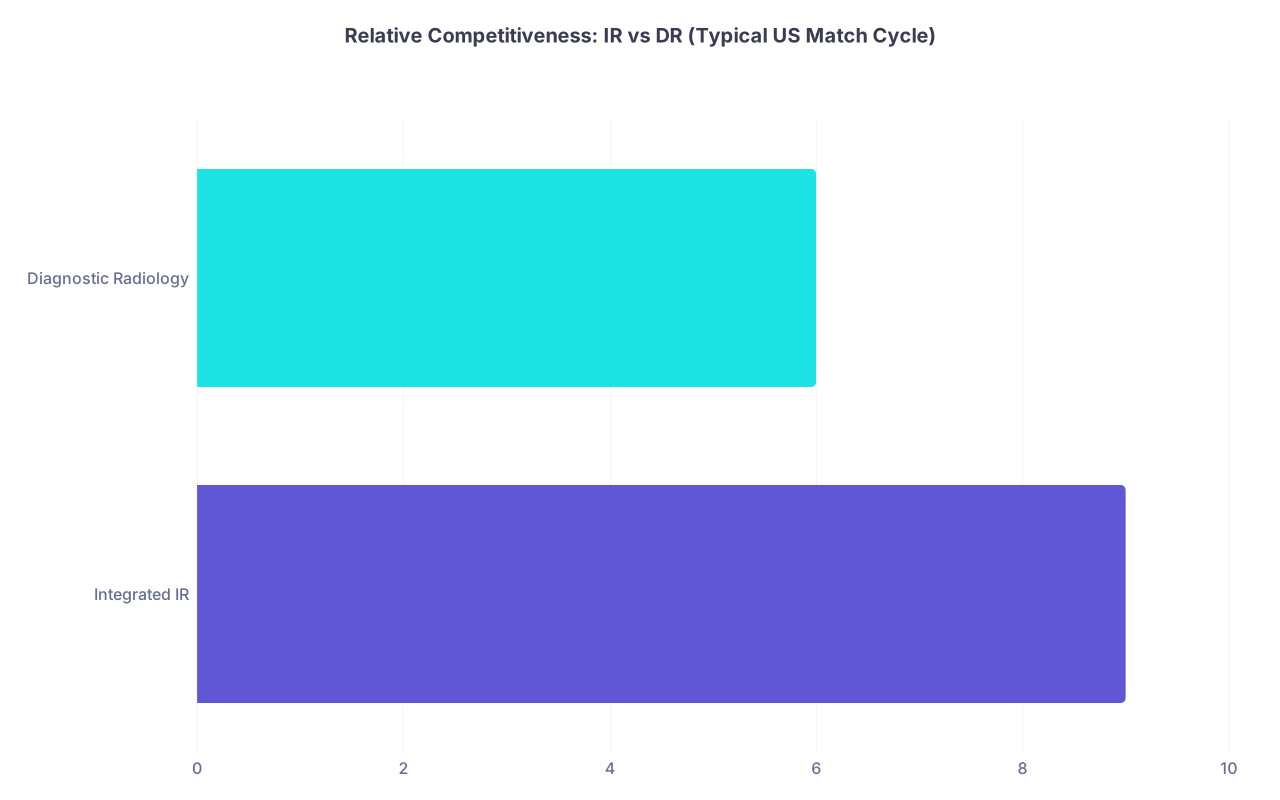
Here is a snapshot style comparison (values illustrative/typical, not exact current‑cycle numbers).
| Category | Value |
|---|---|
| Integrated IR | 9 |
| Diagnostic Radiology | 6 |
Scale: 1 = very easy, 10 = extremely competitive. This is roughly how program directors talk about it in hallways, not just what spreadsheets show.
Match Dynamics You Actually Feel
Where you, as an applicant, notice the difference:
Application volume per seat
IR integrated: many more applicants per position.
DR: still many, but with a wider tail of programs and spots.US MD dominance
IR integrated is dominated by US MD seniors from schools with strong home IR programs.
DR has a more balanced mix: US MD, US DO, and some well‑qualified IMGs.Score expectations
IR programs quietly screen Step/Level scores at a higher informal threshold.
DR screens too, but you have more variability across programs.
Bottom line: If you are a borderline candidate, DR has viable “safety” programs. Integrated IR mostly does not.
4. What Programs Look For: DR vs IR
Different job descriptions. Different filters.
For Diagnostic Radiology
Core things that actually matter:
Cognitive horsepower
Radiology is pattern recognition + deep anatomy + probability reasoning all day. That historically maps to test performance.- Strong performance on Step 2 CK (now the anchor since Step 1 is pass/fail).
- Solid clinical grades help but are not the centerpiece the way they are for surgical fields.
Evidence of interest in radiology
- Radiology elective(s).
- Some radiology research or at least exposure.
- A personal statement that sounds like you understand what radiologists actually do, not just “I like mysteries.”
Professionalism and reliability
A lot of the work is semi‑autonomous. You have to be trusted to handle large reading volumes without melting down.Letters
Good letters from radiologists (ideally from your home program) carry real weight. Generic medicine letters are weaker but still acceptable for some programs.
For Interventional Radiology (Integrated)
Now raise the bar and add more filters.
Top‑tier academic signal
- High Step 2 CK (or COMLEX equivalent). View IR like ENT or ortho in that regard.
- Strong clinical grades, especially on surgery and medicine. You are a proceduralist‑clinician, not just an image reader.
Specific, sustained IR involvement
- IR elective time. Multiple rotations if your school allows.
- IR research, ideally with at least an abstract or poster.
- Mentorship from IR attendings who can write targeted letters.
“Can this person be a procedural leader?” vibe
PDs want to see:- Operative/procedural comfort (you are not squeamish, you can handle a busy lab day).
- Some leadership or initiative: starting a QI project, organizing a clinic pathway, etc.
Letters from IR specifically
A glowing letter from a name IR attending does more for you in IR than two generic “hard worker, pleasure to teach” letters from medicine.
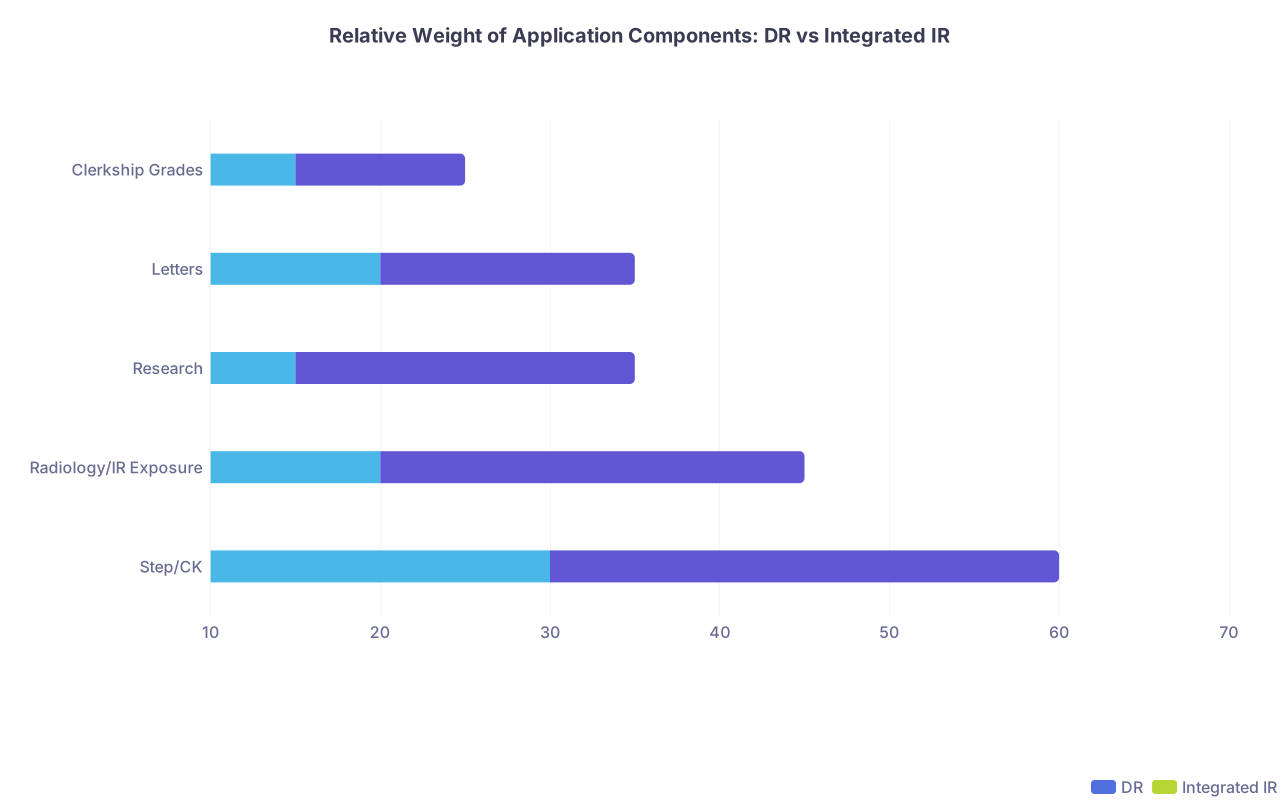
| Category | DR | Integrated IR |
|---|---|---|
| Step/CK | 30 | 30 |
| Radiology/IR Exposure | 20 | 25 |
| Research | 15 | 20 |
| Letters | 20 | 15 |
| Clerkship Grades | 15 | 10 |
Numbers are percentage emphasis, conceptually. You can see: IR demands everything DR wants, plus higher specificity for IR and more research/procedural profile.
5. Day‑to‑Day Reality: Lifestyle, Call, Burnout Risk
You are not just matching into a name. You are matching into 30 years of daily habits.
Diagnostic Radiology Lifestyle
In a typical group (academic or private):
- Hours: Often 8–5 or 7:30–4:30 for day shifts; nights in blocks for many practices; some have teleradiology coverage.
- Call: Night float, evening shifts, or pager call depending on structure. ER and neuro lines can be intense; others quieter.
- Procedures: Variable. Community DRs may have to do more bread‑and‑butter procedures if there is no IR coverage 24/7.
- Flexibility: Massive. Teleradiology, part‑time, remote options, multiple practice settings.
If you like clinical problem solving, pattern matching, and a relatively controllable lifestyle, DR makes sense. But it is not lazy or low‑stress. High volume + time pressure + medico‑legal risk is real.
Interventional Radiology Lifestyle
You are closer to surgery and cardiology in how your day feels:
- Hours: Lab days start early, often 7–7:30. Cases can run over. You might have clinic days that are more “office hours” like.
- Call: Real call. Trauma embolization at 2 a.m., GI bleed, septic patient who needs a drain, dialysis access crisis.
- Physical demands: On your feet, lead aprons, complex cases that run 4–6 hours at times.
- Clinic and longitudinal care: You are managing claudication, venous insufficiency, oncology patients post‑ablation, dialysis patients, etc.
Many students are seduced by the coolness factor of IR but underestimate the call and the responsibility for very sick patients. You own the complications. You get called when the drain stops working, the line gets infected, the stent thromboses.
6. Personality Fit: Who Actually Thrives in DR vs IR
Ignore the memes. Think actual personality–task matching.
DR Personality
Patterns I see over and over:
- Comfortable with long stretches of focused, mostly independent work.
- Enjoys diagnostic puzzles more than “doing” things with hands.
- Tolerates sitting for hours without feeling caged.
- Likes being the behind‑the‑scenes expert that everyone calls.
If the idea of spending most of your day at a workstation bores you or feels suffocating, DR will probably grind you down, regardless of lifestyle perks.
IR Personality
Very different profile:
- Needs to move. Likes being in procedure rooms, talking to nurses, adjusting the plan on the fly.
- More extroverted or at least functional in a team‑heavy, patient‑facing setting.
- Tolerates or even enjoys acute, high‑stakes situations (bleeding, trauma).
- Comfortable with longitudinal responsibility: seeing the same patients in clinic, explaining risk/benefit, managing post‑procedural issues.
You can get through DR if you are mis‑matched personality‑wise. You will not be happy in IR if you hate procedures and clinic, no matter how prestigious it sounds.
7. Strategy If You Are IR‑Curious But Not a Perfect Applicant
Here is where things get interesting, and I see students get burned all the time.
They aim only at integrated IR, have a middle‑of‑the‑pack profile, and end up unmatched in both IR and DR because their list was too “all or nothing.”
The Rational Approach
Use DR and ESIR/independent IR strategically.

| Step | Description |
|---|---|
| Step 1 | MS1-2 Interested in IR |
| Step 2 | Apply Integrated IR |
| Step 3 | Apply DR broadly |
| Step 4 | Rank mix IR and DR |
| Step 5 | Target ESIR programs |
| Step 6 | ESIR during DR |
| Step 7 | Independent IR |
| Step 8 | Competitive Profile? |
If you are a strong candidate (top scores, great letters, real IR research):
- Apply integrated IR primarily.
- Still apply to some DR programs, ideally with ESIR, as a safety net.
- Rank IR highest, DR below.
If you are a borderline candidate (average scores, limited IR exposure):
- Apply broadly to DR.
- Prefer programs that offer ESIR or have a strong IR presence.
- Build your IR portfolio during DR (research, electives).
- Aim for ESIR and then independent IR.
This gives you a path to IR without gambling the entire match on one of the most competitive specialties with a narrow funnel.
8. How Competition Shapes Your Med School Years
Choosing IR vs DR is not a late‑third‑year decision if you care about odds. The earlier you decide, the more you can align your CV with reality.
If You Are Even Remotely Interested in IR
By MS2 / early MS3, you should:
- Get in a lab or QI project with an IR attending. Even one small abstract or poster is better than “I shadowed once and liked it.”
- Schedule an IR elective as early as your school allows, ideally before ERAS opens.
- Meet the IR program director or section chief at your home institution. They will often tell you bluntly how competitive you look.
That early signal is invaluable. I have seen IR PDs say, “Your numbers are marginal for integrated, but if you match DR here and do ESIR, we will take you for independent.” That is gold.
If You Are Leaning DR
Still act intentionally:
- Do at least one DR elective. Show up, be present, read about every interesting case.
- Try to produce one piece of radiology‑related scholarly work. It does not need to be in NEJM. A poster, a retrospective chart review, even a well‑documented QI project.
- Meet with the DR PD and ask where your application stands relative to typical matched residents.
You want your application to say “I chose radiology on purpose,” not “I washed out of something else.”
9. Job Market and Long‑Term Outlook: IR vs DR
Competition at the residency level is only half the story. You also need to know what the job world looks like on the other side.
Diagnostic Radiology Market
The honest state:
- Demand is strong, especially in community and non‑coastal markets.
- Urban academic jobs are still competitive, but there is far less of the doom‑and‑gloom you see on anonymous forums.
- Subspecialization is common. Body, MSK, neuro, breast, etc. Many groups expect fellowship training.
- Teleradiology is a real option for lifestyle flexibility and geographic freedom.
You trade some prestige (compared to IR) for remarkable flexibility in where and how you practice. Plenty of DR attendings in their 40s and 50s transition to part‑time or remote work while colleagues in surgery are still locked in OR schedules.
Interventional Radiology Market
IR is in demand, but the nuance matters:
- Hospitals want 24/7 IR coverage, endovascular interventions, oncology interventions.
- Some practices under‑support IR with staffing and clinic time, treating them as “procedure machines” rather than a full clinical service. That is where burnout spikes.
- Turf wars exist: vascular surgery, cardiology, GI, urology all encroach on historically IR‑dominated procedures.
The IR jobs you actually want:
- Protected clinic time.
- Adequate staff and anesthesia support.
- Clear division of labor with surgery and cardiology, or at least respect for IR’s role.
These are absolutely available, but they cluster in certain systems and markets. You will work a bit harder to find them and may have to be flexible geographically.
10. Red Flags and Bad Reasons to Choose Either
You need to hear the blunt version.
Bad Reasons to Choose IR
“It looks cooler than DR.”
Coolness wears off at 3 a.m. during your third GI bleed of the week.“It is the ‘surgical’ version of radiology and I want to feel like a surgeon.”
Then maybe you should have gone into surgery. IR is its own beast, and the politics are different.“I heard IR makes more money.”
Sometimes true, sometimes not, and the delta is shrinking in some markets. You will absolutely work harder physically and take more acute call for that difference.
Bad Reasons to Choose DR
“Lifestyle. I want an easy life.”
Radiology is not easy. It is cognitively exhausting. High volume, high stakes, lots of interruptions. The lifestyle is better than many fields, but if you are lazy, you will fail and people will notice.“I do not like patients.”
You may see fewer, but you still interact with clinicians constantly, and many radiologists do direct patient contact (breast imaging, procedures, consults). Being misanthropic helps no one.“I just need a fallback if I do not match IR.”
DR deserves respect as a first‑choice specialty. If your heart is 100% in IR and you view DR as a consolation prize, you will be miserable if that is where you land.
11. Concrete Scenarios: How This Plays Out
Let me show you how I’ve seen real students navigate this.
Scenario 1: Strong IR Candidate
- US MD, Step 2 CK 255+.
- Two IR abstracts, one RSNA poster.
- Honors in surgery and medicine.
- Home IR letters that say “top 5% of students I have worked with in 10 years.”
They applied to 25 integrated IR programs and 15 DR programs (favoring ESIR). They matched at a top‑10 integrated IR program.
For this student, not applying IR would have been leaving money on the table.
Scenario 2: Mid‑range Applicant, IR‑Curious
- DO student, strong clinical evaluations, Step 2 CK around 235.
- Some shadowing in IR, one small QI project but no major research.
- No home IR program, only visiting elective.
They were advised against applying integrated IR as a primary plan. Applied broadly to DR (including community and mid‑tier academic), prioritized programs with ESIR. Matched DR at a solid mid‑tier with ESIR.
During residency, they did ESIR and matched into a 1‑year independent IR program. Now practicing IR in a medium‑sized city, well‑balanced lifestyle, very satisfied.
This is what a smart pivot looks like.
Scenario 3: Overreach and Burnout Risk
- US MD, Step 2 CK ~240, minimal radiology research, decided on IR late MS4.
- Applied almost exclusively integrated IR, only a handful of DR programs.
- Ended up unmatched in IR and DR, scrambled into a non‑radiology prelim.
I have seen versions of this every single cycle. The common thread: they misread the competitiveness of IR and underestimated how much DR itself has tightened in some markets.
12. How to Decide: IR vs DR
I am going to strip this to the essentials. Ask yourself:
Do I want to spend most of my day:
- at a workstation, solving diagnostic puzzles → more DR
- in a procedure room and clinic, doing and managing interventions → more IR
Am I willing to own acute complications and get called in for bleeding, trauma, and critically ill patients?
- If yes, IR remains on the table.
- If that makes your stomach sink, DR is probably the better home.
How competitive is my application relative to peers going into high‑end surgical subspecialties?
- If you can hang there (scores, research, letters), integrated IR is realistic.
- If not, DR plus ESIR is a smarter, safer route to the same eventual IR practice.
Do not make this entirely about prestige or internet chatter. Talk to radiology and IR attendings at your institution. Demand honest feedback.
Key Takeaways
Interventional Radiology and Diagnostic Radiology are fundamentally different in practice pattern and competition level; IR integrated is in the same competitiveness league as the most selective surgical subspecialties, while DR is competitive but more forgiving.
If you want IR, the safest, most rational path for many students is DR + ESIR + independent IR, not an all‑or‑nothing bet on integrated IR with a marginal application.
Choose based on how you want to spend your day—procedures and acute clinical care vs high‑volume diagnostic reasoning at the workstation—not just on perceived prestige or lifestyle rumors.