
It is 10:47 pm. The kids are finally asleep. Your spouse just sat down on the couch with that look: tired but trying to be supportive. You have eight tabs open—Doximity rankings, FREIDA, Zillow for three different cities, an Excel sheet labeled “Match Plan v4,” and your email with three new interview invites.
You want a competitive specialty—derm, ortho, plastics, ENT, urology, maybe gas or EM at a top place. You also have a mortgage. Or a lease you cannot easily break. A kid starting kindergarten next year. A spouse with a real job, not something portable like “remote marketing for a startup.”
You are not that single, free-floating applicant who can “just go where the best program is.” You have people tethered to you. Geography actually matters. Income actually matters. School districts, childcare costs, support systems—those are not abstract ideas. They are what will make or break your sanity.
Here is how to plan this match like a grown adult with a family and still take a legit shot at a competitive specialty.
Step 1: Get Brutally Clear on What “Competitive” Means For You
Do not start with “What are the top programs?” Start with: “What is our family’s risk tolerance?”
Because there is a trade-off: prestige vs. geographic/financial stability. And pretending there is not will just screw you later.
Ask (with your spouse, out loud, not in your head):
- Can we move anywhere in the country for 3–7 years?
- Do we need to stay in one region?
- Do we need to stay within true commuting distance of a specific city because of spouse job / custody agreements / extended family dependence?
- Is your spouse willing to restart or change careers, or is their job/location non-negotiable?
- How much debt are you carrying, and how badly do you need a strong financial outcome from residency + fellowship?
Now translate that into an actual “risk category” for this match.
| Profile | Geography Flexibility | Spouse Job | Kids/Support | Match Strategy |
|---|---|---|---|---|
| High Flex | Anywhere in US | Flexible/remote | Young or minimal ties | Aim high, wide net, prestige focus |
| Moderate | 2–3 regions | Some flexibility | Want support if possible | Balance region + program strength |
| Low Flex | 1 metro/commute | Fixed location | School/custody/support anchored | Location first, specialty strategy adjusts |
If you are “Low Flex” and gunning for derm but can only be in one city with four derm spots total, I am going to be honest: you need a Plan B. That is not pessimism. That is math.
Define your non-negotiables
Write down three non-negotiables on paper. Not ten. Three. Example:
- Must be within 45 minutes of City X (spouse job).
- Cannot be in a city with childcare costs higher than $Y/month.
- Need to be in driving distance of grandparents because our childcare backup is nonexistent.
Those anchor your decisions. Everything else—prestige, research reputation, “vibes”—comes after.
Step 2: Reality-Check Your Specialty Odds (Not Your Fantasy Version)
You cannot plan intelligently if you are lying to yourself about where you stand.
For a competitive specialty, three things matter a lot:
- Objective metrics (Step 2 CK, class rank/AOA, honors)
- Specialty-specific “signal” (research, letters, away rotation performance)
- How geographically picky you are
Be honest:
- Step 2 CK 260 with strong research: you can shoot high.
- Step 2 CK 230, average clinical evals, minimal research, and you want ENT in one city? That is a fantasy, not a plan.
You need to know if you are:
- Strong applicant for that specialty
- Borderline but viable
- Long-shot
Because that dictates how hard you must lean into backup plans and dual-apply.
If you are not sure, ask three people separately:
- A mentor in the specialty
- Your dean / advising dean
- A recent grad who matched that specialty
And ask the question exactly like this:
“Assume I was your little brother/sister with a spouse and kids. Based on my objective stats and priorities, is this specialty realistic as my only plan, or do I need to dual-apply?”
If they hesitate, you already have your answer.
Step 3: Decide Early If You Are Dual-Applying (Before ERAS, Not After Interviews)
Married with kids + competitive specialty + geographic limits? You should seriously consider dual-applying. It is not “giving up.” It is protecting your family from a catastrophic miss.
Classic dual-apply pairs:
- Ortho → prelim surgery or categorical general surgery (if you are okay shifting paths)
- ENT → prelim surgery + maybe categorical general surgery at home region
- Derm → internal medicine + transitional year programs (if needed)
- Plastics (integrated) → general surgery
- Rad onc → diagnostic radiology or internal medicine
- Urology → general surgery or possibly prelim + strong mentor support
This is not always necessary. If you are High Flex, star stats, and your spouse is mobile, fine. Go all in. But if your whole life is anchored to one or two cities, dual-applying gives you options where geography might screw you.
Important: dual-applying has to be part of your whole strategy, not a panicked ERAS add-on in October.
- Line up letters for both specialties.
- Tell your mentors what you are doing and why.
- Be consistent in your story: “I love X because…, but if I’m limited geographically, I also strongly enjoy Y and see a good long-term life there.”
You are not required to martyr your family at the altar of a single, ultra-narrow path.
Step 4: Build a Program List That Accounts for Your Family, Not Just Your CV
Here is where most people screw this up: they build a list like they are still single, then they try to backfill family needs later. Reverse it.
Start with regions, not programs
With your spouse, mark on a map:
- Green zones: we’d both be genuinely okay living here
- Yellow zones: acceptable but not ideal; might work with sacrifices
- Red zones: absolutely not (for real reasons, not “I don’t like the cold”)
Now cross-check those zones with where your specialty is actually matchable for you. Use FREIDA and program websites. You want overlap between:
- Places you can live
- Programs where someone like you has actually matched
Then, inside that overlap, categorize programs:
- Must-apply: good fit for your stats + location works well for family
- Should-apply: plausible options, maybe weaker in one dimension
- Only-if-necessary: location or program quality is more of a stretch, but still on the table if you are risk-averse
You need volume if the specialty is competitive. Many married applicants under-apply because they only sprinkle applications to a handful of places that “feel right.” That is how you end up unmatched with a mortgage.
Step 5: Plan the Financial Side Like It Actually Matters (Because It Does)
Competitive specialties often mean:
- More interviews
- More away rotations
- Often more expensive cities
You have kids. This is not monopoly money.
At minimum:
Estimate interview count target
Example: for derm or ortho, you may need 12–15+ interviews to feel comfortable, depending on your competitiveness.Build a realistic interview budget
Flights, gas, hotels, childcare coverage, lost spouse income if they take off work. Be detailed.
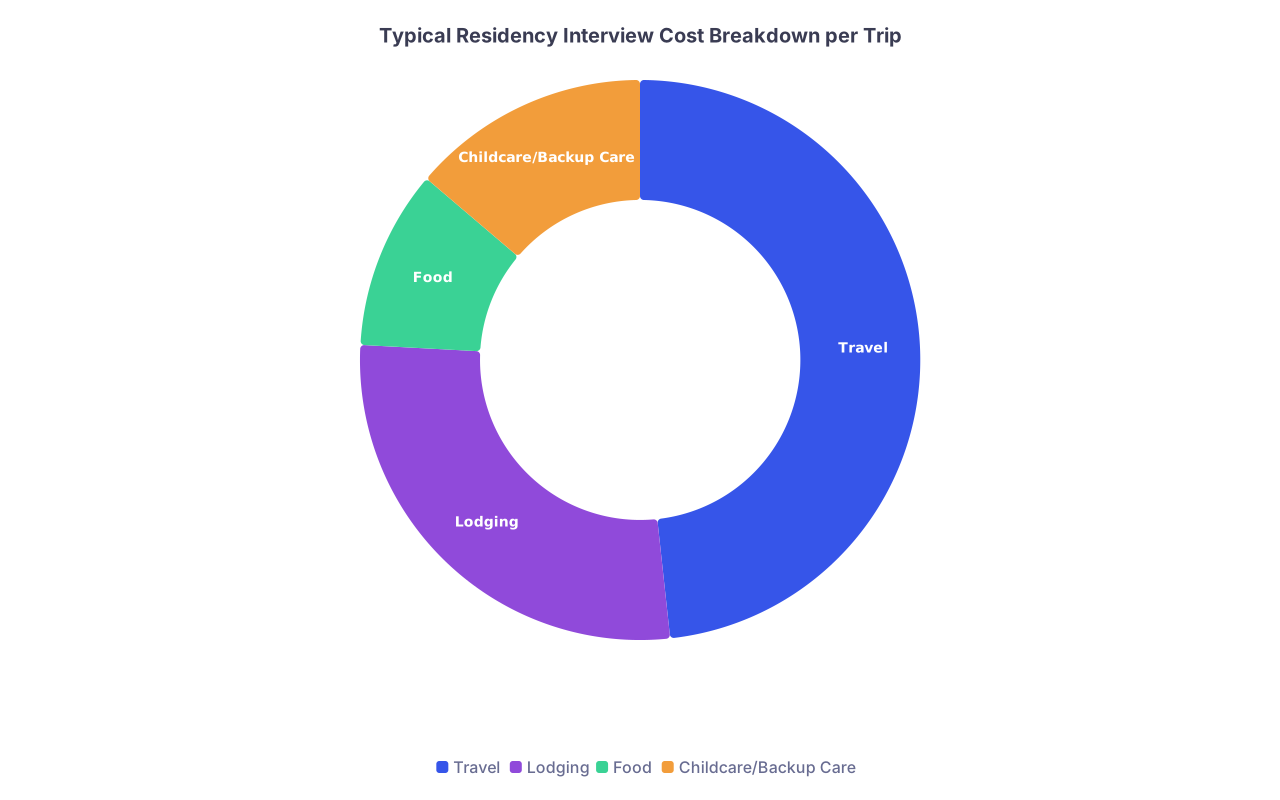
| Category | Value |
|---|---|
| Travel | 350 |
| Lodging | 200 |
| Food | 75 |
| Childcare/Backup Care | 100 |
- Decide ahead of time:
- How many in-person interviews can we actually afford?
- Are we prioritizing regional clustering (e.g., stack Northeast trips together)?
- When will we say “no” to far, low-yield programs?
You are allowed to turn down interviews that would cost you "$1,200 for a program we would never rank above #10." That is not sabotage. That is prioritizing your family.
Also factor residency salary vs. cost of living. A $68k salary in NYC with two kids and daycare is brutal. Same salary in a midwestern city with reasonable housing is a different life.
Step 6: Away Rotations With Kids: Only Do Them If They Are Strategic
Away rotations are currency in competitive specialties. But with kids, they are also expensive, disruptive, and stressful.
Ask these questions before signing up:
- Is this away truly high-yield for me? (Strong match history, my stats fit, I have some connection or mentor there.)
- Does this away broaden my geographic chances in a region we actually like?
- Can our family handle 4 weeks of me being essentially absent or living separately?
You have a few models:
- You go alone, family stays put.
- Most common. Hard on your spouse, especially with young kids.
- Whole family relocates for a month.
- Very expensive. Works rarely if spouse can be remote.
- You decline aways except for 1 absolutely key institution or rely on home + research presence.
- Riskier but sometimes necessary.
If your spouse already looks like they are barely hanging on with your current schedule, three aways in a row six states away is how people end up in therapy or divorce court. I have seen it. More than once.
Pick 1–2 truly strategic aways. Not 4–5 because “that’s what everyone is doing.” You are not everyone.
Step 7: Interview Season With Kids: Set Ground Rules Early
Interview season will wreck you if you do not plan it with your spouse like a joint operation.
Have a pre-season meeting and cover:
- Who covers mornings vs. evenings when you are on virtual interviews?
- Are you doing in-person, virtual, or hybrid interviews if given a choice?
- What is the max number of days you can be gone per month without chaos?
- Who is backup if a kid gets sick mid-interview (grandparents, neighbor, backup sitter)?
For virtual interviews:
- Lock down a real quiet space. Not the kitchen table mid-breakfast.
- Arrange childcare coverage during interview blocks. Kids screaming in the background is not “relatable,” it is distracting.
- Have your spouse fully understand those days are off-limits for errands/interruptions.
For in-person:
- Group interviews by region.
- Leave space between trips for “family reset” days. Seriously. A full day where you are not on the laptop ranking or answering emails, just with your spouse and kids.
Step 8: Ranking With a Family: Stop Pretending It’s Only About Program Prestige
When rank list time hits, your instincts will pull both ways: the ambitious part of you vs. the protective parent/spouse.
Here is how I’d structure your ranking decision-making:
- First pass: rank programs JUST on training quality/fit for your specialty.
- Second pass: have your spouse rank programs JUST on family factors (schools, cost, support, their career).
- Third pass: sit down together and create a merged list where both sides matter.
You will likely see patterns: maybe the Top 3 “best” programs are god-awful for family life. Maybe your spouse’s #1 is a weak program with scary board pass rates. Talk explicitly about those trade-offs.
This is where you have to decide what future you are optimizing for:
- Absolute top-tier fellowship and academic career at almost any cost?
- Strong training plus a stable family life?
- Maximum stability and support, even if the name on the badge is not fancy?
There is no single correct answer. But “I’ll just rank the fanciest name first and assume my spouse and kids will adapt” is a terrible approach.
Also, do not lie to yourself about commute times and childcare logistics. A program “only 30 minutes away without traffic” might be 75 minutes each way at the hours residents actually commute. That is the difference between seeing your kids awake or not.
Step 9: Talk Honestly With Your Spouse So They Know What They Are Signing Up For
What destroys couples is not the difficulty. It is the surprises.
You already know roughly what residency will be like. Your spouse probably does not, even if they say they do.
Have one blunt conversation where you cover:
- Typical work hours for your specialty (not the brochure version, the real version—talk to senior residents).
- Call schedule realities: “Yes, there will be nights. Yes, sometimes back-to-back weekends.”
- Emotional side: you will come home trashed, you will sometimes be mentally absent, you’ll miss things—birthday parties, school plays, bedtime.
Then flip it: ask clearly what your spouse is most worried about.
Common ones I hear:
- “I’m scared of parenting alone most of the time.”
- “I don’t want to move somewhere where I know nobody.”
- “I’m afraid we’ll grow apart because you’ll always be at work.”
Those fears should influence your rank list more than whether the program is #5 vs #15 on Doximity.
Step 10: Protect Your Identity Beyond “Competitive Applicant”
You are not just “the derm applicant” or “the ortho gunner.” You are a spouse. A parent. And you will still be those things when you are a PGY-2 on hour 72 of a terrible week.
Pick a specialty you actually like living, not just matching into. That matters more when you have kids and cannot self-medicate your misery by staying out late with co-residents every night.
Reality:
- Ortho, gen surg, neurosurg, ENT, plastics – long hours, lots of call, can be brutal with very young kids, but absolutely doable with a supportive partner and good systems.
- Derm, rads, path, some IM subspecialties – more predictable or lighter long-term, but still rough during residency years depending on program.
Be honest about your temperament and what you are like under sleep deprivation. Your kids and spouse will live with that version of you.
Quick Visual: How Family Complexity Changes Your Match Priorities

| Step | Description |
|---|---|
| Step 1 | Single No Kids |
| Step 2 | Program Prestige Priority High |
| Step 3 | Geography Flexible |
| Step 4 | Married No Kids |
| Step 5 | Program Prestige Moderate |
| Step 6 | Geography Semi Flexible |
| Step 7 | Married With Kids |
| Step 8 | Family Stability Priority High |
| Step 9 | Geography Often Limited |
| Step 10 | Finances and Support Critical |
When you are married with kids, “family stability” is not a side factor. It belongs in the first line of that flowchart, not as an afterthought.
Final Reality Check
You can do a competitive specialty and still be a decent spouse and parent. People do it every year. I have watched plenty of residents juggle ortho nights with preschool pickup. It is messy, but it is doable.
The ones who crash and burn usually made one of three mistakes:
- They pretended their family constraints did not exist until Match Week.
- They refused to dual-apply or adjust geographically even when the math was obviously against them.
- They ranked for ego, not for the life they actually had at home.
If you remember nothing else:
- Plan with your spouse as if they are a co-applicant. Because they are.
- Be honest about your competitiveness and geographic flexibility, and build your application strategy around that, not your fantasy.
- Rank programs for the life you are actually living—married, with kids—not for the life you would have if you were 25, single, and mobile.
That is how you protect both your career and your family when the specialty you want is competitive and the stakes at home are real.