
The belief that “Ivy med grads always get favored in competitive specialties” is lazy, half-true, and weaponized by insecure people on both sides of the prestige fence.
Some brand names help. A lot less than people think. And in a few key ways, they can actually hurt you if you hide behind them.
Let’s take the myth apart using what actually moves the needle in competitive specialties: numbers, networks, and narrative — not just the crest on your diploma.
What Prestige Actually Buys You (And What It Doesn’t)
First, let’s be blunt: a Harvard or Hopkins MD isn’t “just the same” as an unknown offshore program. Pretending otherwise is as dishonest as pretending the name alone guarantees dermatology at UCSF.
Prestige buys you three things:
- Stronger average peers and faculty
- Better built-in research and connections
- A default assumption of rigor — until you personally prove otherwise
What it does not buy you:
- Immunity from low Step 2 scores
- Immunity from weak letters
- A free pass on a mediocre interview
- Automatic priority over a killer applicant from a non-elite school
I’ve watched program directors flip through ERAS stacks and say things like, “Another Ivy with a 230 and nothing else. Pass. Give me the 255 from State with three pubs.”
That’s the part you never see on Reddit.
The Data: Where School Name Matters And Where It Drops Off
Let’s ground this with patterns that show up across NRMP data and institutional match lists.
For context: competitive specialties = things like dermatology, plastic surgery, orthopedic surgery, neurosurgery, ENT, and sometimes ophtho, urology, IR, and radiation oncology.
| Factor | Typical Weight* |
|---|---|
| Step 2 CK score | Very High |
| Letters/mentor rep | Very High |
| Specialty research | High |
| Class rank/AOA | High |
| School prestige | Moderate |
| Extracurricular fit | Moderate |
*Not some official rubric. This is how PDs actually talk behind closed doors.
Now, how does prestige weave into this?
- At the early screen: A top brand nudges you past a borderline look. If your app is “fine but not amazing,” a big name can be the difference between auto-reject and “eh, let’s peek.”
- For research fields (derm, rad onc, some academic surgery): The pedigree of your mentors often matters more than the name on your MD. If your PI is a big name at a strong-but-not-Ivy school, that can out-muscle a nameless Harvard letter.
- At the interview and rank list stage: The school name fades fast. Your board scores, letters, research, and how you perform on interview day dominate.
Most applicants mentally inflate “moderate” into “decisive.” It isn’t.
Step Scores vs Prestige: Who Wins When They Conflict?
Here’s a reality check: program directors are under pressure to keep their board pass rates high and their match lists shiny. That means they’re allergic to weak Step 2 CK scores in competitive specialties.
So what happens when a big-name school collides with a low-ish score?
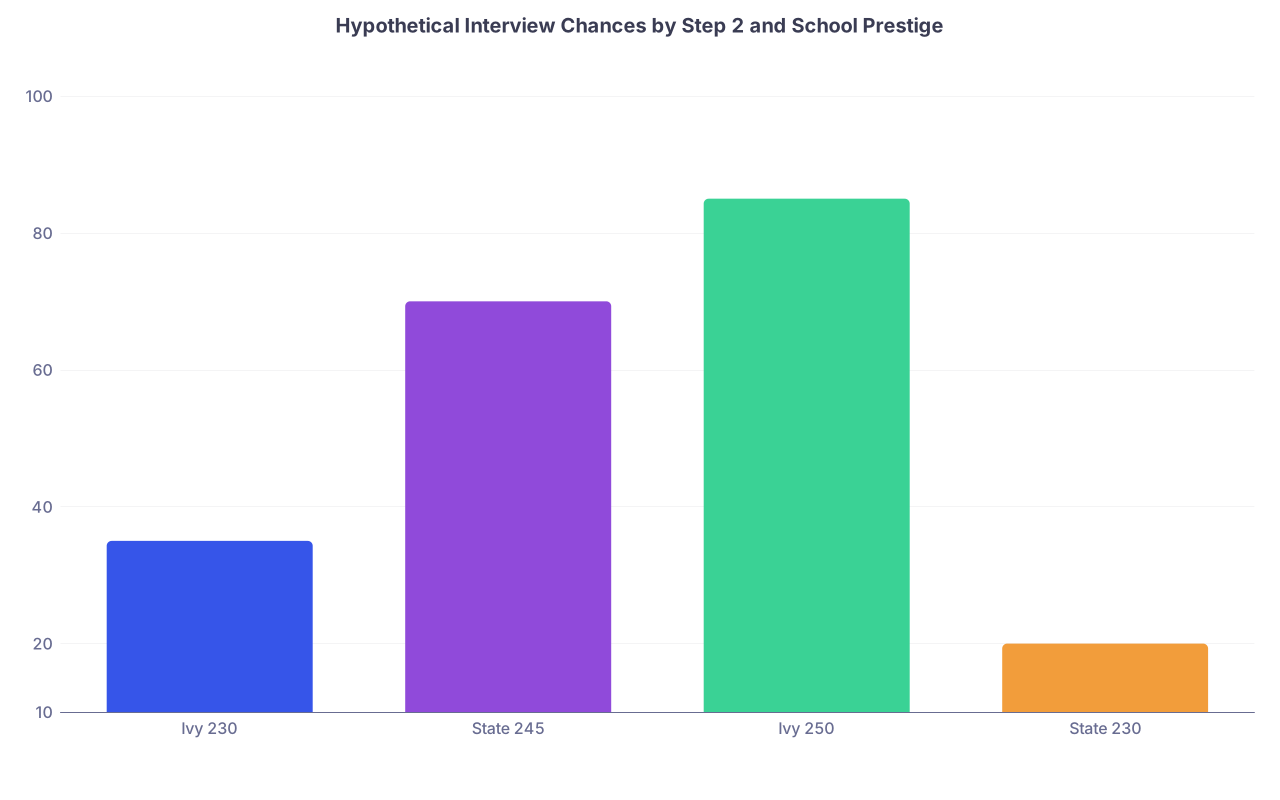
| Category | Value |
|---|---|
| Ivy 230 | 35 |
| State 245 | 70 |
| Ivy 250 | 85 |
| State 230 | 20 |
Numbers are illustrative, but the ordering isn’t an accident.
I’ve heard this exact sentiment from a plastics PD:
“If I have a Harvard 232 and a Midwestern State 247, I’m interviewing the 247. Every time.”
Why?
Because:
- Step 2 = signal of test-taking + knowledge + pass-rate risk
- School name = fuzzy signal that’s meaningful but weaker
Does that mean an Ivy 230 never matches derm? No. But a non-Ivy 250 with solid research is not “doomed” just because they did not train within the Ivy bubble.
The prestige myth survives because people confuse ceiling and floor:
- Prestige slightly raises your floor for being taken seriously with borderline stats.
- Performance (scores, research, letters) raises your ceiling far more than prestige ever will.
Research & Mentors: The Hidden Engine Behind “Ivy Advantage”
Where prestige quietly helps is not the label. It’s the ecosystem.
Big-name schools usually have:
- High-powered faculty with national reputations
- Established pipelines to competitive specialties
- More ongoing projects you can plug into and get on papers
- Alumni already sitting on ranking committees in those specialties
That’s the real edge. Not “Ivy MD,” but “first-author derm paper with a PI who is on the derm PD text thread.”
You can’t see that from the outside, so everyone flattens it into “They matched because of the school name.” Lazy take.
Here’s how this actually plays out.
Imagine two applicants:
Applicant A – Ivy med
- Step 2: 241
- 1 derm abstract, 1 middle-author paper
- Generic letters from local faculty, none are national names
- Decent but not glowing dean’s letter
Applicant B – Strong state school
- Step 2: 253
- 3 derm papers (2 first-author), presented at AAD
- Letter from a derm chair well-known in the field
- AOA, top quartile
If you honestly think PDs will line up for Applicant A purely because of the Ivy tag, you haven’t sat in a rank meeting.
B wins. Almost everywhere.
Where A might win: if B’s school has no track record in derm or the letter writers are unknown, while A’s Ivy-mentors pick up the phone. Again — not “school name.” Mentor and network.
Geographic & Pipeline Bias: Closer to Home Beats Name Brand
Another part people ignore: most programs like people who feel “familiar.”
A lot of so-called “Ivy favoritism” is actually:
- Regional bias. Northeast programs see more apps from Harvard/Columbia/Yale. Texas programs see more UT/BCM.
- Pipeline bias. Programs that historically take from certain schools keep doing it because it works and the faculty know those curricula.
So if Penn derm has historically matched a handful of Penn med students every year, that’s not “Ivy worship.” That’s a home-field / pipeline effect. The same pattern exists between, say, Mayo Clinic Alix and Mayo residencies, or University of Washington and Pacific Northwest programs.
If you come from a “non-elite” school with a strong pipeline to your target field and region, you can be sitting on an advantage that’s every bit as real as being at an Ivy — just less brag-worthy on Instagram.
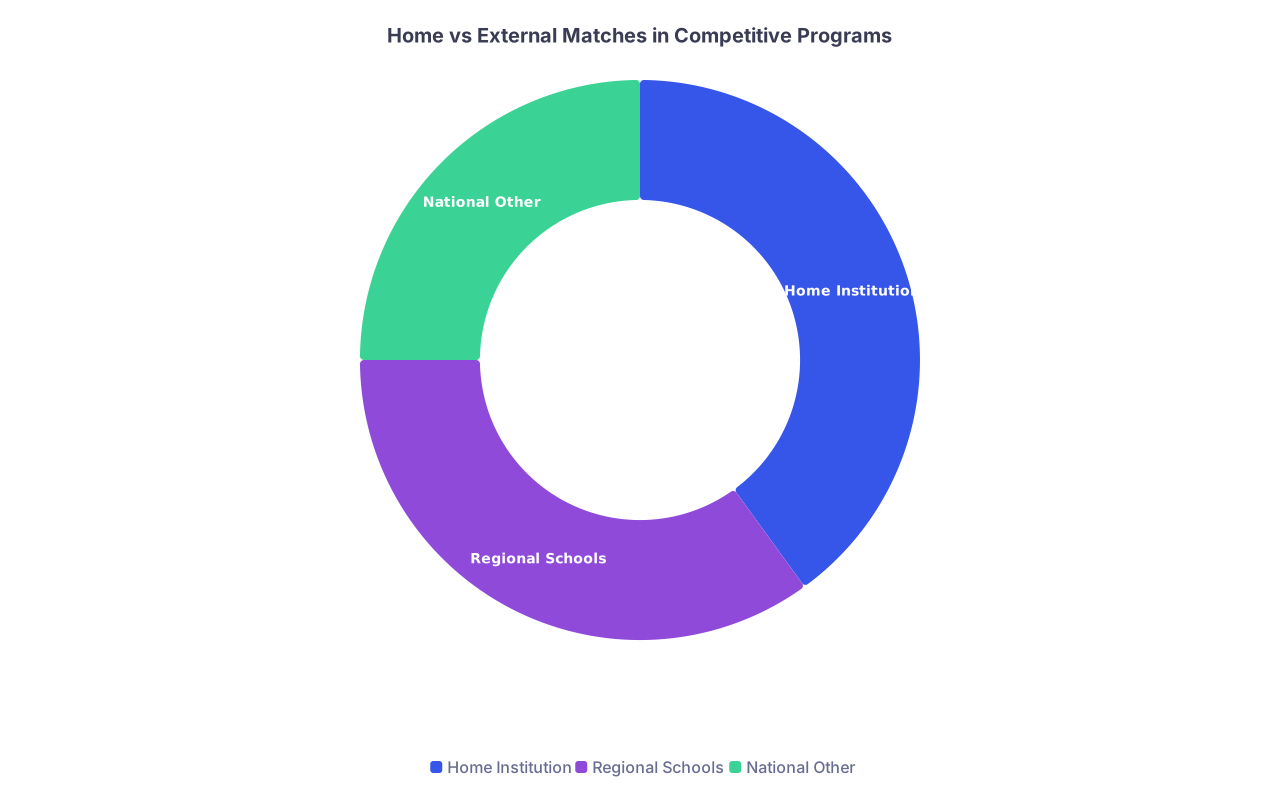
| Category | Value |
|---|---|
| Home Institution | 40 |
| Regional Schools | 35 |
| National Other | 25 |
Again, numbers are illustrative, but the skew toward home and regional schools is absolutely real.
Where Prestige Really Is a Problem: The Psychological Trap
There’s a darker side of the prestige myth that nobody at fancy institutions likes to admit: some Ivy med students coast on the brand and assume doors will open.
I’ve seen it repeatedly:
- They do “acceptable” but not standout research, figuring the school name does the heavy lifting.
- They shoot for derm, plastics, ortho with Step 2 scores 20 points below their classmates at the same institution.
- They pick lukewarm mentors because “any faculty from here will look strong.”
Then the Match list comes out and people are stunned. The top of the class crushes the competitive specialties. The middle of the class is surprised by how many doors quietly closed.
Meanwhile, a non-Ivy student at a solid public school has been grinding:
- Step 2 in the 250s
- 3–5 focused publications in the specialty
- A chair-level letter
- Away rotation performance that has attendings saying “We need this person here”
That applicant walks right past the complacent Ivy middle.
If you’re at a big-name place, this is the part you should actually be afraid of. The brand is not compensating for average performance. It’s hiding how average you look until it’s too late to fix.
Away Rotations: The Real Equalizer
If there’s one thing that repeatedly shreds the “Ivy always wins” myth, it’s away rotations in competitive fields.
On away rotations, nobody cares what your ID badge says when:
- You show up early, stay late, and actually help
- You can talk through cases logically
- You do not crumble in the OR or on consults
- You treat staff decently and do not act entitled
An away rotator from “Nowhere State” who crushes it will often land:
- A top-tier letter: “One of the best rotators we’ve had in five years.”
- A spot near the top of the rank list at that program.
An away rotator from a famous school who shows up uninterested, sloppy, or arrogant will get:
- A lukewarm or actively negative evaluation
- Quiet blacklisting in the resident/attending group chat
And that follows you. Hard.
So if you’re not from an elite school, away rotations are where you can erase a lot of prestige deficit — if your fundamentals are strong. If you are from an elite school, they’re where your label stops protecting you.
When School Name Actually Does Tilt the Scale
To be fair, there are situations where prestige can be the tiebreaker.
Consider two essentially identical applicants:
- Similar Step 2 scores
- Similar research output in the specialty
- Both AOA, strong clerkship narratives
- Equally solid interviews
Now the PD is down to fine-grain heuristics. At this point, some will say:
- “We know the curriculum at X elite school, their trainees adapt fast.”
- “We’ve had great experiences with Y program before.”
- “This letter from the Ivy chair is from someone I personally know and trust.”
So in a straight-up tie, prestige and prior positive experience can break the tie.
But that’s the point: it’s a tiebreaker among already strong applicants. Not a magic key that upgrades a mediocre applicant into a superstar.
US vs International: Where Prestige Really Is Destiny
One place the myth is closer to reality: the divide isn’t Ivy vs non-Ivy. It’s US MD vs everyone else in competitive specialties.
If you’re:
- US MD at any accredited school with strong metrics → competitive specialties are realistically on the table with enough effort.
- DO → some fields (ortho, derm, neurosurgery) remain much tougher at high-tier programs, though doors are slowly cracking open.
- IMG → in most ultra-competitive specialties, the US MD label matters far more than whether that MD is Ivy or state.
| Degree Type | Chance at Top Academic Derm* |
|---|---|
| US MD Ivy | High (with strong metrics) |
| US MD Non-Ivy | High (with strong metrics) |
| US DO | Low–Moderate |
| IMG | Very Low |
*Again, pattern, not destiny. There are exceptions. They’re just rare enough that Reddit writes posts about them.
So the big structural “prestige bias” is at the degree-category level, not Ivy vs non-Ivy within US MD.
What You Should Actually Do With All This
If you’re at an Ivy and shooting for a competitive specialty:
- Assume your school name buys you exactly one thing: access to great mentors. Use that brutally.
- Aim to be top third of your class, not middle. You can’t “Harvard” your way out of a 230-something and no research.
- Get real feedback early from specialty faculty: “If I continue like this, will I match in this field?” Push for honest answers.
If you’re at a non-Ivy US MD:
- Stop acting like your badge dooms you. It doesn’t.
- Lean hard into: Step 2 CK, specialty research, and away rotations at target programs.
- Choose mentors whose names mean something in your specialty, even if your school isn’t famous. Conference presence matters more than US News rank.
If you’re DO or IMG and want a hyper-competitive specialty:
- You’re playing on hard mode. That’s reality, not cruelty.
- You’ll need standout scores, early and aggressive specialty involvement, and probably a plan B you genuinely could live with.
The Bottom Line: Prestige Is Overrated, Performance Is Underrated
Ivy med grads are not always favored in competitive specialties. They’re favored when:
- They leverage their environment to outperform
- They pair strong metrics with strong mentors
- They avoid coasting on the brand
Non-Ivy applicants are not automatically excluded. They’re excluded when:
- They believe the myth so deeply they never even try
- They underinvest in research, scores, and relationships
- They assume “my school isn’t top 10” is the main problem, instead of the gaps in their application
Let me leave you with this: Ten years into practice, nobody cares where you went to medical school as much as they care what kind of colleague you are, how safe you are, and whether patients trust you.
The prestige label fades. The habits you built to match — or the excuses you made — do not.