
Most applicants are still using a 2015 mental model of radiation oncology competitiveness. That will get you burned.
Radiation oncology is no longer the monolithic “hyper‑competitive ROAD specialty” people quote from old SDN threads. It went through a brutal boom‑and‑bust cycle, unmatched spots, then partial recovery. If you apply using outdated assumptions—either “it’s impossible to match” or “it’s a backup now”—you will make serious strategic mistakes.
Let me break this down specifically.
How Radiation Oncology Got Here: From Ultra‑Hot to “Wait, What Just Happened?”
You cannot understand current competitiveness without understanding the whiplash of the last 10–12 years.
From roughly 2010–2016, radiation oncology was a prestige magnet. ROAD + neurosurgery crowd. High Step 1s. Heavy research. Lots of MD/PhDs. People talked about it like dermatology with physics.
Then three things collided:
Overexpansion of residency positions
Programs opened and expanded faster than the job market grew. Everyone assumed “cancer will always increase, we will always need more Rad Onc.” That line was repeated in tumor boards and preclinical lectures. It was also wrong in the short‑to‑medium term.Technology and practice pattern changes
Hypofractionation, SBRT, and more effective systemic therapies meant fewer total fractions per patient in some settings. That translates to less volume per FTE, not more. Departments compensated with efficiency and advanced planning, not by hiring waves of new attendings.Trainees started talking
By late 2010s, residents and early attendings very publicly flagged the job market: limited geographic flexibility, lower‑than‑expected salaries in some areas, saturated metro markets. Those posts circulated widely. MS2s and MS3s started bailing before they even applied.
The match numbers reflected it. Multiple cycles with unfilled radiation oncology positions. Some very solid applicants pivoted out entirely. The specialty went from “you need a 250+ and three first‑author papers” to “why are there 20+ unfilled spots?” in a few years.
Now we are in the correction phase.
Fewer applicants. Programs trimming positions. Some consolidations. The job market slowly rebalancing, unevenly.
This is the context you must walk into.
Where Competitiveness Actually Stands Now
Radiation oncology is not derm or plastics. It is not FM either. It sits in an uncomfortable middle: relatively small specialty, fewer applicants than before, but still selective at strong programs and in desirable cities.
Think of competitiveness along three axes:
- Program tier
- Geography
- Your academic profile (scores, research, letters)
At top‑tier academic centers—places you know by name—radiation oncology is still absolutely competitive. You will be stacked against MD/PhDs, first‑author papers, and glowing letters from known faculty.
At mid‑tier and many community programs, there can be a mismatch: fewer total applicants but a wide range of quality. That does not mean “easy.” It means “high variance.”
To give you a concrete mental model, something like this is closer to reality than the old “all or nothing” view:
| Program Type | Relative Competitiveness | Typical Applicant Profile |
|---|---|---|
| Top 10 academic | High | Strong research, strong letters, high scores |
| Other major academic | Moderate–High | Solid research, good letters, above-average scores |
| Mid-tier university / hybrid | Moderate | Some research, decent scores, convincing interest |
| Community with academic ties | Low–Moderate | Variable; strong clinical story can work |
| Stand-alone small community | Variable | Depends heavily on year, geography, program needs |
The key mistake now: students assume “less competitive overall” means “I can casually apply with minimal targeted work.” Wrong. The competitiveness has shifted from pure numbers (scores, volume of applicants) to depth of fit (clear commitment, real understanding of the field, meaningful mentorship).
How the Match Metrics Have Shifted—and What They Mean For You
Let’s talk numbers in a way that is actually useful.
Old model:
– High Step 1 score
– Large number of publications
– High class rank / AOA
– You’re in the running
Now, Step 1 is pass/fail and the applicant pool is smaller. Programs reach for different signals.
The hierarchy looks more like:
- Serious, demonstrable commitment to radiation oncology
- Research that touches oncology or imaging or outcomes
- Strong narrative in your personal statement and interviews
- Solid clinical performance and Step 2 CK score
Programs are still screening numerically, but with fewer applicants they can read more deeply. That helps people with mid‑range numbers and strong “why Rad Onc” stories.
To capture what matters now:
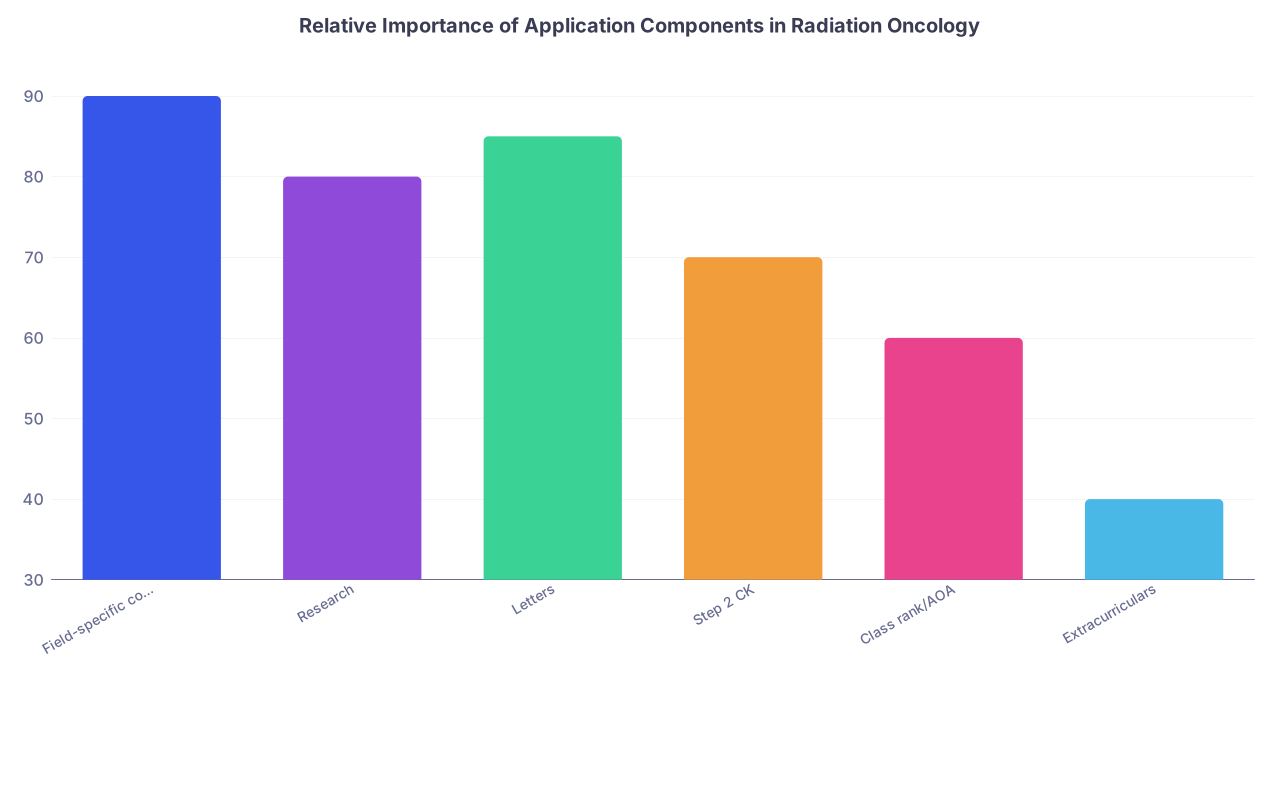
| Category | Value |
|---|---|
| Field-specific commitment | 90 |
| Research | 80 |
| Letters | 85 |
| Step 2 CK | 70 |
| Class rank/AOA | 60 |
| Extracurriculars | 40 |
Are these numbers exact? No. But they reflect how discussions in recruitment committees actually go.
You will hear things like:
- “She has only one oncology paper, but she’s been in our department for two years and everyone loves working with her.”
- “His Step 2 is 235, but he has genuine physics aptitude and three solid Rad Onc letters.”
- “The CV is stacked, but his answers suggest he chose this field last month.”
That first group is getting ranked high. The last group is falling fast, even with great stats.
The Job Market Reality: Why It Scared People—and Where It Stands
You cannot choose a specialty in 2026 pretending the job market chatter does not exist. Residents talk. Twitter talks. ASTRO meeting hallways talk.
The bad news that drove people away:
- Some urban markets saturated with applicants
- Graduates taking multiple temporary or part‑time positions before landing something stable
- Starting salaries below what applicants expected when they picked “oncology” as a high‑income field
- Limited geographic flexibility—if you want a large coastal city and nowhere else, it is tough
The overreaction:
Students extrapolated worst‑case anecdotes to the entire country. “There are no jobs in Rad Onc.” That is false.
Reality now is more nuanced:
- Jobs exist, especially in less saturated regions (Midwest, South, smaller cities, hospital‑employed groups).
- Academic positions are tight and often require serious research output.
- Private practice and hospital jobs vary widely in case mix, autonomy, and compensation.
- The field is still correcting from overexpansion, but not collapsing.
If your life plan is “I must live in one of three specific expensive coastal metros and also do 80% CNS and SBRT in a pure academic center,” yes, your odds are not amazing.
If you are open to a range of cities and practice types, the picture is much better than the doomsayers claimed.
And that loops back to competitiveness:
Applicants who truly understand this and still want the specialty—knowing its pros and cons—tend to present much more convincingly. Programs pick up on that.
Who Actually Fits Radiation Oncology Now?
The field is self‑selecting differently than a decade ago. Less “I like physics and a high lifestyle factor” and more:
- People who actually enjoy longitudinal cancer care
- People who can sit in front of a planning console for extended periods and still think clearly
- People comfortable with uncertainty and evolving evidence, because technology and systemic therapies keep moving
- People who value a mix of clinic, contouring, planning review, and tumor board
If you are thinking about this field, ask yourself honestly:
- Do you like cancer patients enough to see a lot of them, every week, for years?
- Can you handle detail‑heavy, screen‑based work without going insane?
- Are you comfortable defending a treatment volume and dose in front of a sharp physicist and a skeptical surgeon?
- When you did your Rad Onc rotation, did the days fly by—or drag?
I have watched students “fall in love” with the technology but get visibly restless when clinics ran long. Wrong fit. I have also seen quieter students absolutely light up in small exam rooms with complex end‑of‑life discussions. Those are the ones who match and then stay happy.
How to Build a Competitive Radiation Oncology Application in 2026+
Let’s be precise. If you tell me “I am an MS2/MS3 and I think I want Rad Onc,” here is the playbook that actually works now.
1. Lock in early exposure—then double down or walk away
You need a real Rad Onc rotation before you invest your career here.
Ideal sequence:
- MS2 summer or early MS3: Shadow + 2–4 week elective
- During that time: Attend contouring sessions, planning conferences, tumor boards, not just clinic
- After 2–3 weeks, honestly assess: Do I want more of this, or am I forcing it?
If the answer is “more,” that is when you earnestly enter the pipeline.
2. Get into a departmental “home base”
You want at least one radiation oncologist to know you by name, face, and work ethic.
Your goals with a home department:
- Longitudinal presence (months to years, not a 1‑month drive‑by)
- A research project that has a plausible path to abstract/poster/short paper
- A mentor who will eventually write a specific, story‑based letter
You do not need five Rad Onc projects. One done well is far more credible than five half‑finished chart reviews.
3. Targeted research: Depth beats volume now
The research bar has dropped a bit from the hyper‑competitive era, but it has not disappeared. For most applicants, this means:
- At least one oncology‑related output: abstract, poster, or paper
- Ability to talk through your project in detail—methods, limitations, what you actually did
- Some basic literacy in trial design and outcomes relevant to the disease sites you saw
If you are MD/PhD or research‑heavy, then yes, more is better. But if you are a “classic” med student, one good project and one or two smaller contributions are enough at most mid‑tier programs.
4. Step 2 CK: Not the main show, still a gatekeeper
With Step 1 pass/fail, Step 2 CK is the main standardized metric left. Programs are not demanding absurd numbers, but they do want reassurance you can handle oncology content and boards.
As of now, a rough heuristic:
- ≥245: You are in a strength zone for most programs
- 230–244: Fine, if the rest of your application shows clear commitment
- <230: You need strong letters and a very convincing story; some programs may quietly screen you out
This is not derm. A 260+ is not mandatory. But do not ignore Step 2 just because you “only see it as a backup” for another specialty.
5. Letters of recommendation: Your real currency
Radiation oncology is small. Program directors know each other. They know who actually teaches and who writes every student as “top 5%.”
You want at least:
- 2 letters from radiation oncologists (ideally at least one from a known or respected faculty member)
- 1 strong clinical letter from a non‑Rad Onc field (medicine, surgery, etc.)
The Rad Onc letters must:
- Mention concrete examples of your work (contouring diligence, clinic initiative, studying between patients)
- Describe how you responded to feedback
- Sound like the writer interacted with you enough to make a real judgment
If your Rad Onc letter is generic—“hard‑working, pleasant to work with”—that is a bad sign.
6. Away rotations: No longer optional at many places
In this specialty, away rotations still matter a lot, especially if:
- Your home program is small or nonexistent
- You are targeting specific regions or big academic names
- You need another strong letter to offset a weaker numerical profile
Plan for 1–2 away rotations in MS4, typically at programs you would legitimately rank high. Away rotations are extended interviews. People remember if you were:
- Prepared for each clinic day
- Engaged in contouring and planning sessions
- Respectful of staff—therapists, dosimetrists, nurses, physicists
- Curious without trying to show off constantly
You are not auditioning to show that you know everything. You are auditioning to show that you will be trainable and enjoyable to work with for four years.
7. Personal statement and interviews: You must show you did your homework
Programs are hyper‑alert for applicants who:
- Chose Rad Onc late because “Step 1 went badly”
- Are clearly using it as a “competitive but chiller” plan B to another field
- Have never really grappled with the job market questions
Your job is to demonstrate:
- When and how you discovered the field, and why you stayed after learning the hard parts
- What aspects of daily work appeal to you (not generic “I love oncology”)
- That you understand both the good and the challenging sides of the job market
- That you have enough resilience to tolerate future changes in technology and practice
You will absolutely get a version of: “You have probably heard concerns about the Rad Onc job market. How are you thinking about that?”
If you look surprised by that question, you are done.
Program Strategy: How Broadly Should You Apply?
This is where most people miscalculate.
Because there are still occasional unfilled spots, students think they can apply to 15–20 programs and be safe. I have seen this backfire.
Radiation oncology still has:
- Geographic clustering of applicants
- Small program sizes
- Limited flexibility for programs to “overmatch” beyond their slots
Realistically:
- Strong applicants (research + good letters + decent Step 2): 35–50 programs is reasonable if you want a wide geographic net.
- Mid‑range applicants: 50–70 programs, thoughtfully chosen across tiers and regions.
- Weaker applicants (lower scores, minimal research): You either need a very strategic list, or you should seriously consider whether this specialty makes sense.
You also need to be honest about tiering. If your CV screams “mid‑tier academic or solid community,” sending 30 applications only to Top 20 programs is fantasy.
This is how I would think about a balanced list:
| Applicant Profile | Top Academic | Mid Academic | Community/Hybrid |
|---|---|---|---|
| Strong (research heavy) | 15–20 | 15–20 | 5–10 |
| Mid-range | 8–12 | 20–25 | 15–20 |
| Weaker numerics, strong fit | 3–6 | 15–20 | 20–25 |
You adjust for your personal needs, couples match, and geography, but the concept holds: spread reps, do not cluster unrealistically.
How Radiation Oncology Compares to Other “Competitive” Fields Now
A lot of your confusion probably comes from trying to rank specialties: Is Rad Onc “more competitive than EM now? Less than anesthesia? What about neurology?” That mental game is mostly useless, but I know you are going to play it anyway.
So here is the reality:
- It is not on the same plane as plastics, derm, ENT, or neurosurgery. Those still outstrip Rad Onc in overall competitiveness.
- It is more selective than EM, IM, peds, psych, and usually anesthesia, especially at academic programs.
- It sits in a weird space with other smaller, niche fields (like med onc fellowships later, GI, etc.) where fit and mentorship count heavily.
The main difference: radiation oncology has a persistent narrative problem. Older attendings and older students still repeat “crazy competitive.” Online forums for a few years screamed “no jobs, stay away.” Both extremes are outdated.
Current reality is somewhere in the middle—mature, nuanced, and frankly, more honest than most specialties are willing to be with students.
To visualize how it stacks relative to a few contemporaries:
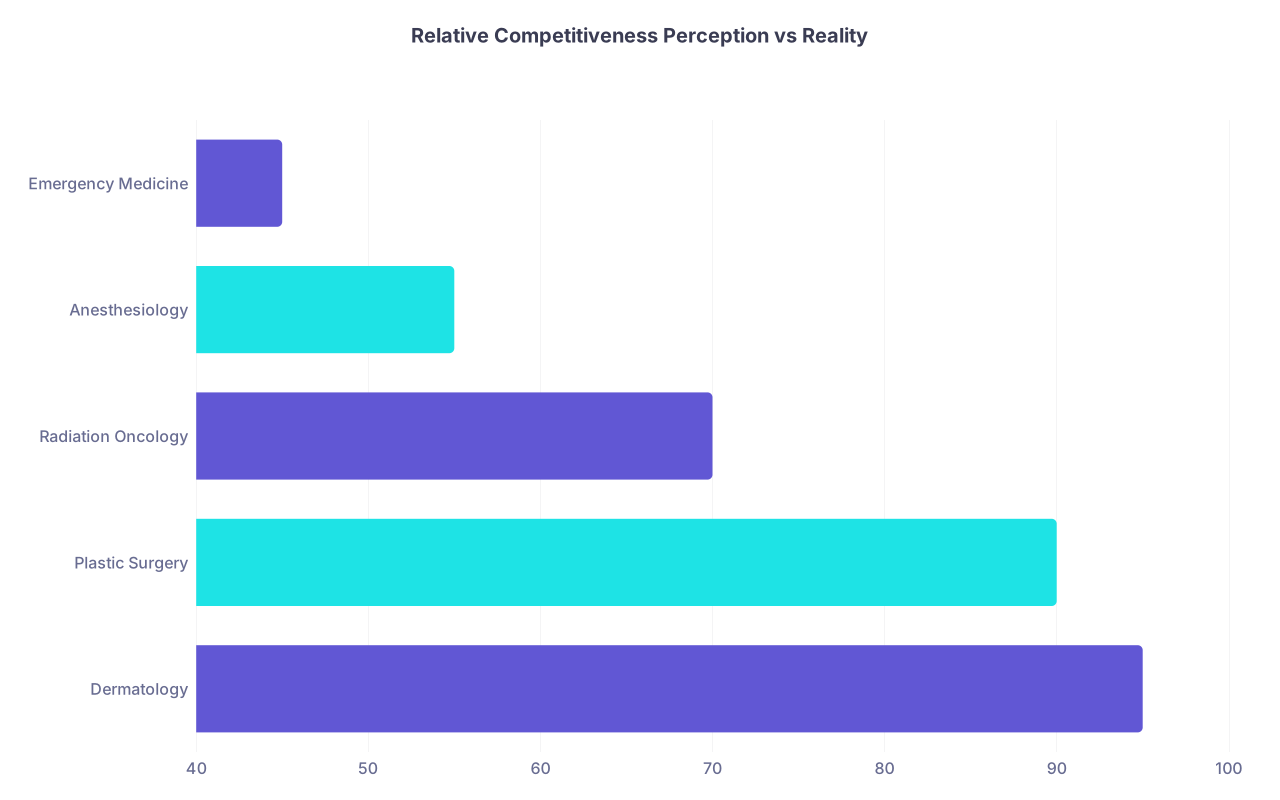
| Category | Value |
|---|---|
| Dermatology | 95 |
| Plastic Surgery | 90 |
| Radiation Oncology | 70 |
| Anesthesiology | 55 |
| Emergency Medicine | 45 |
Perception still overshoots reality for Rad Onc. You can use that to your advantage if you actually understand the field.
Bottom Line: Who Should Still Choose Radiation Oncology?
If you want:
- Deep, longitudinal relationships with cancer patients
- Daily engagement with imaging, physics, and technology
- A mix of clinic and computer‑based work
- Intellectual challenge with real consequences to dose and field decisions
…and you are willing to:
- Accept some geographic constraints after residency
- Be proactive about networking, mentorship, and job search
- Live with an evolving technology and practice landscape
Then radiation oncology remains an excellent choice.
If you want:
- Guaranteed big‑city job of your choosing
- Minimal screen time
- Instant prestige and high salaries everywhere, with zero friction
Pick something else. You will be miserable here.