
The common advice to “only signal your reach programs” in competitive specialties is wrong for a lot of applicants.
You should rarely signal only reach programs. In most competitive fields, a smart strategy mixes reach, realistic, and a small number of safety programs—but that mix depends heavily on your stats, school, and application strength.
Let me walk you through how to decide, without the vague “it depends” nonsense.
1. What Signaling Actually Does (And What It Does Not Do)
Programs don’t treat signals like a golden ticket. They treat them like a sorting tool.
Here’s what signals typically do in competitive specialties (Derm, Ortho, ENT, Plastics, Neurosurgery, Urology, Integrated Vascular, etc.):
- Move you from “might not be reviewed” → “will be reviewed carefully”
- Move you from “borderline interview” → “probably interviewed if above a certain bar”
- Have much less impact if you’re clearly below a program’s usual bar
- Have little added value if you’re already an obvious auto-interview (home program superstar, 280 Step, 10 pubs in their subspecialty, etc.)
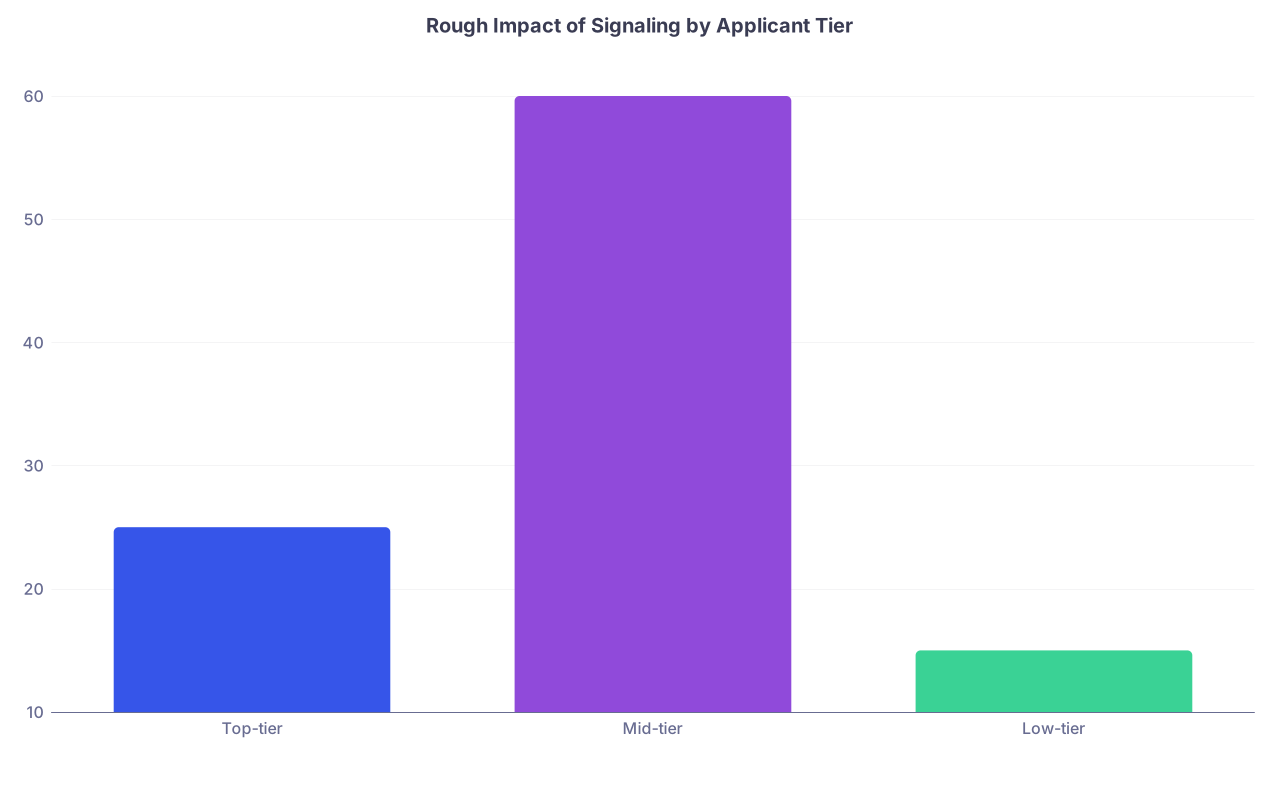
They mostly help in the gray zone. The middle 60–70% of applicants.
| Category | Value |
|---|---|
| Top-tier | 25 |
| Mid-tier | 60 |
| Low-tier | 15 |
Rough idea: signaling has the biggest payoff for the mid-tier candidates. The ones on the bubble.
So no, signaling a massive reach where you’re far below their usual interview range won’t magically save you. But signaling a solid “target” program? That can absolutely be the difference between an interview and a silent season.
2. Types of Programs: Reach, Target, Safety
If you do not define your tiers honestly, your signaling plan will be trash.
Use this rough framework:
Reach programs
- Historically interview/match applicants with:
- Step 2 CK or COMLEX significantly above national average for the specialty
- Heavy research, often multi–first author, big-name labs, or grants
- Often top-20 med schools or strong brands
- For Derm: think UCSF, Penn, MGH/Brigham, Stanford
- For Ortho: HSS, Rush, Mayo, top brand-name university programs
- Historically interview/match applicants with:
Target (realistic) programs
- Programs whose averages and culture align with your stats and story
- Mid-to-upper tier university programs, many strong academic or hybrid programs
- Places where your Step/research/letters are in their “normal” interview range
Safety programs
- Lower average scores, less research heavy, or geographically less desirable
- Often community or smaller academic programs
- You’re clearly above their historical interview metrics, even on a bad day
Be blunt with yourself. If your Step 2 is 245 and the average matched applicant in that specialty is 255–260 with heavy research, you’re not a “strong reach” for a top-5 program.
3. The Core Question: Should You Signal Only Reach Programs?
Here’s the direct answer:
- If you are truly top 5–10% in a very competitive field (scores, school, research, letters, home program support), signaling mostly reach programs is reasonable—but even then, I’d still include at least 1–2 realistic programs.
- If you’re anywhere in the middle 80–90% of applicants, signaling only reach programs is a mistake. You should absolutely include realistic and possibly 1–2 safety programs.
- If you’re below-average for the field but still applying, you must use some signals on realistic/safety programs, or you’re probably signing up for a painful interview drought.
So no, most people should not only signal reach.
4. A Practical Signaling Framework by Applicant Profile
Use this as a starting template. Adjust for your specialty and the exact number of signals available (varies by field and year).
Profile A: Strong applicant in a competitive specialty
Who this is:
- Step 2 CK ≥ 255–260 in very competitive fields (Derm/Plastics/Neurosurg/ENT)
- Top 25 med school or massive research in the specialty
- Strong home department support, glowing letters, meaningful away rotations
Suggested mix (with 15 signals, adjust proportionally):
- 8–10 reach programs
- 3–5 realistic programs
- 0–2 safety programs
Why: You’ll likely get looks at mid-tier places regardless. Signals are better spent trying to break into the very top-heavy, hyper-selective programs. But you still hedge slightly by signaling a few realistic programs you genuinely want.
Profile B: Solid, middle-of-the-road applicant
Who this is:
- Step 2 CK around specialty average (for that competitive field)
- Some research, maybe a few posters/pubs, but not a loaded CV
- Decent letters, maybe good school but not elite, or vice versa
Suggested mix (15 signals):
- 4–6 reach programs
- 7–9 realistic programs
- 1–3 safety programs
This is the group that gets crushed by bad signaling advice.
If you blow all signals on stretches, you’ll get compared to people with 10+ pubs or 20+ points higher Step scores. Your best leverage is on programs where you’re squarely in range or slightly above average.
Profile C: Below-average for the specialty
Who this is:
- Step 2 CK below the mean for matched applicants in that field
- Minimal research in that specialty
- Maybe late switcher, DO applying to a tough MD-heavy field, or personal red flags/academic issues overcome late
Suggested mix (15 signals):
- 2–4 reach programs (max)
- 5–8 realistic programs
- 4–6 safety programs
Your priority is survival: securing enough interviews to have any chance to match. The signal’s best use is at places where you might realistically be near the top of their pool, not the bottom of the giants.
5. Specialty-Specific Reality Checks
Some fields punish bad signaling more than others because of sheer volume.

Dermatology
- Hyper score- and research-heavy.
- Top programs are flooded with 260+ and 270+ applicants with derm-specific publications.
- If you’re not in that range, sending half or more of your signals to top-10 derm programs is mostly a donation.
For derm, mid-tier academic and strong regional programs are where signals can really move you into the “interview” bin.
Orthopedic Surgery
- Heavy emphasis on away rotations and known quantities.
- Home/away programs often matter more than signals alone.
- Community and regional academic ortho programs can be more responsive to signals from realistic applicants.
If you’re a mid-tier ortho applicant and you spend 10/15 signals on HSS, Rush, Mayo, etc., you’re basically accepting a thinner interview season.
ENT, Plastics, Neurosurgery
Same general themes:
- Top programs are small, flooded with elite applicants, and know exactly who they want from research networks and away rotations.
- Signals to those places might help, but only if you’re already in their usual ballpark.
- A signal to a realistic mid-tier academic program often moves the needle more.
6. Common Bad Signaling Strategies (And Better Alternatives)
Let me be blunt: I see these mistakes every year.
Mistake 1: “Flex signaling” only top-10 programs
Mindset: “If I’m going to signal, I’m going to shoot for the moon.”
Reality:
- Those places already have more qualified applicants than interview spots.
- Your signal gets lost in a sea of 270s, MD/PhDs, and people with 20+ specialty pubs.
- Meanwhile, the programs where you’re actually competitive don’t know you exist.
Better:
- Yes, include a few dream programs. But anchor your signals where your odds are meaningful.
Mistake 2: Ignoring geography and fit
If you have strong regional ties (grew up there, partner’s job, prior degree), and a realistic/regional program is important to you, that’s prime signaling territory.
Signals are stronger where:
- You have a plausible story for staying
- The program isn’t overwhelmed by infinite superstar applicants
- Your profile matches their historical trends
Mistake 3: Not signaling “safety” programs at all
I get the fear: “If I signal a lower-tier program, they’ll think I’m not competitive enough for better places.”
They don’t care.
Most programs are self-aware. A strong app signaling them is usually flattering, not suspicious. And if you’d genuinely be happy matching there, you’re taking a real risk by not signaling any safeties.
7. A Simple 4-Step Process to Build Your Own List
Use this as a concrete workflow.

| Step | Description |
|---|---|
| Step 1 | List all programs |
| Step 2 | Classify as Reach Target Safety |
| Step 3 | Assess your applicant profile |
| Step 4 | Set reach target safety signal ratios |
| Step 5 | Adjust for geography ties and priorities |
List your programs
All realistic programs you might apply to in your specialty (and dual-apply if relevant).Tag each as Reach / Target / Safety
Use:- Program reputation
- Average scores (where known)
- Research expectations
- Alumni match history from your school
Identify your profile (A/B/C from above)
Be ruthless with yourself. Ask an advisor or PD who will actually tell you the truth.Allocate signals accordingly, then tweak for geography
- Apply the ratios from your profile
- Add extra weight to regions where you have ties or want to end up
- Make sure every signaled program is one you’d truly consider ranking
8. Quick Comparison: When It’s OK to Mostly Signal Reach vs Not
| Situation | Reach-Heavy Signaling OK? | Why |
|---|---|---|
| Top 5–10% applicant in ultra-competitive specialty | Yes, with some targets | You already clear most interview screens |
| Strong applicant with powerful home program/network | Yes, moderately | Network covers some targets, signals used to aim higher |
| Solid mid-tier applicant in that specialty | No | Signals wasted where you are far below average |
| Below-average applicant trying to “break in” | Definitely not | You need interview volume more than prestige |
| Applying with red flags (failures, late switch, minimal research) | No | Prioritize realistic and safety places that might actually look carefully |
9. How Many Safety Programs Should You Signal?
Here’s the nuanced answer you’re actually looking for:
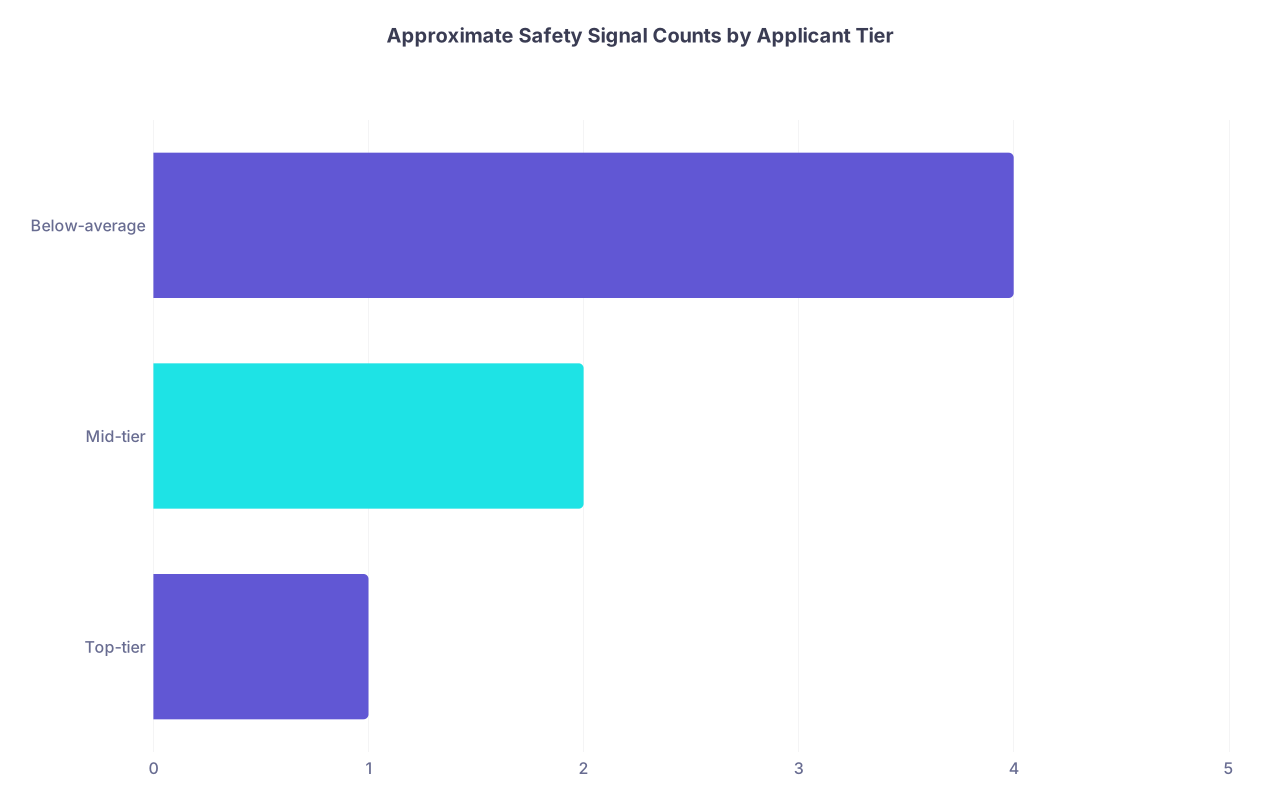
If you’re strong for the field
0–2 safety signals. You probably don’t need them, but it’s not crazy to toss 1–2 to locations you’d genuinely be happy at.If you’re mid-tier
1–3 safety signals. Especially if:- Your home program is weak or nonexistent in the specialty
- You’re from a newer or less-connected school
- Your letters and research are decent but not stellar
If you’re below-average or have risk factors
3–6 safety signals. They’re your insurance. You’re not overdoing it; you’re giving yourself a fighting chance.
| Category | Value |
|---|---|
| Top-tier | 1 |
| Mid-tier | 2 |
| Below-average | 4 |
10. Final Calibration: What If You’re Still Unsure?
Two simple tie-breakers:
Would you be unhappy but relieved to match there?
If yes, it’s a valid safety to consider signaling if your risk of not matching is non-trivial.If you got only 8–10 interviews total, would you need this one?
If the answer is yes, that program probably deserves a signal if it’s realistic or safety.
If you’re sitting at a borderline profile for your specialty and debating between signaling one more ultra-reach vs a realistic or safety program, default to the realistic/safety. Future-you, in March, will thank you.
FAQ (Exactly 7 Questions)
1. If I’m a very strong applicant, is it actually a waste to signal safety programs?
Mostly, yes. If you’re clearly above the standard for a safety program, they’ll often invite you without a signal. Your limited signals are usually better spent trying to move from “maybe” to “yes” at top and upper-mid programs. But if there’s a specific safety in a must-have location (partner’s job, family, etc.), signaling one or two is fine.
2. How do I know if a program is truly a “reach” for me?
Look at: their reputation, your school’s historical matches there, and your stats vs those who matched. If your Step, research, and letters are clearly below what your school’s prior matches had at that program—or they rarely take people from your type of school—it’s a reach. If you have no one at your school who’s matched there in years, assume reach until proven otherwise.
3. Should I always signal my home program in a competitive specialty?
Almost always yes, unless your home PD explicitly says they consider you a lock and would rather you use the signal elsewhere. Most PDs appreciate the commitment signal. And in some specialties, not signaling your home can be interpreted as a lack of interest if they know you have signals to use.
4. Is it dumb to use signals on community programs in a competitive field?
Not dumb if they’re realistic or safety options where you’d truly be willing to match. Some community or hybrid programs in Derm, Ortho, ENT, etc. are still very selective and may be more responsive to signals from mid-tier applicants than elite academic programs drowning in 270s.
5. What if I’m dual-applying to a less competitive specialty—do I change how I signal?
Yes. If your primary specialty is highly competitive and your profile is borderline, you should treat signals in that competitive field more conservatively—more toward realistic and safety within that field—because your Plan A is fragile. Do not burn all your signals on moonshot programs when you’re already dual-applying out of concern.
6. Can signaling a safety program hurt me with reach programs?
No. Programs don’t see how you used your other signals. A safety doesn’t know they’re a safety. A reach doesn’t know they’re a reach. They just see “we were signaled” or “we were not.” There’s no prestige ranking of your signal choices for PDs to judge.
7. If I get advice from my school that conflicts with this, who do I listen to?
Listen to people with data and skin in the game. A good advisor or specialty PD at your institution who sees match lists and knows your exact application always outranks generic advice online—even mine. Use this framework as a sanity check: if someone tells you to send all signals to top-10 programs despite a very average application, push back and ask them to explain the logic with actual outcomes from prior years.
Key takeaway 1: Most applicants in competitive specialties should not signal only reach programs. A mixed approach—with a strong emphasis on realistic programs and a few safeties for mid- and lower-tier applicants—is far safer and more effective.
Key takeaway 2: Signals are most powerful where you’re already within or just above a program’s usual range, not where you’re wildly below it. Use them to turn plausible interviews into likely ones, not to chase long-shot fantasies.