

What do you do when the person who was supposed to open doors for you has quietly started closing them instead?
If you’re reading this, you’re probably in one of a few painful spots:
- Your “mentor” keeps taking credit for your work.
- They bad-mouth you to others or subtly undermine you.
- They ignore your emails unless they need something.
- They promised letters, projects, or support… then ghosted.
And now you’re stuck. Because this person is important. Maybe they run the lab. Or run the department. Or they’re the only big name in your niche. You’re afraid that if you pull away, they’ll punish you. But staying is already hurting you.
Here’s how to get out. Without lighting yourself on fire. And then how to rebuild a real support network that actually helps you.
Step 1: Call the Situation What It Is
You can’t fix what you won’t name.
You don’t have a “miscommunication” if:
- They repeatedly promise timelines and blow past them with no apology.
- You learn about your own work from a conference abstract with their name first and yours buried.
- They’re supportive in 1:1 meetings but dismissive or critical in front of others.
- They use fear: “You’ll never match in ortho without me,” “Everyone comes through my lab.”
That’s not mentoring. That’s exploitation or control.
On the other hand, not every frustrating mentor is “bad”:
- Busy surgeon takes a week to reply, but when they do, it’s helpful and concrete.
- They push back on your ideas but help you refine them.
- They’re blunt about your weaknesses and then work with you on a plan.
Point is: before you blow up a relationship, make sure it’s actually toxic, not just imperfect.
A quick gut-check test:
- After leaving interactions with them, do you consistently feel smaller, anxious, or ashamed?
- Over the last 6–12 months, has this relationship helped your career in tangible ways (letters, projects, intros, skills) or mostly caused stress?
- If a junior asked you whether they should work with this person, would you enthusiastically say “yes,” cautiously say “maybe,” or secretly think “run”?
If you’re at “run,” then this article is for you.
Step 2: Decide Your Exit Strategy (Quiet vs Confrontational)
You have three realistic options:
- Quietly drift and disengage.
- Direct but diplomatic conversation.
- Hard boundary + potential bridge-burning (rarely needed, but sometimes necessary).
The “right” one depends on:
- Their power: division chief vs mid-level faculty vs postdoc.
- How vengeful they are.
- How quickly you need out (weeks vs months).
- Whether you need anything from them still (letter, publication sign-off, rotation evaluation).
Let’s map it out.
| Scenario | Best Initial Strategy |
|---|---|
| Chair-level, known to be vindictive | Quiet disengagement |
| Mid-level faculty, mixed behavior | Diplomatic conversation |
| Clear harassment or abuse | Document + report + hard exit |
| You still need a letter from them | Slow fade after securing LOR |
| You have alternative strong mentors already | Faster, clearer exit |
If you’re unsure, assume you’ll start with a soft, quiet exit and escalate only if necessary.
Step 3: Protect Yourself Before You Move
Before you change anything, secure what you can.
Get your work in your hands.
- Download copies of drafts, data summaries you created, figures you designed (whatever is allowed and appropriate in your institution).
- Save emails where they praise your work, acknowledge your contributions, or outline project agreements.
Document patterns.
Keep a simple dated log: “1/10 – promised abstract revision by 1/20, no response; 2/1 – told me not to contact co-author directly.” You’re not building a lawsuit file. You’re giving yourself clarity. And if things escalate, this becomes critical.Identify at least one “safe” senior person.
This might be:- A different attending you trust.
- Your program director or associate PD.
- An advisor from a different department.
You don’t need to dump every detail yet. But know who you could go to if this goes sideways.
Check your dependency.
Ask yourself:- Do they control your core clinical evaluations?
- Are they on a key promotions or residency selection committee?
- Are they your only promised letter writer in your specialty?
Wherever dependency is high, your exit needs to be slower and more strategic. You don’t have to like that. But you do have to respect it.
Step 4: The Quiet Disengagement Playbook
If you’ve decided confrontation is risky or useless, here’s how to leave without announcing you’re leaving.
You’re going to create three shifts:
- Less access.
- Less obligation.
- More parallel support.
Change availability without making a speech.
Start responding a bit slower. Be “less available” for ad hoc meetings. You do not need to justify with life stories. Simple lines:- “My schedule’s gotten tighter this term with added responsibilities, but I’m still working on X.”
- “I’m adjusting my commitments to focus on a few key projects.”
Stop volunteering for new things.
When they try to pull you into another endless project:- “I’m at capacity right now and don’t want to commit to something I can’t finish well.” Use that exact wording if you want. It’s hard to argue with.
Re-route your energy.
While you’re fading out, you’re simultaneously:- Joining another research group, QI project, or committee.
- Asking other faculty for one-off advice (“Could I get 15 minutes of your feedback on this abstract?”).
- Showing up at grand rounds, specialty meetings, journal clubs where non-awful people hang out.
Shift how you talk about them publicly.
Don’t trash them. But stop overselling the relationship:- Old way: “Dr. X is my main mentor; we’re doing several projects together.”
- New way: “I worked with Dr. X on some earlier projects. Lately I’ve been focusing on Y with Dr. Z’s group.”
You’re nudging the narrative without detonating anything.
Plan a “natural” stopping point.
Use:- End of a semester.
- Completion of a manuscript.
- Transition in rotations or training level.
Around that time, you send something like:
“Thank you again for the opportunities to work on X and Y. As I move into my [sub-I’s / new role / next rotation block], I’ll be focusing my efforts on a smaller number of projects aligned with my current goals. I appreciate your guidance so far.”
Polite. Non-accusatory. Also very clear: you’re not signing up for Part 2.
Step 5: If You Choose the Direct Conversation
Sometimes, direct is better:
- They’re not malicious, just chaotic or oblivious.
- You actually want to see if the relationship can be salvaged.
- Their behavior is hurting you in visible ways and you need to set boundaries.
Do not walk in and say, “You’re a terrible mentor.”
Use specific, behavior-based language, and tie it to your needs and goals.
Structure it like this:
Start with your goals.
“I’m really focused on developing as a [future internist/academic surgeon/etc.], and I want to make sure my mentorship is aligned with that.”Describe 2–3 specific issues.
- “When authorship decisions changed without a conversation, I felt sidelined and unsure how decisions were being made.”
- “When timelines stretch out without updates, it makes it hard for me to plan for applications.”
Make a concrete request or boundary.
- “Going forward, I’d like to agree on authorship roles at the start of a project.”
- “I need more predictable communication. If that’s not possible, I may need to shift to fewer commitments.”
Give them a path to save face.
- “I know your schedule is demanding and you’ve got a lot of trainees. I want to be respectful of your time while also being intentional about my own development.”
Then watch what they do over the next 1–2 months. Not what they say that day.
If behavior genuinely improves, you can cautiously continue. If they:
- Get defensive.
- Blame you.
- Punish you subtly after this conversation.
You’ve confirmed: this is not someone you fight to keep.
At that point, you pivot back to the quiet disengagement strategy, just possibly on a shorter timeline.
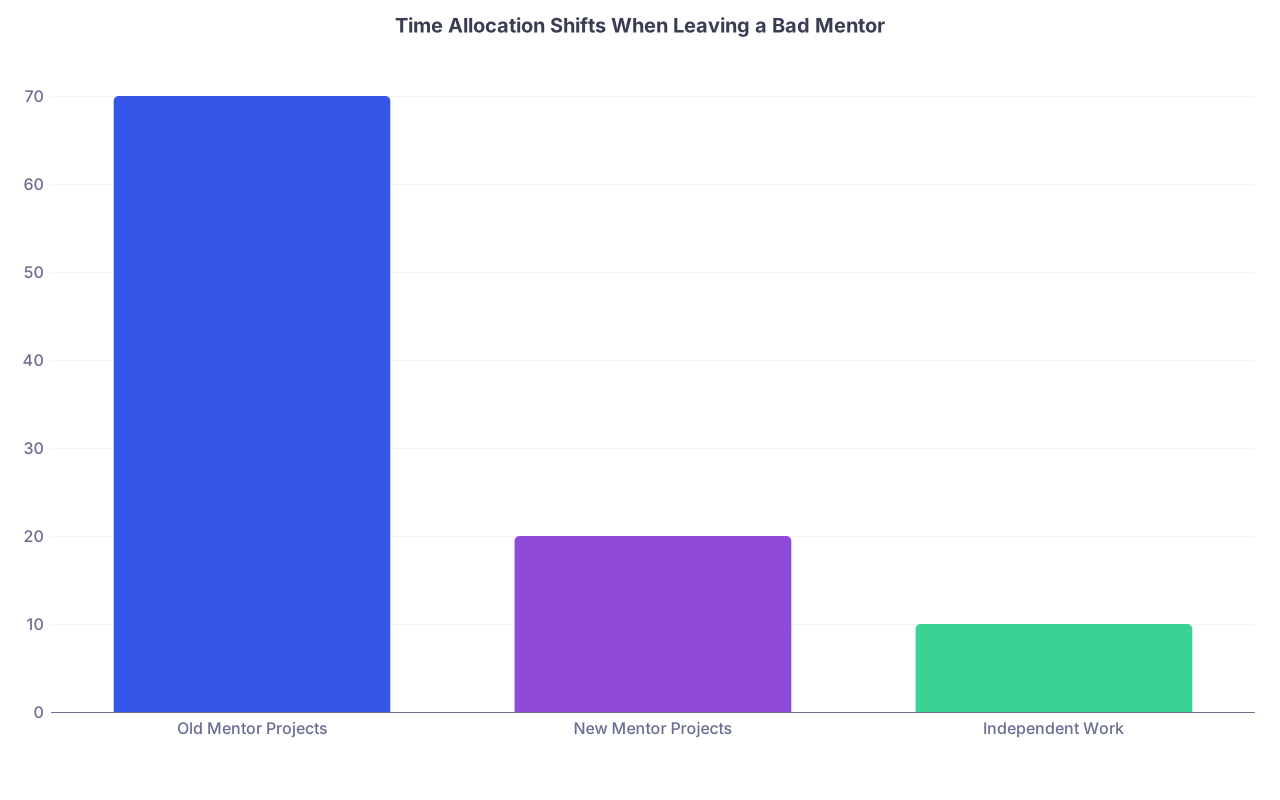
| Category | Value |
|---|---|
| Old Mentor Projects | 70 |
| New Mentor Projects | 20 |
| Independent Work | 10 |
Step 6: Handling the Fallout (Real or Imagined)
Sometimes the fear of retaliation is worse than what actually happens. But yes, in medicine, people talk. And powerful people sometimes behave badly.
Here’s how to minimize damage.
If they get cold or petty
You may notice:
- Short, icy emails.
- You’re no longer invited to meetings.
- They brag about new mentees to you.
You respond with boring professionalism:
- “Thanks for the update.”
- “Understood.”
- “Appreciate the clarification.”
What you do not do: clap back, gossip widely, send emotional essays, or post vague subtweets. They have power. You have to be smarter, not louder.
If they block a letter or evaluation
If they suddenly refuse to write your LOR after previously agreeing:
- Do not beg.
- Say: “Thank you for letting me know. I’ll seek a letter from someone who can strongly support my application.”
Then immediately:
- Ask other attendings who’ve seen you clinically.
- Request letters earlier from people you still trust.
You can also quietly explain to a program director or dean:
“I initially planned on a letter from Dr. X given a project we worked on, but I ultimately felt that other mentors knew my work better and could speak more directly to my strengths.”
That’s enough. Anyone sane can read between the lines.
If they actively bad-mouth you
This is where your documentation and alternative mentors become crucial.
You do not wage a one-person PR war. You:
- Keep showing up and doing excellent work.
- Make sure multiple other faculty see you at your best.
- If needed, have a quiet meeting with a trusted senior person:
“I’m aware there may be some negative perceptions coming from my previous mentor relationship. I’d appreciate any guidance and also wanted to provide context if you ever hear concerns.”
No name-calling. Just facts, maturity, and asking for guidance.
Step 7: Rebuilding Your Mentorship Network – Without Repeating the Same Mistakes
Leaving a bad mentor is only half of the story. You still need support. And you need to be smarter this time.
Think of mentorship like a portfolio, not a single stock.
You want:
- A clinical mentor (day-to-day skills, evaluations).
- A career mentor (strategy, specialty choice, long game).
- A project mentor (research, QI, education projects).
- A peer or near-peer mentor (residents, fellows, senior students).
No single person has to do all of it. In fact, they shouldn’t.
How to find better mentors
Stop fishing in one pond. Use multiple entry points:
- Ask residents/fellows, “Who’s actually good to work with around here?”
- After a great lecture, email the speaker a short note:
“Your talk on X really clarified Y for me. I’m interested in [field]. Could I schedule a 15-minute chat about early career decisions?” - Join a committee (education, DEI, QI) where you see how attendings behave in the wild.
When you meet someone promising, don’t open with “Will you be my mentor?”
Start with:
- “Could I run a couple of questions by you about [applications/research/next steps]?”
- After 1–2 good meetings: “Would you be open to my checking in a few times a year as I plan my path in [field]?”
Red flags you now know to avoid
From what I’ve seen, the worst mentorship disasters often start with at least one of these:
- They talk a lot about their “brand” and very little about your goals.
- They bad-mouth other mentees to you (you’re next).
- They’re vague about authorship, credit, and timelines.
- Everything they offer you is unpaid, undefined, and “urgent.”
- They love being called “mentor” more than they like doing the work of mentoring.
If you see those in the first 1–2 months, keep the relationship limited and do not hand them your whole future.
Build redundancy on purpose
Do not wait until the next fire to find the fire exit.
Even if you land a fantastic mentor:
- Continue meeting occasional new faculty.
- Present your work at different venues.
- Stay visible to multiple attendings in your field.
Redundancy isn’t disloyal. It’s survival.

| Step | Description |
|---|---|
| Step 1 | Realize mentor is harmful |
| Step 2 | Document issues and secure work |
| Step 3 | Quiet disengagement |
| Step 4 | Direct conversation |
| Step 5 | Shift time to new projects |
| Step 6 | Continue cautiously |
| Step 7 | Identify new mentors |
| Step 8 | Build diverse mentor network |
| Step 9 | Need confrontation? |
| Step 10 | Behavior improves? |
Step 8: Mentally Reset – So This Doesn’t Follow You
Being burned by a mentor hits harder than people admit. It messes with:
- Your confidence (“Maybe I was the problem.”)
- Your trust in faculty generally (“They’re all out for themselves.”)
- Your risk tolerance (“I won’t get close to anyone again.”)
You don’t fix that just by switching labs.
A few things that actually help:
Name the loss.
Yes, loss. You probably invested hope, time, identity into this relationship. Write down what you thought this mentor would be for you, and what actually happened. Then close the chapter on that fantasy.Separate their behavior from your worth.
Someone who hoards credit, manipulates trainees, or uses fear doesn’t suddenly become ethical with better students. That’s about them, not you.Get a neutral mirror.
Talk to:- A mental health professional (especially if there was harassment or bullying).
- A trusted senior resident/fellow.
- A career advisor outside your department.
Ask two questions:
- “What do you think I did right in that situation?”
- “What could I do differently next time when choosing who to trust?”
Decide what you’ll do differently, not what you’ll never do again.
“I’ll never trust any attendings” is a trap.
Better: “Next time, I’ll test the relationship with one small project before I commit to more.”
You’re not weak for having been burned. The system is built so trainees depend on a few people with a lot of unchecked power. You’re learning to play the game with your eyes open.
FAQ (Exactly 3 Questions)
1. Should I warn junior students and residents about this bad mentor?
Cautiously and privately, yes—if you can do it without turning it into a smear campaign. If a junior directly asks, “Is Dr. X good to work with?” you can say: “I got some opportunities, but communication and follow-through were challenging for me. If you do work with them, I’d recommend getting clear expectations up front about credit and timelines.” That’s honest, specific, and not defamatory. Do not send mass warnings or gossip in public channels; that usually backfires on the trainee, not the faculty.
2. What if this mentor is the only big name in my specialty at my institution?
Then you treat them like a limited resource, not your only lifeline. Maintain a minimal, professional relationship—do the required rotations, be competent, do not pick fights. Meanwhile, build stronger mentorship externally: national specialty societies, virtual mentors at other institutions, people you meet at conferences, online research collaborations. Many applicants match with letters and support from outside their home institution when their local environment is weak or toxic. You’re not trapped, but you do have to be more intentional.
3. How do I explain leaving a mentor on applications or in interviews?
Briefly and without drama. For example: “Earlier in my training I worked on some projects in Dr. X’s group, but as my interests evolved I found a better fit with Dr. Y’s work in [specific area], so I shifted my efforts there.” If pressed about any gaps or conflicts, keep it high-level: “There were some differences in working style and expectations, and I realized I do best with more structured communication and clearer project timelines.” Then pivot immediately to what you learned and how much better things are with your current mentors. Interviewers are watching how you handle conflict, not just what happened.
Two things to walk away with:
- You’re allowed to leave a bad mentor. You just have to do it strategically, not impulsively.
- Your career is safer when no single person holds all the keys—build a network, not a savior.


