
It is one month before a major conference. You just got the registration confirmation email for something like ATS, ASCO, AHA, or RSNA. You know the conference is important. You also know that “just showing up” basically wastes 70% of the networking value.
Here is what you do. Week by week. Then day by day. Then what you do after everyone else forgets to follow up.
30–21 Days Before: Build the Target List and Story
At this point you should stop thinking about “going to a conference” and start thinking about “running a 60‑day networking project.” The conference itself is just the 3–5 day core.
30–25 Days Before: Define your networking goals
Block one focused hour. No phone. No email.
Write down:
- Your role: MS3/4, resident, fellow, junior attending, industry, etc.
- Your 6–12 month goals in medicine:
- Research collaboration?
- Fellowship/job?
- Mentorship in a niche area (e.g., heart failure device therapy)?
- Exposure to a new field (AI in radiology, telemedicine models, implementation science)?
Then force yourself to pick two primary goals and one secondary goal. If everything is a priority, nothing is.
Examples:
- Primary: Meet at least 3 faculty who do cardio‑oncology research.
- Primary: Talk with 2 program directors about fellowship fit.
- Secondary: Learn what a realistic early‑career industry role looks like for hospitalists.
Now those goals will drive what you do, who you email, and which sessions you attend. Not the other way around.
25–21 Days Before: Build your target people + events map
You are now curating who you want to run into—on purpose.
Scan the conference site
- Pull the:
- Plenary speakers
- Panel moderators in your niche
- Session chairs for topics you care about
- “Meet-the-expert” style sessions
- Open every relevant speaker bio in new tabs. Yes, it takes time. It is worth it.
- Pull the:
Filter your list Prioritize:
- People in institutions you realistically might join
- People whose work you genuinely read or cite
- Alumni from your med school / residency / fellowship
- People your current mentors know personally
Create a simple tracking sheet
Use something like this:
| Name | Role | Institution | Why connect | Plan (email / find after talk / reception) |
|---|---|---|---|---|
| Dr A | PD | Big University | Fellowship interest | Email + attend her session |
| Dr B | Junior faculty | Regional Center | Similar research | Catch after poster |
| Dr C | Industry | Device company | Career insight | Find at exhibit booth |
| Dr D | Division chief | Large hospital | Future job | Ask mentor for intro |
Aim for:
- 10–15 high‑priority people
- 10–15 “nice to meet if possible”
Do not make a list of 60. You will not manage that. You are not a CRM platform.
21–14 Days Before: Outreach and Pre‑Warming
At this point you should start showing up in people’s inboxes before you show up in hallways.
21–17 Days Before: Draft your outreach templates
You are going to send short, tight emails or messages. Not essays.
Base structure:
- Who you are (one line)
- Why you are reaching out (one line, specific)
- Tiny ask that fits into 10–15 minutes
Example for a trainee:
Subject: Quick hello before [Conference Name]
Dear Dr [Last Name],
I am a PGY‑2 in internal medicine at [Institution] with an interest in [specific area]. I have been following your work on [very specific paper or project], and I’ll be attending [Conference].
If you have 10–15 minutes during the meeting, I would appreciate the chance to briefly introduce myself and ask a few questions about how you built your research program.
I understand the meeting is hectic, so if it is easier, I am also happy to connect after the conference.
Best regards,
[Name]
[Institution]
[Cell number]
Create variants for:
- Faculty / PDs
- Industry people / medical affairs
- Peers / other trainees
Save them. You are going to reuse and customize.
17–14 Days Before: Send targeted messages
Now you execute.
- Send 5–10 high‑priority emails first
- Then send 5–10 secondary emails (faculty or peers you would like to meet, but not critical)
Timing rule: do this 2–3 weeks before the conference. Earlier and it gets forgotten. Later and calendars are already full.
What you ask for:
- “10–15 minutes in the lobby after your session”
- “A brief coffee between 2 sessions”
- “Stop by my poster if you have time” (if you are presenting)
Track responses in your sheet:
- Confirmed
- Maybe / follow up closer
- No response
Do not chase non‑responders aggressively. You will still look for them at their talks and touch base casually.
14–7 Days Before: Strategic Prep (Not Just Packing)
At this point you should transition from outreach to tactical preparation. You are building tools you will use in the moment.
14–10 Days Before: Fix your professional presence
You are going to meet people who will look you up on their phone the second you walk away.
Do the following:
- Update your:
- Doximity / institutional profile
- Google Scholar (if relevant)
- Make sure:
- Your headshot is not from 7 years ago or a wedding
- Your current role and interests are obvious in the first lines
If you have any online portfolio, GitHub (for informatics), or personal academic page, make it at least not embarrassing.
10–7 Days Before: Create your micro‑pitches
You will be answering “So what do you do?” a hundred times. If you babble, people forget you.
Prepare 2–3 crisp versions:
10‑second version (hallway / line for coffee)
- “I’m a PGY‑3 in IM at [Institution] looking at [very specific area]. Right now I’m focused on [1 specific type of project or question].”
30‑second version (reception / walk between rooms)
- Add:
- A concrete example of work
- What you are hoping to learn or find at this meeting
- Add:
90‑second version (over coffee / seated next to someone)
- Brief training path
- 1–2 key projects / skills
- Clear “direction of travel” (e.g., “aiming for a career in academic GI with a focus on outcomes research”)
Practice out loud. Not in your head. You will hear what sounds awkward.
7–1 Days Before: Logistics, Schedule, and Mental Game
Now you are one week out. At this point you should lock down the schedule and remove friction.
7–4 Days Before: Build your real schedule (not the fantasy one)
The conference app schedule is not your plan. It is a buffet. Your plan is a plate.
Steps:
Start with anchored events:
- Your own presentation(s)
- Any scheduled 1:1 meetings you already set up
- Key receptions (trainee, women in medicine, DEI, subspecialty groups)
- Society business meetings or interest groups
For each day, add:
- 1–2 sessions you care about for content
- 1–2 sessions you care about only for who will be there (e.g., “Heart Failure Clinical Trials Update” because the PI you follow is speaking)
Leave open blocks:
- At least 1–2 hours per day for:
- Spontaneous coffee
- Hallway conversations
- Poster-wandering
- At least 1–2 hours per day for:
If you pack the schedule end‑to‑end, you will run past the best networking moments.
Drop the schedule into something visual. This helps:
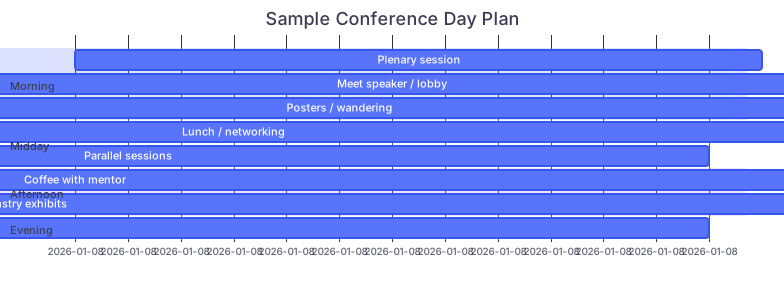
| Task | Details |
|---|---|
| dateFormat HH | mm |
| Morning: Plenary session | a1, 08:00, 01:30 |
| Morning: Meet speaker / lobby | a2, 09:30, 00:30 |
| Morning: Posters / wandering | a3, 10:00, 01:00 |
| Midday: Lunch / networking | b1, 12:00, 01:00 |
| Midday: Parallel sessions | b2, 13:00, 02:00 |
| Afternoon: Coffee with mentor | c1, 15:30, 00:30 |
| Afternoon: Industry exhibits | c2, 16:00, 01:00 |
| Evening: Reception / mixer | d1, 18:00, 02:00 |
4–2 Days Before: Pack like someone who takes this seriously
Minimal but deliberate:
- Business‑casual layers (conference rooms are meat lockers)
- Comfortable but professional shoes (you will easily hit 10k–15k steps per day)
Networking kit:
- Small notebook or a notes app with:
- Your target list
- Daily schedule
- Space to jot names + follow‑up items
- Portable charger
- Simple, clean business cards if your environment still uses them
(Academic medicine is mixed—some people care, many do not; either way, a card does not hurt.)
Design one card that has:
- Name, degree(s)
- Current role, institution
- LinkedIn or personal page
No giant logo. No inspirational quote.
Day Before Travel: Mental prep and last scan
The night before:
- Re‑review your target list. Circle your top 5 people.
- Check the app for:
- Session cancellations
- Room changes
- Newly announced events (industry symposia, trainee meetups)
Then spend 10 minutes deciding:
- What success will look like:
- e.g., “Have 5 meaningful conversations and 3 planned follow‑ups per day”
Not: “Meet everyone” or “Have the perfect elevator pitch.”
- e.g., “Have 5 meaningful conversations and 3 planned follow‑ups per day”
This resets expectations and takes the pressure down.
Conference Days: On‑Site Networking Playbook
You have arrived. At this point you should behave like someone who came here to connect, not to collect tote bags.
Day 1: Orientation and low‑stakes reps
Morning:
- Pick up badge early. Standing in line at 8:55 a.m. is amateur hour.
- Walk the main spaces:
- Poster halls
- Exhibit hall
- Main session rooms
- Main coffee spots
Use Day 1 for warm‑up conversations:
- People sitting near you in sessions
- Other trainees at your institution’s booth or poster
- Lines (coffee, registration, book signings)
Your script is simple:
- “Hi, I am [Name], [role] at [Institution]. What brings you to [Conference]?”
- Then follow with 1–2 curiosity questions:
- “Are you presenting anything this year?”
- “Anything on the program you’re especially excited about?”
End with:
- “It was good to meet you—do you have a card or LinkedIn?”
Connect that day, not 3 weeks later when you forget their face.
All Days: How to work sessions and posters
Before a talk you care about:
- Arrive 5–10 minutes early
- Sit somewhere that lets you:
- Make eye contact with the speaker leaving the stage
- Exit fast if you need to catch someone
After the talk:
- Do not start with “Great talk.” Everyone says that. Be specific.
Example:
- “Dr [Last Name], your comment about implementation barriers in community hospitals really resonated. I am at [Institution] and we are seeing similar issues with [X]. I’m [Name], a [Role]. Could I ask you one quick question?”
After 1–2 sentences of conversation:
- If it is going well and the line is small:
- “I would love to follow up later in the meeting or by email. Could I get your card?”
- If the line is large:
- “I do not want to block the line; could I email you a brief question later? What is the best address?”
Posters:
- Do not just wander. Use the poster locator:
- Look up presenters in your interest area
- Target junior / mid‑level people if you want realistic collaborations
How to approach:
- Read the title and 1–2 key figures before speaking
- “Hi, I am [Name], [role] at [Institution]. I am also working on [related topic]. Could you walk me through the main finding?”
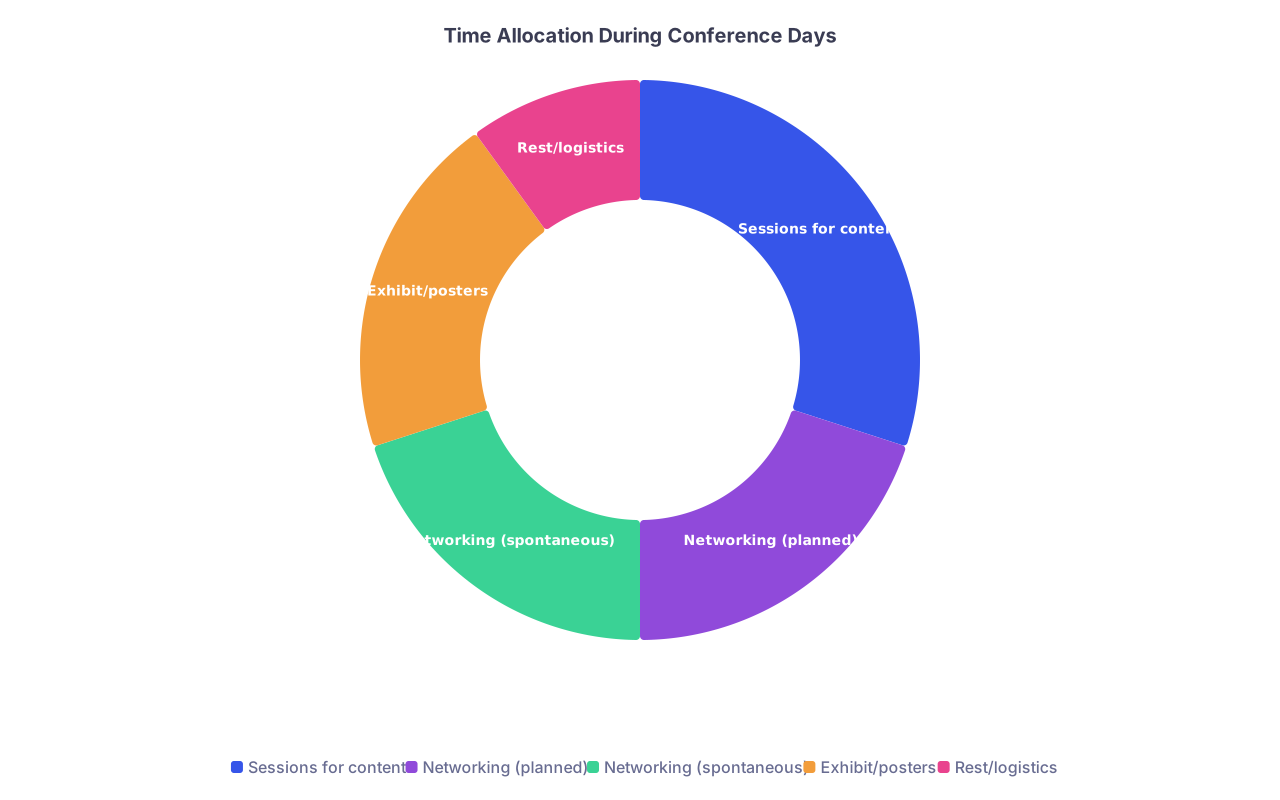
| Category | Value |
|---|---|
| Sessions for content | 30 |
| Networking (planned) | 20 |
| Networking (spontaneous) | 20 |
| Exhibit/posters | 20 |
| Rest/logistics | 10 |
0–3 Days After: Immediate Follow‑Through
You are on the flight home or just back. At this point you should assume your memory will decay by 50% in 48 hours.
Day 0–1 After: Sort your contacts and notes
Same day or next morning:
- Open your notes / notebook
- For every meaningful interaction (more than 30 seconds), write:
- Name
- Institution
- Where you met (session, poster, reception)
- 1–2 concrete details you discussed
- Any promised action (send a paper, connect them to someone, share slide, etc.)
Do not trust yourself to “remember later.” You will not.
Day 1–3 After: Send first‑wave follow‑ups
This is where 90% of people fail. You will not.
Template:
Subject: Great to meet you at [Conference]
Dear Dr [Last Name],
It was a pleasure meeting you at [specific event or session] at [Conference]. I appreciated our conversation about [specific topic you discussed].
As we discussed, I am [1‑line recap of who you are + what you are working on]. I would be very interested in [the specific next step: reviewing your paper, exploring data collaboration, learning more about your fellowship, etc.].
If you are open to it, I would appreciate the chance to schedule a brief Zoom call in the next few weeks. I have availability [2–3 options].
Thank you again for your time and insights.
Best regards,
[Name]
Send:
- To all high‑priority contacts: within 72 hours
- To secondary contacts: within 5–7 days
For peers you met:
- Use LinkedIn or email with something lighter:
- “Good to meet another person interested in [X]. Happy to stay in touch and share ideas or opportunities.”
4–14 Days After: Turn Contacts into Concrete Next Steps
At this point you should stop viewing these as “people I met at a conference” and start treating them as part of your professional network.
Week 1 After: Schedule real conversations
From your responses, aim for:
- 3–5 short Zoom/phone calls with:
- Potential mentors
- Future collaborators
- People in roles you are curious about (industry, policy, etc.)
Before each call:
- Re‑read their work / website
- Prepare 3–4 real questions:
- “If you were a PGY‑3 again with my interests, what would you focus on?”
- “Where do you see [subfield] going in the next 5–10 years, and what skills will matter?”
End each call with:
- “Is there anyone else you think I should speak with about this?”
This is how a single contact turns into three.
Week 2 After: Create a simple “relationship map”
Do not overcomplicate. A basic spreadsheet or note works:
- Name
- Role
- Where you met
- How they might help you
- How you might help them
- Next check‑in date
You are building what people in industry call a “pipeline.” In medicine, we pretend that is crass, but the people with strong careers quietly do exactly this.
15–30 Days After: Consolidate, Contribute, and Stay Visible
The conference is fading from memory for most people. At this point you should be the rare person who is still closing the loop.
Days 15–21 After: Deliver on any promises
If you said:
- “I will send you my abstract.”
- “I will introduce you to my PI.”
- “I will share that dataset link.”
Do it now. This is where people decide whether you are reliable.
Also:
- Share helpful things without being asked:
- A paper related to someone’s work
- A relevant grant RFA
- A slide deck you offered to send
Days 21–30 After: Light‑touch re‑engagement
You are not trying to become their new best friend. You are staying on the radar.
Options:
- Email: “Thought you might find this interesting” with a 1‑line explanation
- Comment on LinkedIn post with a specific insight (not “Congrats!” spam)
- If you built something (poster turned into draft, new dataset, code, QI project plan), send a short update if they expressed interest
The point is not volume. It is consistency and relevance.
Putting It All Together: 60‑Day Conference Networking Timeline
Here is the bird’s‑eye view:
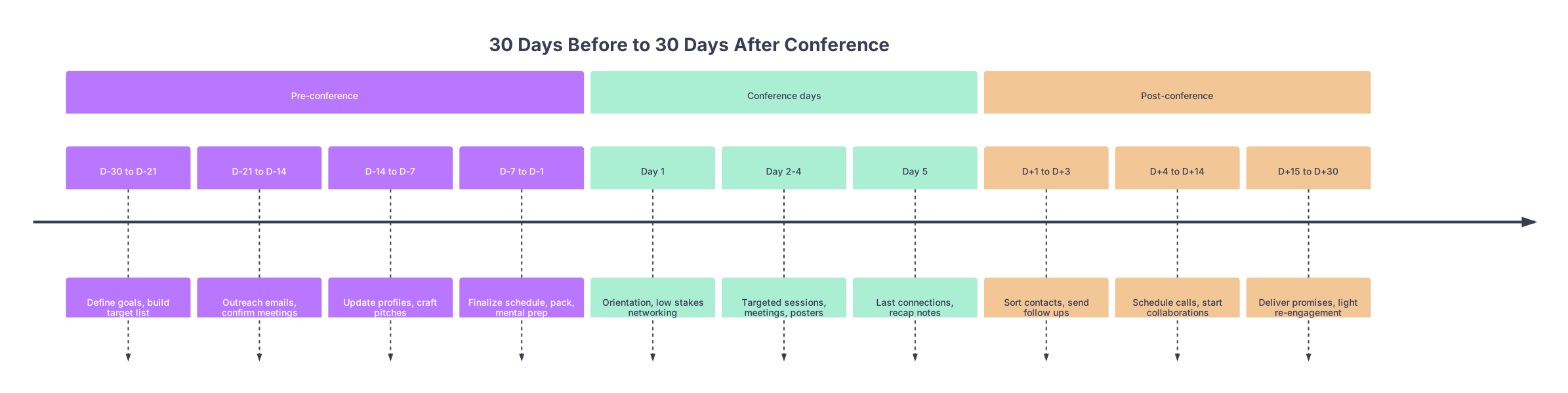
| Period | Event |
|---|---|
| Pre-conference - D-30 to D-21 | Define goals, build target list |
| Pre-conference - D-21 to D-14 | Outreach emails, confirm meetings |
| Pre-conference - D-14 to D-7 | Update profiles, craft pitches |
| Pre-conference - D-7 to D-1 | Finalize schedule, pack, mental prep |
| Conference days - Day 1 | Orientation, low stakes networking |
| Conference days - Day 2-4 | Targeted sessions, meetings, posters |
| Conference days - Day 5 | Last connections, recap notes |
| Post-conference - D+1 to D+3 | Sort contacts, send follow ups |
| Post-conference - D+4 to D+14 | Schedule calls, start collaborations |
| Post-conference - D+15 to D+30 | Deliver promises, light re-engagement |
Three Things to Remember
- Start 2–3 weeks earlier than you feel like you need to. The best meetings are set before anyone lands at the airport.
- Treat the conference as a 60‑day project, not a 3‑day event. The follow‑up is where the actual value appears.
- Aim for a small number of strong connections, not a giant stack of business cards. Depth beats volume every single time in medicine.