
The worst time to start networking for fellowship is when ERAS opens. If you wait until then, you’re not networking—you’re begging.
Here’s the fix: a ruthless, month‑by‑month networking calendar for the 12 months before you apply. At each point, I’ll tell you what you should actually be doing, who you should be emailing, and what is frankly a waste of time.
I’ll assume:
- You apply in July (ERAS opens/submits)
- Interviews run September–November
- You’re starting 12 months before that July
Shift months as needed if your specialty is off-cycle, but keep the sequence.
12 Months Before Application (July): Quiet Recon & Inventory
At this point you should stop guessing and map the field. No outreach yet. Just intel.
Concrete tasks this month:
Define your realistic target specialties and tracks
- Example: “Cardiology – mostly academic, some community-based; okay with Midwest + East Coast.”
- Decide if you’re research-heavy, clinically heavy, or in the middle. This changes who you network with.
Build a simple program spreadsheet Include:
- Program name
- City/state
- PD name + email
- Associate PDs
- Fellowship coordinator (name + email)
- Known alumni from your residency
- Notes (research focus, VISA issues, call structure, etc.)
Identify your built‑in network
- Recent grads from your residency and medical school
- Attendings who trained at your target programs
- Current fellows at your institution, stratified by subspecialty
Start with something like this:
| Contact Type | Where to Find Them | Primary Use |
|---|---|---|
| Recent grads | Residency alumni list | Realistic intel |
| Current fellows | Your hospital | CV feedback, timing |
| Faculty champions | Your department | Calls/emails for you |
| National leaders | Society websites | Long-term sponsors |
If you do nothing else this month, create the spreadsheet and fill 30–40 programs with basic info. That list will drive everything.
11 Months Before (August): Baseline Conversations at Home
At this point you should activate your local network—low-risk, high-yield conversations.
Week 1–2:
- Schedule 2–3 short meetings with:
- Your program director or associate PD
- At least one faculty in your desired subspecialty
- One senior fellow you respect
Goal of each meeting:
- “I’m planning to apply in July. I’d love your honest assessment and advice on where I’d be competitive and who I should talk to.”
Bring:
- A rough CV
- A draft list of programs
- 3–4 pointed questions (not “what do you think?”)
Week 3–4:
- From those meetings, you should now have:
- A list of 2–4 faculty who “know people” elsewhere
- A sense of which programs make sense for you
- A reality check on research expectations
Start a running log (one page, not fancy):
- Date
- Who you spoke to
- Main takeaways
- Follow-up actions
You’d be shocked how often people forget who suggested what six months later.
10 Months Before (September): Early, Low-Stakes Outreach
Now you move one layer out from your home institution.
At this point you should send polite, non-desperate feeler emails to:
- Alumni of your program now in fellowship
- Fellows at target institutions you have any connection to (mutual friend, same med school, same country, etc.)
Example email skeleton (keep it tight):
Subject: [Your Residency] resident interested in [Subspecialty] – quick question
Hi Dr. X,
I’m a PGY-2/3 in [program], planning to apply for [subspecialty] fellowships next cycle. We share [connection – same program/mentor].I’d really appreciate 10–15 minutes of your perspective on training at [their institution] and how you approached the application process. No rush—any time this month or next would be great.
Best,
[Name, PGY level]
Your goal in these calls is intel, not a letter:
- What their program really values
- How many fellows, what the vibe is
- Any “unwritten rules” about that fellowship’s application
Write down:
- Any specific faculty names they mention
- Any visiting electives, rotations, or research opportunities
By the end of September, you should have had 3–5 brief conversations outside your institution. That’s enough to adjust your target list and see patterns.
9 Months Before (October): Be Visible in Your Own Department
At this point you should be unignorable to the people who will vouch for you.
Your focus:
- Talk with your subspecialty division chief or key faculty
- Get on at least one project that will put your name in front of the field (even if it’s a case series or review)
Tactical steps this month:
Ask for concrete roles
- “Is there a small project I can realistically complete by spring that would help my fellowship application?”
- Accept something bite-sized but finishable. Abstracts and posters count.
Volunteer for academic activities
- Give a short talk at noon conference or journal club in your subspecialty
- Present interesting cases on rounds with some polish
- These are soft networking plays—faculty remember who shows up prepared.
Tell your champions your rough program list
- Don’t be vague. Say: “I’m thinking of [Region + 10–15 programs]. If you know anyone at those places, I’d value an introduction later this year.”
This is when your name starts getting associated with that fellowship choice in your local ecosystem.
8 Months Before (November): Society Membership & Digital Footprint
Now we go national—quietly.
At this point you should:
- Join the relevant specialty society (or update your membership)
- Figure out which annual meeting matters most for your field
Tasks:
Join / renew memberships
- Cardiology → ACC/HFSA
- GI → ACG/AGA
- Heme/Onc → ASH/ASCO
You know your field. Get on the email list.
Clean your professional online presence
- Update your institution bio
- Update LinkedIn (yes, programs look)
- Basic, professional headshot
- Make sure your subspecialty interest is obvious in 2–3 lines
Identify upcoming conferences and key dates
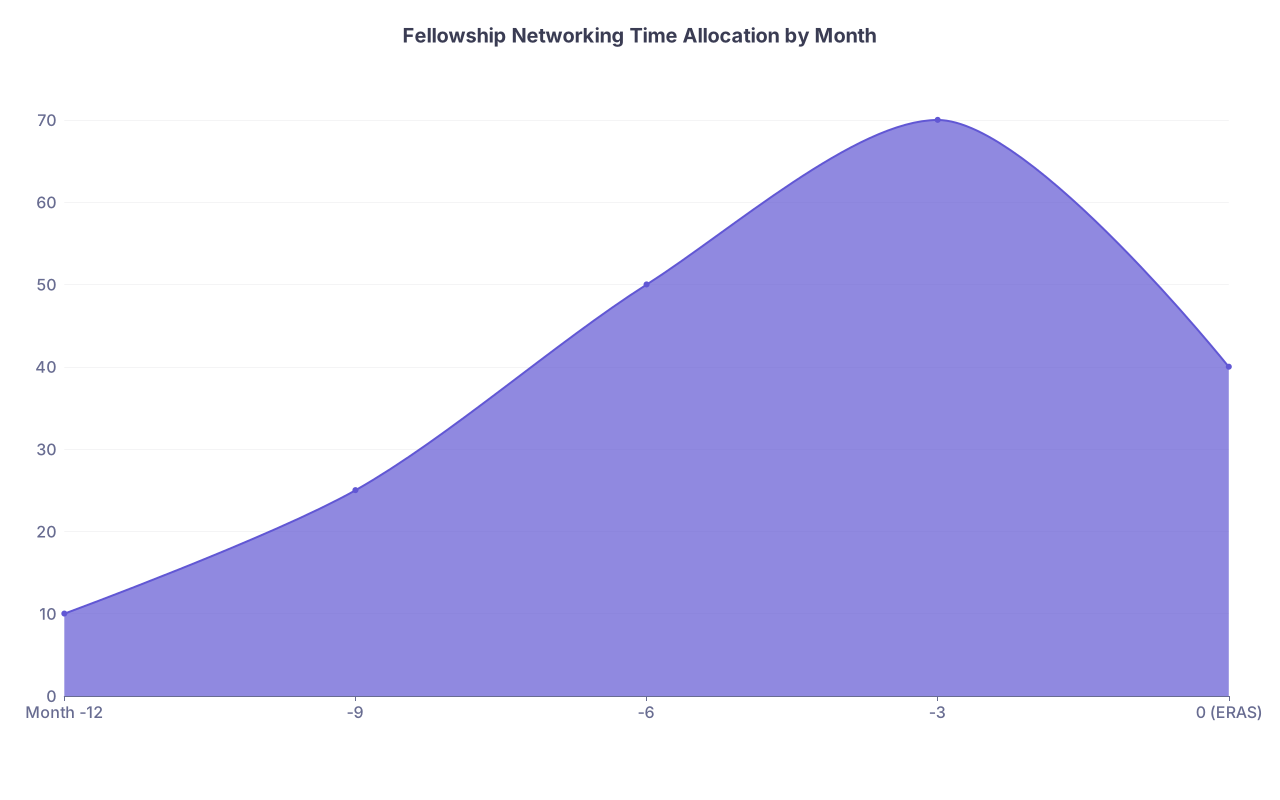
| Category | Value |
|---|---|
| Month -12 | 10 |
| -9 | 25 |
| -6 | 50 |
| -3 | 70 |
| 0 (ERAS) | 40 |
You want conference dates on your radar now so you can:
- Submit abstracts on time
- Plan funding/vacation
- Schedule intentional networking at those meetings
By the end of November, you should know exactly which conference(s) you’re aiming to attend before ERAS.
7 Months Before (December): Abstracts, Cases, and Visible Work
At this point you should be producing something sharable.
Not necessarily a NEJM paper. Just something that puts your name next to your subspecialty.
Focus:
- Case reports
- Quality improvement projects
- Small retrospective studies
- Review presentation for a local/regional meeting
Ask your mentors specifically:
- “Are there any upcoming abstract deadlines I should target for [major society meeting]?”
- “Can I help turn this case/series into an abstract under your guidance?”
Aim for:
- 1–2 abstracts submitted this cycle (even if acceptance is uncertain)
- Clear discussion with your mentor that you’d like to attend and present
Why December?
- Many spring/summer conference abstracts are due winter/early spring
- This gives you enough lead time to collect data and write something that isn’t embarrassing
6 Months Before (January): Targeted Faculty Introductions
Now you start explicitly building bridges to other institutions.
At this point you should ask your home mentors:
- “Would you feel comfortable introducing me by email to colleagues at [X, Y, Z programs] where I hope to apply?”
Be specific:
- Give them a short paragraph they can use:
- Who you are
- Your interests
- Any strengths (research, teaching, clinical) relevant to that program
Their email might look like:
“Hi [Colleague], I’d like to introduce [Your Name], one of our senior residents strongly interested in [subspecialty]. They’ve been working with me on [project] and plan to apply this coming cycle. Would you be open to a brief conversation with them about your program?”
Your job:
- Respond promptly
- Keep your ask small: a 15-minute call or permission to reach out later with questions
- Do not ask for a letter or rotation in the first email
By the end of January, you want:
- 3–6 faculty-level contacts at outside programs who know your name and have at least seen your CV once.
5 Months Before (February): Visiting Rotations & Observerships (If Applicable)
Not every specialty cares about away rotations. Some absolutely do.
At this point you should decide:
- Are you doing a visiting fellowship elective/away rotation?
- If yes, where and when?
Steps:
Check each program’s:
- Policies on outside rotators
- Application deadlines
- Required documents (immunizations, letters, etc.)
Ask your PD and division chief:
- “If I can only do one away elective, where would you prioritize, given my goals and competitiveness?”
Use your January intros:
- “Dr. X, I’m considering applying for an elective at [your institution] this spring. Would that be helpful for getting a sense of the program?”
This is advanced—and optional—but done well, an away elective is networking on steroids: daily face time, real clinical work, lots of potential advocates.
4 Months Before (March): Conference Season – Networking on Hard Mode
At this point you should show up in person somewhere.
Ideally, you’re:
- Presenting a poster or oral abstract
- Attending at least one major national or regional meeting
- Email your external contacts:
- “Will you be at [Conference]? I’d love to say hello briefly if schedules allow.”
- Ask your mentor:
- “Who should I try to meet from [X program] while I’m there?”
During the conference:
- Go to your subspecialty’s:
- Early-career or trainee sessions
- Program director or fellowship information sessions
- Any meet-the-professor / networking events
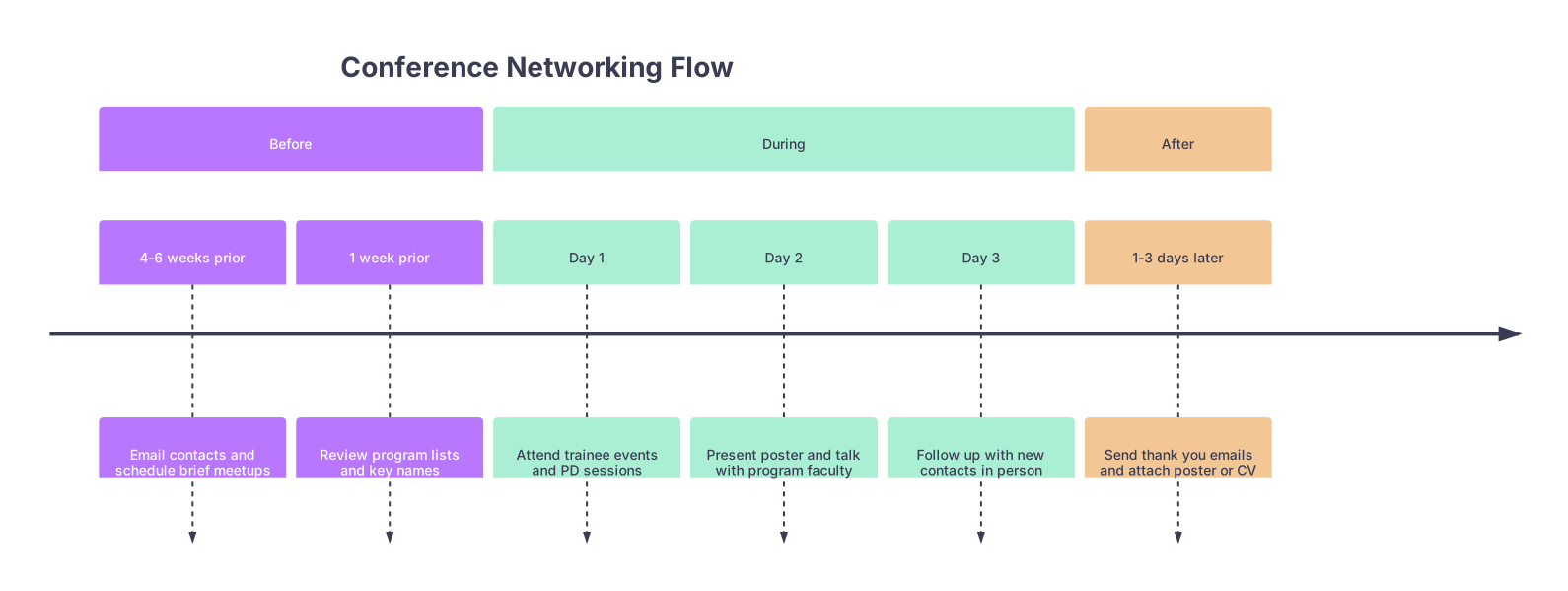
| Period | Event |
|---|---|
| Before - 4-6 weeks prior | Email contacts and schedule brief meetups |
| Before - 1 week prior | Review program lists and key names |
| During - Day 1 | Attend trainee events and PD sessions |
| During - Day 2 | Present poster and talk with program faculty |
| During - Day 3 | Follow up with new contacts in person |
| After - 1-3 days later | Send thank you emails and attach poster or CV |
Your goal isn’t to impress everyone. It’s to:
- Have 3–5 substantive conversations where you’re remembered
- Get concrete advice: “Given your background, I’d definitely apply to us; focus on X and Y in your application.”
Right after the conference (within 72 hours):
- Send quick thank‑you emails to anyone who spent real time with you
- Attach your poster/abstract if relevant
- Mention that you’ll be applying in July and appreciated their insight
3 Months Before (April): Tightening the List & Signaling
At this point you should stop expanding and start refining.
Tasks:
Narrow your list to something realistic.
- Most people should be sitting around 20–40 programs, depending on competitiveness and risk tolerance.
Re‑contact key external mentors:
- “I’m planning to submit to [list of programs]. Do any of these seem like poor fits for me, or is there somewhere obvious that I’m missing?”
Update your champions on your progress:
- “Since we last spoke, I’ve [submitted an abstract / presented at X / started Y project]. I’m finalizing my program list this month.”
Also:
- Make sure every program on your list has at least one point of connection:
- Faculty there you’ve met
- Alumni who trained there
- Someone you can reasonably email with a specific question
If you can’t name anyone connected to a program, that’s a networking gap—fix it now.
2 Months Before (May): Pre‑Application Touchpoints
This is subtle but powerful. At this point you should be gently on the radar of your top-tier programs.
How:
Email your external contacts at top choices:
Very short, respectful update:
“I wanted to let you know I’ll be applying to [Program] this upcoming cycle. Your advice about [specific topic] has shaped how I’ve approached things this year. Thanks again for your time.”
Do not ask them to “put in a word” unless your relationship is clearly that strong and they offer.
Make sure your own PD and subspecialty chiefs:
- Know your finalized list
- Know your true top 5–10 choices
- Are aware of any geography/family constraints
Finish any low‑hanging academic work:
- Get abstracts submitted
- Turn posters into manuscripts if feasible
- Ask mentors if they’re planning any recommendation letters and if they need updated CVs
By the end of May, the phrase “oh yeah, I know that person, they’re applying this year” should be something people at a few outside sites could realistically say about you.
1 Month Before (June): Letters, Logistics, and Final Impressions
Now we’re at the last pre‑ERAS month.
At this point you should:
- Have all your letter writers confirmed
- Have your CV final
- Have your personal statement in late‑draft form
Networking this month is gentle:
Confirm letters:
- “I’m planning to open ERAS on [date]. Do you still feel comfortable writing a strong letter on my behalf?”
- Give them your CV and a brief bullet list of what you hope they’ll highlight.
Make sure your PD and division leadership:
- Know your story: why this subspecialty, what you’re aiming for, and your realistic + stretch programs.
Do one last check‑in with a trusted external mentor:
- 15–20 minutes to sanity-check your list and strategy.
No cold emails now. No “hey, remember me?” to people you met once. Late June is for tightening relationships you’ve already built.
Application Month (July): ERAS Opens – Convert Network to Momentum
ERAS opens. Now your networking calendar shifts.
At this point you should:
Notify your key external contacts:
- “I’ve submitted my application to [Program]. I appreciated your guidance this year and wanted to say thank you again.”
Quietly let your champions know:
- “Applications are in. My top programs remain [X, Y, Z]. If you’re comfortable reaching out to anyone you know there, I’d be very grateful.”
Be reachable:
- Check email frequently
- Respond same-day to any program communication
This is not the time to start new relationships. It’s the time to let your existing network do what you spent 12 months building it to do.
Putting It All Together
Here’s the 12‑month arc in one shot:
| Months Before ERAS | Primary Networking Goal | Core Actions |
|---|---|---|
| 12–10 | Intel & local foundation | Map programs, meet PD/faculty |
| 9–7 | Internal visibility & projects | Case/abstracts, division presence |
| 6–4 | External bridges & conferences | Faculty intros, attend/present |
| 3–2 | Refine list & light signaling | Confirm programs, update mentors |
| 1–0 | Letters & quiet reinforcement | Final check-ins, thank-yous |
You’re not trying to “network” in the cheesy LinkedIn sense. You’re building a small, real set of people who:
- Know who you are
- Understand your goals
- Believe you’ll be good for their field
Do that over 12 months and your application stops being a PDF in a pile and starts being a person in people’s minds.
Today’s next step is simple:
Open a blank document and build your program + people spreadsheet with at least 20 programs and 10 potential contacts. Name it “Fellowship Network – [Your Name]” and save it. That file is your roadmap for the next year.