

It’s 6:45 a.m. You’re on surgery rounds. The chief is joking loudly with the reps, the senior resident is storytelling, the medical assistant is chatting with literally everyone, and you’re…standing there with your neatly written list, heart racing, rehearsing one sentence in your head and still somehow terrified to say it out loud.
And in your brain there’s this constant loop:
“I’m too quiet for this. They’re never going to remember me. I’m going to disappear. I’ll never match here. Loud specialties are for loud people. I picked wrong.”
I’m just going to say the nightmare thought out loud:
You’re scared that no matter how hard you work, your personality type is going to cap your ceiling.
Let’s pick that apart.
Reality check: Do loud specialties really only notice loud people?
Short answer: no. But they do notice visible people. And that’s what’s freaking you out, right? You’re equating “visible” with “loud.”
Surgery, EM, ortho, IR, even some procedural-heavy IM programs – they feel built for extroverts. People talk over each other. “Confidence” often looks like volume. The residents who joke with everyone seem to get the best cases. The student who loudly answers one question wrong still gets complimented for “engagement,” while you nail all your notes and get…“good job.”
I’ve seen this play out:
- In the OR: one student always speaking up, asking a ton of questions, getting invited to scrub more.
- Another student (you, basically) shows up early, preps the patient, knows the entire chart, but barely gets a nod.
So yeah, your anxiety isn’t imaginary. There is a bias toward the visible. But here’s the part people don’t say enough:
“Visible” is not the same as “loud.”
You can be quiet and still be:
- Memorable
- Valued
- Advocated for on rank lists
Where you’re at risk isn’t because you’re introverted. It’s because if you stay silent and hope “they’ll just notice the hard work,” they usually won’t. Not in these specialties. That strategy is how good, smart, quiet people end up as “solid, but unremarkable” on evals.
The goal is not to become loud. It’s to become intentionally noticeable in an introvert-compatible way.
How quiet people actually get noticed (without becoming fake extroverts)
Let me be blunt: if your plan is “I’ll just keep my head down and work hard and they’ll see it,” that’s not a plan. That’s a fantasy.
You need small, predictable, repeatable ways to show your value. Not a personality transplant.
1. Use the “one deliberate interaction per day” rule
Trying to “speak up more” 24/7 is overwhelming. Your brain just shuts down. So shrink the target: one meaningful interaction per day.
Stuff that counts:
- Asking one thoughtful, specific question about a case (“For this patient with peripheral vascular disease, what would be the absolute contraindication to surgery?” – not “tell me more about this disease.”)
- Offering one concrete task: “Dr. Lee, would it help if I called radiology to track down that CT result?”
- Giving one micro-presentation: a 60–90 second summary of a topic they mentioned (“You asked about SGLT2s in heart failure; I read a quick paper last night… very briefly, it showed…”).
You don’t need to dominate the room. You just need enough data points that someone, when filling out your eval, hears their own brain saying: “Oh yeah, they were engaged. They followed up. They cared.”
2. Pre-commit phrases so you’re not paralyzed in the moment
A huge introvert problem: you want to speak, but by the time you form the sentence, the moment is gone. Or your anxiety goes: “This is dumb, don’t say it.”
Pre-written phrases help. Memorize a few so your mouth can move even while your brain is spiraling.
Examples:
- On rounds: “I read about this last night, would it be okay if I share one quick thing I learned?”
- In the OR: “Could I ask a quick question about the anatomy while we’re at this step?”
- When cases are being assigned: “If there’s room, I’d really like to scrub on any vascular or trauma cases; that’s an interest of mine.”
You don’t have to be clever. You have to be heard.
3. Switch from “I don’t want to bother them” to “I’m making their life easier”
Quiet people constantly run this script: “They’re busy. I’ll be annoying. I’ll just stay out of the way.” In loud specialties, “staying out of the way” reads as “checked out” or “low initiative.”
Reframe what you’re doing.
You’re not pestering. You’re removing friction.
You’re the person who:
- Shows up with the consent already in the chart
- Has the relevant labs printed and highlighted
- Writes a clean, concise progress note they barely need to edit
And you name it gently:
“Dr. Patel, I noticed we had to track down outside records yesterday. For today’s new patient, I already called their outside cardiologist office and uploaded their last echo and cath. Would you like me to summarize it for you?”
That’s not bragging. That’s signaling. It makes you memorable and useful. No volume required.
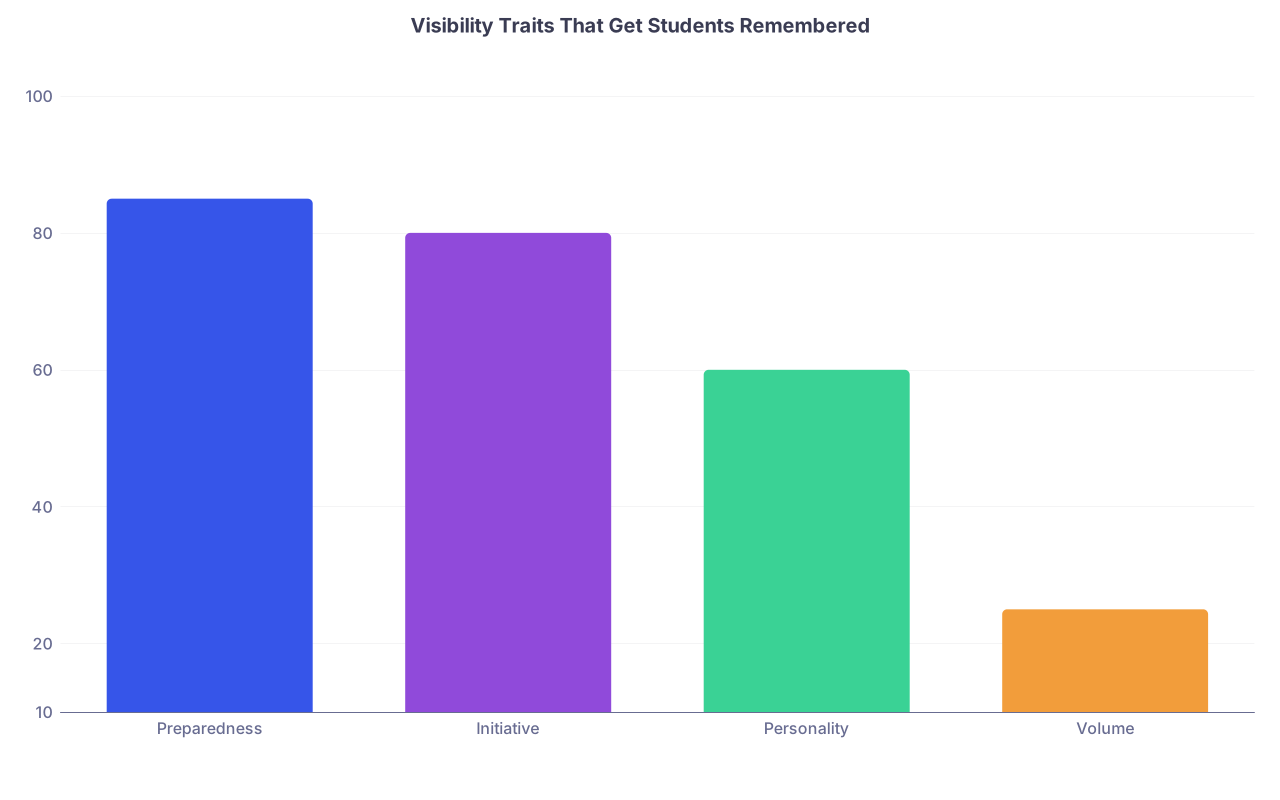
| Category | Value |
|---|---|
| Preparedness | 85 |
| Initiative | 80 |
| Personality | 60 |
| Volume | 25 |
Networking when you hate “networking”
You see your classmates at national meetings hugging faculty from away rotations, going out for drinks with residents, adding everyone on Instagram, and your stomach just drops.
You’re thinking: “If that’s what networking is, I’m screwed.”
The secret: the loud, social stuff is one version of networking. It’s not the only one. And honestly, it’s not even the most reliable.
Here’s what actually works for quiet people.
1. Replace “work the room” with “build a tiny, real circle”
You don’t need 30 attendings who vaguely know your name. You need 3–5 people who know you well enough to say something real on a phone call or in a letter.
You can build that in quiet-friendly ways:
- Stay late one day with an attending you like and ask genuinely: “Can I get your advice about going into [specialty] as someone more on the introverted side?”
- Email a faculty member after the rotation: “I really appreciated how you explained X. If you’re open to it, I’d love to check in a couple times over the next year as I apply.”
- When a resident seems kind, say: “Do you mind if I email you in a month or two to ask some questions about [program/specialty]?”
Then actually follow up. Two or three times. Not just once.
This is networking. You just did it quietly.
2. Use projects as your main “networking currency”
If you hate small talk, lean on work as your way in.
Research, QI, case reports, curriculum projects – they all do the same thing: put you in repeated, structured contact with faculty and residents. That contact becomes familiarity. Familiarity becomes advocacy.
So you say:
“Dr. X, I really enjoyed working with you. If you ever have a small project or case I could help with – literature search, data cleanup, drafting – I’d love to be involved.”
Yes, it feels vulnerable. Worst case? They say they don’t have anything. You’re right where you started. Best case? Now you have a built-in reason to email them, meet with them, and get on their radar without trying to charm a room.

The fear underneath all this: “What if the specialty culture eats me alive?”
Let’s not sugarcoat it. Some programs are absolutely built on “who talks the loudest.” Some chiefs love big personalities and overlook the quiet person in the corner who is more prepared than the whole room combined.
You’re probably asking yourself:
“What if I match to a place where being me is always a disadvantage?”
You’re not wrong to worry. Culture matters. And you can be miserable in the wrong environment, even in the right specialty.
So you do two things:
1. You screen for culture on purpose
When you rotate or interview, don’t just ask, “Is this a good program?” Ask:
- “How would you describe the quiet resident who thrives here?”
- “When a resident is more reserved but very prepared, how is that received?”
- “Who here is successful but not super extroverted?” (Then watch: do they have a real answer? Or do they struggle to name anyone?)
Look at who gets praised on rounds. Only the loud ones? Or the steady, quiet ones who handle things well?
Programs where introverts quietly succeed do exist. You’re trying to find those, not force yourself into a place where the only model is the loud, showy chief who lives to roast people.
2. You separate “stretch” from “self-erasure”
Every specialty will stretch you. As a quiet person, you will have to:
- Speak up in chaotic settings
- Present clearly in front of groups
- Advocate for patients, fast and decisively
That’s growth territory. Uncomfortable but survivable.
Self-erasure is different. It feels like:
- You’ve stopped recognizing yourself
- You never get credit unless you perform extroversion you don’t have
- Your baseline anxiety never comes down, even once you’re competent
If somewhere demands that to function? That’s not “you need to grow.” That’s “they don’t value your wiring.” And that’s not a you problem. That’s a bad fit problem.
You’re not weak for caring about that. You’re realistic.
| Sign | Quiet-Friendly Program | Loud-Only Program |
|---|---|---|
| Who gets praised | Prepared, steady residents | The most talkative, jokey ones |
| Teaching style | Calm, structured, open to questions | Public grilling, sarcasm as default |
| Feedback to introverts | “We value your reliability, here’s how to speak up a bit more” | “You’re too quiet, you need a new personality” |
| Resident role models | At least one respected, low-key senior | Only big, loud personalities at the top |
So… can quiet people actually thrive in loud specialties long-term?
Not just survive – thrive. That’s the scary question, right?
Here’s what I’ve seen over and over:
Quiet attendings who are:
- The ones families trust most because they’re calm and present
- The surgeons residents go to when they’re scared they messed up, because they won’t get humiliated
- The EM docs who don’t scream when trauma rolls in – they just get very, very organized
They are not invisible. They’re anchors.
How they got there:
- They didn’t try to out-volume the loud people. They out-prepared them.
- They carved out a niche: teaching, a specific procedure, research area, QI role, scheduling, residency leadership.
- They were consistent. Not flashy, not constantly “on,” just relentlessly dependable and a little better each year.
Were they always 100% comfortable? No. They still had to present in conferences, handle angry families, run codes. But they did it their way – quieter voice, fewer words, more structure.
“Loud” is not a requirement. Credible and visible is.
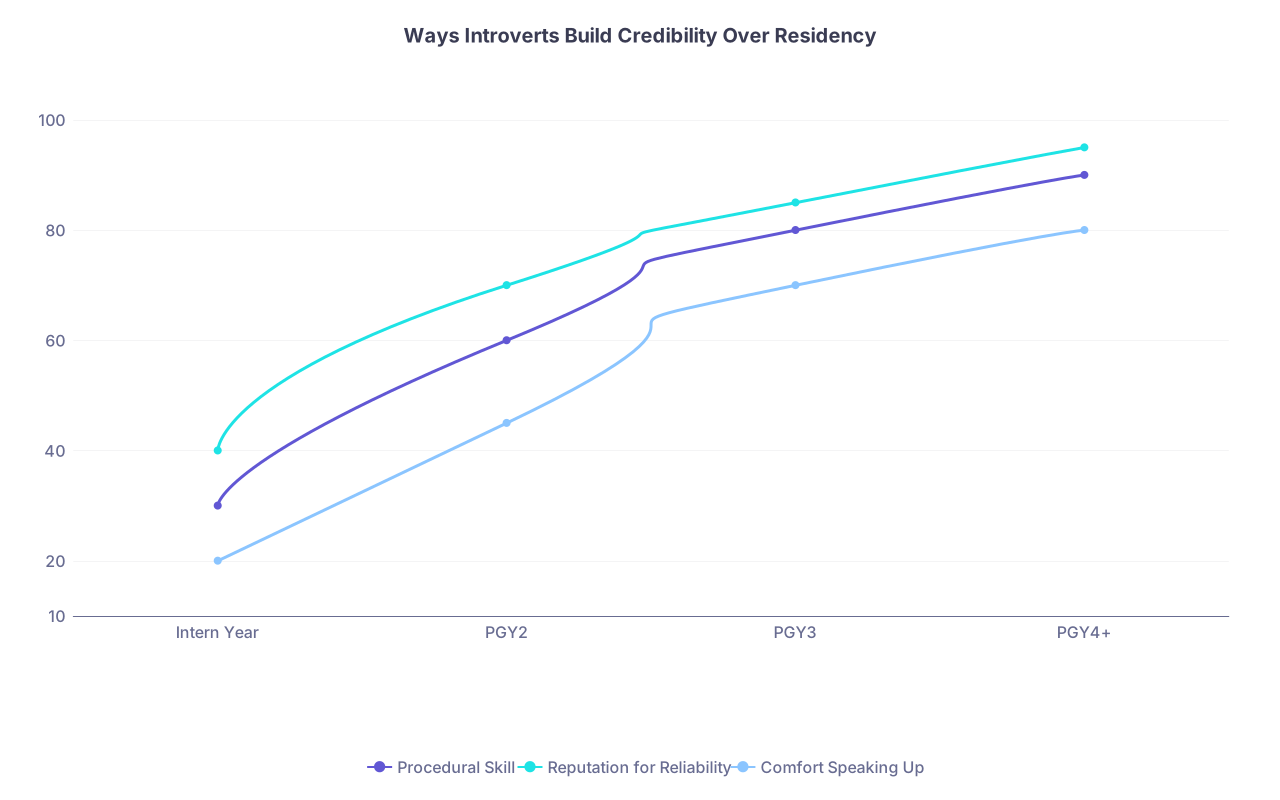
| Category | Procedural Skill | Reputation for Reliability | Comfort Speaking Up |
|---|---|---|---|
| Intern Year | 30 | 40 | 20 |
| PGY2 | 60 | 70 | 45 |
| PGY3 | 80 | 85 | 70 |
| PGY4+ | 90 | 95 | 80 |
What to actually do next (so this isn’t just nice theory)
If you’re sitting there thinking, “Okay, but I have to be on rotation tomorrow,” here’s how you keep your anxiety from eating you alive.
On your next loud rotation:
- Pick one deliberate interaction per day. Not ten. One.
- Use pre-committed phrases so you don’t freeze.
- Look for one quiet-friendly attending or resident. Attach yourself professionally. Ask for advice.
- After the rotation, email 1–2 people thanking them and saying you’d like to stay in touch.
- Keep a tiny log of what you actually did: questions you asked, tasks you took on, patients you followed. It’s proof for your brain that you weren’t invisible, even when you felt like you were.
You don’t have to become the person who owns every room. You just have to make it impossible for reasonable people to write, “I barely noticed them.”
You can do that without betraying who you are.
FAQ (6 questions)
1. What if my evaluations literally say “too quiet”? Am I already screwed?
No, but that’s a signal you have to treat seriously. One “too quiet” comment is data. Multiple ones mean attendings are not seeing your engagement, regardless of your internal effort. You don’t fix this by “changing your personality”; you fix it by making your participation undeniable in small ways — presenting one topic, asking one question, taking ownership of one task daily. And then you tell a trusted resident or attending: “I’ve gotten feedback that I’m too quiet; I’m working on speaking up more. If you notice times I could do that better, I’d appreciate it.” That alone can flip how they write you up.
2. I freeze when put on the spot. How do I handle pimping or rapid-fire questions?
First, you’re not alone. Half the room is panicking; the extroverts just hide it better. When asked something you don’t know, use a structured format: “I’m not sure of the exact answer, but I think [brief reasoning], and I’d guess [best attempt]. If it’s okay, I can read about this and report back next time.” Then actually follow up. That follow-up — especially if you bring a 60-second summary — often matters more than the original answer. They remember that you came back.
3. Is it bad if I avoid social events with residents, like bars or dinners?
Not automatically. But if you skip everything, you’re removing one of the easiest places to be seen as a human being, not just “the quiet med student.” Pick your battles. Maybe you don’t stay the whole night, but you show up for 45 minutes, talk to one or two people, and leave. Or you choose lower-stimulation things — pre-interview lunches, coffee chats, debriefs at the hospital. You don’t get extra points for pretending to love loud bars, but you do get points for being at least a little present.
4. What if my dream specialty is notoriously bro-y and loud (ortho, some surgery programs, etc.)?
Then you need to be ruthless about fit. There are ortho and surgery programs where quiet, detail-oriented residents absolutely thrive — often at academic or more “cerebral” places. Others are pure locker-room energy; you’ll always feel wrong there. Use away rotations and interview days as reconnaissance. If you leave a place thinking, “I’d have to fake my way through every day here,” believe that feeling. Your career is too long to spend in permanent performance mode.
5. How do I network at conferences without wanting to crawl under a table?
Go in with micro-goals, not “meet everyone.” Example: “I will talk to 2 people per day: 1 resident and 1 attending.” Prepare one or two genuine questions (“How did you choose your program?” “What surprised you most about this specialty?”). Attend smaller sessions or workshops rather than huge poster halls. And when you meet someone good, ask if you can email them a specific question later — then actually do it. One real connection beats 20 awkward business card exchanges.
6. What if I try all this and still feel invisible?
Then it’s time for a blunt check-in with someone who’s seen you work — a resident you trust, a student affairs dean, or a faculty mentor. Ask: “From your perspective, how am I showing up? What’s actually coming across to attendings?” Sometimes your self-perception is harsher than reality. Sometimes they’ll tell you, kindly, that you’re still too far in the background and help you strategize concrete changes. And if you keep running into environments where being thoughtful, prepared, and steady is never valued? That’s not a you problem. That’s a sign to look for spaces in the same specialty — or in related ones — where your wiring is actually seen as an asset.
If you remember nothing else:
- You don’t have to be loud; you do have to be visible.
- You’re allowed to choose environments that value quiet competence instead of punishing it.
- Small, deliberate actions beat trying to rewrite your whole personality.
You’re not “too quiet for medicine.” You’re just playing on hard mode in a loud game. And hard mode is beatable.


