
What If My Only Mentor Leaves or Retires? Protecting Your Network
It’s 7:48 p.m. You just opened an email from the one attending who actually knows you, likes you, and has been quietly holding your career together.
Subject line: “Transition Announcement.”
You skim. “Stepping away.” “New opportunity.” “Retiring.” “Leaving at the end of the year.”
Your stomach drops.
Your brain instantly jumps to the worst-case reel:
Who’s going to write my letter?
What happens to my research project?
Did my entire career plan just evaporate in a three-paragraph email?
You’re not overreacting. In medicine, mentors are leverage. Protection. Social capital. Having one good mentor can feel like the only thing standing between you and getting completely lost in the system. And when that person leaves, it feels like you’re back to zero.
You’re not at zero. But you are in a vulnerable spot—and pretending you’re not is how people get burned.
Let’s be blunt and then rebuild from there.
The Harsh Truth: Relying on One Mentor Is a Career Risk
I’m not going to sugarcoat this. Having a single mentor is like having one power outlet in your entire apartment. When it works, you’re fine. When it blows, you’re sitting in the dark.
In medicine, this is what “single outlet” looks like:
- One attending knows your story, sees your work, and believes in you.
- One person is handling: letters, research, “I’ll make a call for you,” and “I’ll vouch for you on the rank list.”
- Everyone else vaguely recognizes your face from rounds and maybe misremembers your name.
When that one person leaves or retires:
- Your LOR pipeline is suddenly unstable.
- Your “I’ll support you for this specialty” plan is now a giant question mark.
- Your research may die in a half-analyzed spreadsheet on someone’s desktop.
- And you have to introduce yourself all over again to people who haven’t been paying attention.
This isn’t dramatic. I’ve watched people lose an expected “glowing” letter because their attending left in December and then “didn’t have institutional access” to submit the letter. I’ve seen projects vanish when the PI moved institutions and just… never took the student with them in the transition.
So yes, if your only mentor leaves, it can screw you. If you let it.
The whole point of this is making sure that doesn’t happen.
First: Stabilize What You Can Right Now
If you even suspect your mentor might leave—talk of retirement, “this system is getting worse every year,” applying for a chair position elsewhere—don’t wait for the official email.
You need to quietly shift into “preserve and extract value” mode.

| Step | Description |
|---|---|
| Step 1 | Hear mentor may leave |
| Step 2 | Confirm timeline |
| Step 3 | Secure letters |
| Step 4 | Clarify ongoing projects |
| Step 5 | Ask for future advocacy |
| Step 6 | Identify backup mentors |
Here’s what that actually looks like in real life.
1. Get clarity (without sounding clingy or desperate)
You’re not asking, “What about me??” You’re asking about logistics.
Something like:
“I saw your announcement—congratulations, though I’ll really miss working with you. I’m applying to [specialty/position] in [cycle/year], and you’ve been such an important mentor for me. Could we set up a time to talk about how to best plan things like letters and ongoing projects with your transition?”
Polite. Respectful. Direct. You’re flagging that career stuff needs to be handled.
2. Lock in letters early
If you’re anywhere within 18 months of applying, you should be thinking: I need that letter written before they’re gone.
Ask them explicitly:
- Would you be willing to write a strong letter of recommendation for my [residency/fellowship/job] applications?
- Is it possible to draft that letter earlier in the year in case there are system changes with your move/retirement?
If they’re supportive, they’ll usually say yes. Many will say something like “Oh absolutely, I’ll keep it on my computer and upload when it opens.”
You’d be shocked how many letters are actually written months before the system technically opens. The attending just logs in later and presses upload.
And if they’re leaving institutions entirely, ask:
“Will you still be able to submit letters as external faculty after you transition?”
Most systems allow outside letters. Programs see that all the time.
3. Get their “finalized” version of your story
You want them to be able to advocate for you long-term, even when they’re at a different institution.
In a meeting, hit these points:
- Your target specialty or backup options
- Rough timeline of your applications
- The 3–4 things you most want them to emphasize when they talk about you (work ethic, leadership, specific research contribution, whatever is actually true)
You’re not scripting them. You’re making sure they remember you as “the student who did X, Y, Z” rather than “uh… good student, I think?”
That matters more than you want to believe.
4. Clarify what happens to your research
This one gets messy if you don’t handle it.
Ask bluntly:
- “What’s the plan for our project after you transition?”
- “Can I stay on it even if you move institutions?”
- “Would it be possible for me to lead the manuscript and loop in a new local co-mentor if needed?”
You are trying to avoid your work dying in the “we’ll get to it after the move” black hole.
If they’re supportive, they’ll often say:
- “Yes, let’s keep emailing and finish the paper.”
- Or, “Let me introduce you to Dr. X here who can be your on-site support while I’m away.”
That intro is gold. You want that.
How To Build Protection: A Redundant Network (Not Just One Hero Mentor)
The real fix here is uncomfortable: you can’t keep your entire career balance on one person’s shoulders.
You need redundancy. Backup systems. Multiple adults in the room who know you exist.
Think of your network like this:
| Role Type | Main Function |
|---|---|
| Career Mentor | Big-picture guidance |
| Research Mentor | Projects, pubs, CV building |
| Sponsor | Makes calls, opens doors |
| Near-Peer | Realistic, recent advice |
| Skills Coach | Helps you with performance |
If one person has been doing all of that for you, you’re structurally exposed.
So how do you fix it without looking fake or opportunistic?
Start with “proximity mentors”
You already interact with people who could become secondary mentors:
- Attendings who seem to like teaching and have said, “You asked good questions today.”
- Fellows who stay after to explain something.
- Senior residents who say, “Email me if you want to talk about [specialty].”
Most people don’t follow up. You should.
Send a short, non-cringey email:
“Hi Dr. X, I really appreciated how you walked us through the differential for [case] last week. I’m starting to think seriously about [specialty/interest] and would love to ask you a few questions about training and career paths sometime if you’re open to it.”
You’re not asking them to adopt you as their lost child. You’re asking for 20–30 minutes. That’s how relationships start.
Use your current mentor to multiply mentors
While your primary mentor is still in place, say:
“You’ve been an incredible mentor to me. As I’m getting closer to [applications/fellowship/etc.], I’m realizing I should probably connect with a couple of other people in the field as well. Is there anyone you think I should reach out to for additional perspectives?”
Mentors respect that. Good ones like that you’re building a safer structure.
Then ask:
“Would you be comfortable sending a brief introductory email so they know who I am before I reach out?”
Those warm intros are career currency. That’s how people go from “random student” to “Dr. X’s mentee that I should probably be nice to.”
What If They’ve Already Left? (The After-The-Fact Panic Scenario)
Let’s say you opened the email too late. Or you weren’t proactive. Or you thought they’d be around forever and now… they’re not.
You still have options. It’s not over.
1. Reach out anyway
Even if they’ve moved institutions, retired, or gone part-time, send a short update:
“Hi Dr. X, I hope your transition to [new place/retirement] has gone smoothly. I wanted to thank you again for all your mentorship during my time on [rotation/lab]. I’m now planning to apply to [specialty/cycle year], and you were such an important part of that decision. If you’re still open to it, I’d be incredibly grateful to stay in touch and possibly ask for your support with a letter.”
Worst case? They say they’re too busy or not able to. Best case? They say yes and you’re back on semi-solid ground.
2. Salvage partial mentors from your past
Go back through your brain (and your email) and look for:
- Attendings who praised you on evals
- Research supervisors you communicated well with
- Residents/fellows who said “you did great” and meant it
- Course directors who know your name for good reasons
You’re going to re-open those doors with an honest angle, not pretending you were best friends:
“Hi Dr. Y, I was a student on your [rotation] in [month/year]. You gave me really helpful feedback about [specific thing]. I’m now applying to [specialty/field], and your teaching on that rotation really stuck with me. Would you be open to a short meeting to talk about career paths, and possibly to see if a letter or ongoing mentorship might make sense?”
You’re acknowledging: “We’re not there yet, but I’d like to see if we can get there.”
Some won’t bite. Some will. You don’t need all of them. You need a few.
3. Use near-peers as bridges
If you’re totally mentor-poor at the attending level, find:
- Chief residents
- Fellows in your target specialty
- Alumni 1–3 years ahead of you
They often know which attendings are actually decent mentors and who isn’t. They can say, “Don’t bother with Dr. A, but Dr. B is great if you show initiative.”
They can also do soft intros:
“Hey Dr. B, this is [Your Name], they rotated with us and are really interested in [specialty]. Thought it’d be great if you two connected.”
Much less awkward than blind cold emails.
The Quiet Reality: Programs Know People Move
Here’s something your anxiety brain won’t tell you: committees know mentors leave. People retire. Chairs get poached by other hospitals. Whole divisions turn over.
What they look for on your application isn’t “Did this person have a mentor who stayed put for 10 uninterrupted years?” They’re asking:
- Does this applicant have anyone willing to stick their neck out for them?
- Do these letters sound like real, specific advocacy or generic fluff?
- Does their trajectory make sense, or does it look chaotic and unexplained?
A strong letter from a mentor who’s now at a different institution is still a strong letter. A publication with an attending who retired still counts. An email that says, “I’ve known this student for three years and I’d absolutely take them into my own program,” is still powerful even if they’re not there anymore.
Your job is to make sure your mentor isn’t the only person who can say that sort of thing.
Track Your Network Like It Actually Matters (Because It Does)
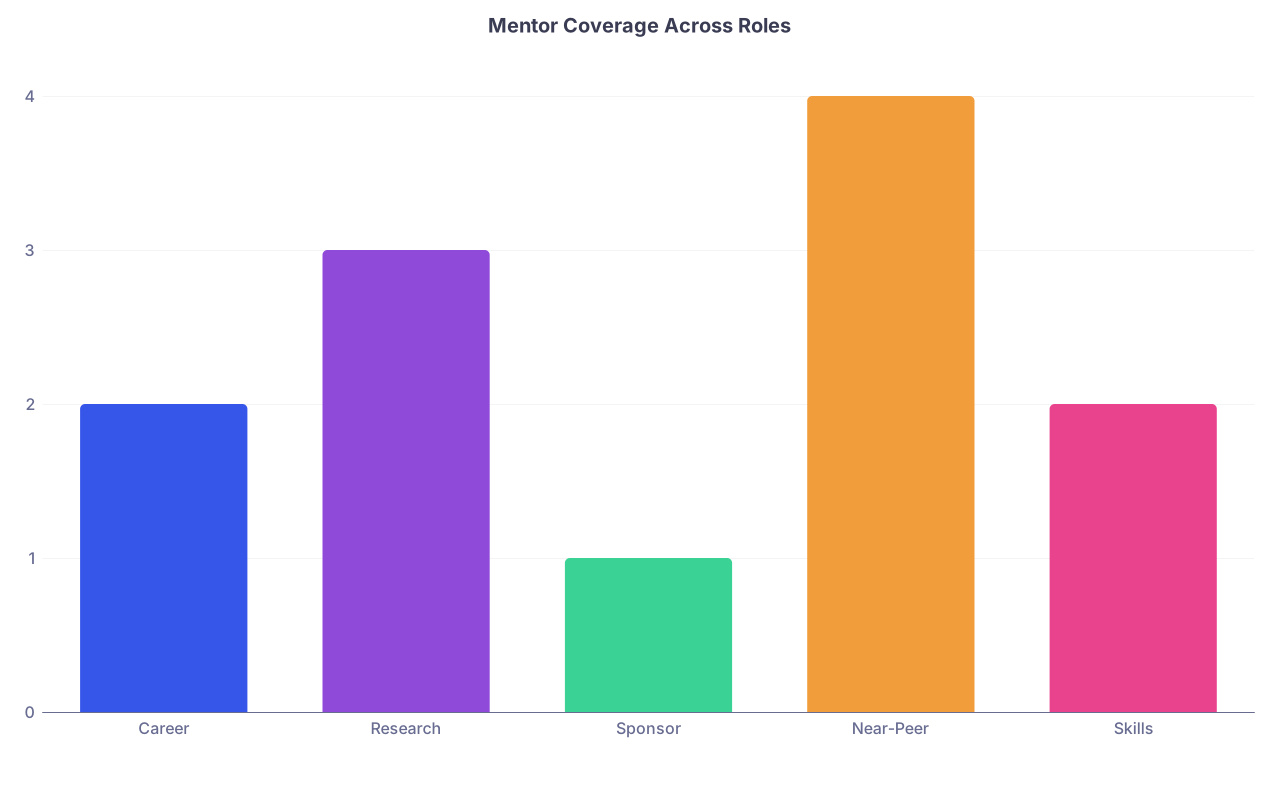
This sounds neurotic, but it works: treat your network like a living thing you monitor.
| Category | Value |
|---|---|
| Career | 2 |
| Research | 3 |
| Sponsor | 1 |
| Near-Peer | 4 |
| Skills | 2 |
You don’t need a fancy app. A simple spreadsheet or doc works. List:
- Name
- Role (career mentor, research, sponsor, near-peer, etc.)
- How well they know you (vague / moderate / well / very well)
- Last contact date
- Potential letter writer? (yes/no/maybe)
Why bother? Because it makes the risk obvious.
If you see:
- Career mentor: 1 (your soon-to-retire attending)
- Sponsor: 0
- Research mentor: 1 (same person)
That’s a red flashing warning sign. You start intentionally filling those gaps now instead of realizing it when their farewell cake is already in the break room.
How To Approach New Mentors Without Feeling Like A Leech
This is the part everyone hates: “I don’t want to seem transactional.”
Yeah. No one does. But pretending everything is purely “organic” is how you end up the invisible hard worker with no letters.
Here’s the line you walk:
- You do have an agenda: career survival and growth.
- You also show up as a real person who’s curious, prepared, and respectful of their time.
Concrete tips so you don’t feel gross:
- Don’t open with “Can you be my mentor?” It’s like proposing on the first date.
- Ask for small, specific things: 20-minute call, advice on a decision, feedback on a draft.
- Show you’ve done work: read their papers, know their role, have 2–3 targeted questions.
- Follow up once or twice a year with updates, not just when you need something.
That’s how actual adult professional relationships form. Slow. Repeated contact. Mutual benefit over time.
Example Email Templates You Can Actually Use
Here are a few “fill-in-and-send” style options so you’re not staring at a blank screen.
When your mentor announces they’re leaving
Subject: Thank you and next steps
Dear Dr. [Name],
I saw your announcement about your transition to [new place/retirement], and I wanted to say congratulations, though I’ll really miss having you here. You’ve been such an important mentor for me over the past [time period], especially with [specific project/rotation].
I’m planning to apply to [specialty/position] in [cycle year], and I’d really value your guidance on how best to plan for letters and ongoing projects in light of your move. Would you be open to a brief meeting in the next few weeks to talk through a plan?
Thank you again for everything you’ve done for me.
Best,
[Your Name]
When asking for introductions
Subject: Potential introductions in [specialty]
Dear Dr. [Name],
As I get closer to applying in [specialty], I’ve been realizing how important it is to get perspectives from multiple people in the field. You’ve been my primary mentor, and I’m incredibly grateful for that.
If there are colleagues you think I should connect with—either here or at other institutions—would you be comfortable introducing me by email? I’d really appreciate any suggestions.
Best,
[Your Name]
Future You Will Not Be Mentorship-Helpless
One last thing that anxiety never allows: perspective.
| Category | Value |
|---|---|
| MS1 | 0 |
| MS2 | 1 |
| MS3 | 2 |
| MS4 | 3 |
| PGY1 | 4 |
| PGY3 | 5 |
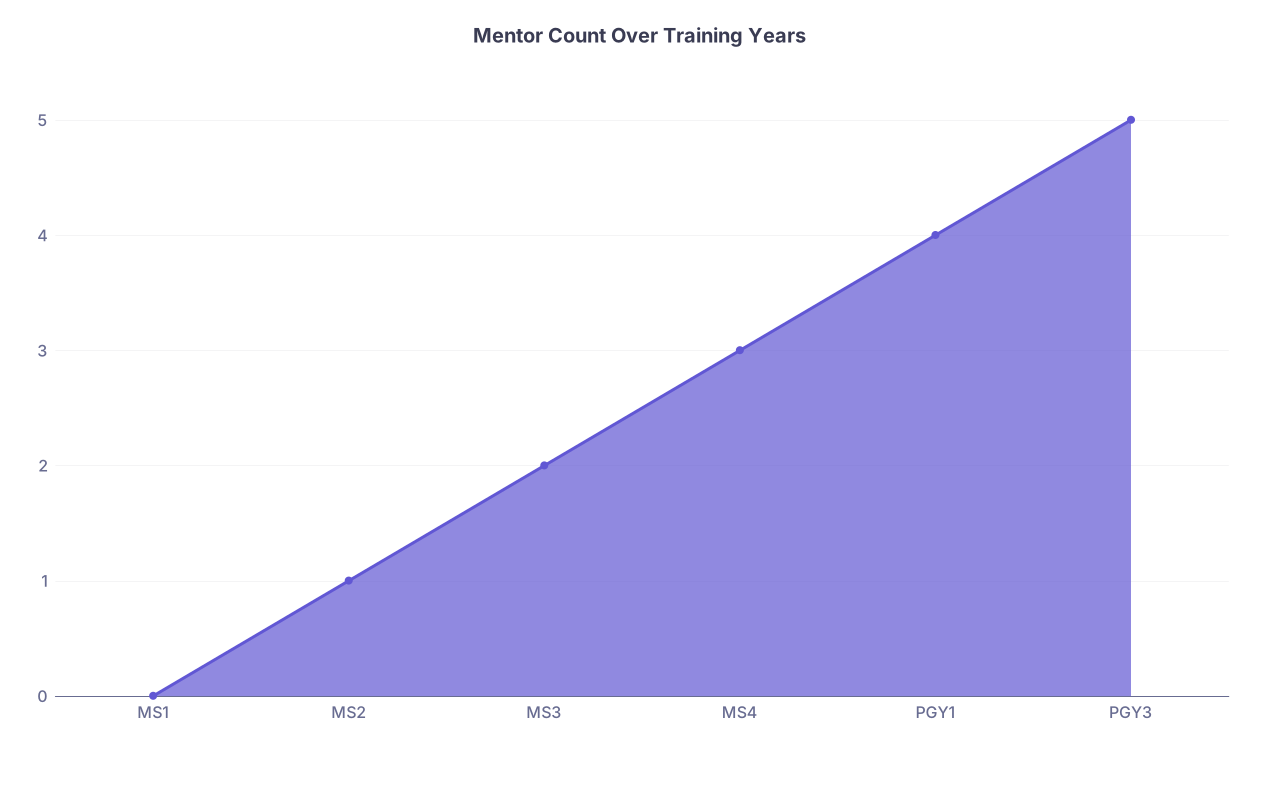
Most people start with zero mentors. Then they get one. Then that one leaves or retires or just gets too busy, and it feels like the universe is personally targeting them.
Years later, the same people have:
- An attending who got them their fellowship
- A PI from residency who still writes letters
- A co-resident who’s now faculty and puts their name on things
- A program director who quietly calls in favors for them
Mentorship networks grow slowly and unevenly. There will be gaps. People will disappear. Some will disappoint you. Some will be incredible and permanent.
You don’t need certainty. You need enough coverage that when one person leaves, you’re rattled—but not ruined.
You can build that. Starting now. Even from a place of panic.
Years from now, you won’t remember this exact email or this exact wave of dread. You’ll remember whether you froze… or started quietly building something sturdier.
FAQ (Exactly 6 Questions)
1. Is it bad to ask a mentor for a letter early before I’m officially applying?
No, it’s smart—especially if you think they might leave. You can say, “I know it’s early, but with upcoming transitions, I wanted to see if it’d be possible to draft a letter ahead of time.” Many attendings prefer this. They’re less rushed, and your performance is still fresh in their mind.
2. Will programs care if my strongest letter writer is now at a different institution?
Not in any negative way. People move all the time. A detailed, specific letter from someone at another institution is far better than a bland one from someone still local. Committees care about content and credibility, not whether the logo on the letter matches your current hospital.
3. What if my only mentor retires and says they’re “slowing down” and doesn’t want to write letters?
Then you treat them as a legacy advocate and history holder, not an active sponsor. You can still say in personal statements or interviews, “I worked closely with Dr. X over [time period] on [project].” But you immediately prioritize finding new mentors who are still active in the system and willing to support you now.
4. Do I need multiple big-name mentors to match a competitive specialty?
Big names help, but they’re not magic. What matters more: at least one person who knows you very well and can write a powerful, detailed letter, plus a couple of others who can honestly vouch for your work and professionalism. Three lukewarm famous names are weaker than one strong advocate and two solid supporters.
5. Is it fake to intentionally “build a network” instead of waiting for organic mentorship?
No. Waiting for everything to be “organic” is how capable people stay invisible. You’re not manipulating anyone—you’re being intentional about seeking guidance, showing up, and maintaining relationships. That’s adulthood, not scheming.
6. What if I’ve been quiet and invisible so far—did I already miss my chance?
You’re behind, not doomed. I’ve seen MS4s and even PGY2s “wake up” and start building real mentorship networks that changed their trajectory. You’ll have to be more deliberate and a bit braver with reaching out, but you’re not disqualified. The worst thing you can do is assume it’s too late and keep hiding.


