
Does Being a ‘Founder Resident’ Boost Your Fellowship Chances?
What actually happens when you’re the “founder resident” in a brand‑new program and then try to match GI, cards, or heme/onc against people from Mass General and Mayo?
Let me ruin the marketing pitch up front: the title “founder resident” by itself does almost nothing for your fellowship chances. Sometimes it even makes things harder.
But the situation is not that simple. There are real upsides. Real landmines. And some very specific ways a new program can either supercharge your trajectory or quietly kneecap it.
Let’s separate the brochure fantasy from the actual match dynamics.
The Core Myth: “Founder Resident = Automatic Edge”
The sales pitch you hear on interview day at a new program is usually some version of:
“As a founder resident, you’ll get leadership, personalized mentorship, tons of research opportunity, and program visibility that will distinguish you for competitive fellowships.”
That line is polished. Rehearsed. And only half true.
Here’s what the fellowship world actually sees when they open your application from a brand‑new residency:
- Unknown training environment
- Unproven board pass rates
- Vague institutional culture
- Letters from attendings who’ve never had graduates in that subspecialty
- No historical outcomes to benchmark against
That is the default. You start in a hole. You might climb out of it. Some residents do and match extremely well. But the name “founder resident” is not a golden ticket; it’s a flag that raises questions you’ll have to answer with hard evidence—scores, letters, research, concrete outcomes.
What fellowship program directors actually care about
They don’t care about your cute label. They care about:
- Board scores (yes, even now with all the pass/fail noise)
- Strength and credibility of letters
- Quality and reputation of your clinical training environment
- Research and scholarly output (especially in that field)
- How previous graduates from your program have done (which you don’t have if you’re early cohorts)
- How much they trust the people saying, “This resident is the best I’ve worked with”
New programs start with a blank track record. That’s not doom. But it means you are running without a tailwind.
What the Actual Data and Patterns Show
There isn’t a giant randomized trial of “founder resident vs. legacy program” in fellowship matching. But there is plenty of indirect data and a lot of observable patterns.
1. Name recognition still matters — a lot
If you look at where competitive GI/cards/onc fellowships pull residents from, a disproportionate number come from:
- Long‑established university programs
- Large academic community programs with a track record of subspecialty success
- Institutions with heavy research infrastructure
New programs almost never show up in those lists early on. Not because the residents are worse, but because PDs are conservative. They trust known pipelines.
When a fellowship PD at, say, Cleveland Clinic sees applicants, they know exactly what “UMass IM graduate” means. They have no shared mental model for “new community program founded in 2023 with 6 residents per year.”
So you’re not disqualified. You’re just not pre‑sold.
2. Early new‑program grads often match regionally, not “upward”
Informally, many early graduates of new programs do one of three things:
- Stay at their own institution for fellowship (if/when fellowships are created)
- Match to local/regional fellowships that know their hospital and faculty personally
- Match in less competitive subspecialties or in less “brand‑name” academic centers
When they do jump into top‑tier fellowships, it’s not because they were “founders.” It’s because they had:
- A killer Step 2 / ITE record
- Strong research in the field with known mentors
- A PD or subspecialist willing to go to war for them on the phone
In other words: same ingredients as successful applicants from established programs. Just harder to assemble.
3. “Founder” years are usually messy — that cuts both ways
I’ve seen this repeatedly at new IM and EM programs:
- No existing didactics structure → residents build it
- No evaluation system → residents help design it
- Faculty figuring out how to teach while also convincing hospital admin the program is “working”
That chaos gives you stories for your personal statement and interviews that sound impressive:
- “I led development of our M&M structure from scratch.”
- “I co‑built a QI registry that became the basis for our sepsis protocol.”
Fellowship PDs like self‑starters. But they also want reassurance you weren’t undertrained while doing admin work for free.
So your application can either read as: “Builder and high‑level clinician”…
Or: “Overextended, under‑mentored, and used as program labor.”
How that lands depends on evidence you attach to both sides—clinical performance AND leadership.
Concrete Advantages of Being a Founder Resident
Now the part programs are not lying about: there are real upsides, and if you exploit them correctly, you can more than offset the “new program” handicap.
1. Access and visibility you never get at big legacy programs
In a mature program with 120 residents, you’re one of many. In a new one with 6 per class, attendings and leadership know you intimately.
That often means:
- Direct access to PD and Chair for mentorship
- Easier entry into leadership roles: chief resident, curriculum committee, QI task forces
- More flexibility to shape rotations in your subspecialty interest
Those things do matter for fellowships. But only if documented:
- Leadership roles clearly listed and described
- Concrete outcomes: new clinics, pathways, educational products
- Strong letters from institutional leaders who actually know your day‑to‑day work
2. Research: wide open if you’re aggressive
New programs often sit in institutions that have:
- Untapped datasets
- Underused IRBs
- Attendings who want to publish but never had residents
The bottleneck becomes you, not the environment.
You can leverage this to build a research portfolio that might be harder to achieve at a crowded, well‑established program where all the “good” projects are already taken by senior residents and fellows.
But you have to push. Nobody is standing there in July with a prepackaged GI outcomes project waiting for you.
3. Faster promotion into “trusted” roles
New programs are desperate to prove “our residents are strong and safe.” That leads to:
- Early involvement in teaching med students
- Being the “pilot” resident for new rotations or services
- Rapid growth into a supervisory presence on the wards
Fellowship PDs notice when multiple letters independently describe you as functionally operating above your PGY level. That’s a subtle but real boost.
The Real Risks That Can Damage Your Fellowship Chances
Now the part nobody mentions on interview day.
1. Weak letters from unknown names
A dazzling letter from “John Smith, MD – Associate Program Director, New Regional Medical Center IM Residency” is competing against:
- Letters from national figures in the field
- Chairs or division chiefs at recognizable academic centers
- Subspecialists who routinely send residents into that exact fellowship
The issue isn’t just prestige. It’s calibration. Fellowship PDs know how to interpret “Top 5% resident I’ve seen in 20 years at X Big Name Program.” They have no idea what “best resident in our young program” really means.
To mitigate this, you need at least one or two:
- Letters from people with established academic footprints
- Coauthored papers, posters, or projects with those people
- Evidence the writer is known in the subspecialty (national committees, guidelines, talks)
2. Under‑developed subspecialty exposure
Early in a new program, subspecialty services might be:
- Covered mainly by hospitalists
- Light on fellows / no robust teaching structure
- Focused on service, not scholarship
You say you want cards. But your cards exposure may be mostly “ED obs unit + some consults,” not true advanced HF, EP, or cath involvement.
Fellowships can sniff that out. If your clinical letters and experiences don’t convincingly show depth in the field, you lose ground to someone who had three solid cards rotations and a research year at a big center.
3. Lower‑than‑advertised board prep and didactics
New programs almost always overestimate their educational quality in year one. They have not stress‑tested:
- Didactics structure
- In‑training exam prep
- Support for Step 3 / board certification
If your program fumbles this and your exam performance looks mediocre, the “founder” bonus disappears. You just look underprepared.
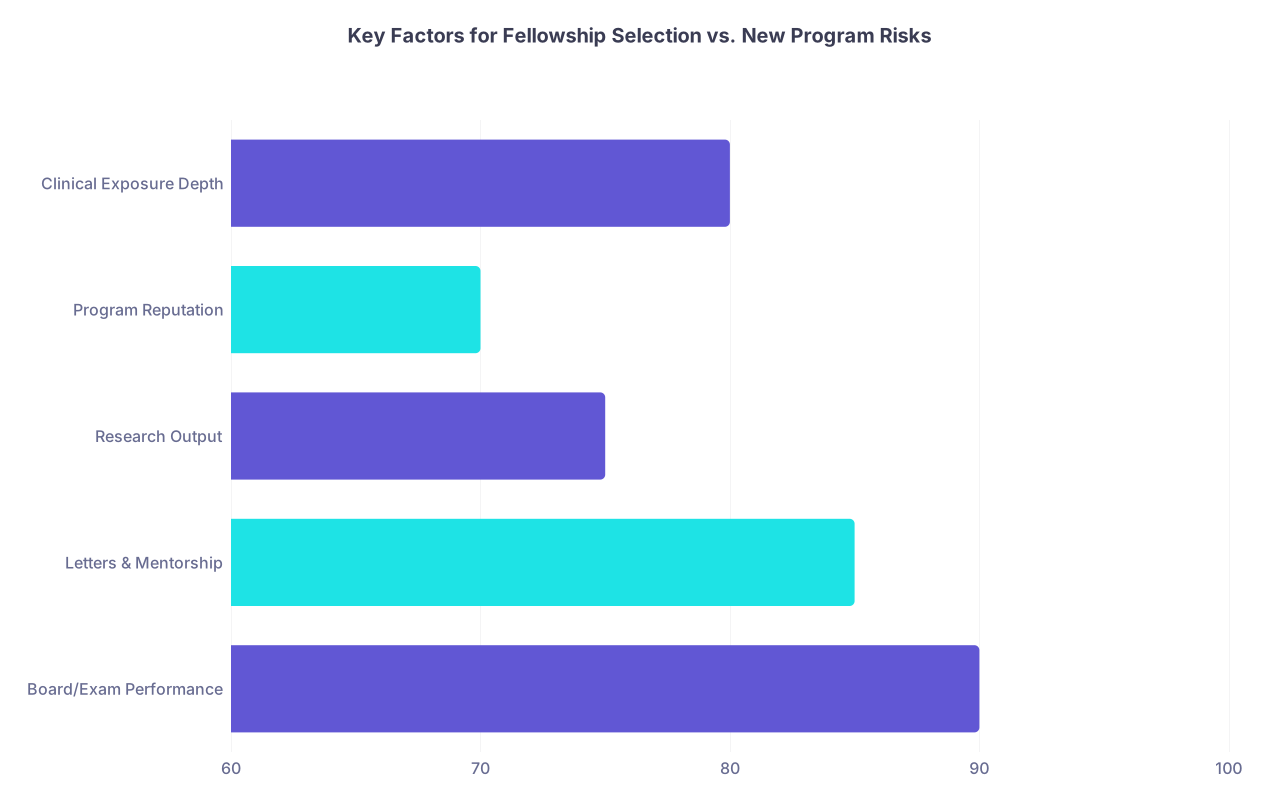
| Category | Value |
|---|---|
| Board/Exam Performance | 90 |
| Letters & Mentorship | 85 |
| Research Output | 75 |
| Program Reputation | 70 |
| Clinical Exposure Depth | 80 |
The chart isn’t actual percentages from a paper—it’s a realistic weighting based on surveys of program directors and what they actually emphasize. And almost all of those categories are harder, not easier, at a brand‑new program.
How to Make a New Program Actually Work For Your Fellowship Goals
So, if you’re already in a founder cohort or seriously considering it, what do you do?
1. Stop believing the label matters
Erase “founder resident” from your brain as an evaluative category. Keep it as a talking point, nothing more.
Your fellowship value comes from:
- Performance in high‑acuity clinical settings
- Objective markers (scores, evaluations, awards)
- Documented leadership, QI, and teaching impact
- Scholarly work tied to recognizable mentors
Whenever you catch yourself saying, “But as a founder resident, I…”, translate it into something concrete: “I designed X,” “I led Y,” “Our outcomes improved by Z.”
2. Build external credibility early
You cannot rely on internal reputation alone at a brand‑new program. You need outside validators.
That means:
- Reach out to subspecialty faculty at nearby established programs for research or electives
- Present at regional and national conferences—get your name on posters, abstracts, talks
- Join national organizations’ resident sections (ACC, ACG, ASH, etc.)

| Step | Description |
|---|---|
| Step 1 | New residency program |
| Step 2 | Strong clinical performance |
| Step 3 | External research mentor |
| Step 4 | High board and ITE scores |
| Step 5 | Abstracts and presentations |
| Step 6 | Strong letters from trusted faculty |
| Step 7 | Competitive fellowship match |
You’re trying to move the center of gravity of your application away from “unknown small program” and toward “individually strong candidate with recognizable collaborators.”
3. Be ruthless about program red flags before you sign
Some new programs are legitimately excellent from day one because they are:
- Spin‑offs of established academic centers
- Led by PDs who were APDs at known programs
- Surrounded by strong subspecialty divisions
Others are built because a hospital CEO wants cheap labor and prestige.
Here are questions you should ask—and not politely gloss over:
| Area | Red Flag Example | Reassuring Example |
|---|---|---|
| Leadership | PD never led a program before | PD/APDs from established academic centers |
| Subspecialties | Limited or locums-heavy coverage | Stable, academic subspecialty divisions |
| Research | No IRB or resident-track publications | Active trials, QI, and faculty publications |
| Mentorship | “We’ll figure that out once you arrive” | Named mentors with clear track records |
| Outcomes Planning | Hand‑wavy about boards/fellowship plans | Specific pipelines and metrics discussed |
If they cannot answer very basic questions about:
- How they’ll support fellowship applicants
- How their residents will get subspecialty exposure
- Who will write your letters
Walk away. Founder status will not save you from a structurally weak program.
4. Time your fellowship aspirations realistically
Another uncomfortable truth: being in the very first class (PGY‑1 of year 1) is riskier than being in class 3–4, when at least some kinks are worked out.
If you are dead‑set on hyper‑competitive subspecialties at brand‑name fellowships, pairing that with “literally the first ever class in a brand‑new non‑university program” is stacking risk.
Sometimes the right play is:
- Do a solid but not ultra‑competitive residency (new or old)
- Crush it
- Then pursue a research year, hospitalist role at a big academic center, or internal non‑ACGME fellowship to build subspecialty juice
- Apply to fellowship with a stronger portfolio and mentors from both institutions
That’s the long game. More work, but much more controllable.
Where Founder Status Does Genuinely Help
Let me give it credit where it deserves it.
The “founder resident” label is useful when:
- You’re applying to fellowships at your own institution where leadership has seen you build from scratch
- You’re aiming for academic careers focused on education, QI, or systems building
- You’re competing for chief resident positions or early faculty jobs—admin types love builders
It also makes your story memorable:
- “I was one of six residents who opened the X Medical Center IM program. I built our sepsis QI registry, designed half our M&M format, and led a project that cut time‑to‑antibiotics by 40 minutes.”
That lands better than “I did my job and attended conferences.”
But note the pattern: it’s the work, not the “founder” label, doing the heavy lifting.
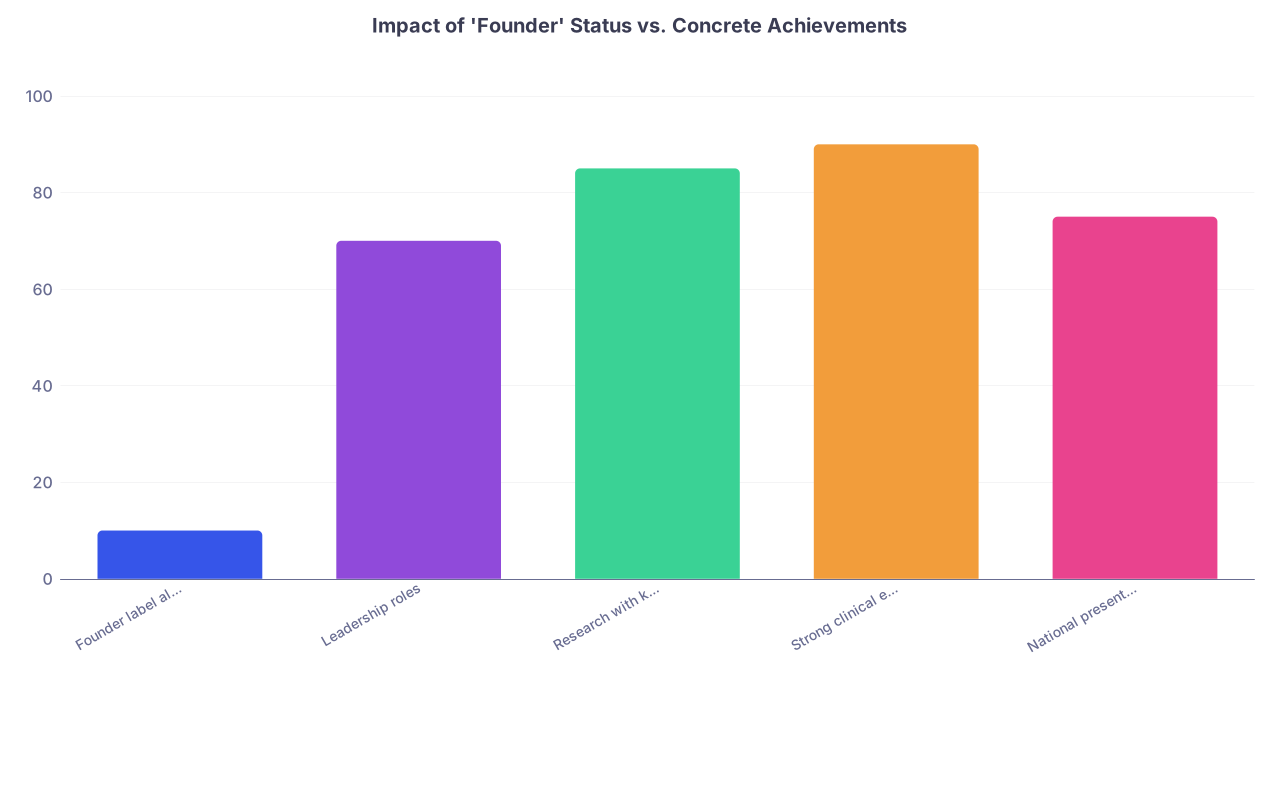
| Category | Value |
|---|---|
| Founder label alone | 10 |
| Leadership roles | 70 |
| Research with known mentors | 85 |
| Strong clinical evaluations | 90 |
| National presentations | 75 |
The label gets you maybe a novelty bump. The rest is what moves actual fellowship decisions.
The Bottom Line
Being a “founder resident” does not inherently boost your fellowship chances. It gives you leverage points:
- Access
- Flexibility
- Visibility
- Autonomy
If you convert those into objectively strong performance, real scholarship, and powerful letters from credible people, you can absolutely match excellent fellowships—from a new program.
If you coast on the title, you’ll find out quickly that fellowship PDs do not care who helped design the noon conference scheduler.
Years from now, you won’t remember the branding on your badge. You’ll remember whether you had the training, mentorship, and courage to build something real out of a blank slate.
FAQ (Exactly 4 Questions)
1. Do fellowship programs look down on new residency programs?
They’re skeptical, not hostile. New programs are unknown variables. If your application clearly shows strong exam performance, robust clinical exposure, and letters from respected faculty, the “newness” becomes a minor factor. If those things are mediocre, the newness becomes a convenient reason to pass.
2. Is it safer to avoid being in the first class of a new program if I want a competitive fellowship?
Yes, in general. First classes deal with the most chaos and untested systems. If you want cards, GI, or heme/onc at high‑tier places, being in class 2–4 at a new program (or choosing an established one) gives you a more stable platform. First‑class success is possible, but it demands a lot of self‑direction and luck with leadership quality.
3. Can I compensate for a new program by doing away electives at big academic centers?
Electives help, but only if they produce something lasting: strong letters from known subspecialists, research projects, or at least advocates who will email or call fellowship PDs on your behalf. A month of “shadowing” at a big name with no output is resume decoration, not real leverage.
4. What’s the single biggest mistake founder residents make regarding fellowship prep?
They assume their role in “building the program” is enough. They collect titles—committee member, curriculum lead, chief—and neglect hard metrics: exam scores, substantive research, and strong relationships with subspecialty mentors. Titles without output read as fluff to fellowship directors who are sorting 400 applications for 4 spots.