
New residency programs are not automatically weaker on case volume or procedures. That’s a lazy assumption, not a data-driven conclusion.
I’ve watched students cross strong new programs off their rank lists because “I need volume,” while they chase brand-name residencies that look busy on paper but throttle junior residents out of the procedures they supposedly came for. The mythology around new programs is loud. The numbers, when you actually dig, tell a different story.
Let’s dismantle the biggest myths about case volume and procedural exposure in new residencies.
Myth #1: “New programs have low volume, so you won’t see enough pathology”
This is the flagship myth. It sounds plausible, so people repeat it.
Reality: most new residencies are started in hospitals that already have high clinical volume and want residents to help manage it. A brand-new residency in a 1,000-bed safety net hospital with 90%+ occupancy doesn’t magically have fewer sick patients because the ACGME paperwork is fresh.
The volume question is not “old vs new.” It’s:
- Size and type of hospital (community vs tertiary vs safety net)
- Regional catchment area and referral patterns
- Service structure (how patients are distributed between services and providers)
- How much of that volume is truly resident-run vs mid-level / hospitalist–dominated
Program age barely cracks the top 5.
You want data? Look at case logs and hospital stats:
- Annual ED visits
- Annual admissions
- ICU beds, ORs, procedural labs
- Trauma designation, transplant services, cath lab volume, stroke center level
A 2-year-old internal medicine residency at a 700-bed county hospital with no fellows may be far richer in “real” responsibility and procedures than a 40-year-old university program where every tube, line, and scope goes to fellows first.
To visualize it:
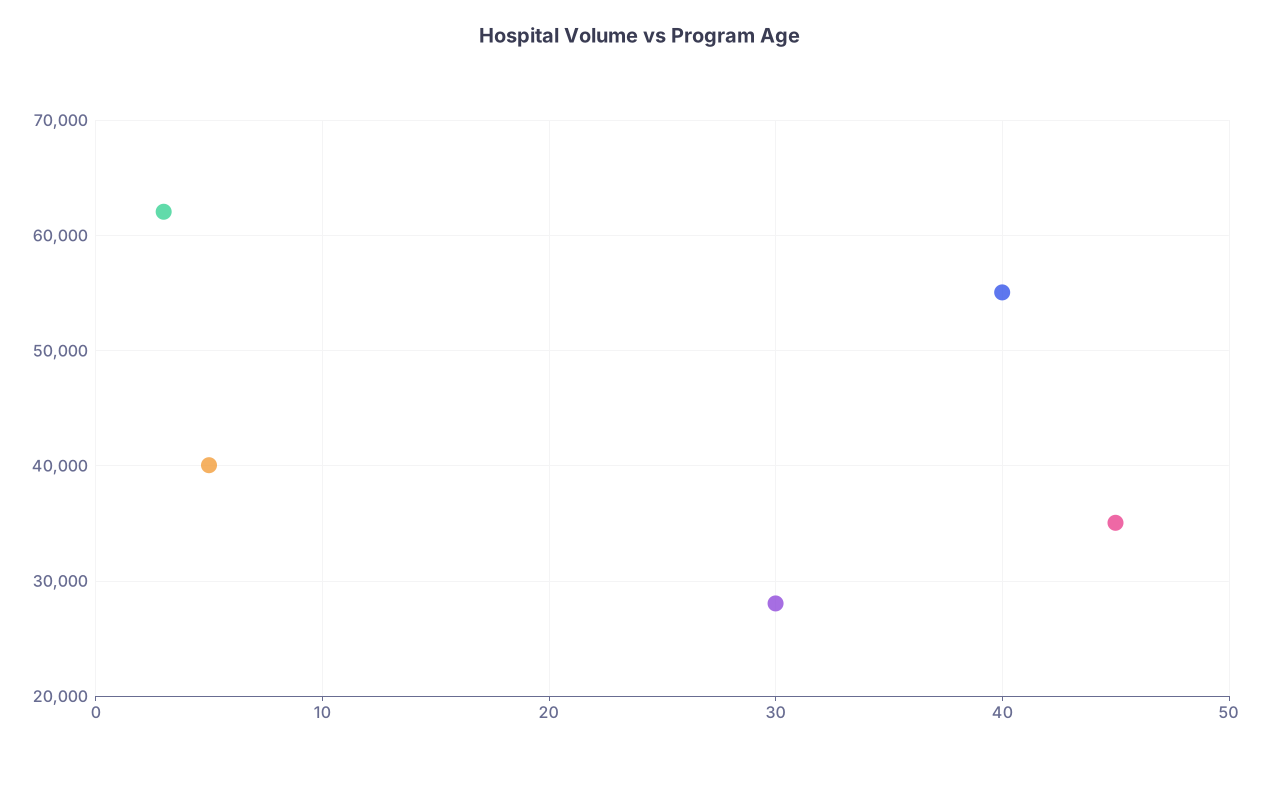
| Category | Value |
|---|---|
| Old Univ A | 40,55000 |
| Old Comm B | 30,28000 |
| New Safety Net C | 3,62000 |
| New Hybrid D | 5,40000 |
| Old Elite E | 45,35000 |
X-axis (not shown in text) is program age in years, Y-axis is annual admissions. There’s no simple “older = more volume” slope. It’s a smear.
If you care about pathology:
- A new EM program in a high-volume county ED will drown you in undifferentiated sick people.
- A new IM program in a community hospital that’s the only game in a large rural radius will see everything.
- A new surgery program starting in a regional level I trauma center didn’t become “low volume” when the first intern showed up.
Stop equating “new” with “quiet.” It’s usually the opposite: volume has outgrown current staffing, and residents are being added because the place is already slammed.
Myth #2: “Older programs always give better procedural exposure”
No. Older programs have more inertia. That cuts both ways.
Plenty of legacy programs have:
- Established fellowships that Hoover up procedures
- Long-standing unwritten rules: “Interns don’t intubate,” “Residents don’t put lines in the OR,” “That’s IR’s case now”
- Consultants who are used to calling anesthesia, IR, GI, or cardiology for everything slightly invasive
A new program often has the one thing you desperately need: open procedural turf.
Picture two internal medicine programs at similar hospitals:
- Program A: 40-year-old university IM program. 12 residents per class. Cardiology, GI, pulmonary/critical care, and nephrology fellowships. Central lines? Fellows. Temporary transvenous pacers? Fellows. Bronchs? Fellows.
- Program B: 3-year-old IM program. 8 residents per class. No cardiology or pulmonary fellows (yet). Lines, thoras, paras, pacers, bronch? If the attending trusts you and you’re competent, you do it.
Who actually graduates with more hands-on procedural reps? Often Program B.
Here’s how that trade-off looks in practice:
| Item | Old University Program | New Community Program |
|---|---|---|
| Central lines (non-ICU) | Mostly fellows | Mostly residents |
| Bronchoscopies | Fellows only | Shared, heavy resident |
| Temporary pacers | Cards fellows | ICU attendings + residents |
| Paracentesis/thoracentesis | Procedure service | Floor/ICU residents |
The ACGME only requires minimums. It doesn’t cap your experience. I’ve seen residents graduate from smaller or newer programs with:
- 100+ central lines
- Dozens of intubations
- Enough chest tubes that they stopped counting after 30
Meanwhile, their peers at “big name” places are begging anesthesia to let them get one more intubation before graduation.
Historical prestige doesn’t equal procedural access. Sometimes it blocks it.
Myth #3: “You’ll be a guinea pig; case logs will be unsafe or inadequate”
The “guinea pig” line gets thrown around by people who’ve never actually read ACGME requirements or looked at site visit reports.
New programs are under more scrutiny than old ones:
- They start with initial accreditation and get frequent reviews
- They have to submit detailed data on case logs, supervision, and outcomes
- Any hint of residents not meeting minimums is a red flag for continued accreditation
Older programs can sometimes coast on reputation until a major problem triggers intervention. New programs have to prove they’re safe and sufficient from day one.
This doesn’t mean every new program is amazing. Some are poorly planned. But the assumption that new = unsafe or inadequate is backwards.
Real risk factors for inadequate procedural exposure:
- Hospital is too small for the intake (microscopic ED, tiny OR volume)
- Competing learners: fellows, PAs/NPs, hospitalists doing procedures to protect their own billing or convenience
- Culture of risk-avoidance: “Better let IR handle everything”
- No one is tracking or caring about resident case logs
None of those are specific to new programs. I’ve seen established residencies where graduating chiefs had to scramble to hit minimums in basic procedures because the hospital kept bleeding procedural turf to other services.
If you want to know whether a new program is “using you as a guinea pig,” ask simple, concrete questions:
- Show me anonymized case logs from your first or second class.
- How do you track procedural exposure? Who reviews it, and how often?
- What happens if a resident is behind on a required procedure category?
If the PD can answer that clearly, they’re not experimenting on you. They’re building deliberately.
Myth #4: “New programs = great volume but no structure, so your experience will be chaotic”
This one’s half-right if you pick the wrong place. Some new programs really are chaos disguised as “autonomy.” But again, age isn’t the real variable.
What people label “new program problems” are usually just bad program design:
- No clear procedural responsibilities by level of training
- Attendings disagree about who gets which cases; residents get stuck in the middle
- No simulation program or formal procedural curriculum
- No protected time to learn and debrief
But here’s the twist: some of the best structured procedural training I’ve seen is in newer programs that started after ACGME got serious about competency-based education.
They build in, from the ground up:
- Mandatory procedure bootcamps (airway, lines, chest tubes, arthrocentesis, lumbar puncture)
- Ultrasound-guided everything as the default
- Clear expectation: you’re not just logging numbers; you’re being assessed on technique and safety
- Simulation of rare but critical events (cricothyrotomy, surgical airway, massive transfusion) early and repeatedly
Compare that to older programs still running on the “see one, do one, teach one” myth, where your “training” is a bleary-eyed upper year showing you a chest tube at 3 am once and then signing your log.
Here’s what a solid newer program often looks like on paper:

| Step | Description |
|---|---|
| Step 1 | Orientation Bootcamp |
| Step 2 | Supervised Bedside Procedures |
| Step 3 | Simulation Refreshers |
| Step 4 | Graduated Autonomy |
| Step 5 | Advanced Procedures Electives |
| Step 6 | Case Log Review and Feedback |
The chaos risk is real. But it’s not automatic. Ask programs how they think about structure vs autonomy. Newer ones often have more deliberate answers because they’ve just gone through the accreditation gauntlet.
Myth #5: “Volume is everything; just chase the busiest program”
No. Volume without meaningful participation is background noise.
Unpopular opinion: “We see 100k ED visits a year” is not inherently impressive if:
- Interns are glorified triage scribes
- Every major procedure is done by an airway team or procedure service
- Notes and orders are the only things you fully own
You don’t learn to operate by watching a thousand cases from the corner. You don’t become a competent intensivist because you rounded in a huge ICU where the fellow did every line while you “presented the plan.”
For procedural exposure, what matters more than raw volume:
- Resident-to-patient ratio: too many residents chasing too few core procedures is just as bad as low volume
- Competing trainees: anesthesia, EM, surgery, cardiology, GI, IR—who actually owns what?
- Service design: are residents embedded in the procedural workflow, or are they “consult note machines”?
- Culture: do attendings deliberately frontload you into procedures, or do they reflexively call another service?
Let’s make this tangible:
| Feature | Program X (High Volume) | Program Y (Moderate Volume) |
|---|---|---|
| Annual ED visits | 120,000 | 60,000 |
| Anesthesia airway team | 24/7, owns all airways | Called only when needed |
| Central lines | Procedure team | ICU and floor residents |
| Resident intubations by PGY3 | 25–30 | 80–120 |
| Resident satisfaction | “Busy, but don’t do much” | “Hands-on, feel confident” |
Which one actually trains you better? It’s obvious.
New programs often sit in that second column: moderate-to-high volume with high resident ownership because there simply isn’t an army of fellows or procedure teams yet.
Myth #6: “New programs can’t match the complexity of cases at the ‘big names’”
“Complexity” is usually code for “prestige pathology” (transplants, LVADs, ECMO, rare zebras). It’s true: if you want a career in cardiac transplant or obscure autoimmune lung disease, it helps to train where those things live.
But confusing “rare prestige cases” with “adequate complexity to be competent” is a mistake.
Most residents need:
- Bread-and-butter pathology at high frequency (sepsis, DKA, CHF, COPD, trauma, appendicitis, SBO, ACS, strokes)
- A solid mix of sick-but-manageable and occasionally truly crashing patients
- Enough ternary-level complexity to stretch them, not drown them
A new program at a regional referral center will still see:
- Massive polytrauma
- Multi-organ failure
- Complicated surgical abdomens
- Severe STEMIs and cardiogenic shock
- Septic shock, ARDS, and all the usual ICU horror shows
The “we’re the only center in the state that does XYZ transplant” line sounds good on recruitment day, but you might see five LVAD disasters your entire residency. That’s not what will make or break your ability to practice independently.
For most specialties, resident case logs back this up: the majority of your training case mix is common pathology with moderate complexity. That’s what new programs in robust hospitals can deliver in spades.
To illustrate balance:
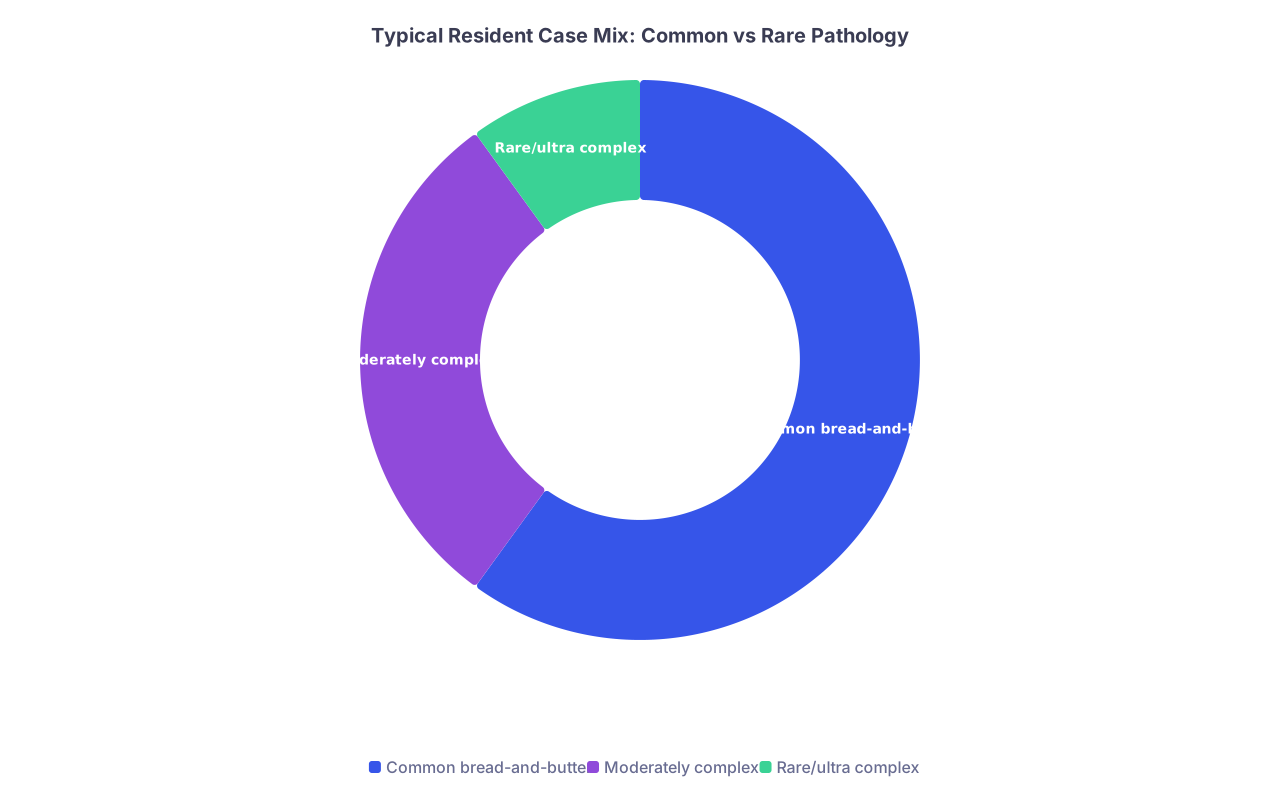
| Category | Value |
|---|---|
| Common bread-and-butter | 60 |
| Moderately complex | 30 |
| Rare/ultra complex | 10 |
If a new program can reliably fill the first two slices—and many do—you’re not missing out on core competence because you didn’t see the exact exotic zebras a marketing brochure bragged about.
How to Actually Assess Case Volume and Procedural Exposure (New or Old)
If you strip away the myths, here’s how you judge any program:
Hard numbers
- Ask for anonymized average case logs (especially for senior residents).
- Ask for hospital-level stats: admissions, ED visits, OR cases, ICU beds.
Ownership and turf
- Who intubates? Who does central lines? Who manages chest tubes?
- For surgery: what percentage of cases are logged as primary surgeon vs first assist?
- For EM: how many airways and critical procedures are residents expected to have by graduation?
Structure and culture
- Is there a procedural curriculum, simulation, or skills lab?
- How do they intervene if a resident is behind on procedures?
- Do the seniors say, unprompted, “We get a ton of procedures,” or do they wince and change the subject?
Competition for cases
- How many residents per class?
- How many fellows across overlapping specialties?
- Any non-resident procedure teams that take core training cases?
Do this, and you’ll quickly see that “new vs old” is a terrible proxy for what you actually care about.
Here’s a simple comparison frame:
| Factor | Why It Matters |
|---|---|
| Hospital volume & type | Sets maximum ceiling for cases |
| Resident/fellow mix | Determines case competition |
| Procedural culture | Decides who really does what |
| Curriculum & tracking | Ensures you meet and exceed mins |
| Resident ownership | Converts volume into skill |
The Future: New Programs Will Keep Taking Procedural Turf
One last point. The future of medicine is shifting toward environments where:
- Mid-levels are doing more routine work
- Hospitals want efficiency and protocolization
- Fellowship-trained subspecialists guard high-RVU procedures
In that world, new residencies that grow up without entrenched fellowships and rigid turf wars can actually be better positioned to give residents real hands-on work—if leadership protects that vision.
I’ve already seen it in new EM, IM, and surgery programs: they define, early, “These procedures are resident-owned unless there’s a clear reason otherwise.” As the program matures and fellowships are added, that early culture often persists. Residents keep their turf.
Compare that to mature institutions where residents are constantly trying to claw back experiences that were lost years ago.
The Bottom Line
Three points, then I’ll stop:
- Program age is a lousy predictor of case volume or procedural exposure. Hospital type, service design, and turf battles matter far more.
- New programs can offer excellent hands-on experience—sometimes better than big-name incumbents—because there’s less competition for procedures and more deliberate, modern curriculum design.
- If you care about becoming technically competent, stop asking, “Is it new?” and start asking, “Who actually does the procedures here, and how many will I get?”