
New Residency Programs Are ‘Easier’ to Match? What the Evidence Shows
So you heard there’s a brand‑new residency program in your specialty and your first thought was: “Perfect, less competition. Easier match.”
You sure about that?
Let’s tear apart this very persistent myth, because I’ve watched applicants bank their entire strategy on “new program = safety program” and then sit on the SOAP list wondering what went wrong.
Spoiler: the data do not support the idea that “new” automatically means “easy.”
What actually happens when a program is new?
There are two different “new” scenarios that get blurred together:
Completely new ACGME-accredited program
Brand-new institution (or hospital system) starting residency from scratch.Expansion or conversion
- A long-running community program that just got university sponsorship
- A former AOA (osteopathic) program converting in the single accreditation era
- A program adding a new track (rural, research, prelim, etc.)
These are not the same animal.
I’ve sat in rooms where PDs of brand‑new programs say things like, “We can’t afford to take a chance on someone we’re not confident can pass boards. Our first few classes are critical.”
That’s exactly the opposite of “we’ll take anybody, just to fill spots.”
The myth: “New programs are easier to get, because no one wants them”
Let me lay out the unspoken assumptions medical students make:
- “Top candidates will avoid new programs, so the competition must be weaker.”
- “They need to fill spots or risk closure, so they’ll be desperate.”
- “They don’t have a reputation yet, so they can’t be picky.”
Reality check:
- Many new programs are launched by big health systems trying to become academic players. They absolutely care about their first few board pass rates and match lists.
- There’s a subset of applicants who aggressively target these programs precisely because they think they’re easier. That crowd is bigger than you think.
- PDs talk. A lot. They know when a program is new, but they also know who’s involved, what the institution’s reputation is, and they factor that into their own ranking decisions and candidate evaluations.
So yes, some new programs are less competitive. But some are quietly very selective, especially in early years. And you can’t tell which is which just by seeing “Initial Accreditation” on FREIDA.
What the numbers actually suggest
ACGME and NRMP do not publish a neat “old vs new program fill rate by year of existence” chart. So no, you won’t find a clean table telling you “new programs = 25% easier to match.” That dataset doesn’t exist.
But we do have enough pieces to see trends:
- New programs often have more unfilled positions in their first 1–3 years, especially in less popular locations and less competitive specialties.
- The open slots that remain after the main Match are usually taken in SOAP by:
- IMGs (US and non-US)
- DOs in highly competitive specialties or geographic targets
- Reapplicants
The key nuance: a vacancy does not mean they’re taking everyone who applies. It means they didn’t like their main pool enough at the price (rank position) they were willing to pay.
Here’s why that matters.
If you’re a reasonably strong US MD / DO applicant with no major red flags and you’re willing to go to a new internal medicine or family medicine program in a mid-tier city, yes, a brand‑new or expanding program likely improves your odds relative to gunning only for longstanding brand-name programs.
But if you’re swinging at new general surgery, ortho, derm, or EM in an attractive city and you’re thinking “new means easy,” you’re living in fantasy land.
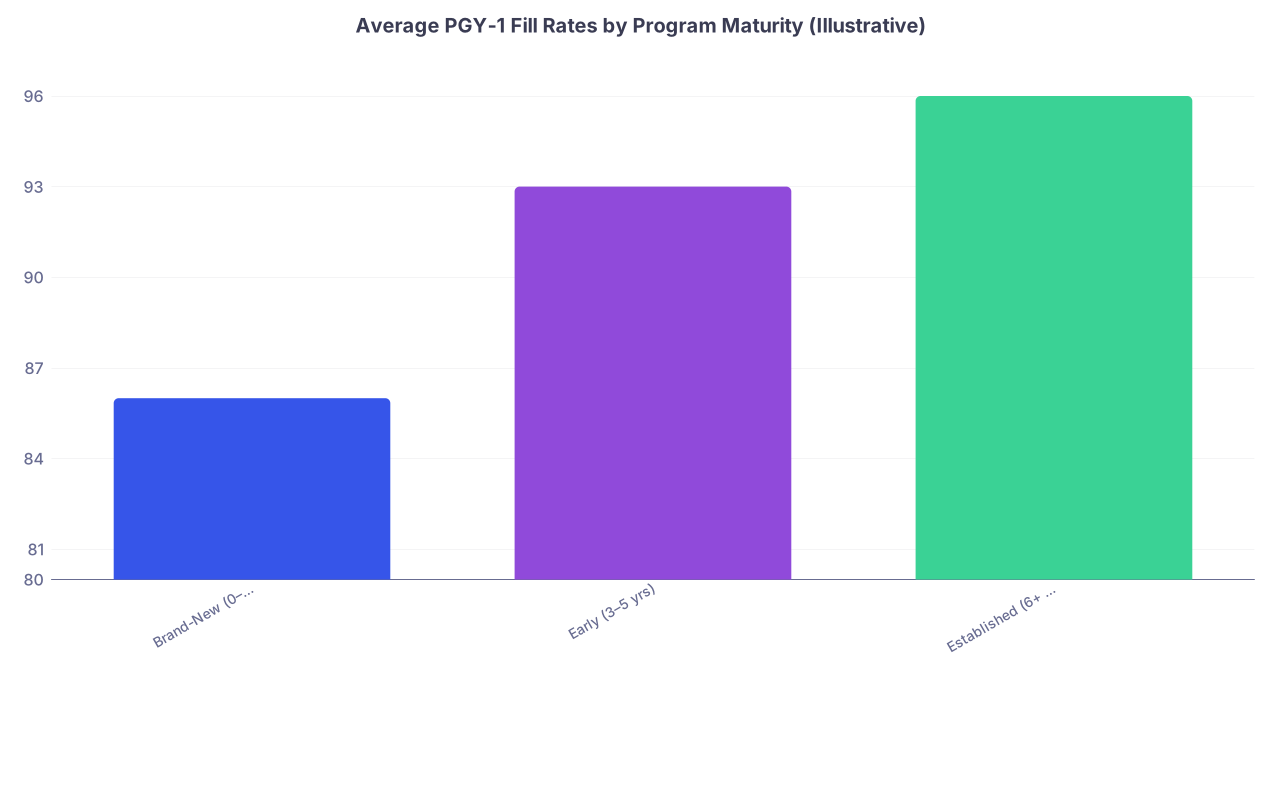
To make this concrete, look at how fill rates behave once programs are actually established:
| Category | Value |
|---|---|
| Brand-New (0–2 yrs) | 86 |
| Early (3–5 yrs) | 93 |
| Established (6+ yrs) | 96 |
These are approximate patterns seen across several NRMP cycles looking at program-level data: newer programs tend to have slightly lower fill rates. But “slightly lower fill rate” isn’t the same as “wide-open back door.”
Reputation is not the bottleneck you think it is
Students obsess over “reputation.” PDs obsess over “risk.”
If you’re building a program from the ground up, you worry about:
- Accreditation site visits
- First few years’ board pass rates
- Word-of-mouth among medical students and faculty
- Getting enough patient volume to justify the program
That leads to a specific behavior: early classes are often curated more carefully, not less.
I’ve sat with a brand-new IM PD reviewing a list and heard:
“We don’t have a track record yet. If three people fail boards from this class, that’s a disaster. I’m not taking Step 1 failures this year, period.”
This was a small, new, community-based IM program that many students assumed would be “easy.”
If you’re a mid-range applicant with marginal exams, a brand-new program might actually be less forgiving than a large, established IM program that has 80 residents and a long history of remediation systems.
Where new programs do shift the odds
Let’s stop generalizing and get specific.
Where does a new or expanding program legitimately create leverage for you?
Primary care-heavy specialties
Internal medicine, family medicine, pediatrics, psychiatry, neurology in undervalued locations. New programs there often:- Need warm bodies to cover service
- Have more positions per class
- Are less attractive to prestige-chasers
Less desirable geographic locations
Rural, rust-belt, or small-town community hospitals.
Nothing magical about being new, but being both “new” and “geographically unsexy” pushes fill pressure onto these programs. That increases odds for flexible, open-minded applicants.Hospital systems aggressively expanding GME
Large systems (think HCA-type expansions or regional chains) sometimes open multiple programs/tracks rapidly. When you see a hospital go from zero to five residency programs in a few years, the brute force of numbers does make it easier to land something there, especially in the core specialties.
But here’s the nuance again: easier to land something is not the same as “easier to land a competitive specialty at a great program.”
The ugly underbelly: why “new” can be worse for you
Here’s what students don’t want to hear.
New programs come with real risks that applicants routinely ignore because they’re so focused on simply matching:
Unproven education and clinical volume
You’re the guinea pig. Didactics may be thrown together. Rotations might not exist yet. You may be the first resident showing up on that service, dealing with attendings who’ve never had trainees.Accreditation instability
Provisional / Initial Accreditation is not a rubber stamp forever. Programs can be:- Put on warning
- Undergo special site visits
- In rare cases, lose accreditation
Could you still graduate? Usually, yes, if you’re already in. But your life will be chaos.
No alumni network
No one to vouch for you when you apply for fellowship. No track record of where grads go. You’ll be explaining your program on every interview: “So… tell us about this new place.”-
- Call schedules a mess
- EMR access issues
- Conflicts with nursing or consultants who aren’t used to having residents
- Constant shifting of rotation sites, clinic schedules, and policies
I’ve seen PGY-1s at new programs learning about major schedule changes through a group text the night before.
So yes, chasing “new = easier” might help you match. But you can absolutely end up in a program where the training quality is noticeably worse than at a slightly more competitive, older program you could’ve gotten with a smarter rank list.
How to tell if a new program is actually a good opportunity
Treat new programs like speculative investments. Some are early Apple. Some are early Theranos.
Here’s how to sort them:
| Factor | Good Sign | Red Flag |
|---|---|---|
| Sponsoring institution | Well-known system, strong volume | Tiny hospital, unknown system |
| Leadership | PD/APD from respected programs | PD with thin or vague CV |
| Faculty depth | Multiple core faculty, stable | 1–2 overworked faculty |
| Rotations | Clear, diverse, named services | Hand-wavy “TBD” or “mostly wards” |
| Fellowships present | Some subspecialties on site | None; all referrals elsewhere |
If you can’t get straight answers about these points from the website, FREIDA, or interviews, that’s not a neutral sign. It’s bad.
And yes, you should absolutely ask blunt questions on interview day:
- “What specific rotations are still being developed?”
- “What feedback did you get from your last ACGME site visit?”
- “What does your board pass strategy look like for the first few classes?”
A PD with nothing to hide will answer that without flinching.
Matching strategy: how to use new programs intelligently
Let’s talk tactics, because this is where people screw it up.
1. Use them as supplements, not the foundation
If you’re applying internal medicine with Step 2 = 226 and some red flags, adding 5–10 new IM programs in less popular locations is rational. Making 15 out of 20 of your IM applications to brand-new, unknown programs? That’s gambling.
2. New programs don’t excuse weak applications
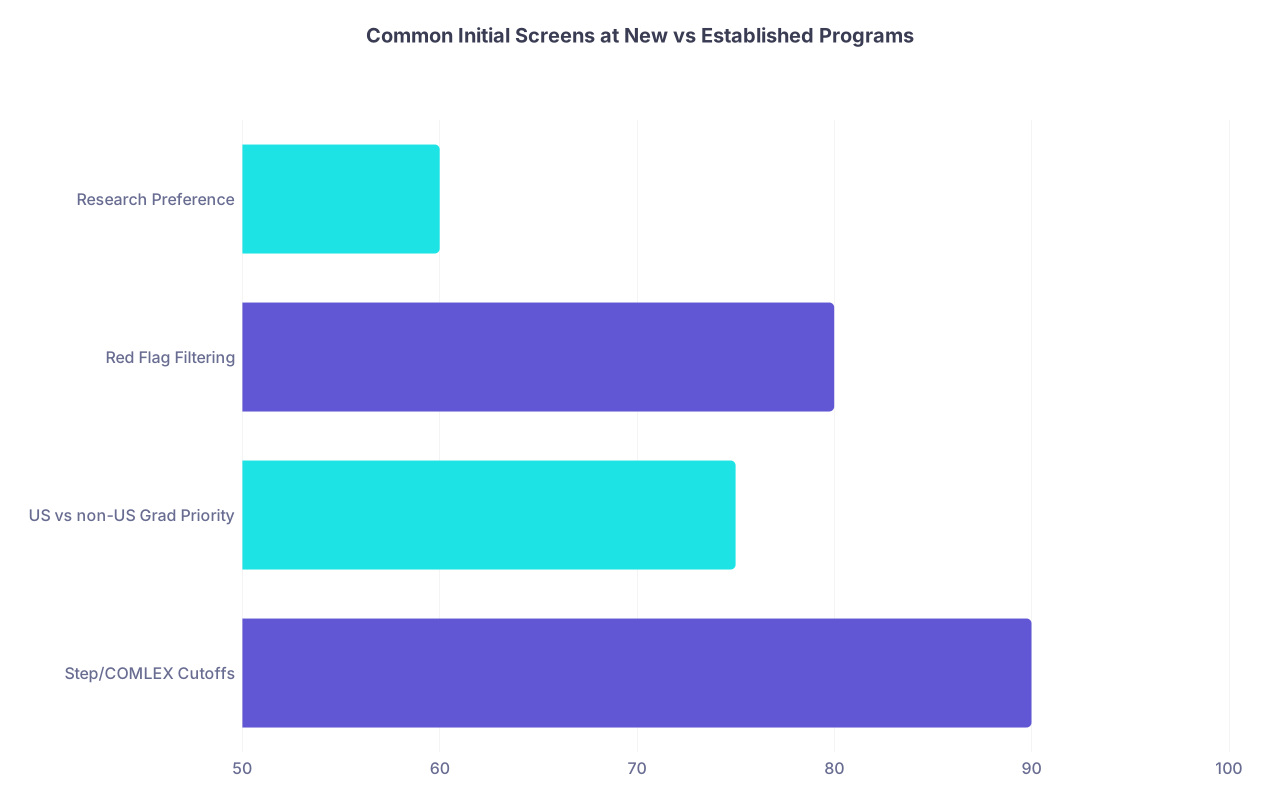
Programs might be newer, but the main filtering logic doesn’t suddenly vanish:
| Category | Value |
|---|---|
| Step/COMLEX Cutoffs | 90 |
| US vs non-US Grad Priority | 75 |
| Red Flag Filtering | 80 |
| Research Preference | 60 |
Roughly speaking, most new programs I’ve seen still:
- Use score cutoffs
- Deprioritize non-US IMGs (with some exceptions)
- Avoid unaddressed failures or professionalism issues
The main difference is they may interview somewhat deeper into the pool once the top tier ignores them. But “deeper” is still filtered.
3. Don’t over-rank them out of fear
I’ve seen this pattern over and over:
- Applicant interviews at one strong, mid-tier established program and three shaky new programs.
- Convinced they’re “not competitive,” they rank the new programs higher “just to be safe.”
End result: they match at a chaotic, under-resourced new program they didn’t actually like, while someone with a similar profile ranks the stronger established program #1 and matches there.
If you’d honestly be miserable or worried about training quality at a program, do not rank it above a place you’d be proud to graduate from. Rank lists are about preference, not “where I think I’m more likely to match.” That’s the whole point of the algorithm.
How this plays out for IMGs and DOs
Let’s be blunt.
- Non-US IMGs probably benefit the most from new programs, especially in IM/FM/Psych/Peds. Many new programs, particularly in community settings, are more IMG-friendly because they’re built in hospitals already staffed heavily with IMGs.
- US DOs get some leverage too, especially in transitional year, prelim surgery, EM (in some markets), and IM.
- US MDs often overestimate how much “newness” they need. Many put low-quality new programs on their lists “just in case” when they were fully competitive for better places.
For IMGs, though, the same risk calculus applies. A questionable new program with poor structure can hurt you when you apply to fellowship or jobs. Don’t throw standards out the window just because someone finally sent you an interview invitation.
The future: will new programs stay a “secret advantage”?
No.
Hospitals are opening programs faster than students are updating their mental models. But that lag is closing.
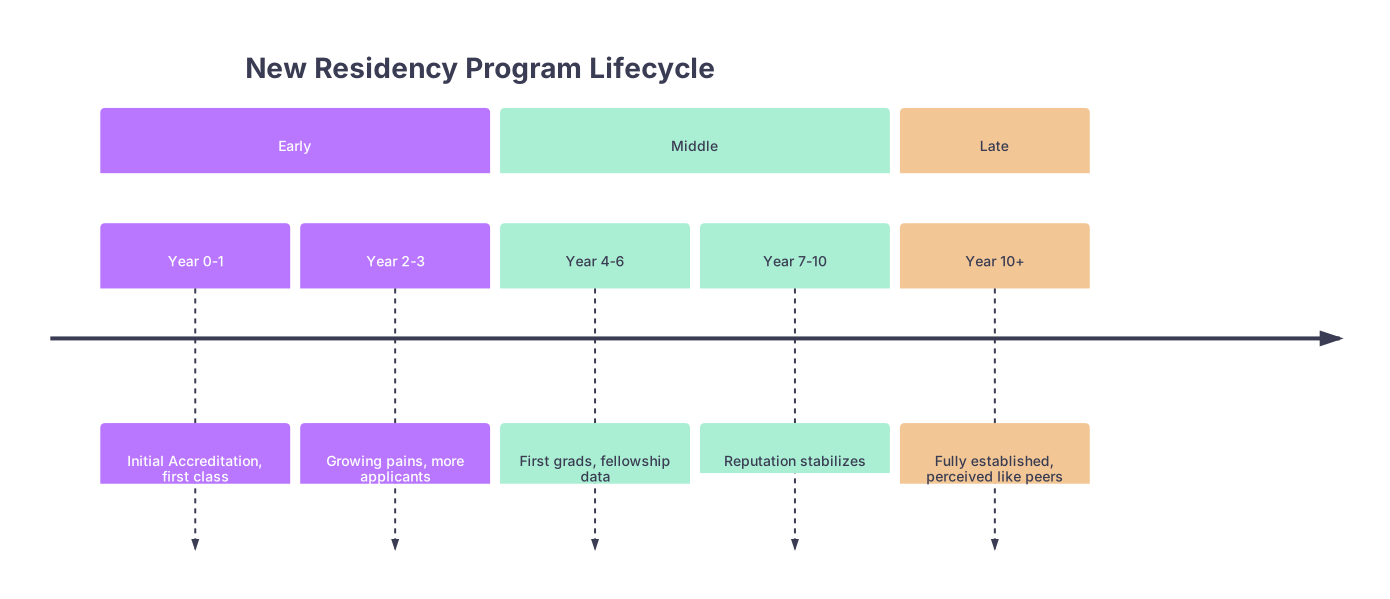
Here’s the direction things are trending:
| Period | Event |
|---|---|
| Early - Year 0-1 | Initial Accreditation, first class |
| Early - Year 2-3 | Growing pains, more applicants |
| Middle - Year 4-6 | First grads, fellowship data |
| Middle - Year 7-10 | Reputation stabilizes |
| Late - Year 10+ | Fully established, perceived like peers |
The “easy-ish” window, where a program is new enough to be slightly overlooked but stable enough to not be a mess, is relatively short—maybe years 3–6. After that, it’s either recognized as a decent program and becomes comparably competitive, or it stagnates and struggles chronically.
Either way, the fantasy of “new programs as permanent safety valves” is dying.
When a new program is strategically smart
You’re not wrong to use them. You’re wrong to romanticize them.
They’re smart additions when:
- You’re in a moderate-to-high risk category for not matching (low Step/COMLEX, reapplicant, limited interviews).
- You’re flexible on location and prestige but care about getting some accredited training spot.
- You’ve done your due diligence and the leadership + hospital look solid, even if the program is still rough around the edges.
What they’re not:
- A cheat code that lets you skip having a decent application.
- A guarantee that training quality will match their marketing language.
- A simple binary of “easier” vs “harder.”
Visual reality check: where “easy” really comes from
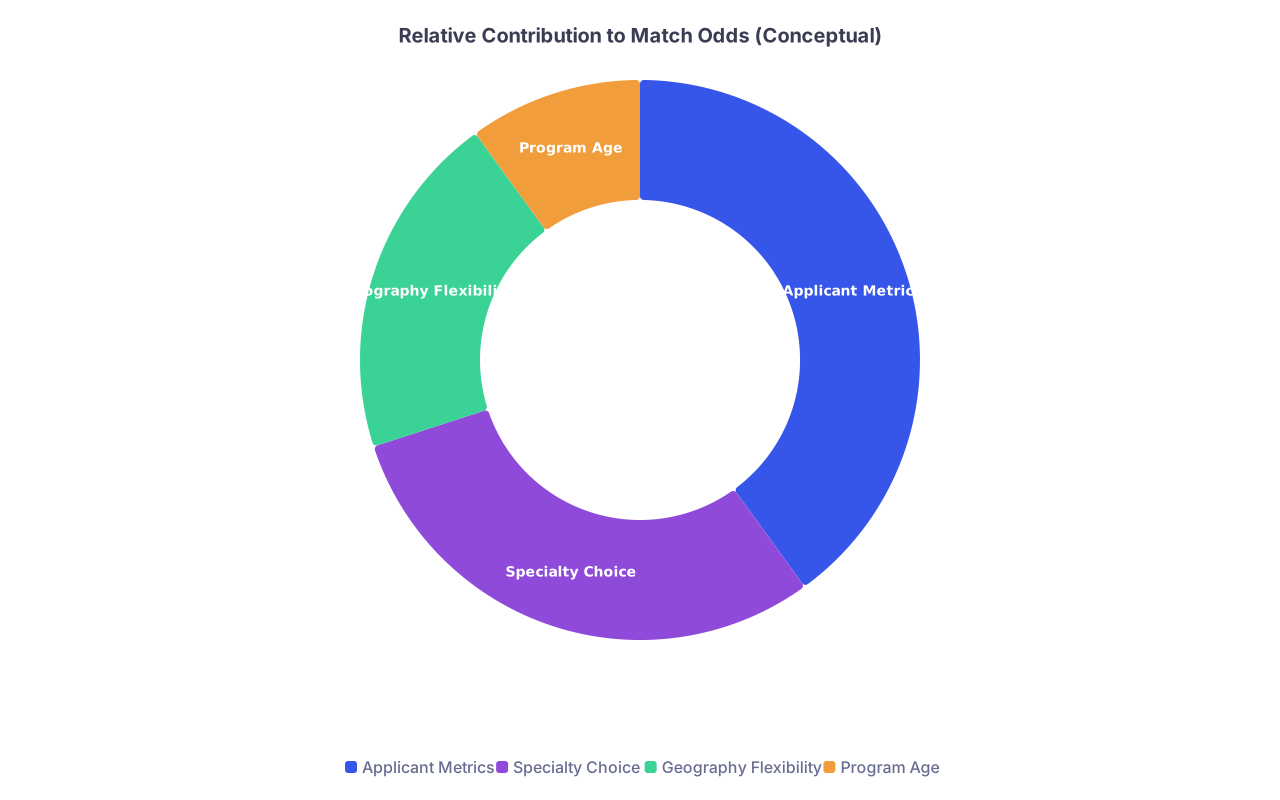
Most of your match odds still boil down to the boring stuff: specialty competitiveness, geography, and your own metrics.
| Category | Value |
|---|---|
| Applicant Metrics | 40 |
| Specialty Choice | 30 |
| Geography Flexibility | 20 |
| Program Age | 10 |
Program age is a slice of the pie. Not the pie.
Bottom line
Three things to walk away with:
New programs are not automatically easier. Some are modestly less competitive, some are just as picky, and a few are actually more selective early on to protect their reputation and accreditation.
The risk–reward tradeoff is real. You might gain match probability but sacrifice stability, mentorship, and training quality. Do your homework on leadership, hospital volume, and early resident experiences.
Use new programs strategically, not desperately. Add them as part of a broad, realistic list—especially if you’re a higher-risk applicant—but don’t rank or chase them blindly just because the word “new” feels like a shortcut.
The myth is simple: “new = easy.”
The reality is more annoying: “new = different risk profile, sometimes helpful, sometimes harmful, never a guarantee.”