
ACGME Initial Accreditation Does Not Mean “This Program Is Safe”
ACGME initial accreditation is not a safety seal. It is a starting gun. Treating it as anything more is how residents end up in chaotic, under-resourced, or frankly dangerous new programs that technically “meet standards” on paper while burning trainees out in practice.
Let me be direct: a site visit and a checkbox-driven process do not magically create competent faculty, stable leadership, functioning call schedules, or a healthy learning culture. Initial accreditation is necessary. It is nowhere near sufficient.
If you’re a student considering a brand‑new residency, or faculty being courted to join one, you need to understand exactly what ACGME initial accreditation does and—more importantly—what it absolutely does not protect you from.
What Initial Accreditation Actually Means (And What It Doesn’t)
The myth: “If the ACGME gave them initial accreditation, they must be fine.”
Reality: Initial accreditation means the program has demonstrated minimal infrastructure, plans, and policies on paper and has survived an early review. It is a risk-screening process, not a quality guarantee.
Here’s what initial accreditation usually does indicate:
- There is a sponsoring institution with basic GME infrastructure (DIO, GMEC, some GME policies).
- There is a program director, core faculty, and a written curriculum.
- There are some clinical sites that, in theory, can support the required experiences and case volumes.
- The program has addressed obvious catastrophic problems from the planning stage.
And here’s what it does not prove at all:
- That the clinical volume is adequate with residents present (service creep changes volume and patterns).
- That the faculty actually know how to teach, supervise, or give feedback.
- That schedules are humane, sustainable, and compliant once reality hits (sick calls, departures, census surges).
- That leadership is stable and not about to implode in the first 2–3 years.
- That the hospital culture will treat residents as learners rather than cheap labor.
Most importantly: there is literally no graduate data yet. No board pass rates. No job placement patterns. No long‑term outcomes. You are the beta test.
The Data: Accreditation Status Alone Is A Blunt Instrument
Let’s drag this out of the world of reassuring emails and into actual evidence.
What do we know from ACGME and ABMS data?
- Board pass rates vary wildly between fully accredited programs with similar status labels.
- Programs that have continued accreditation can still land on warning, probation, or “adverse actions” several years in.
- Site-visit cycles are periodic. A program can deteriorate between reviews while still holding a clean-looking accreditation label on ERAS.
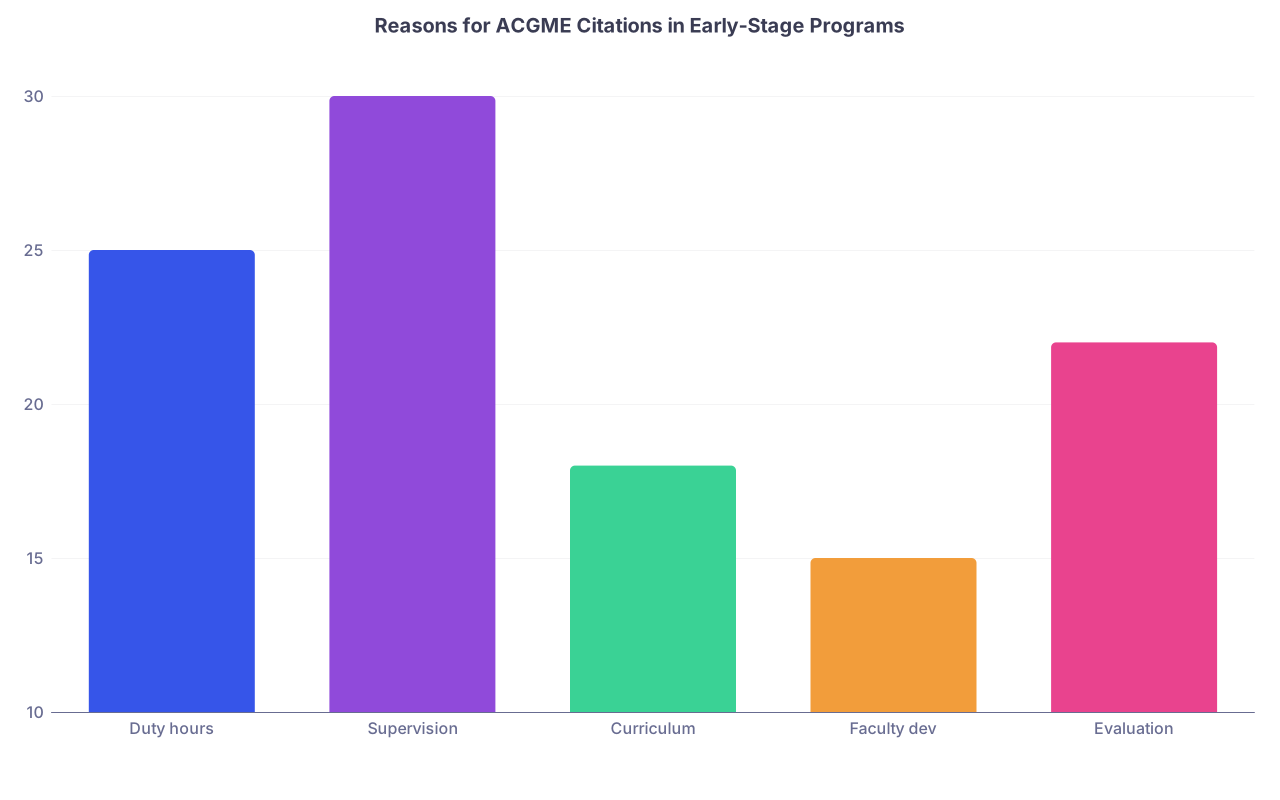
ACGME’s own public reports and NAS (Next Accreditation System) data show a non-trivial number of programs each year with citations for:
- Inadequate supervision
- Duty hour violations
- Deficient didactics
- Poor assessment and feedback systems
All of these programs are, by definition, “accredited” in some form when those problems are detected.
| Category | Value |
|---|---|
| Duty hours | 25 |
| Supervision | 30 |
| Curriculum | 18 |
| Faculty dev | 15 |
| Evaluation | 22 |
These categories show up disproportionately in new or rapidly expanding programs. You do not need a randomized trial to see the pattern: growth and novelty are risk factors for training instability.
Another uncomfortable truth: ACGME decisions lean heavily on documentation and interviews. A polished PD with a good narrative and clean minutes can mask decent-sized fires for a while. Residents in trouble often underreport early on—out of fear, loyalty, or just not knowing what “normal” should look like.
So no, the presence of “Initial Accreditation” on the website is not your safety net. It is the bare minimum entry pass.
Why New Programs Are Inherently Higher-Risk For Trainees
Let’s spell out why you should approach new residencies with caution, even if accreditation is technically in place.
1. No Track Record, No Feedback Loop
Established programs have:
- Graduation rates
- Board pass data
- Fellowship match lists
- Alumni you can cold‑email and ask, “How bad is it really?”
New programs have none of that. At best, they have a first class mid‑way through training who might be reluctant to trash the place publicly while still dependent on that PD for letters.
That means:
- You are betting on promises, not performance.
- You have no data to triangulate whether the training you think you’re getting is actually comparable to peers.

2. Faculty Learning How To Be Faculty—On You
Most new programs launch in community hospitals or smaller health systems where:
- Faculty were previously pure service attendings.
- Many have never had formal residents, only maybe a random third‑year medical student rotation.
- There is little to no culture of structured teaching, feedback, or milestones.
So while you’re trying to learn how to be a physician, the faculty are trying to learn:
- How much to supervise.
- How to sign notes without turning into scribes.
- How to create and deliver a didactic schedule.
- How to evaluate residents without defaulting to “everyone is fine.”
This “everyone is learning at once” dynamic is exactly how safety nets fail. It’s also how you get ridiculous variability: one attending will suffocate you, the next will leave you hanging with admissions you’re not ready for.
3. Systems and Workflows Are Built On The Fly
When an established program grows by 2–4 residents, the system usually flexes. When a new program appears out of nowhere, the system contorts.
You see:
- EMR workflows being rewritten mid-year.
- Call schedules “updated” three times in two months.
- New services created to “give residents more exposure” but staffed with one attending and no night coverage.
Early residents in some new programs have described things like:
- No clear protocol for how to escalate a crashing patient at 3 a.m.
- Being the default “code leader” on day 3 because “you’re the resident now”.
- Being sent to off‑site clinics where no one was told a resident was coming and there’s no preceptor room, no orientation, no anything.
None of that violates ACGME initial accreditation by itself. All of that can crush learning and compromise safety.
4. Leadership Instability Is Common
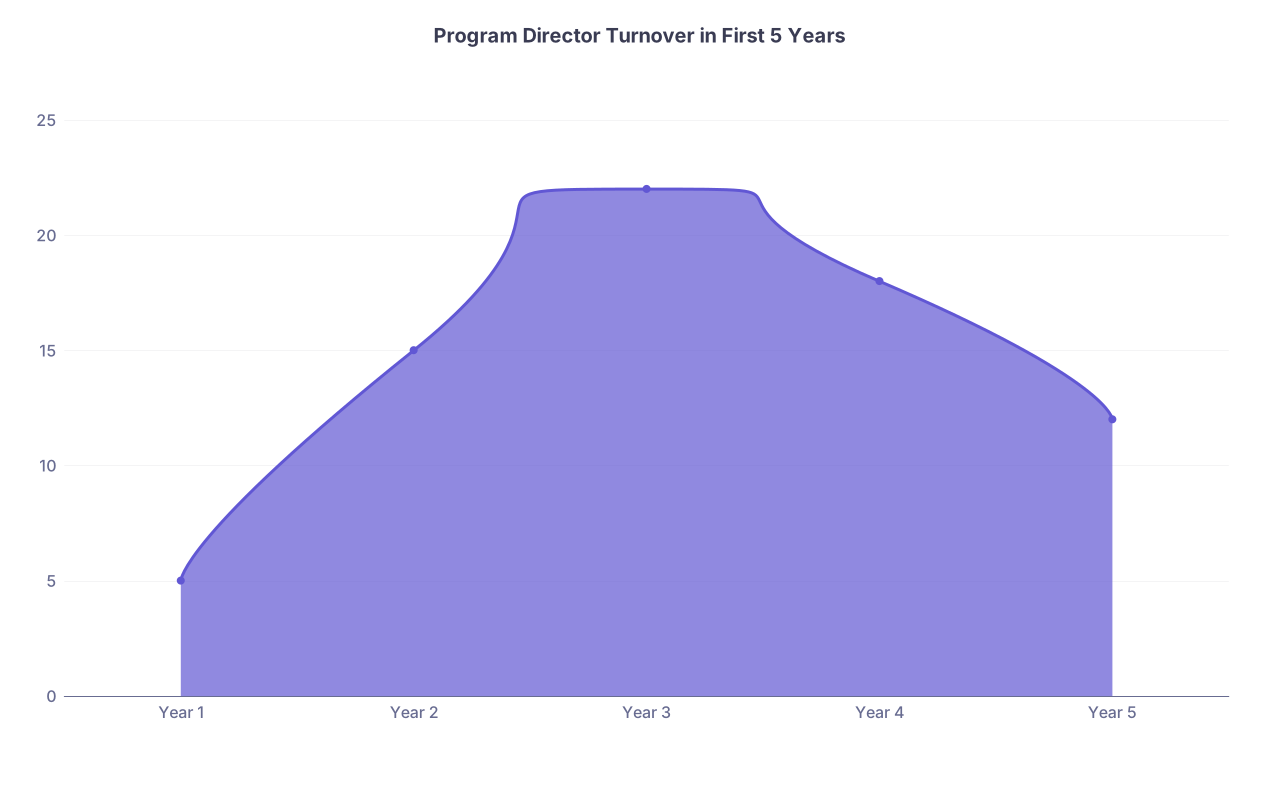
Program directors for new residencies burn out or get pushed out at higher rates. Starting a program is political, exhausting, and frequently under-resourced.
I’ve seen:
- PDs resign in year 2 over constant pressure to increase service coverage.
- GME offices merge, change sponsors, or lose key staff right when the first class hits PGY‑2.
- Hospitals get acquired by a larger system that decides the program must expand fast—or contract suddenly.
ACGME cares about leadership stability. But it reacts after disruption, not before. Again: accreditation status lags reality.
| Category | Value |
|---|---|
| Year 1 | 5 |
| Year 2 | 15 |
| Year 3 | 22 |
| Year 4 | 18 |
| Year 5 | 12 |
Those percentages (illustrative but consistent with reported patterns from GME conferences and institutional data) are not trivial when you’re locked into a multi-year training contract.
Safe Training: What Actually Matters More Than Initial Accreditation
So if initial accreditation is just a starting point, what should you actually be interrogating when you consider a new residency?
Here is where you separate marketing from reality.
1. Sponsoring Institution Strength
This matters more than the shiny brochure for the specific program.
Look for:
- Does the institution already run other ACGME-accredited programs with decent reputations?
- Is there a real GME office with a DIO who’s actually present, or is it a part-time title?
- Are there established policies for moonlighting, remediation, grievances, and wellness that have been tested in other programs?
A completely green institution starting its first program is a very different risk profile than a large academic center adding one more fellowship.
| Feature | High-Risk New Program | Lower-Risk New Program |
|---|---|---|
| Sponsor experience | First GME program ever | Multiple existing residencies |
| PD prior experience | No prior PD/APD role | Former APD at established program |
| GME office | One part-time coordinator | Full GME team and DIO |
| Clinical volume | Marginal, recently expanded | Historically high and stable |
| Academic culture | Minimal prior teaching | Longstanding teaching missions |
2. Program Leadership Track Record
Forget the generic PD letter. Ask concrete questions:
- Where did the PD train and how long have they been in GME roles?
- Have they helped run or grow programs before, or is this their first shot?
- What happened to residents at their prior institution under their leadership—board pass rates, fellowships, jobs?
Red flag: “Our PD is a great clinician and we thought they’d be perfect to lead a residency.” Being clinically strong is not the same as being structurally competent.
3. Honest Resident Voices—Unfiltered
For very new programs, you might only have one class. That’s still invaluable.
Ask them, directly and privately:
- “What surprised you in a bad way?”
- “What changed between what you were promised on interview day and what actually happened?”
- “If you could go back, would you choose this program again?”
If someone says, “We’re the guinea pigs, but it’s been fun,” that’s one thing. If they pause, hedge, and then say, “Well, we’re learning a lot,” listen to what they’re not saying.

4. Objective Workload and Support Signals
ACGME has duty hour rules. That does not mean they’re perfectly followed or enforceable in real time, especially in year 1–2 of a new program.
Drill into specifics:
- What is the average capped census for interns and seniors?
- Who covers nights, and what backup exists if multiple admissions crash at once?
- Are there in-house intensivists, or are you “discussing by phone” at 2 a.m.?
Then cross-check with residents: “Is this what actually happens?”
New programs are notorious for “informal expectations” that conveniently do not appear on any slide deck.
5. Educational Currency vs. Service Creep
Look for proof that education is not an afterthought:
- A real didactic schedule with protected time that is actually protected.
- Faculty development sessions that have happened already, not “we plan to.”
- Simulation resources, QI projects, M&M conferences that aren’t just one PD talk per quarter.
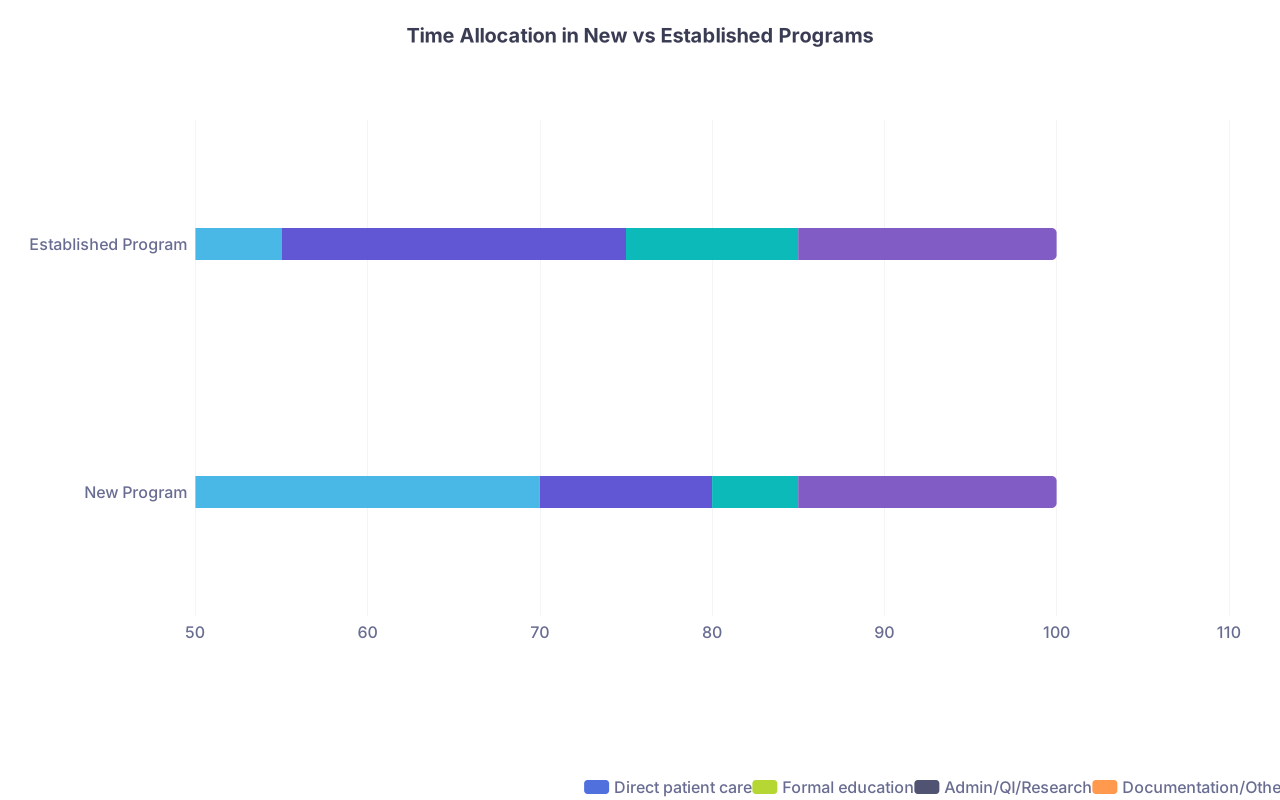
If every answer centers on “we have tons of autonomy” and “you’ll see everything,” translate that: “We’ll lean heavily on you for service.”
| Category | Direct patient care | Formal education | Admin/QI/Research | Documentation/Other |
|---|---|---|---|---|
| New Program | 70 | 10 | 5 | 15 |
| Established Program | 55 | 20 | 10 | 15 |
You want the right-hand bar, not the left.
How To Use ACGME Data The Right Way
You should absolutely look at ACGME status. Just not naively.
For programs more than a couple years old:
- Check if they have “Initial Accreditation,” “Continued Accreditation with Warning,” “Probation,” etc., on the ACGME public site.
- Look at citations categories if available. Repeated issues with supervision or duty hours are not small things.
But then you layer it with:
- ABMS board pass rate data (for specialties that publish it).
- NRMP Program Director surveys and reputational data.
- Word-of-mouth from residents and fellows at nearby institutions.

| Step | Description |
|---|---|
| Step 1 | See ACGME Initial Accreditation |
| Step 2 | Assess sponsor strength |
| Step 3 | Check citations and outcomes |
| Step 4 | Talk to current residents |
| Step 5 | Probe workload and support |
| Step 6 | Decide risk vs alternatives |
| Step 7 | New program only? |
Initial accreditation is one node in the flow, not the final state.
When It Can Make Sense To Choose A New Program
Let me not overcorrect. New does not automatically mean bad.
There are scenarios where a new program is a rational—and even smart—choice:
- It’s a new program inside a historically strong academic center with deep faculty benches and solid GME.
- The PD and APDs are imported from high-performing programs with reputations for good training.
- The clinical volume is rich and previously handled by attendings who are already teaching-focused.
- You have strong geographic or family reasons and are willing to accept some chaos.
Just do not confuse “high upside” with “low risk.”
You are trading predictability for potential. Fine, if you know that and you’re honest with yourself.

The Bottom Line: Accreditation Is A Floor, Not A Shield
ACGME initial accreditation is like passing a building inspection before anyone actually lives inside. It tells you there’s plumbing, electricity, and no obvious structural cracks. It does not tell you how the place holds up when a family of five moves in and starts actually using everything, every day, under stress.
You are that stress test.
So here’s the practical translation:
- Do not treat “initial accreditation” as a synonym for “safe training.”
- Treat it as a minimum bar that lets you start asking harder questions.
- Judge the sponsor, leadership, culture, and real-world workload at least as much as the ACGME label.
Years from now, you won’t remember whether the website had a big “ACGME Initial Accreditation Achieved!” banner. You’ll remember the nights you felt either dangerously alone or solidly supported—and the people and systems that made the difference.