
It is Match season minus 3 months. You are staring at a shiny new residency program on FRIEDA and the program’s website. The rotation schedule looks decent, the faculty list is short but respectable, and the photos are all glossy stock images of happy residents that clearly do not exist yet. What you cannot see from the brochure: whether the program’s funding model will actually hold up for the next 3–7 years of your life.
That is the real risk with new programs. Not “will they teach me?” (they usually try very hard). The core question is: “Is the money behind this thing stable or fragile?” Because funding instability is what leads to frozen positions, unfilled faculty lines, vanishing electives, and, in the worst-case scenario, residents scrambling if a program downsizes.
Let me walk you through how to read between the lines and spot sustainable vs shaky funding models behind newly accredited programs.
1. The Uncomfortable Truth: New Programs Live or Die on Funding Structure
Programs do not fail because they forget to write a curriculum. They fail because:
- The hospital overestimated GME reimbursement
- Leadership turnover leaves the program without a financial champion
- Expansion was mostly a “we want residents” vanity project, not a strategic necessity
You cannot fix any of that as a resident. Your only real defense is pre‑match due diligence.
Behind every new program there is some mix of:
- Federal GME money (CMS Medicare funds)
- State / local subsidies or special grants
- Hospital operational budget
- Faculty practice revenue
- Philanthropy or one‑time grants
Sustainable programs have a clear, multi‑source funding plan anchored in stable hospital operations and appropriately structured Medicare caps. Fragile programs lean excessively on “temporary” money (start-up grants, philanthropy, one enthusiastic CEO) without long‑term reimbursement logic.
2. Know the Game: Medicare GME Funding and Caps
If you do not understand GME caps, you are essentially blind to program sustainability.
There are two main buckets from Medicare:
- DGME (Direct Graduate Medical Education): covers resident salaries, benefits, a portion of faculty, program admin
- IME (Indirect Medical Education): bonus payments to hospitals to account for higher costs teaching hospitals incur
The trap hospitals fall into—and you need to recognize—is around Medicare GME caps. In short: the federal government will only pay for a set number of residents at a given hospital, based on historical training levels.
Here is where new programs land in that landscape.
| Scenario | GME Funding Position | Sustainability Signal |
|---|---|---|
| No existing cap | Can set new, higher cap | Strong upside |
| Under cap | Room to add residents with funding | Generally favorable |
| At/over cap | New spots mostly unfunded | Higher risk |
| Rural/CHGME add-ons | Extra federal programs | Conditional upside |
If a hospital has never had residents before, they get a new “cap-setting window” (usually 5 years) where the number of residents they train will set their long‑term Medicare funding ceiling. Hospitals that understand this game plan carefully and expand in a measured way. Desperate or poorly advised institutions expand haphazardly, then discover the financial hole 3–4 years in.
You cannot see their cost report, but you can triangulate.
Ask on interview day or in emails, very directly:
- “Is your institution currently under, at, or above your Medicare GME cap?”
- “When did your hospital first start training residents?”
- “How many ACGME programs share this institution’s cap right now?”
Confident, sustainable programs have ready, specific answers. Evasive or vague answers are a warning sign. I have seen programs where leadership literally did not understand their cap status when they started. Those programs struggled almost immediately.
3. Dissecting Common Funding Models in New Programs
Let me break down the typical models you will encounter and how they look from a sustainability standpoint.
A. Hospital‑anchored, strategy‑driven model (the gold standard)
You hear things like:
- “We are using residency expansion to staff our growing service lines.”
- “The Board has a multi‑year commitment to fund 36 residents in this program.”
- “Residency is core to our recruitment pipeline for this region.”
Characteristics:
- Resident salaries and admin are budgeted as a line item in the hospital’s long‑range financial plan
- Growth of the residency is tied to actual service expansion (new clinics, new inpatient units, regional network growth)
- GME is part of the institution’s identity, not an experiment
This model is usually sustainable, especially when paired with either:
- Under‑cap status with room to grow, or
- Reasonable over‑cap commitment that is still strategically justified
Green flags you should see or hear:
- Stable or growing hospital margins (or at least not in free‑fall)
- Capital projects underway (new tower, new ED, new outpatient building) that “need” residents
- Longstanding teaching relationships with other universities—even if the residency is new, the teaching culture is not
B. Grant‑plus‑hope model (common, dangerous if unaccompanied)
Here is the pattern:
- New program funded by a 3–5 year state grant, HRSA grant, or philanthropic endowment
- Marketing emphasizes “innovation,” “rural pipeline,” “community transformation”
- No crystal‑clear answer to what happens when the grant sunsets
Grants are not bad. They are often essential to get programs off the ground, especially in rural or underserved areas. The problem is when the grant is doing the heavy lifting with no downstream plan.
You want to identify:
- Does the institution have a credible path to internalizing costs after the grant ends?
- Is there evidence they are building service lines around residents (clinics, call coverage, outreach)?
- Do they already run other, older programs that successfully transitioned off grant funding?
If the only answer to “what happens after the grant?” is “we expect continued funding” or “we will apply for renewal,” that is weak. Grants end. Political priorities change.
C. Faculty‑driven “pet project” model
You see this more often in smaller hospitals or community affiliates of big brands. A charismatic or motivated department chair decides “we should have a residency,” pushes it through, and the hospital grudgingly funds a small program.
- Very small complement (e.g., 3 residents per year) in a hospital doing large volume
- PD and core faculty already extremely overextended clinically
- Administration appears mildly annoyed when residents are mentioned (“well, we are seeing how it goes”)
These programs can be educationally excellent, but the funding is fragile because leadership buy‑in is shallow. If the champion leaves or the PD burns out, money is the first thing that gets questioned. You want to see either:
- Explicit statements of long‑term commitment from hospital leadership
- Evidence of broader academic investments (multiple programs, GME office, DIO with real authority)
D. “Brand‑extension” academic model
A large university or academic center slaps its name on a smaller community site and starts a program there.
You will see:
- University name and logo everywhere
- Main campus faculty “adjunct” at the new site
- Some rotations at the flagship hospital, majority at the affiliate
Financially, this can be reasonably robust if:
- The affiliate hospital is healthy and truly wanted the program
- There is a clear agreement about cost‑sharing of faculty time, administration, and resident support
Risk comes when the affiliate is using the university brand as bandwidth and hoping “being academic” alone will cover thin margins. The university will protect its main campus first if money tightens. Residents at satellites can feel that quickly: frozen lines, fewer electives, collapsed research support.
Ask bluntly:
- “How are costs shared between the main campus and this site?”
- “Is this program governed by the main GME committee, or a separate structure?”
You are trying to see whether you are part of the core academic mission or an off‑balance‑sheet experiment.
4. Hard Questions to Ask: What Actually Reveals Funding Stability
Most applicants ask soft questions: mentorship, research, call schedule. All useful. None of them tell you whether the program will exist in 7 years.
Here are targeted questions that cut through the fluff. Ask faculty, PD, coordinator, or even the DIO if you get access.
“Who funds resident salaries and benefits—just this hospital, a system, or multiple partners?”
- Strong answer: “They are in the hospital’s core operating budget; our health system funds all GME centrally.”
- Weak answer: “We are using a few grants right now, but we think it will be fine later.”
“How many years of funding are already committed for your planned resident complement?”
- Strong answer: concrete number of years, explicit approval by Board or C‑suite.
- Weak answer: “We plan to keep funding it as long as possible.”
“Is your planned full complement already approved financially, or are you still waiting for phases of approval?”
- Multi‑phase, contingent approval carries risk. Especially if early cohorts are already stretching faculty or space.
“How is your program affected by Medicare GME caps at this institution?”
- You want someone who can articulate: “We are at X cap, have Y current residency slots, and Z available positions remaining.”
- If no one knows, that is extremely telling.
“Has there been any discussion of freezing or reducing positions in the last 2 years?”
- Programs that tell you “we actually increased positions” are in a better place than “we have avoided cuts so far.”
5. Reading Between the Lines: Signals from the Environment
Funding models leave fingerprints. You can often sense them without seeing a spreadsheet.
A. Physical plant and capital investment
Walk the hospital.
- Freshly built or renovated ICU, ED, or OR complexes?
- New outpatient buildings, cancer centers, or procedural suites?
- Or is everything visibly aging with slow, patch‑repair energy?
Hospitals that are building have some level of capital access and planning horizon. That correlates with a better chance they can support GME growth over time.
B. GME infrastructure
Even if the program is new, the GME ecosystem around it tells you a lot.
Look for:
- Dedicated GME office with staff (not just one coordinator wearing 5 hats)
- Active DIO who can intelligently discuss multiple programs
- Simulation center, structured didactics, system‑wide education days
A hospital that invests in GME infrastructure is not likely to casually abandon programs. One that sees your residency as a stand‑alone “experiment” might.
C. How they talk about residents’ value
Listen carefully.
Strong, sustainable framing sounds like:
- “Residents are integral to patient care and to our pipeline; we recruit many of our faculty from graduates.”
- “We built new clinic models assuming resident continuity panels.”
- “Our strategic plan explicitly includes being a teaching hospital.”
Weak, fragile framing:
- “We hope residents will improve our coverage issues.”
- “Once residents are here, we may be able to decrease locums costs.”
- “We wanted to be more competitive so we started a residency.”
Residents as strategic investment vs residents as cheap labor. The first is sustainable. The second gets ugly when finances tighten.
6. Numbers That Matter: Ratios, Volumes, and Headcount
You are not getting a pro forma, but you can infer whether a program is stretched or appropriately resourced.
Here is a simple way to think about it:
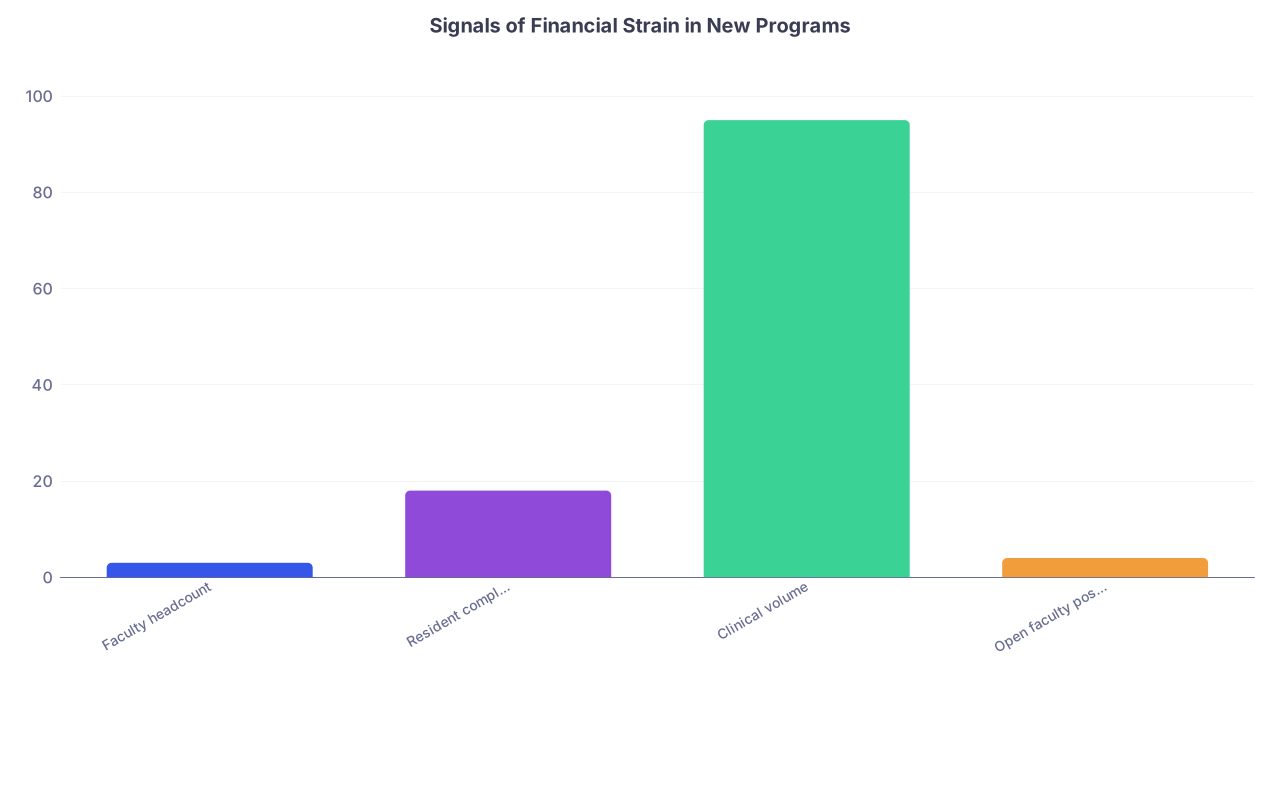
| Category | Value |
|---|---|
| Faculty headcount | 3 |
| Resident complement | 18 |
| Clinical volume | 95 |
| Open faculty positions | 4 |
When you see:
- 3–4 core faculty
- Planned complement of 18–24 residents
- Several open faculty searches that “have been hard to fill”
That is not just a workload issue. It is a funding and prioritization issue. Either the hospital cannot pay competitive salaries or it was not willing to fund a realistic academic staffing model before starting the program.
On the positive side, look for:
- Reasonable resident-to-faculty ratios (for IM/FM: at least 1 core faculty per 4–6 residents at full complement)
- Unpressured timelines to grow into full complement
- Transparent acknowledgement of recruitment challenges with a realistic plan, not wishful thinking
7. Special Cases: Rural, Safety-Net, and “Mission-Heavy” Programs
Some of the best training happens in financially precarious institutions. Rural and safety‑net hospitals often run thin margins, yet have incredibly committed leadership and a deep mission to serve.
Here is how to discriminate between a noble but doomed idea and a hard‑scrabble but stable program.
A. Rural programs
- Many rural programs are buoyed by special federal or state mechanisms: rural GME grants, state loan‑repayment tie‑ins, or specific workforce development funds
- Relationship with local FQHCs, health departments, or critical access hospitals can diversify funding streams
You should ask:
- “Which specific mechanisms are supporting your rural training model?” (HRSA, state GME initiative, etc.)
- “Have any of these been renewed already, or are you still in initial funding cycles?”
- “How many graduates have stayed in the region so far?” (For slightly older new programs)
Rural hospitals that survive long‑term do so because they became indispensable to regional care delivery. Same for rural residencies.
B. Safety‑net / public hospital programs
Public systems can look perpetually broke on paper but have very high GME stability because:
- Residents are essential to day‑to‑day operations
- Local politics make cutting residency positions politically painful
- Teaching status is woven into the institution’s identity
Your job is to figure out whether the new residency is being layered onto an already well‑established teaching culture, or if it is an attempt to “rescue” a failing hospital.
Look at:
- Existing history of training (students, fellows, other residencies)
- Clarity of county / state funding commitments
- Comments about “pending restructuring,” “service line closures,” or “seeking a partner merger”
If you hear a lot of merger / acquisition talk, understand things can change fast.
8. Doing Your Own Background Check: Public Clues You Can Pull
Do not just rely on what they tell you on interview day.
You can quietly do the following:
Search for the hospital’s bond ratings (Moody’s, S&P).
- Upgrades or stable outlooks are reassuring.
- Downgrades, negative outlooks, or news about debt covenant concerns should get your attention.
Scan local business journals or health system news.
- Headlines like “System posts $200 million loss” for two consecutive years are a clue.
- Also look for “Service closures,” “bed reductions,” “layoffs,” “divestment.”
Check for union negotiations or strikes with nurses/ancillary staff.
- A single contract dispute is not catastrophic. A pattern of “crisis management” financing is.
Analyze their growth story.
- Are they acquiring practices, opening satellites, affiliating with universities?
- Or are they divesting, closing rural sites, and “refocusing on core services”?
Growth can be overambitious, yes, but chronic retreat is a more immediate red flag.
9. What You Can Tolerate vs What You Should Avoid
No program is perfectly secure. Even large academic centers take hits. Your job is not to find a zero‑risk option. It is to distinguish between:
- Normal level of uncertainty in healthcare vs
- Structural instability and poor planning
You can reasonably tolerate:
- Some reliance on time‑limited grants… if there is a realistic plan to internalize costs
- Early-stage faculty recruitment gaps… if there is obvious administrative support and strong applicant interest
- Being one of the first 2–3 classes… if leadership can show you specific 3–5 year plans and the hospital is otherwise stable
You should be very cautious if:
- No one can explain how Medicare GME funding and caps relate to your program
- Resident salaries are explicitly tied to an ending grant with no backup plan
- The hospital has highly publicized financial losses and closures with no credible turnaround story
- Leadership turnover in PD, DIO, or C‑suite has been frequent in the last 2–3 years
If you match at a place that hits several of those red flags, do not panic—but go in with open eyes, keep your ear to the ground, and maintain relationships elsewhere. I have seen residents successfully transfer from unstable programs, but it is much easier if you planned ahead.
10. A Simple Mental Model: “Would This Program Survive a 3‑Year Financial Squeeze?”
Healthcare runs in cycles. Reimbursement swings, pandemics hit, supply costs spike.
When evaluating a new program, ask yourself:
If this hospital experiences 3 years of margin compression, will they:
- Defend GME funding because it is central to strategy?
- Or quietly chip away at positions, electives, and support because it is seen as optional?
You are not just choosing a curriculum. You are hitching your training to an institution’s risk tolerance and financial backbone.
Here is a rough mental risk matrix:
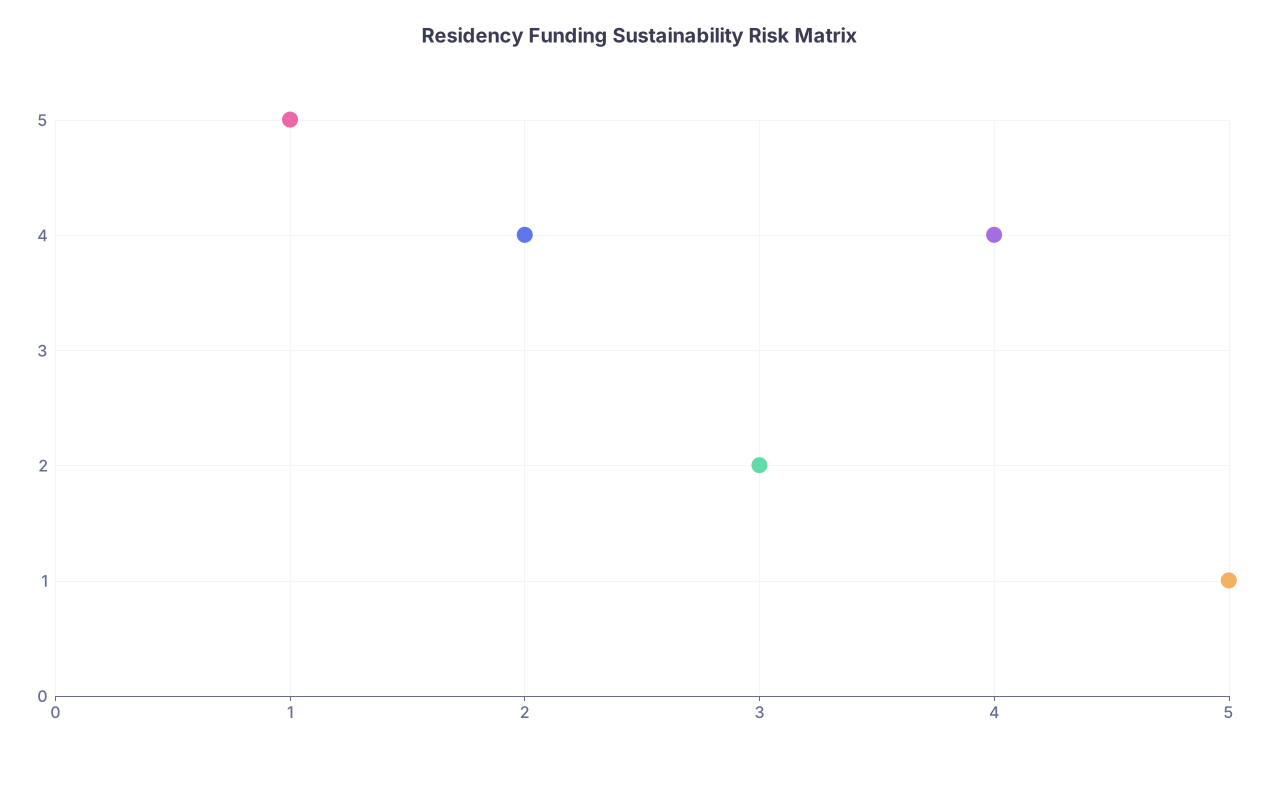
| Category | Value |
|---|---|
| Hospital A | 2,4 |
| Hospital B | 4,4 |
| Hospital C | 3,2 |
| Hospital D | 5,1 |
| Hospital E | 1,5 |
X‑axis (1–5): Financial health of hospital
Y‑axis (1–5): Institutional commitment to GME
- High financial health + high GME commitment (top right) → safest
- Low financial health + low GME commitment (bottom left) → avoid if possible
- Mixed cases require judgment and risk tolerance
You will not put numbers on it for real programs, but think in that grid.
11. What Stable New Programs Actually Look Like Over Time
Let me describe the pattern I see in new programs that age well:
Year 1–2:
- Small class, over‑attentive faculty, some logistical hiccups
- Continuous talk about building, recruiting, shaping the program
- Administration shows up to graduation and academic events
Year 3–4:
- Full complement achieved or nearly there
- Clear integration of residents into service coverage without overreliance
- Faculty numbers increased proportionally, with at least a couple of hires “because of education needs”
- Residents participating in hospital committees, QI, leadership groups
Year 5+ (for programs that started as “new” and grew up):
- Former graduates on faculty
- Residency present in hospital strategic documents and marketing
- More than one program at the site, or formal system‑wide GME structures
Contrast that with unstable trajectories:
- Positions reduced or left unfilled “to save money”
- Rapid turnover of PDs or core faculty with no time for succession planning
- Didactics or elective time gradually sacrificed to cover service gaps
- Eventual merger or transfer of the program to another site
You want the first curve, not the second.
12. Quick Flow: How to Evaluate a New Program’s Funding Model
Sometimes it helps to see the reasoning as a process.

| Step | Description |
|---|---|
| Step 1 | Identify new program |
| Step 2 | Check hospital financial context |
| Step 3 | Ask about GME cap status |
| Step 4 | Clarify funding sources |
| Step 5 | Assess GME infrastructure |
| Step 6 | High funding risk |
| Step 7 | Lower funding risk |
| Step 8 | Long term plan clear |
| Step 9 | Leadership committed |
Walk yourself through that mentally after each interview. You will be surprised how quickly patterns pop.
FAQ (Exactly 6 Questions)
1. Can a residency program actually close while residents are still training?
Unfortunately, yes. It is rare, but it happens. More commonly, programs stop taking new residents, shrink their complement, or are forced to merge with another institution. When a full closure occurs, ACGME usually coordinates transfers or “teach out” arrangements so current residents can finish somewhere, but it is disruptive. The risk is higher in new programs with weak funding models or hospitals in severe financial distress.
2. Does having university affiliation guarantee financial stability for a new program?
No. University branding can mask a fragile financial relationship with the actual training site. What matters is who is paying salaries, who controls the GME budget, and whether the affiliate hospital has healthy operations. I have seen university‑affiliated community sites that were financially weaker than completely independent community programs.
3. How much should I worry about Medicare GME caps as an applicant?
You do not need to become a reimbursement expert, but you should absolutely ask about cap status. A hospital that is under cap and expanding in a controlled way is generally safer than one that is far over cap and funding most positions out of pocket. Cap ignorance or confusion from leadership is more concerning than being slightly over cap with a deliberate plan.
4. Are grant‑funded new programs always a bad idea?
Not automatically. Grants are often necessary seed money, particularly in rural or underserved settings. The key is whether the hospital has a specific plan for what happens when the grant ends: integrating residents into service lines, incorporating GME into the operating budget, and demonstrating previous success transitioning other programs off grant support. A grant with no exit strategy is the real problem.
5. What if a program is only taking one small class initially—does that mean funding is weak?
Not necessarily. A slow ramp‑up can be a sign of responsible planning, especially if faculty numbers are modest and the hospital is new to GME. You should ask whether the full planned complement is already financially approved and on what timeline. A small, well‑planned start with clear support is better than an overambitious launch with shaky backing.
6. If I am already matched and then discover funding concerns, is there anything I can do?
You cannot redo the Match, but you still have leverage in your own planning. Build relationships with mentors outside your program, keep your performance strong (to be a desirable transfer candidate if needed), and stay informed about institutional changes. If serious instability appears—position cuts, talk of closure—speak early with the PD, DIO, and your specialty society about transfer pathways. It is not pleasant, but residents do move successfully when they are proactive.
Two key points to carry with you:
- Do not judge a new program only by curriculum and faculty bios. Judge it by the clarity and durability of its funding model.
- Look for hospitals where GME is woven into the institution’s strategy and budget, not bolted on with wishful thinking and temporary money.