
What if every single thing in my application just screams, “this person is having an identity crisis” instead of “this person is a future physician”?
Because that’s the fear, right? You’re older. You’ve had a career. Maybe you have kids. Maybe you’ve already been “successful” by normal standards. And suddenly you’re the 30‑, 35‑, 40‑something saying, “Actually…I want to start over and go to med school.”
And you can practically hear some imaginary admissions dean in your head going:
“Uh huh. So you hate your job, watched Grey’s Anatomy, and now you want to blow up your life.”
Let’s talk about that. Honestly.
What Adcoms Actually Worry About With Older Applicants
They’re not automatically thinking “midlife crisis.” They’re thinking “risk.”
You know what makes committees nervous about non‑trads?
- Will this person actually finish the insane, 7–11 year training pipeline?
- Can they still handle rigorous science coursework?
- Are they running toward medicine, or just running away from something else?
- Are they going to melt down when the lifestyle hits them and say “never mind”?
That’s it. Not your age. Not your gray hair. Not your kids. Risk.
Here’s the ugly part: some non‑trads really do look like they’re having a midlife crisis on paper. I’ve seen it. People with:
- Zero sustained clinical exposure
- One random volunteer shift in the ER three months ago
- A personal statement that reads like, “I’m unhappy in consulting so I want a more meaningful career” with almost nothing specific about medicine
That’s what sets off their alarm bells.
They don’t care if you’re 22 or 42. They care whether your file says: “I know exactly what I’m signing up for, and here’s the evidence.”
So your job is to make it absolutely impossible for them to see “impulsive crisis” instead of “tested commitment.”
The Red Flags That Do Look Like a Midlife Crisis
Let me be harsh for a second, because this is where a lot of us mess up.
These are the things that really scream “impulsive” to adcoms:
No longitudinal clinical experience
You say you’ve wanted medicine for years, but you’ve:
- Shadowed for 20 hours total
- Volunteered in a hospital for a month
- Never had consistent patient‑facing work
That doesn’t say “lifelong calling.” It says, “I got the idea recently and haven’t tested it properly.”
Massive career pivot with no narrative
Example: 10 years in finance. No health‑related anything. Then suddenly prereqs, MCAT, done. Your story can’t just be “I wanted to help people.” Everyone says that. It sounds fake because it’s vague.
Burnout energy
If your essays spend more time trashing your old career (“toxic,” “soul‑crushing,” “empty”) than explaining the pull of medicine, you look like someone escaping, not choosing.
Inconsistent timeline
If your transcript and CV show:
- Psychology → MBA → law school semester → grad‑school start/stop → now premed
that looks like repeated identity pivots. Commitment becomes the question.
- Psychology → MBA → law school semester → grad‑school start/stop → now premed
No plan for realistic adult constraints
Mid‑30s, two kids, mortgage, spouse with demanding job… but not a single sentence anywhere about how you’ve thought through childcare, finances, or support. Adcoms aren’t judging your life, they’re judging whether you’ve thought about it like an adult.
If you recognize yourself in some of that, it doesn’t mean you’re doomed. It means you need to over‑correct and build evidence that directly counters those fears.
What a Real Commitment Looks Like on Paper
You can’t talk your way out of looking impulsive. You have to show them you’re not.
Here’s what genuinely committed non‑trads tend to have:
| Area | Looks Like Crisis | Looks Like Commitment |
|---|---|---|
| Clinical Experience | Short, scattered, recent | Longitudinal, years, patient-facing |
| Coursework | Minimal science, old grades | Recent, rigorous sciences with strong performance |
| Narrative | “I was unhappy so I changed” | Clear, specific, tested reasons for medicine |
| Life Logistics | No mention of plan | Concrete support systems and realistic planning |
Let’s break it down in actual human terms.
1. Longitudinal clinical work
If you’re worried they’ll think you’re impulsive, this is your biggest weapon.
You want stuff like:
- 2+ years as a medical assistant, EMT, CNA, scribe, hospice volunteer, etc.
- Hundreds of hours of direct patient contact
- Letters from physicians or supervisors who can say:
“They’ve seen the good, bad, and ugly. They’re not naïve.”
If right now your clinical exposure is: “Some shadowing and a hospital volunteer gig,” that’s not enough for a non‑trad who’s changing careers. You’re asking them to bet on a huge life pivot. Show them you’ve actually lived in the environment.
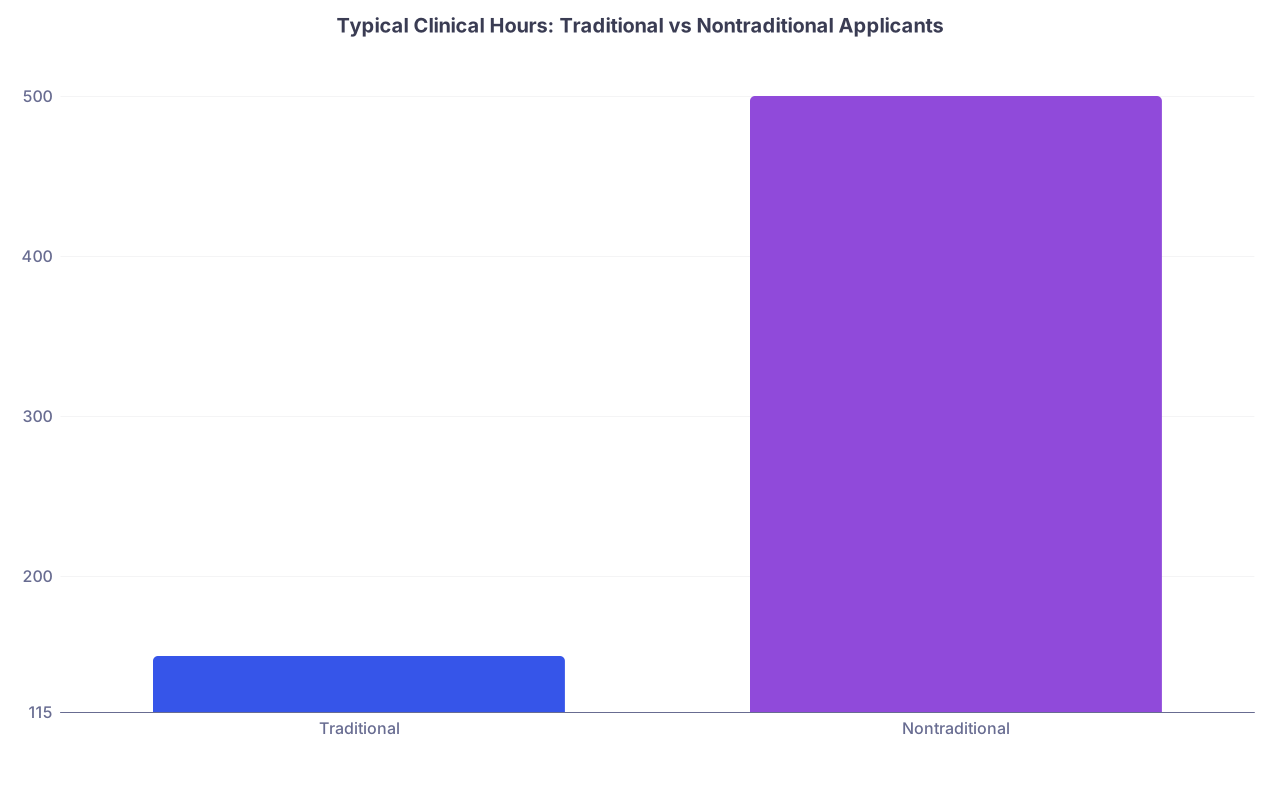
| Category | Value |
|---|---|
| Traditional | 150 |
| Nontraditional | 500 |
2. Recent, strong science performance
They’re not thinking “midlife crisis” when they see you’re 35. They’re thinking, “Can this person still grind through dense material like a 20‑year‑old?”
You counter that by:
- Taking upper‑level sciences recently (within the last 3–5 years)
- Doing it well—A/A‑ minus, not “I survived”
- Not hiding from hard courses: biochem, physiology, microbiology
If your original undergrad GPA was mediocre or ancient, you use a post‑bacc or DIY coursework as a “this is who I am now” signal. That’s how you say “I’m serious” without speaking.
3. A narrative that doesn’t sound like a movie plot
Your personal statement is not the place to dramatize your “awakening.” That’s exactly what makes it sound like a crisis.
You want your story to feel:
- Boringly logical
- Stepwise
- Tested over time
Instead of:
“One day, as I stared at my spreadsheets, I realized I was destined for medicine…”
Try:
“For years I loved working in operations, but found myself increasingly drawn to the clinical side. I began volunteering at the free clinic after work, then transitioned to a part‑time scribe role to understand physician workflow. Over four years, that exposure shifted a vague interest into a concrete, tested commitment.”
Less cinematic. Way more believable.
How to Talk About Your “Late” Switch Without Sounding Unstable
You can’t ignore the career switch. If you pretend it’s not a big deal, that looks flaky.
You have to own it head‑on.
A framework that usually works
Whenever I help non‑trads with this, we basically use some version of:
- What you genuinely liked about your previous career
- What felt missing in a specific, concrete way
- How that led you to test medicine in low‑risk, realistic ways
- What you’ve seen in medicine that is both compelling and sobering
- Why—despite the downsides—you’re still choosing it
Example:
“I liked the analytical challenge of engineering and the satisfaction of seeing projects completed. But I found myself missing sustained human connection and a clearer link between my work and individual lives. That disconnect led me to volunteer on a hospital quality improvement committee, then to shadow clinicians implementing those changes at the bedside. Over the next three years, I took night classes in biology and worked weekends as a patient care tech. I’ve now seen medicine’s bureaucracy, long hours, and emotional weight up close. Those realities didn’t push me away; they clarified that the daily problems I want to wrestle with are clinical, not corporate.”
See what that does?
It doesn’t thrash the old career. It doesn’t pretend medicine is only noble and pure. It sounds like someone who thought, tested, and then chose—slowly.
That doesn’t read like a midlife crisis. That reads like an adult.

The Age & “Starting Over” Question You’re Afraid They’re Asking
Let me say the quiet stuff out loud.
Yes, some adcom members privately think things like:
- “Will this 38‑year‑old handle 80‑hour weeks?”
- “They’ll be 45+ when they finish residency…will they burn out faster?”
- “Do they realize how disruptive this is financially?”
Are those thoughts fair? Not always. But they’re real.
So you address them without sounding defensive or needy.
A short paragraph somewhere (secondary, interview, or even primary if it fits) can do a lot of heavy lifting:
“I’m acutely aware that starting this path in my mid‑30s means a longer and less traditional training timeline. This wasn’t a romantic or impulsive decision. My spouse and I spent two years adjusting our finances, trialing schedules while I took night classes, and arranging reliable childcare with extended family. We’ve already lived a scaled‑down version of the intensity I’ll face in medical school, and we’re committed to it as a family.”
That’s the opposite of midlife crisis energy. That’s “I rehearsed the chaos and still chose this.”
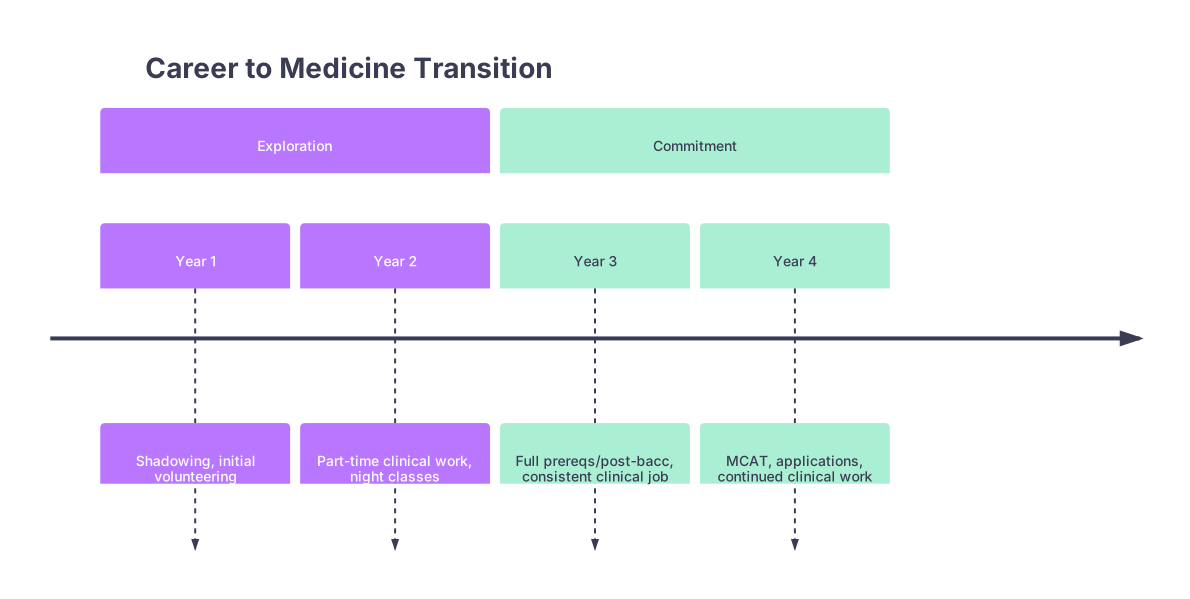
| Period | Event |
|---|---|
| Exploration - Year 1 | Shadowing, initial volunteering |
| Exploration - Year 2 | Part-time clinical work, night classes |
| Commitment - Year 3 | Full prereqs/post-bacc, consistent clinical job |
| Commitment - Year 4 | MCAT, applications, continued clinical work |
The Worst-Case Fears (And What’s Actually True)
Let’s just name the nightmares:
- “They’ll laugh at my age.”
- “They’ll assume I couldn’t cut it in my old career.”
- “They’ll reject me because I might retire earlier.”
- “They’ll think I’m just bored with my life.”
Here’s the reality I’ve seen over and over:
Someone on that committee loves non‑trads.
There’s almost always a faculty member who’s sick of teaching 22‑year‑olds who’ve never held a real job and wants people who’ve dealt with bosses, bills, and kids.They care way more about evidence than speculation.
If your app is: strong recent academics + deep clinical experience + coherent story, they’re not sitting there psychoanalyzing your “crisis.” They’re thinking: “Can this person survive our curriculum? Will they be a good doc?”If they do reject you for being “too risky,” that’s a data point, not a verdict on your sanity.
Some schools are conservative about non‑trads. Others love them. It’s not always about you. It’s about their institutional comfort level.
Your job is to move them from “this feels like a midlife pivot” to “this is a calculated, resourced, tested decision.”
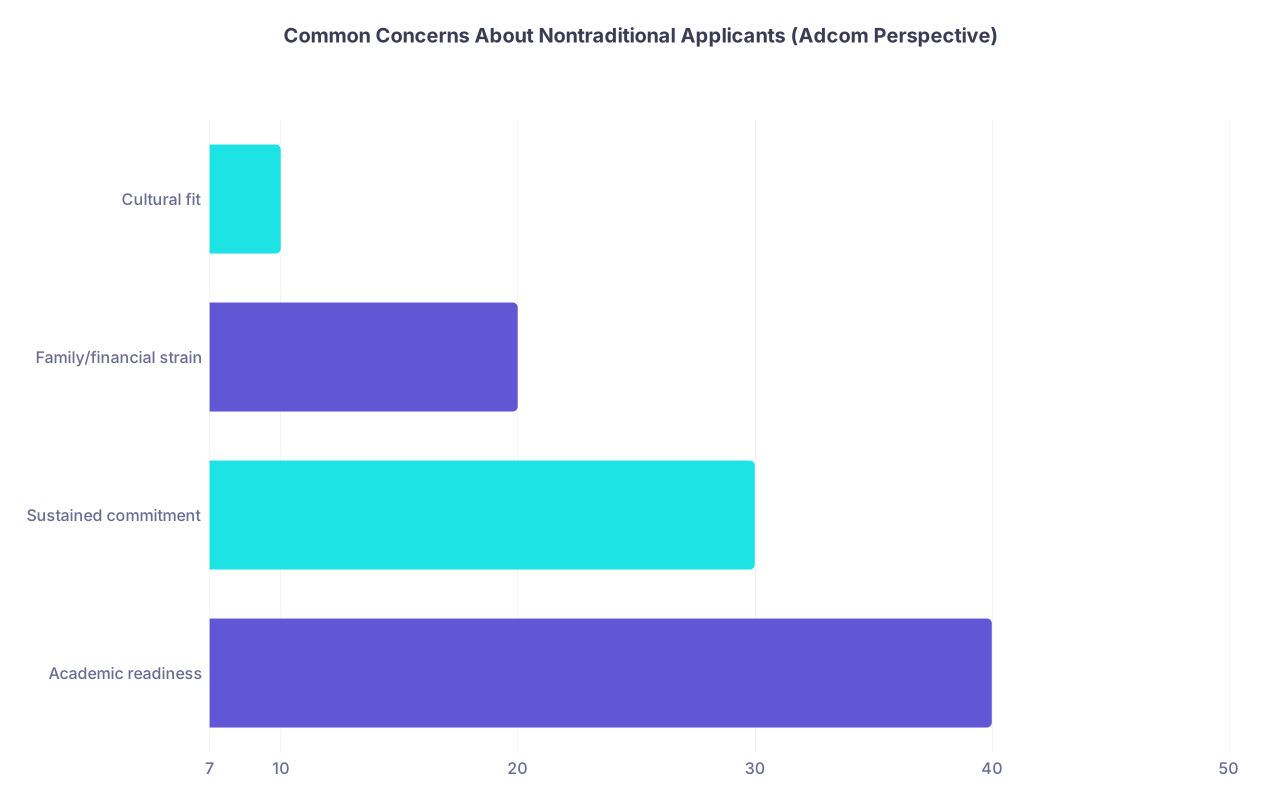
| Category | Value |
|---|---|
| Academic readiness | 40 |
| Sustained commitment | 30 |
| Family/financial strain | 20 |
| Cultural fit | 10 |
Concrete Steps If You’re Worried You Already Look Like a Crisis Case
If you’re reading this thinking, “Oh no, I am that red flag person,” here’s what I’d actually do:
Delay your app by a year if:
- Your clinical hours are under ~300 and all in the last 6–9 months
- Your recent science coursework is thin or mediocre
Rushing just feeds the “impulsive” narrative.
Get one solid, serious, patient‑facing role.
Not 10 scattered hospital volunteer gigs. One clear role where:- You’re there weekly
- You stay for at least 1 year
- Someone can write you a detailed letter
Re‑write your personal statement with the “no crisis” filter.
Ask:- Am I overselling the epiphany moment?
- Do I sound like I’m escaping my past instead of building on it?
- Do I mention the downsides of medicine in a realistic way?
Have one brutally honest conversation with someone in medicine over 40.
Ask them:- “If you were me, would you still do it?”
- “What do you wish you’d understood about timing, family, exhaustion?”
Mention this in your app. It shows you didn’t romanticize the path.

How to Answer “Why Medicine Now?” In an Interview Without Sounding Unstable
This question haunts non‑trads.
Bad answer energy:
- Long monologue about hating your previous job
- Overly emotional “I just know this is what I’m meant to do”
- Dramatic life event you haven’t clearly processed yet
Better structure:
- “Here’s what I did before and what I valued about it.”
- “Here’s what shifted for me and how I explored that slowly.”
- “Here’s what I’ve seen in medicine that makes me specifically committed.”
- “Here’s how I know I’m ready now, logistically and emotionally.”
Example:
“I spent a decade in marketing and really enjoyed managing teams and communicating complex ideas. Over time, though, I realized the problems I was solving didn’t feel as meaningful to me anymore. I started volunteering at a community clinic, then moved into a part‑time role as a patient navigator while taking my science prerequisites at night. Over four years, I’ve seen how challenging medicine is—insurance issues, limited time with patients, burnout. But I’ve also seen how my skills in communication and systems thinking can directly improve patient care. My family and I have already lived through me working full time plus classes and clinic hours, and we’ve built a support system that makes this a sustainable move, not an impulsive one.”
No drama. No “destiny.” Just a grown‑up explaining a big decision.

FAQ (Exactly 4 Questions)
1. Will adcoms secretly judge me as irresponsible for switching careers “this late”?
Some will question it; that’s their job. But “irresponsible” is not the word they’re looking for. They’re asking: “Is this person making a thought‑through decision?” If your application shows a clear timeline of exploration, strong recent academics, serious clinical exposure, and a realistic plan for finances/family, most will see you as intentional, not reckless. You can’t control the one or two people who just dislike non‑trads. You can make it really hard for reasonable people to label you impulsive.
2. My clinical experience only started last year. Does that automatically look like a crisis pivot?
It depends how dense and consistent that year is. If you’ve done 600+ hours as a scribe/MA/tech, plus ongoing volunteering, and can articulate specific things you’ve learned about medicine’s realities, that can still look solid. If it’s 50 hours of shadowing and a few weekend shifts, yes, for a non‑trad that often reads as “new idea, not fully tested.” In that case, waiting an extra year to apply and building depth is usually smarter than applying now and hoping they ignore the thin evidence.
3. Should I downplay my old career so I don’t look like I’m running away from it?
No. Weirdly, that backfires. When you trash your old career, you look reactive. When you pretend it didn’t matter, you look shallow. The strongest apps say: “Here’s what I gained from that phase of my life. Here’s what was missing. Here’s how medicine fits who I am now better than it did then.” You’re not erasing your past; you’re using it to explain why you’ll probably be a better med student and physician.
4. What if someone literally asks, “Are you having a midlife crisis?”
It’s rare, but I’ve heard versions of it: “How do I know this isn’t just a phase?” The move is to stay calm and almost treat it like a logistical question. Something like: “I can see why you’d wonder that. This is a big shift. For me, it hasn’t been a sudden change—it’s been a 4‑year process of working in clinics, taking science courses while working full time, and adjusting my family’s life to this plan. That timeline, plus what I’ve seen on the ground, makes me confident this is a sustained commitment, not a passing phase.” If you don’t flinch, it helps prove their point wrong in real time.
Key things to remember:
- They’re not afraid of your age. They’re afraid of betting on someone who hasn’t proven they understand what they’re getting into.
- You beat the “midlife crisis” narrative by showing boring, unsexy evidence: long‑term clinical work, recent strong academics, and a clear, grounded story.