
What if there really aren’t any mentors who get you—and that quietly means you’ll never make it into medicine?
That’s the fear underneath this, right? Not just “I can’t find a mentor,” but “I can’t find a mentor who isn’t confused by my age, my previous career, my messy path… so maybe that’s a sign I don’t belong.”
You’re not crazy for thinking that. I’ve watched nontraditional premeds get politely sidelined by advisors who only know how to handle the clean 20-year-old bio major with parents who are both dentists. If that’s not you, it can feel like the whole system is built for somebody else.
Let’s walk through this without sugarcoating it.
The Ugly Truth About Mentorship When You’re Nontraditional
Here’s the part nobody tells you on those glossy med school websites: a lot of premed “mentorship” is copy-paste.
You say:
- “I’m 31, changing careers from software.”
- “I have kids and need to work while doing prereqs.”
- “My GPA from 10 years ago is bad but I’ve grown since then.”
They respond with:
- “Have you considered volunteering in a hospital?”
- “Try to get A’s in your science classes.”
- “Research is good.”
None of that is wrong. It’s just uselessly generic when you’re trying to figure out things like:
- How do I explain a 6-year work gap?
- What do I do when my boss doesn’t understand why I need time off for the MCAT?
- How do I take orgo while working full-time and still have something left in my brain?
And then the worst thought shows up: “If nobody around me has done what I’m trying to do, maybe it’s not really possible.”
I want to be blunt: that’s false.
Nontraditional students get into med school every year with:
- Previous careers in engineering, teaching, business, military, bartending, you name it
- Kids. Mortgages. Divorces.
- GPAs that started out ugly and climbed later.
But. They usually did not have some perfect “official” mentor who held their hand the whole way.
What “Mentor” Actually Needs to Mean for You (It’s Not What You Think)
You’re imagining one magical person:
- MD or DO
- Loves nontrads
- Has your exact background
- Knows every detail of the current application process
- Has time to meet monthly and review everything
Those unicorns exist, but you probably won’t find one at your undergrad premed office on a random Tuesday.
So instead of one perfect mentor, think “mentor ecosystem.” Literally a patchwork of people who each cover a slice of what you need.
| Mentor Type | What They’re Good For | Where You Find Them |
|---|---|---|
| Process Mentor | Application strategy, timelines, MCAT | Premed advisor, online advising, forums |
| Content/Academic Mentor | Classes, study strategies, prereqs | Professors, TAs, tutors |
| Identity/Path Mentor | Age, career-change, life logistics | Other nontrads, online communities |
| Clinical Mentor | Shadowing, what real doctor life looks like | Doctors at clinics/hospitals |
| Emotional/Support Mentor | Keeping you sane when everything sucks | Friends, partner, therapist, peers |
You probably won’t get all five in one person. That’s fine.
The key shift is this: stop waiting for one mentor who “understands your whole story” and start intentionally assembling a small, messy team of people who understand pieces of it.
Is this ideal? No. Is it what a lot of successful nontrads actually do? Yes.
How to Survive When Your Premed Office Doesn’t Get You
I’ve seen this exact pattern so many times it’s basically scripted:
You meet the premed advisor.
You explain you’re 28 with a previous degree.
They stare for a second and then hand you the same generic info sheet they give the sophomores.
You walk out feeling like trash.
If that’s you, here’s how I’d play it.
1. Strip-mine them for what they are good for
They might not get your life, but they usually know:
- Which schools your college’s alumni get into
- How committee letters work (if your school has them)
- Where to find institutional data (average GPAs, MCATs, etc.)
- Who on faculty is friendlier to premeds
So instead of asking, “What should I do?” ask very targeted questions:
- “What GPA and MCAT ranges have historically been competitive from this school?”
- “Are there faculty you’d recommend for letters who are familiar with career-changers?”
- “Can you walk me through how the committee letter process works for alumni/nontraditional students?”
Use them for data and logistics. Not life guidance.
Finding “Mentors” Who Don’t Live at Your School
You’re probably going to have to go fishing outside your immediate environment. That’s not you failing. That’s the system being built for 20-year-olds living in dorms.
Here are realistic sources nontrads actually use.
1. Other nontrads (even if you never meet them in person)
Honestly, this is where a lot of the real mentorship is happening now:
- Reddit: r/nontraditionalmed, r/premed
- SDN nontraditional forum (yes, it’s chaotic, filter the noise)
- Discord and Facebook groups specifically for nontraditional premeds
- School-specific “nontrad” clubs if you’re lucky enough to have one
Is this as good as one dedicated mentor? No.
Is it better than having some 19-year-old with a 3.99 GPA tell you “just study more”? Absolutely.
You can:
- Ask “Has anyone applied at 32 with kids and full-time work?” and actually get people who’ve done it.
- See successful profiles with stats, timelines, school lists.
- Borrow structures: post-bacc setups, MCAT schedules, essay angles.
2. Physicians who don’t share your background—but are still useful
You’re worried: “If they’ve never been nontraditional, how can they advise me?”
Here’s the thing. You don’t need every mentor to “get” being 30+ or switching careers. You need some of them to:
- Let you shadow.
- Write letters.
- Tell you honestly what day-to-day medicine looks like.
- Answer basic questions about specialties, training paths, lifestyle.
So when you cold-email or approach physicians, don’t lead with, “I’m a weird nontraditional case.” Lead with:
- Your seriousness
- What you’ve already done
- A simple, specific ask
Example email:
Dr. ___,
I’m a premed student who previously worked in [field] and am now completing the prerequisites for medical school. I’ve been volunteering at [clinic/hospital] and am hoping to learn more about what your day-to-day work in [specialty] looks like.Would you be open to letting me shadow you for a few half-days this month, or to a brief 15–20 minute conversation about your path into medicine and what you wish you’d known as a student?
They don’t need to fully understand your path to be incredibly valuable. They just need to open a door or two.
3. Cobbling together “asynchronous mentors”
You know what a lot of people underestimate? Mentors you’ll never meet:
- Long-form podcast interviews with physicians and students
- Blogs written by older med students and residents
- YouTube channels of nontraditional premeds going through the process
- Books by doctors who took weird routes
You’re not going to email Atul Gawande with your GPA, but you can absorb how people think, make decisions, deal with doubt.
If you’re starved for examples of “people like me,” you might have to accept “people somewhat like me who started from a different weird angle.” That still counts.
Building a Strategy Without a “Perfect” Mentor
This is the part that really scares you, right? The idea that without someone experienced sitting next to you, you’ll miss some crucial step and blow your one shot.
Let’s be methodical about this anxiety.

| Step | Description |
|---|---|
| Step 1 | Define Your Timeline |
| Step 2 | Gather Hard Data |
| Step 3 | Draft Big-Picture Plan |
| Step 4 | Get Plan Reality-Checked |
| Step 5 | Adjust Based on Feedback |
| Step 6 | Execute in 3-6 Month Chunks |
Step 1: Define your rough timeline
Not perfect. Rough.
- When do you realistically finish prereqs?
- When could you feasibly take the MCAT?
- Which application cycle are you targeting?
Now you’re not “lost.” You’re on a defined path with blurry edges.
Step 2: Gather hard data (not vibes)
This is where your anxiety will want to spiral: “What if I need 2000 hours of research? 5000 hours of shadowing? A 528 MCAT?”
You need numbers, not nightmares.
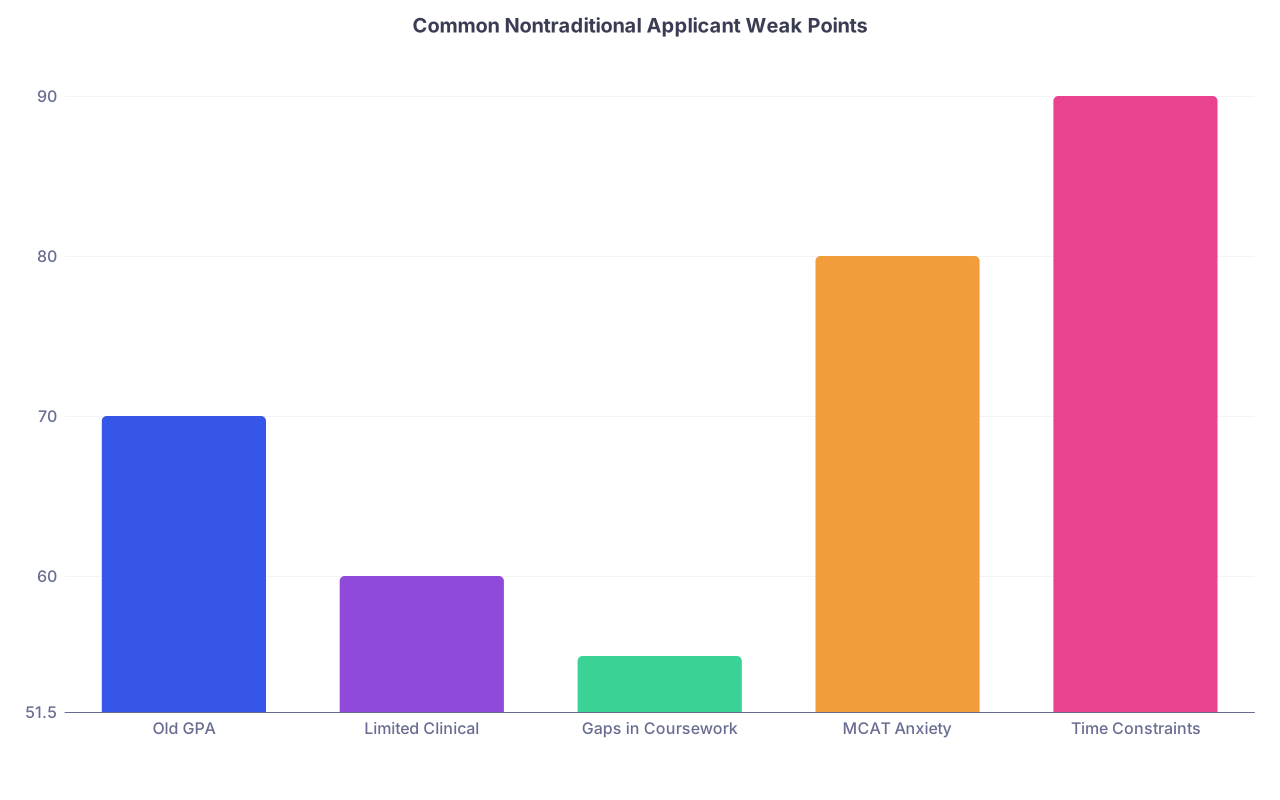
| Category | Value |
|---|---|
| Old GPA | 70 |
| Limited Clinical | 60 |
| Gaps in Coursework | 55 |
| MCAT Anxiety | 80 |
| Time Constraints | 90 |
That chart is basically your brain. But schools aren’t sitting there expecting you to fix all five categories to perfection.
Look up:
- MSAR (for MD) or Choose DO Explorer (for DO) to see school ranges
- School websites for nontraditional student stories
- Forums where people post accepted stats and backgrounds
You want to answer:
- “Given my old GPA and current performance, what MCAT range makes me competitive?”
- “What’s the minimal viable set of experiences so I don’t look clueless about medicine?”
Step 3: Draft a big-picture plan yourself
This feels terrifying. Do it anyway.
Example:
- Next 12–18 months: Finish prereqs, aim for A/A-, low B only if necessary
- Next 9–12 months: Ongoing clinical exposure (even 4–8 hrs/week matters)
- Next 6–9 months before MCAT: Focused, structured prep
- Application year: Apply early, realistic school list, strong personal statement that actually explains your path
You don’t need a mentor to start this. You need a brain, a calendar, and access to the internet.
What If Nobody Ever Fully “Gets” Your Story?
Let me just say what you’re afraid of:
“What if adcoms don’t get it either? What if they look at my messy career shift, my age, my non-perfect GPA and just think ‘nah’?”
Sometimes they will. Some schools are absolutely biased toward the young and linear. I’m not going to pretend otherwise.
But your job is not to find the magical audience of people who totally understand you. Your job is to:
Present a coherent narrative:
“Here’s where I started, here’s what changed, here’s what I did about it, here’s why medicine now, here’s proof I understand what I’m getting into.”Show academic readiness recently:
Post-bacc, DIY coursework, strong recent GPA. Not vague “I’ve grown a lot” without grades to prove it.Demonstrate contact with real medicine:
Not “I watched Grey’s Anatomy and shadowed twice.” Ongoing, consistent exposure.
Plenty of successful applicants never had a mentor who fully got them. They had:
- A patchy support system
- Some decent advice half the time
- A lot of trial and error
- And a stubborn refusal to quit
That can be enough.
You’re Not Behind, You’re Just on a Different Map
You’re watching 21-year-olds with neatly lined-up research posters and committee letters from premed offices that know them by name. You feel like you’re showing up to a marathon at mile 10.
You’re not behind. You’re just not running their race.
Let me be blunt:
You’re going to have to do more self-guiding.
More advocating for yourself.
More “I know this doesn’t fit the usual box, but here’s why I’m doing it this way.”
That doesn’t mean you’re less competitive. It means you’re running a different track with fewer signposts.
And honestly? A lot of attendings respect that more than the flawless premed robot who’s never failed at anything.

If You’re Panicking Right Now, Do This in the Next 2 Weeks
Keep it simple. Just two weeks.
Talk to one official advisor (even if they suck)
- Goal: get data, not life advice
- Ask about school outcomes, committee letters, logistics
Contact 3–5 possible clinical mentors
- Short, respectful email or in-person ask
- Aim for a shadowing opportunity or brief conversation
Join at least one nontraditional community
- Lurk, read success stories, search terms like “30-year-old accepted,” “career-change applicant”
- Ask one question that’s specific to your situation
Draft a one-page outline of your path
- Where you are now
- Targeted application year
- What you still need: prereqs, MCAT, experiences
Then, and only then, ask someone to reality-check that page. That can be:
- An advisor
- A nontrad who’s ahead of you
- A physician you’ve met through shadowing
- Even a decent online advising service if you can afford it
You’re not asking them to build your path. You’re asking: “Does this look broadly reasonable? What am I missing?” That’s a much easier ask—and people are way more willing to help when they’re not responsible for your entire life.
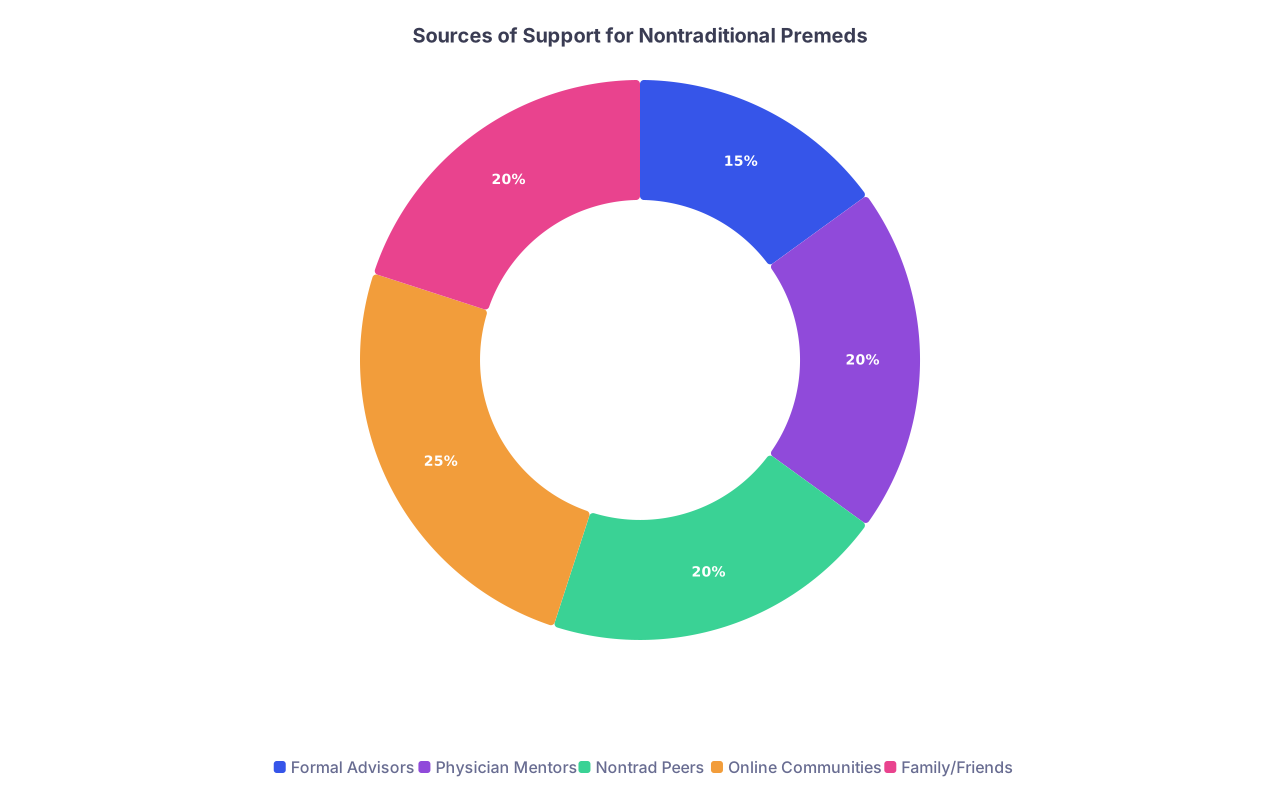
| Category | Value |
|---|---|
| Formal Advisors | 15 |
| Physician Mentors | 20 |
| Nontrad Peers | 20 |
| Online Communities | 25 |
| Family/Friends | 20 |
Notice how small the “Formal Advisors” slice is? That’s real. Most nontrads end up leaning more on peers, online communities, and a handful of physicians than on any single official mentor.
You’re not failing because you don’t have a “Dr. Perfect Nontrad Mentor” in your corner. You’re just doing what almost everyone in your situation has to do: building your own weird, stitched-together support network.
FAQs (Because Your Brain Won’t Stop Spinning)
1. What if I literally can’t find a single mentor who was a career-changer?
Then you lean on function over identity. You don’t need them to have been a 29-year-old accountant. You need:
- A doctor you can shadow
- Someone who understands the application logistics
- Someone—anyone—a little ahead of you who has actually applied
You can get those from three different people. That’s still mentorship, even if nobody matches your backstory.
2. Will med schools judge me for not having a fancy mentor or committee letter?
Some schools like committee letters, but they don’t care whether you had a “prestige mentor.” They care about:
- Strong letters from people who know your work
- Evidence you understand medicine beyond a surface level
- Recent academic performance
Nontrads get in all the time with:
- Individual letters instead of committee letters
- Regular community doctors writing for them
- No glamorous PI mentor attached to a big-name lab
3. How do I know if the advice I’m getting is actually good?
Red flags:
- “You’re too old, don’t bother” said without looking at your specifics
- “You must do X or you’ll never get in” with no nuance, especially if X = full-time unpaid research for a year
- People who haven’t applied in 10+ years pretending nothing’s changed
Green flags:
- They ask questions before giving advice
- They give ranges and options, not absolutes
- They’re honest about what they don’t know
Cross-check everything against current data: MSAR, school websites, multiple accepted students’ experiences.
4. What if my family thinks this is a bad idea and I have no emotional support?
Then emotional mentorship might need to come from:
- Online nontrad groups
- A therapist (seriously underrated in this process)
- One or two friends who don’t need to understand medicine to say, “I believe you can do this”
You’re allowed to separate “people who get my dream” from “people who just love me and keep me alive during this.” Both matter.
5. Is it a bad sign that everything feels harder for me than for traditional premeds?
No. It’s a sign you’re juggling more: work, kids, bills, old grades, self-doubt, age anxiety. Traditional students have their own nightmares, but yours are different and more logistical.
Harder doesn’t mean impossible. It just means you have less margin for wasted time and vague plans. You’ll need a clearer strategy and more self-advocacy. But plenty of people in your exact shoes have made it.
Key points to keep in your head when the panic spikes:
- You don’t need one perfect mentor who understands your entire career-change path; you need a small, imperfect collection of people who each help with one piece.
- Lack of “ideal” mentorship is normal for nontraditional applicants, not a secret sign you don’t belong in medicine.
- You can start building a real, workable plan yourself—then use whoever you can find to refine it, not to write it for you.