
Can You Reuse Parts of Your Personal Statement Across Specialties?
It’s November. You thought you were applying only to Internal Medicine, but after a rough sub-I and a surprisingly great Anesthesia elective, you pivoted. Now you’re staring at your IM personal statement and wondering: “Can I just tweak this and use it for anesthesia too? Or psych? Or prelim surgery + categorical IM?”
Here’s the answer you’re actually looking for, not the hand-wavy “it depends” version.
You can reuse parts of your personal statement across specialties—but only if you’re smart and ruthless about what carries over and what must be rewritten. Most people get this wrong. Programs can spot a recycled, lazy statement in about three lines.
Let’s break this down.
The Short Answer: Yes, But Only Specific Parts
You can safely reuse:
- Core personal story elements (a key patient, formative life experience, short anecdote)
- Your broader motivations for medicine as a whole
- Values and traits that matter in any specialty (work ethic, curiosity, teamwork, resilience)
- A bit of your background narrative (first-gen, non-traditional, major life shifts)
You must not reuse:
- The specialty-specific “why X” paragraphs (e.g., why EM, why Derm)
- The way you frame your strengths for that specialty
- Your discussion of clinical experiences that clearly scream a different specialty
- Any language that sounds like you copied an Internal Medicine essay and slapped “Pediatrics” in a few spots
If your statement reads like: “I am drawn to the broad differential diagnosis and longitudinal care of Internal Medicine” and you send that to Anesthesia programs with one word changed…that’s how you get quietly down-ranked.
What Can Be Reused Safely (And How To Do It)
Think of your personal statement in four rough chunks:
- Hook / Opening story
- Why medicine / who you are as a person
- Why this specialty
- What you offer / closing
Chunks 1 and 2 are where you can reuse the most.
1. Opening Story
If you have a strong, authentic story about:
- A key patient encounter
- An early life experience
- A turning point in clinical rotations
- A personal challenge that shaped how you show up as a physician
You can absolutely reuse that across specialties—if you frame it correctly.
Wrong approach:
Make the story obviously tied to a specific specialty and then force it onto another.
Example of a bad reuse:
You write about managing a complex heart failure patient on your IM rotation, talk nonstop about your love of complex chronic disease and continuity, then send the same opening to EM and pretend it’s about “acutely stabilizing undifferentiated patients.”
Better approach:
Use an experience that shows core physician qualities: communication, composure, empathy, analytical thinking. Then relate those qualities differently in each specialty-specific section.
Same story, two different uses:
- For Internal Medicine: you emphasize longitudinal thinking, diagnostic reasoning, building trust.
- For Emergency Medicine: you emphasize rapid assessment, prioritization, working under pressure as part of a team.
The story can be recycled. The lesson you draw from it should be tuned to the specialty.
2. Why Medicine / Who You Are
Your broad “why I wanted to become a physician” usually doesn’t change between specialties. That can be reused almost verbatim if it’s not stuffed with specialty-specific buzzwords.
You can safely reuse:
- Background: “I grew up as an interpreter for my parents in medical settings…”
- Motivations: “I’m driven by reducing barriers to care, especially for underserved patients…”
- Traits: “I tend to take ownership, seek feedback, and actively look for ways to improve team function…”
This is your “general physician” narrative. It’s the spine you can use in all versions.
Just watch for landmines:
- Don’t say: “I always knew I wanted to go into surgery…” in a statement you send to Pediatrics.
- Don’t mention a specific specialty society, conference, or mentor in a way that obviously belongs to one field and then reuse it for the others.
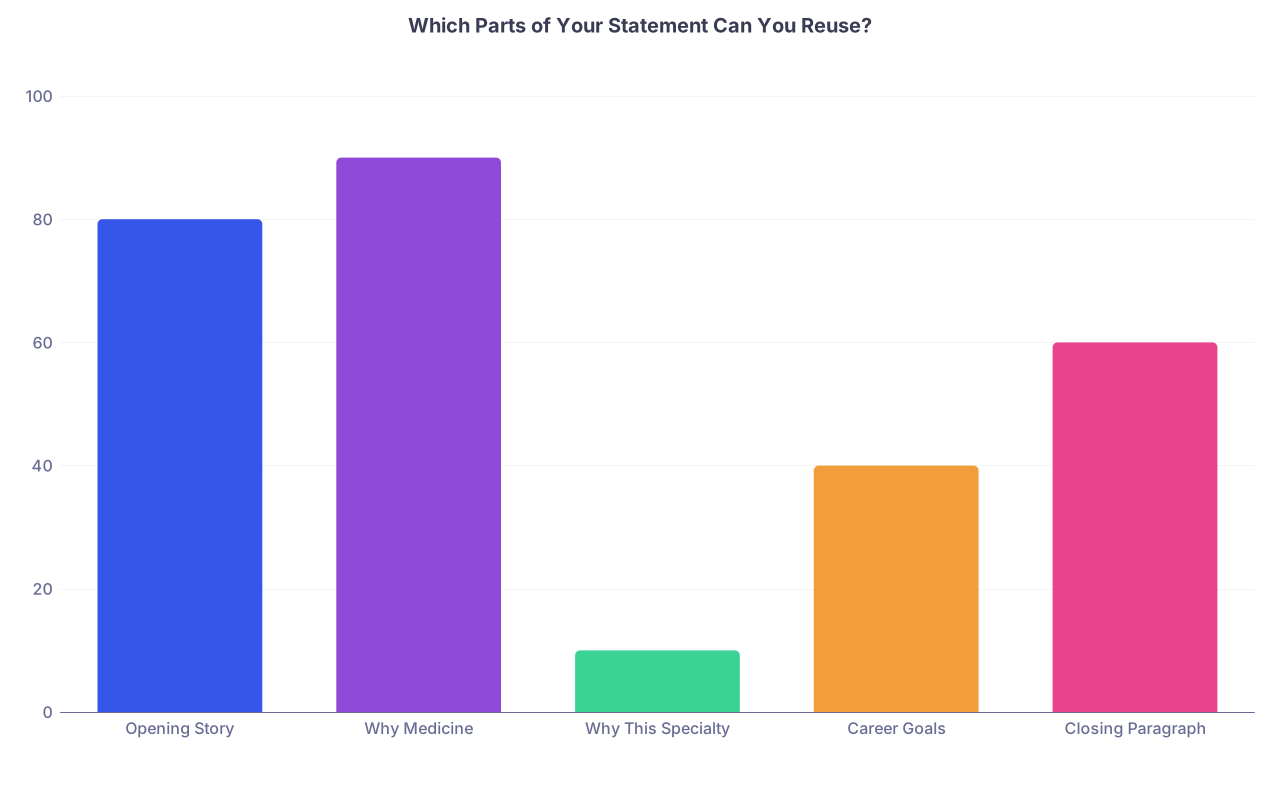
| Category | Value |
|---|---|
| Opening Story | 80 |
| Why Medicine | 90 |
| Why This Specialty | 10 |
| Career Goals | 40 |
| Closing Paragraph | 60 |
What Must Be Rewritten For Each Specialty
This is where people get lazy and get burned.
Three areas must be specialty-specific:
- Why this specialty
- How your experiences prepared you for this specialty
- Your future career goals in that field
1. The “Why This Specialty” Paragraph
If a PD can swap out “Internal Medicine” and put “Psychiatry” and your paragraph still makes sense, you did it wrong.
You need concrete, specialty-specific reasons:
- IM: longitudinal relationships, complex chronic disease, systems thinking, ward leadership, inpatient + outpatient balance.
- EM: undifferentiated patients, acute resuscitation, shift work, procedural mix, team-based crisis care.
- Anesthesia: physiology focus, perioperative medicine, airway management, real-time problem solving.
- Psych: therapeutic alliance, narrative work, complexity of mind/brain, long-term recovery.
Vague lines like “I enjoy working with a variety of patients in multiple settings” could fit almost anything. That’s the kind of fluff that gets you ignored.
2. How Your Experiences Fit That Field
Same rotations, different emphasis.
You might reuse the experience, but you must reframe:
- For IM: “On wards, I enjoyed following patients over several days, adjusting management and watching them improve.”
- For EM: “On my ED rotation, I thrived during high-volume shifts, rapidly triaging and initiating workups for multiple patients at once.”
Don’t send an EM program a statement that raves about continuity clinic and then toss in one line about “also enjoyed the ED.”
If you’re applying to two specialties, you should have:
- At least one major experience anchor that clearly aligns with each.
- Distinct language about what you actually enjoyed in those rotations.
3. Career Goals
You do not need an exact 20-year roadmap. But you should not send this:
“I hope to pursue a career in academic Internal Medicine with a focus on inpatient teaching and quality improvement”
…to a Transitional Year program or an Anesthesia program.
Create a few “modular” goal options that you can drop in:
- Medicine: academic hospitalist, primary care in underserved settings, subspecialty with research, etc.
- EM: community EM, academic EM, EMS, ultrasound, toxicology interest.
- Psych: outpatient work, inpatient, C/L, addiction, integrated care.
Then customize the paragraph so it’s obviously tailored, not copy-pasted with different nouns.
How To Reuse Without Getting Caught Looking Lazy
You’re not trying to game the system; you’re trying not to rewrite your life story from scratch five times. That’s fine. Here’s a clean way to structure it.
Build a “Master” Personal Statement
Write one long, honest, high-quality version that covers:
- A strong opening story
- Your path into medicine
- Your core values and traits
- A few key clinical experiences (not hyper-specialty-locked yet)
- A general sense of your interests
This is your raw material, not the final product.
Then, for each specialty:
- Duplicate the document.
- Rewrite:
- The “why this specialty” section
- How you describe and interpret your clinical experiences
- Your future goals paragraph
- Scan and remove:
- Any specialty-specific terms that don’t fit this version
- Any faculty/program names that don’t belong
- Any obvious copy/paste edits (e.g., “my interest in internal pediatrics…”)

| Step | Description |
|---|---|
| Step 1 | Write Master PS |
| Step 2 | Copy for Specialty 1 |
| Step 3 | Copy for Specialty 2 |
| Step 4 | Customize Why Specialty |
| Step 5 | Adjust Experiences |
| Step 6 | Set Specific Goals |
| Step 7 | Customize Why Specialty |
| Step 8 | Adjust Experiences |
| Step 9 | Set Specific Goals |
Mixed Applications: Prelim, TY, and Multiple Categorical Specialties
This is where it gets messy and people overthink or under-think.
Categorical + Prelim/TY (e.g., Neuro + Prelim Medicine)
For prelim/TY programs, your statement can:
- Reuse your main opening and background.
- Briefly acknowledge your intended categorical specialty.
- Emphasize what makes you a good intern in any field: reliability, work ethic, communication, teachability.
You do not need a totally separate life story for prelims. But do not send a heartfelt love letter to Dermatology to a Medicine prelim spot without mentioning why you’ll be a committed, functional intern.
One clean approach:
Write a prelim/TY-specific closing paragraph like:
“While my long-term goal is to train in [Specialty], I see my intern year as foundational to becoming a strong physician. I’m looking for a program that will challenge me clinically, support my growth as a team member, and prepare me to care for medically complex patients across settings.”
Paste that into your prelim/TY versions and adjust slightly as needed.
Truly Dual Applications (e.g., IM + Anesthesia, EM + Psych)
This is the danger zone. Programs can often tell when you’re hedging.
You need:
- Two distinct personal statements.
- Two distinct “why this specialty” narratives.
- Overlap only in background and core values.
If you try to use 80% of the same essay and just swap a paragraph, your tone will feel off. I’ve seen PDs read a statement for Anesthesia that spent half its time on Primary Care and just shake their head.
Split your master essay into:
- Shared sections: background, general “why medicine.”
- Forks: clinical experiences, why specialty, goals.
Aim for maybe 40–60% shared content, 40–60% specialty-specific. More shared than that and it starts to smell like a template.
| Scenario | Approx. Reusable Content |
|---|---|
| Categorical + matching TY (IM + TY) | 60–70% |
| Categorical + prelim in same field | 70–80% |
| IM + closely related subspecialty | 50–60% |
| IM + Anesthesia | 40–60% |
| EM + Psych | 40–60% |

Common Mistakes When Reusing Personal Statements
I’ve seen these sink otherwise solid applications:
Specialty name swap disasters
“My passion for Internal Medicine” in a Pediatrics statement because you forgot to change one instance. People notice.Contradictory motivations
You tell EM programs you love shift work and acute care, then tell Psych programs you’re drawn to longitudinal relationships and long-term follow-up—using the same core story. That reads manufactured.Over-generic statements
You remove every specialty-specific phrase so you can reuse the whole thing. What’s left: a bland, content-free essay that could be for any job in health care.Old-personal-statement recycling
Reusing your med school personal statement content with minimal changes. The voice, maturity, and experience level will not match who you are now. PDs can tell when something reads “premed-y.”Last-minute edits that break the logic
You change the specialty name but forget to adjust which rotations you highlight or how you describe them. Now your “favorite experience” is a Surgery sub-I in a Radiology application with no explanation. Looks sloppy.
A Practical Workflow You Can Actually Use This Week
If you’re already time-crunched, do this:
- Pick your primary specialty and write that statement first. Make it your best work.
- Save that as your “master” version.
- For each additional specialty:
- Strip out the “why this specialty” paragraph and goal paragraph.
- Rewrite those completely from scratch.
- Scan the remaining essay for any language that leans too hard toward the first specialty and neutralize or reframe it.
- Print each version and read it out loud once. You’ll catch most of the awkward carryover language that way.
- If possible, have someone who knows the specialty (resident, fellow, faculty) read your specialty-specific paragraphs only. Ask: “Does this sound like someone who actually understands and wants this field?”
If they say it sounds generic or off, fix it. Do not trust your own gut fully here; you’re biased toward “good enough” when you’re tired.
FAQ (Exactly 7 Questions)
1. Can I use the exact same personal statement for two different specialties?
You can, but you should not. Using the exact same statement with only the specialty name changed signals lack of genuine interest and poor judgment. At minimum, rewrite the “why this specialty,” the discussion of relevant experiences, and the goals section for each field.
2. Is it okay to use the same opening patient story for multiple specialties?
Yes, as long as you interpret it differently for each specialty. The story can stay, but the lesson you highlight and how it points you toward that field must change. If the story clearly screams one specialty (e.g., OR-focused moment) and you send it to a very different field without reframing, it looks lazy.
3. How different do my statements need to be if I’m applying to both a categorical and a prelim in the same general area (e.g., IM categorical + prelim medicine)?
They can be quite similar. You can reuse most of the background and values. What you must add for prelim/TY is a clear acknowledgment of your role as an intern and why you’ll be a reliable, teachable, hard-working team member regardless of eventual specialty.
4. Will program directors actually notice if I recycle too much?
Yes. They read hundreds of these every year. Generic statements, leftover specialty names, mismatched motivations, and copy-paste vibes stand out fast. You may not get “rejected for the essay alone,” but in competitive pools, this is exactly the kind of thing that gets you quietly dropped.
5. Can I reuse parts of my medical school personal statement?
You can borrow bits of your story, but you should not reuse the text. Your voice, insight, and clinical experience have changed. A residency personal statement that sounds like a polished premed essay is a red flag. Translate the core story into your current perspective as someone who has actually taken care of patients.
6. How long should each specialty-specific section be?
Roughly one solid paragraph each for: “Why this specialty” and “How my experiences fit this field.” Another shorter paragraph for “Goals in this specialty.” Together, those specialty-specific sections should make up at least one-third of the essay for that field.
7. If I only have time to perfect one statement, which should it be?
Prioritize the specialty you care about most or the one that’s most competitive for your profile. Make that statement excellent. Then build the others by carefully adapting that master version. Just do not let “time pressure” be your excuse for sending painfully generic, obviously recycled essays.
Core takeaways: you can reuse the backbone of your story, but you must rewrite the specialty-specific muscles and joints. Make one strong master narrative, then be intentional and precise in how you adapt it for each field. And never assume programs “won’t notice.” They will.