
The idea that a PhD before med school “shortens” your path is fantasy. It almost never shortens anything. It just trades one kind of time for another.
The Core Myth: “I’ll Get a PhD First, Then Med School Will Be Faster”
Here’s the blunt version:
Doing a PhD before medical school almost always makes your overall training longer, not shorter. And not by a little.
Let’s define some basics.
- MD only: 4 years of med school
- MD + residency: 7–11 years total after college, depending on specialty
- PhD in biomedical sciences: 4–7 years on average (yes, real-world average, not brochure fantasy)
People imagine this pathway:
“I’ll do a PhD, become a research beast, then med school will be easy, I’ll place out of stuff, and I’ll finish earlier / advance faster.”
Reality: you almost never get meaningful advanced standing. You just start med school older, often with different strengths, sometimes with more credibility in research-heavy environments—but the calendar does not care about your narrative.
Let’s put typical timelines side by side.
| Pathway | College | PhD | MD | Residency/Fellowship | Total Post-High School |
|---|---|---|---|---|---|
| MD only | 4 yrs | — | 4 yrs | 3–7 yrs | 11–15 yrs |
| MD-PhD (MSTP) | 4 yrs | 3–5 yrs | 4 yrs | 3–7 yrs | 14–20 yrs |
| PhD → MD | 4 yrs | 4–7 yrs | 4 yrs | 3–7 yrs | 15–22 yrs |
You read that right. The PhD → MD route is usually the longest of all.
What Actually Happens When You Arrive at Med School With a PhD
You don’t start in third year. You don’t get to “skip” core clerkships. You do not get a special track that magically compresses training.
Here’s what you actually get in most US programs as a PhD entering MD:
Emotional and intellectual advantages
You’re more comfortable with uncertainty, stats, reading primary literature, giving talks. You’re better at “I don’t know, but I can find out.”Occasional curricular exemptions
- Some schools will let you skip a basic research methods course or a token scholarly project requirement.
- Maybe you can waive a summer research block because you’ve already done plenty.
- Rarely, you might get out of one or two didactic units if they overlap heavily with your PhD (e.g., advanced immunology).
Zero change to the big milestones
- Same Step exams
- Same core clerkships
- Same length of MD program
- Same residency requirements
You’re not shortening the MD. You’re reframing your four years of med school with a heavier research lens.
And here’s the kicker: many PhD→MD students I’ve seen end up adding extra research time during or after med school (research year, postdoc-like fellowship) because they want a serious academic job. So the training gets even longer.
“But My PhD Will Make Residency Shorter… Right?”
No. Residency is a clinical apprenticeship with mandatory time requirements, often enforced by boards and accrediting bodies. They don’t care if you’ve pipetted 10,000 times or published 12 first-author papers.
You can use PhD skills to:
- Match better in some academic programs
- Land more competitive research-heavy fellowships
- Progress faster in terms of academic rank once you’re faculty
But shaving years off board-required clinical training? That’s fantasy.
Let’s be concrete. A few real patterns I’ve seen:
- Internal Medicine: 3 years, whether or not you have a PhD.
- IM + Hem/Onc: 3 + 3. Most physician–scientists still do full-length fellowship because they need the clinical volume and protected research time structure.
- Neuro + research: 1 prelim + 3 neuro + 1–3 years of postdoc-like research either embedded or afterward. The PhD doesn’t delete residency years.
Where a PhD might save time is post-residency ramp-up. You hit your first faculty job with:
- Grants already written (and maybe funded)
- A defined niche
- A CV that can go to an R01 sooner
But that’s career stage, not calendar years of training. You’re still older than your MD-only colleague who started residency five years before you.
Let’s visualize the “age at first attending job” reality.
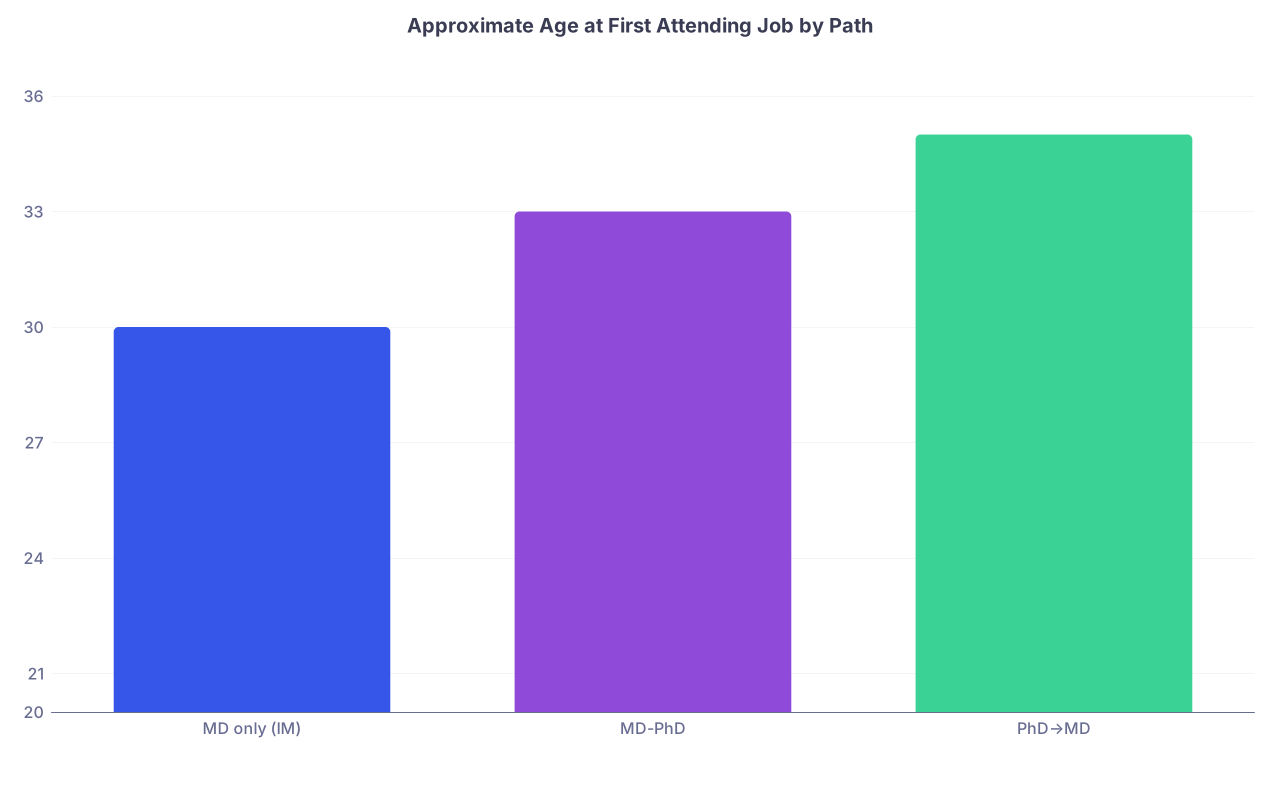
| Category | Value |
|---|---|
| MD only (IM) | 30 |
| MD-PhD | 33 |
| PhD→MD | 35 |
These are typical, not universal. But the direction is correct: PhD before MD delays, not accelerates, the attending start line.
The Real Question: Are You Buying Time or Buying Options?
The PhD isn’t a time-saver. It’s an options-expander—in very specific lanes.
Where a PhD before med school actually pays off:
- You want to be a serious, grant-funded physician–scientist in a basic or translational field (e.g., cancer immunology, stem cell biology, systems neuroscience).
- You love being in the lab enough that spending your 20s (and maybe early 30s) there actually sounds good.
- You want the credibility and technical depth to run an independent wet lab later, not just be “the MD on the grant.”
Where it’s usually overkill or even counterproductive:
- You mainly want to be a clinician who “does some research on the side.”
- You’re chasing prestige or trying to “stand out” for medical school applications.
- You think the PhD will be some kind of shortcut to derm, ortho, or plastics.
If you’re mostly clinically driven, the more efficient route to research credibility is:
MD (maybe with built-in research) → research-intensive residency/fellowship → mentored research time / K award.
That’s a lot shorter than PhD → MD for most people.
PhD Before MD vs Combined MD-PhD (MSTP): Not the Same Game
Another misconception: “I’ll do the PhD first, then med school—same as MD-PhD, just in a different order.”
No. The structure and incentives are different.
| Feature | PhD → MD | MD-PhD (MSTP-style) |
|---|---|---|
| Funding for MD | Usually full tuition, self-funded | Often fully funded (tuition + stipend) |
| Integration of training | Minimal | High (designed to interlock) |
| Total time | Longest on average | Long, but more optimized |
| Research continuity | Often disrupted | Preserved with structured reentry |
| Signaling to programs | More variable | Clear physician–scientist track |
PhD-first folks often finish their PhD, then sit out research almost completely for 4–7 years while they grind through med school and early residency. By the time they come up for serious grant funding, their research may be stale, their techniques outdated, and their network cooled off.
With a well-run MSTP-type program, you at least have:
- Built-in mentorship for reentering the lab
- Institutional expectation you’ll be a physician–scientist
- Protected time models somewhat baked into residency decisions
Is MSTP perfect? No. Plenty of MD-PhDs never end up doing much research. But structurally, it’s less of a detour than PhD → MD as two separate, non-communicating worlds.
Does a PhD Help You Get Into Med School?
Yes—but not the way people think.
Admissions committees do not give you a magic GPA/MCAT discount just because you have a doctorate. They care about:
- Can you handle the academics? (GPA, MCAT, recent coursework)
- Do you understand what medicine actually is, in real life?
- Do your experiences and letters show reliability, teamwork, maturity?
Where a PhD helps:
- Maturity and narrative: You’ve actually committed to something hard, for years, and finished it.
- Research cred: At research-heavy schools, they like people who can generate papers and grants.
- Interview performance: You can talk about failure, iteration, and uncertainty in a way college kids often cannot.
Where it does not help:
- Weak MCAT: A 504 with a PhD in cell biology is still a 504.
- Poor clinical exposure: Spending 7 years in a windowless lab and zero time shadowing does not convince anyone you want to treat patients.
- Social mismatch: If you come off as condescending to non-PhD classmates or faculty, the degree becomes a liability.
I’ve watched applicants walk in with 3 first-author Nature papers and still get grilled because they couldn’t explain why they wanted to practice medicine rather than just keep pipetting.
So yes, a PhD can be a plus. But it isn’t a golden ticket, and certainly not a time-saver.
What About Money? Does It Pay Off Financially?
Another quiet myth: “I’ll be older, but my higher academic rank and research grants will compensate. It evens out.”
Sometimes. But not reliably.
Think about the lost-earning-years problem:
- MD-only internist might start attending life at ~30.
- PhD→MD internist might start at 34–36.
That’s 4–6 years of attending-level earnings (easily $200k–$300k+ per year) traded for PhD stipend wages plus more trainee income. You need a very strong reason to believe that later-career advantages will compensate for $1M+ in foregone early-career income. Sometimes they do. Often they do not.
Here’s a simplified rough picture.
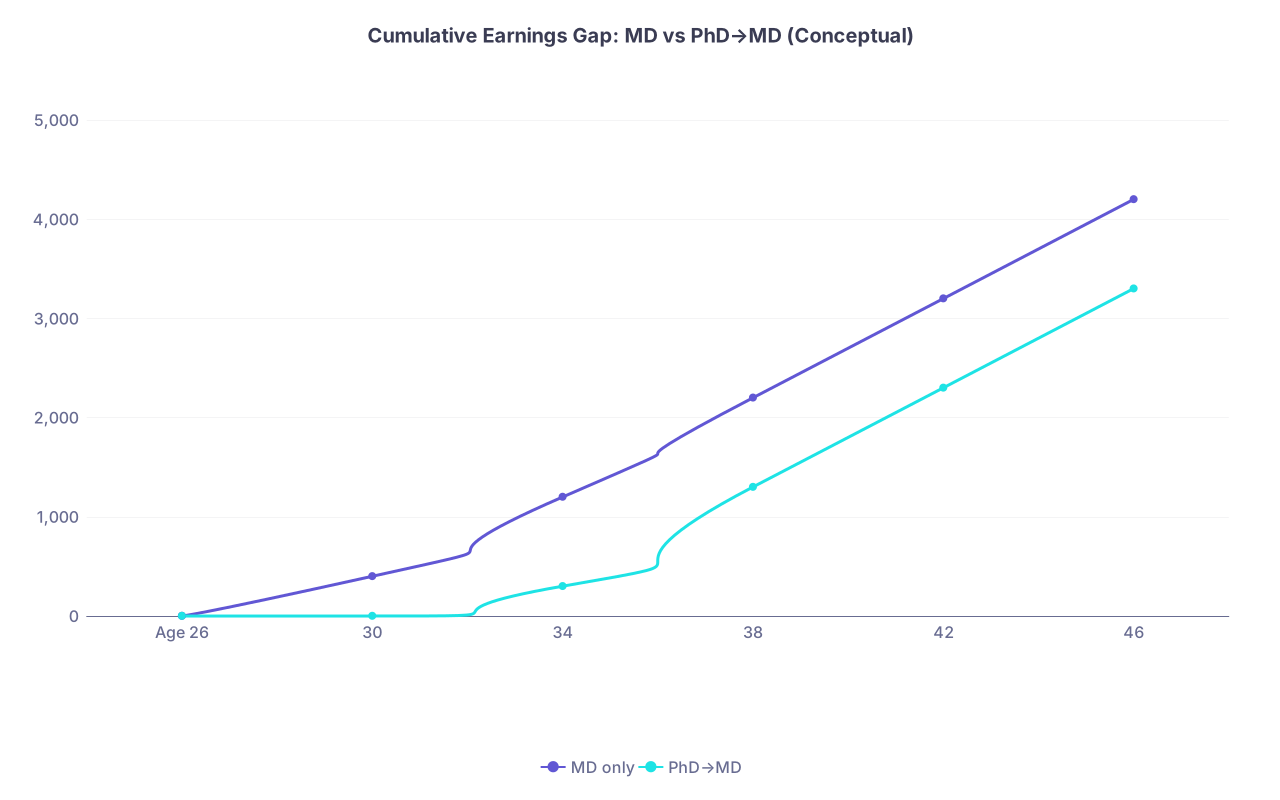
| Category | MD only | PhD→MD |
|---|---|---|
| Age 26 | 0 | 0 |
| 30 | 400 | 0 |
| 34 | 1200 | 300 |
| 38 | 2200 | 1300 |
| 42 | 3200 | 2300 |
| 46 | 4200 | 3300 |
Units here are “thousands of dollars” and the numbers are illustrative, not precise. The shape is the point: the later you start as an attending, the more you’re betting the long-term academic upside will be worth the delayed earnings.
If you want to be a clinician–educator or community doc? The PhD rarely makes financial sense.
If you want to be a funded lab PI with clinical privileges? Different story—but again, you’re trading time for that shot.
Where a PhD Before MD Does Make Sense
Let me be fair. There are scenarios where PhD → MD is not crazy, and sometimes exactly right.
You already started and are deep into a PhD when you realize you want medicine.
You’re in year 3–4, you like research but you want clinical work too. In this case, quitting your PhD may cost you almost as much time as just finishing it. Here, PhD → MD is damage control plus opportunity.Your research field and future specialty actually need deep, technical lab expertise.
Example: you’re doing advanced computational neuroscience or CRISPR engineering and you want to be the person who spans bench to bedside. Your future value might rely on that deep technical history.You’re targeting the 1–5% of jobs that are truly 80%+ research, 20% clinic.
Top-tier academic centers sometimes prefer or expect a PhD for hardcore bench PIs who also happen to be physicians. You’re trying to become that person.
But in all of these, the motivation is:
“I want to do this exact kind of work, and a PhD is the appropriate tool,”
not:
“I want medicine, and maybe a PhD will make it faster/more prestigious.”
Decision Flow: Should You Do a PhD Before Med School?
Let’s make the choice brutally clear.

| Step | Description |
|---|---|
| Step 1 | Want to be a physician |
| Step 2 | Do NOT add a PhD |
| Step 3 | MD with strong research track |
| Step 4 | Consider MD-PhD not PhD then MD |
| Step 5 | Reevaluate - quitting may be ok |
| Step 6 | Finish PhD then apply MD |
| Step 7 | Primary identity clinical or research |
| Step 8 | Need deep lab expertise |
| Step 9 | Already in PhD? |
If you’re mostly drawn to seeing patients, solving diagnostic problems, and working on teams in clinical environments, a PhD is unnecessary ballast. It will not make you a better clinician faster. It will just make you an older clinician later.
If you’re honestly more in love with research, then you have to decide which kind:
- If it’s very technical bench science → PhD can fit.
- If it’s outcomes, education, QI, or clinical trials → MD + targeted research training is more efficient.
The Bottom Line: What the Data Actually Show
Let’s stop pretending a PhD before med school is some secret shortcut. It isn’t.
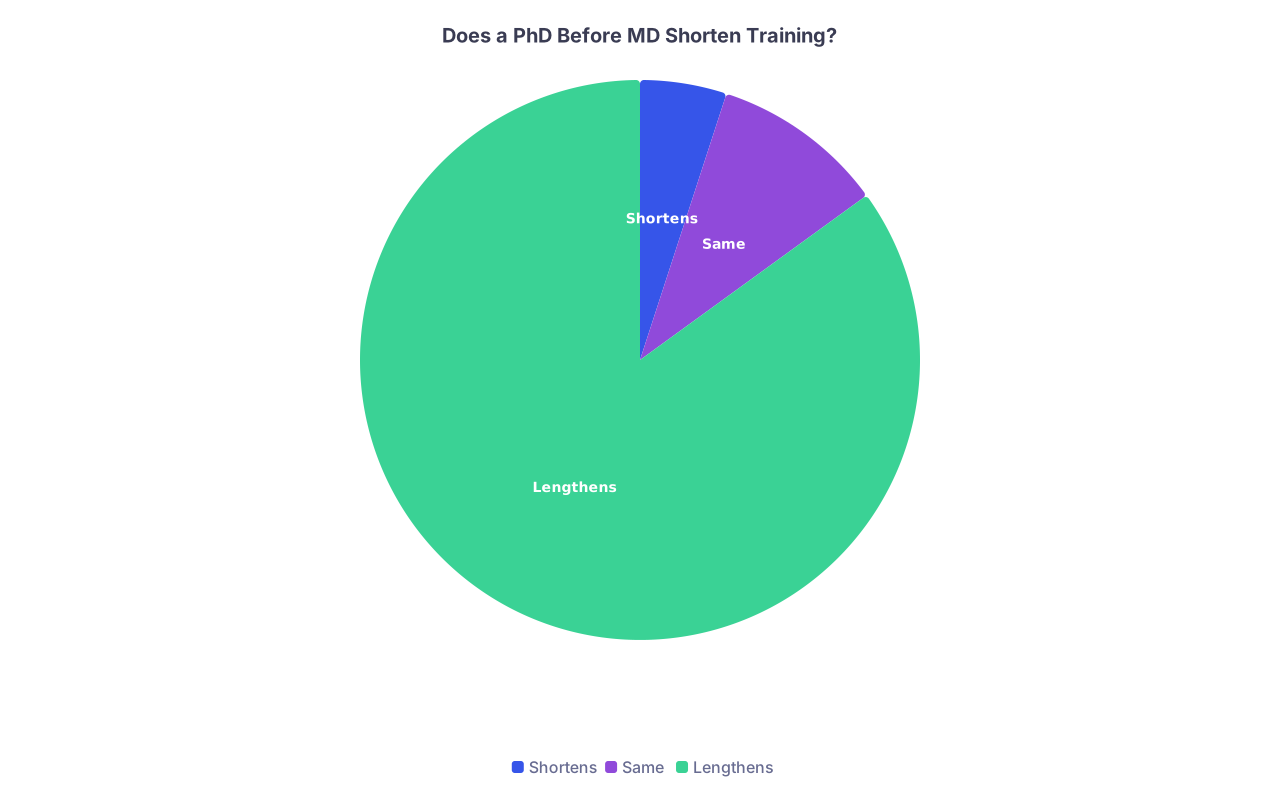
| Category | Value |
|---|---|
| Shortens | 5 |
| Same | 10 |
| Lengthens | 85 |
Again, approximate, but directionally accurate: in the overwhelming majority of realistic paths, your training is longer, not shorter, with a PhD before MD.
If you remember nothing else, remember this:
- A PhD before med school does not shorten MD or residency; it nearly always extends your total training time.
- The PhD only “pays off” if you genuinely want a research-heavy, physician–scientist career—not just a competitive residency or a shiny line on your CV.
- Choose the PhD for the work you want to do, not as a time-saving hack. The calendar does not care about your narrative.