

The worst time to remember your $300,000 in student loans is after you have already signed your first attending contract. But if you are there now, you are not stuck. You just have to stop wishing and start negotiating with a plan.
You can add loan repayment to an existing job offer. I have watched physicians do it after verbal acceptance, during onboarding, even at renewal. The ones who win treat it like a structured negotiation, not a casual ask.
Here is the stepwise plan.
Step 1: Get Completely Clear on Your Current Position
You cannot negotiate from fog. You need hard numbers and clear terms.
Do this in writing, not in your head.
Pull your current offer or contract.
- Identify:
- Base salary
- Bonus structure (wRVUs, quality, call, etc.)
- Any existing incentives (sign-on bonus, relocation, CME, stipend)
- Contract term (1 year, 2 years, 3 years)
- Termination clauses (without cause notice, with cause)
- Non-compete / restrictive covenants
- Look for any existing educational loan assistance clause, even if currently blank or “not applicable.” That is your hook.
- Identify:
Get your loan reality on paper.
- Total principal
- Weighted average interest rate
- Current or expected monthly payment on your chosen plan
- Whether you are aiming for:
- Standard payoff
- Aggressive early payoff
- PSLF or other forgiveness
- Number of years left under each scenario
You are not going to send this whole spreadsheet to your employer. This is for you, so you can back into a rational ask.
Clarify your exact goal. This is where most physicians get vague and lose.
Decide:
- Do you want:
- A fixed annual loan repayment (e.g., $25,000 per year for 3 years)?
- A lump sum sign-on bonus explicitly earmarked for loans?
- A forgivable loan structure (e.g., $90,000 paid off over 3 years if you stay)?
- How much per year changes your life in a meaningful way while still being defensible to the employer?
- Do you want:
You are not just asking: “Can you help with my loans?” You are going to ask: “Can we add $X per year of educational loan repayment, tied to Y-year commitment?”
Step 2: Know What Is Reasonable in Your Market
You want to play inside the boundaries of what your employer’s finance or HR committee has already seen before. That is how you get to “yes.”
Research typical physician loan repayment
Use both public and behind-the-scenes data.
- Public sources:
- MGMA or AMGA data (if you have access through your institution or colleagues)
- Job listings on:
- 3RNet (lots of rural and underserved positions with structured loan repayment)
- Major health systems in your region
- Federal positions (VA, IHS, NHSC) as reference points
- Ask actual people:
- Recent grads from your residency/fellowship:
- “Anyone get loan repayment at [Your System] or similar?”
- Recruiters you did not sign with:
- “What are you seeing for loan repayment in [Your Specialty] in [Region]?”
- Recent grads from your residency/fellowship:
You are looking for realistic ranges, not unicorn offers.
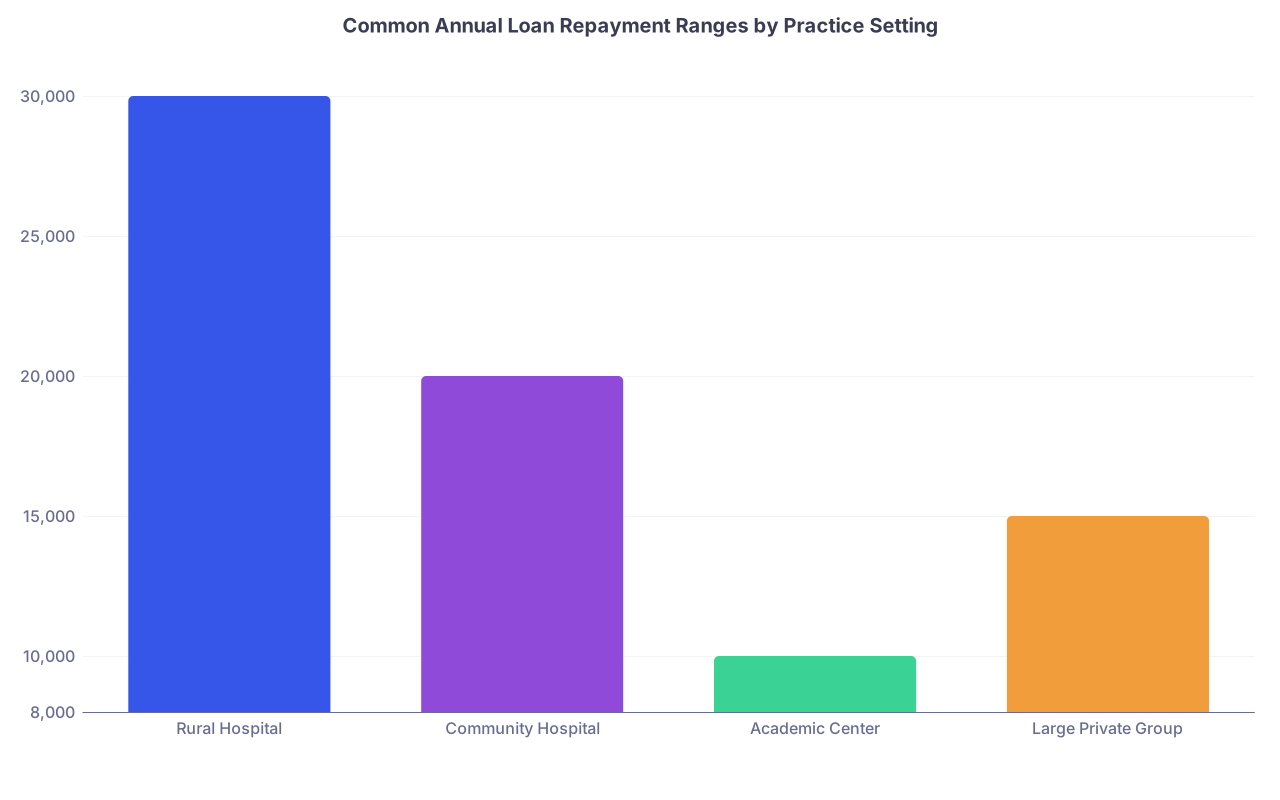
| Category | Value |
|---|---|
| Rural Hospital | 30000 |
| Community Hospital | 20000 |
| Academic Center | 10000 |
| Large Private Group | 15000 |
Rule of thumb I see repeatedly:
- Rural / underserved: $20,000–$50,000 per year
- Community hospitals: $10,000–$30,000 per year
- Academic centers: $0–$15,000 per year (often weak here)
- Private groups: highly variable; sometimes bigger numbers but more strings attached
Map your ask to your local reality
Now anchor your request.
- If you are in a high-need rural setting, you can credibly ask on the higher side.
- If you are at a prestige academic center in a major city, you are not getting $50,000 per year. Ask in the $10,000–$20,000 range and tie it to retention.
- If you are a high revenue specialty (orthopedics, cardiology, GI), the overall package tolerance is larger, but these groups often prefer wRVU incentives over loan language. You can still add it, but expect pushback on structure, not amount.
Your goal: an ask that feels aggressive to you but still lands as “within the realm of industry norm” for them.
Step 3: Decide When to Raise Loan Repayment
Timing is half the battle. The mistake: asking after everything is signed and you are three months on the job. Very little leverage left.
Here is the realistic leverage scale:
| Timing Window | Leverage Level |
|---|---|
| Before signing contract | High |
| After verbal offer, before signing | High |
| During contract renewal | Medium |
| During active employment (mid-term) | Low–Medium |
| After announcing other offers | Mixed |
If you have NOT signed the contract yet
This is the best case.
You say something like:
“I am very interested and would like to move forward. There is one remaining concern for me, which is my student loan burden. Is your group open to incorporating an educational loan repayment component into the package if I commit to a longer term?”
That line does a few things:
- Confirms enthusiasm.
- Frames loans as “remaining concern,” not a demand.
- Signals willingness to trade time/commitment for loan help.
If you HAVE signed but have not started
You have less leverage but still some. They have invested in onboarding, credentialing, scheduling.
Frame it as:
“As we get closer to my start date, I have been looking hard at my student loan picture. I should have discussed this earlier. Would your system consider adding an educational loan repayment benefit tied to a multiyear commitment?”
You are not threatening. You are inviting them to secure you more firmly.
If you are already working
Your leverage now depends on your value and your credible alternatives.
Good times to ask:
- During annual review.
- When renewing or extending the contract.
- After demonstrable high performance (wRVUs, patient satisfaction, taking extra call, leadership roles).
Use your performance:
“Over the last year, my volumes have been at [X% above target], and I have taken on [Y responsibilities]. I am committed to staying here long term, and my only real pressure point is student loans. Can we look at adding a structured loan repayment benefit tied to an extended commitment?”
Step 4: Build a Specific, Trade-Based Proposal
You are not begging for charity. You are trading something the employer wants for something you need.
Step 4A: Quantify what you are offering
Employers respond to stability and predictable revenue.
You can offer:
- Longer initial contract term (e.g., 3 years instead of 1 or 2)
- Longer repayment/retention period (e.g., 4 years of service obligation)
- Additional roles:
- Medical directorship
- Committee leadership
- Additional call coverage
- Geographic or schedule concessions:
- Willingness to cover satellite locations
- Less desirable shifts
Pick 1–2 that are true, not 10 that are theoretical.
Step 4B: Design loan repayment structures they can actually implement
Here are the main structures I see work. Stick to one of these unless you have a strong reason not to.
Annual payment with service obligation
- Example: $20,000 per year for 3 years
- Paid either:
- Directly to lender
- As taxable income marked as “educational loan repayment”
- Usually tied to:
- “If physician voluntarily terminates before 3 years, prorated portion must be repaid.”
Forgivable loan
- Hospital pays, say, $90,000 into a forgivable loan.
- Loan is forgiven in equal parts over 3–5 years of continuous service.
- If you leave early, you owe the unforgiven balance.
Reframed sign-on bonus
- If they hate the word “loan repayment,” they might accept:
- Increased sign-on bonus with explicit language:
- “Sign-on bonus intended to assist with educational loans.”
- Increased sign-on bonus with explicit language:
- Same claw-back terms as typical sign-on: repay prorated amount if you leave before X years.
- If they hate the word “loan repayment,” they might accept:
Hybrid
- Smaller sign-on; ongoing annual payments.
- Example:
- $15,000 immediate bonus
- $10,000 per year for 3 years
Choose a structure that aligns with your risk tolerance:
- If you are absolutely sure you will stay: multi-year forgivable loan is fine.
- If you are not sure: favor annual payments earned each year with no backward claw-back beyond that year.
Step 5: Craft Your Ask — The Actual Words
Stop winging it. Script the first 2–3 sentences.
You will probably do this first in an email, then by phone or in person.
Sample initial email (pre-signing)
Subject: Finalizing Offer – Educational Loan Repayment
Dear [Recruiter/Administrator Name],
I appreciate the offer and am enthusiastic about joining [Group/Hospital]. Before we finalize, I wanted to ask whether your organization is able to offer an educational loan repayment component as part of the package. My student loan burden is significant, and structured loan assistance tied to a multiyear commitment would make a substantial difference for my family.
Would it be possible to discuss options such as an annual loan repayment benefit or a forgivable loan over a 3–4 year period? I remain very interested in the position and I am hopeful we can address this last piece.
Sincerely,
[Your Name]
Sample initial email (already signed, not started)
Subject: Question About Loan Repayment Options
Dear [Name],
As I prepare to start with [Group/Hospital] on [Date], I have been reviewing my student loan situation. I should have raised this earlier, but I wanted to ask if your organization has any flexibility to add an educational loan repayment benefit tied to a longer-term commitment.
I am committed to making this my long-term practice location. If there is a way to structure, for example, an annual loan repayment contribution or a forgivable loan over several years, I would be very interested in discussing what might be possible.
Thank you for considering this,
[Your Name]
Sample framing in live conversation
Keep it clean:
- Lead with commitment.
- Name loans as the only real friction.
- Propose a structure, not just a dollar number.
“I see myself here long term. My main financial pressure is my educational debt. If we could add something like $20,000 per year in loan repayment tied to a 3-year commitment, that would make it very easy for me to fully commit. Is that something your system has done before?”
Let them talk. Your job is to get them to say one of three magic phrases:
- “We’ve done that before.”
- “I’m not sure, but I can check.”
- “We cannot do that, but we might be able to…”
Any of those are workable.
Step 6: Anticipate Pushback and Have Ready Counter-Moves
They will have objections. Some valid, some lazy. You need clean responses.
Objection 1: “We do not offer loan repayment.”
You respond:
Clarify:
“Is that a system-wide policy, or more of a usual practice?”
Reframe as structure:
“If the term ‘loan repayment’ is difficult, would there be flexibility in the form of a sign-on bonus or forgivable loan tied to a retention period? The goal for me is addressing educational debt, but I am open regarding the exact mechanism.”
You are giving them a face-saving out while still pushing for money.
Objection 2: “We cannot increase the total package.”
Often code for: “Finance gave us a compensation cap.”
Your move:
“Understood. Within that total cap, would there be flexibility to shift some of the sign-on or incentives into a structured loan repayment benefit? I am willing to consider modest adjustments to other components if we can prioritize help with the loans.”
You are signaling trade, not pure addition.
Objection 3: “We can only do this for shortage specialties.”
Common in systems that used loan repayment mainly to attract psychiatrists, primary care, etc.
Counter:
“I recognize my specialty might not be categorized that way. I also know my current and projected volumes and the service need here are significant. If classic loan repayment is restricted, would a forgivable recruitment loan or structured retention bonus be more acceptable?”
Again: structure flexibility, same outcome.
Objection 4: “Legal/Compliance makes this difficult.”
Sometimes real, sometimes a stall.
You respond:
“I absolutely want to stay within all compliance requirements. If it helps, I have seen other systems use a forgivable loan structure with clear service obligations, or taxable bonus income designated for loan assistance. I am happy to explore any structure your legal team is comfortable with.”
You are signaling that you know this is solvable because it is solved everywhere else.
Step 7: Nail Down the Exact Terms in Writing
Verbal “yes” means very little if the written language is vague or dangerous.
You want the final language to answer:
- How much?
- Exact dollar amount per year or total.
- When is it paid?
- Once a year?
- Each paycheck?
- Up front as a lump sum?
- To whom is it paid?
- Directly to lender?
- To you as taxable income?
- What are the strings?
- Length of required service.
- Repayment obligations if you leave early.
- Any performance thresholds?
Here is a cleaned-up example of contract language (for concept, not cut-and-paste):
“Employer agrees to pay on behalf of Physician up to $25,000 per year for a period of three (3) years toward Physician’s qualifying educational loans. Payments shall be made in equal quarterly installments directly to the loan servicer(s) designated by Physician.
In the event Physician voluntarily terminates employment or is terminated for cause prior to completing three (3) years of continuous full-time employment, Physician shall repay to Employer the portion of loan repayments made during the 12 months immediately preceding termination.”
Key things you want to avoid:
- Claw-back of all payments ever made if you leave one month early. Insane.
- Language that allows them to “discontinue in their sole discretion” without cause. Make sure if they stop paying, your repayment obligation is limited.
Step 8: Coordinate with Tax and Legal Advice (Briefly, But Seriously)
You do not need a 30-page memo, but you do need two professionals:
Physician contract attorney
- Someone who reads these for a living, not your uncle who does real estate closings.
- Ask them to:
- Check the loan repayment language.
- Flag any aggressive claw-back or vague termination wording.
- Confirm there is no hidden trap in the structure.
Tax professional (CPA or similar)
- Many physicians are shocked to learn:
- Most “loan repayment” is taxable income.
- Ask:
- “If I receive $25,000 per year for 3 years, what does that look like after tax?”
- “Does the employer gross this up at all, or is that on me?”
- Many physicians are shocked to learn:
Do this before you start mentally spending the full stated amount.
Step 9: If They Say No — Use the Data, Not Emotion
Sometimes the answer really is no. Policy, budget, whatever. Do not throw a tantrum. Use it.
If you are pre-signing:
- Factor it directly into your comparison with other offers:
- A $250,000 salary with $30,000 annual loan repayment is not the same as $280,000 with no loan help when you run the math with taxes and interest.
- You are allowed to walk. You have to live with these loans, not the recruiter.
If you are post-signing:
- At least now you know their flexibility ceiling.
- Plan for:
- Aggressive refinancing or optimized repayment strategy.
- Targeted applications to loan-repayment-heavy positions before your renewal date if you want leverage.
Do not keep complaining about loans to an employer who has clearly said, “We will not help.” Take the hint and either accept it or plan your exit.
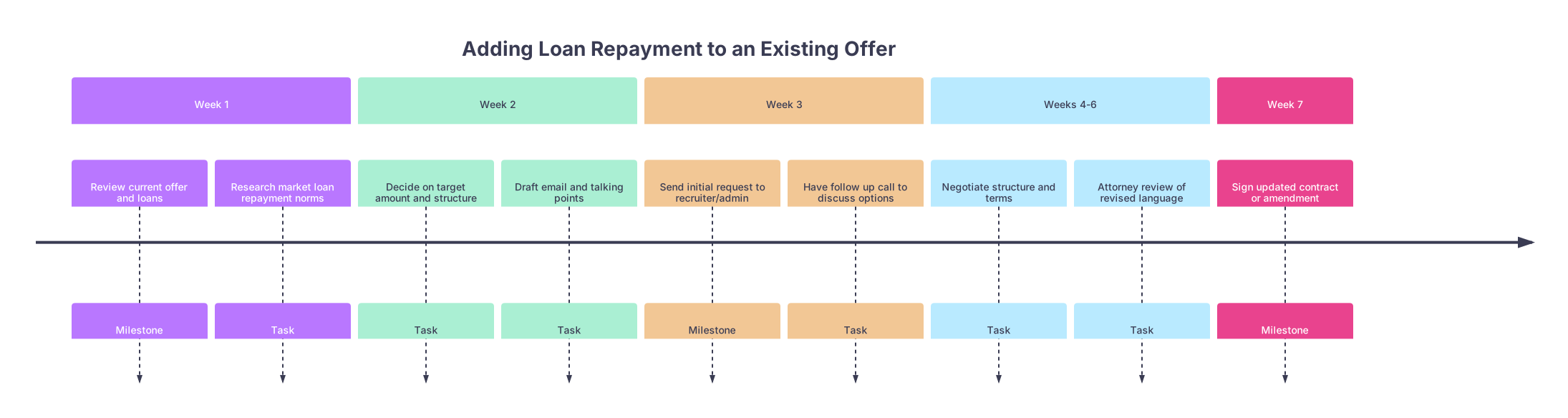
Step 10: Simple Timeline You Can Actually Follow
Stop hand-wringing. Put this on a calendar.
| Period | Event |
|---|---|
| Week 1 - Review current offer and loans | Milestone |
| Week 1 - Research market loan repayment norms | Task |
| Week 2 - Decide on target amount and structure | Task |
| Week 2 - Draft email and talking points | Task |
| Week 3 - Send initial request to recruiter/admin | Milestone |
| Week 3 - Have follow up call to discuss options | Task |
| Weeks 4-6 - Negotiate structure and terms | Task |
| Weeks 4-6 - Attorney review of revised language | Task |
| Week 7 - Sign updated contract or amendment | Milestone |
If you are already in practice, map this around your annual review or contract renewal window.
Quick Comparison: Structures You Can Propose
| Structure | Pros | Cons |
|---|---|---|
| Annual payment | Simple, earned each year | Often taxable, lower total |
| Forgivable loan | Larger total possible | Claw-back risk if you leave early |
| Sign-on bonus | Immediate cash | Big tax hit, claw-back common |
| Hybrid (bonus+annual) | Flexibility, easier to approve | Slightly more complex to draft |
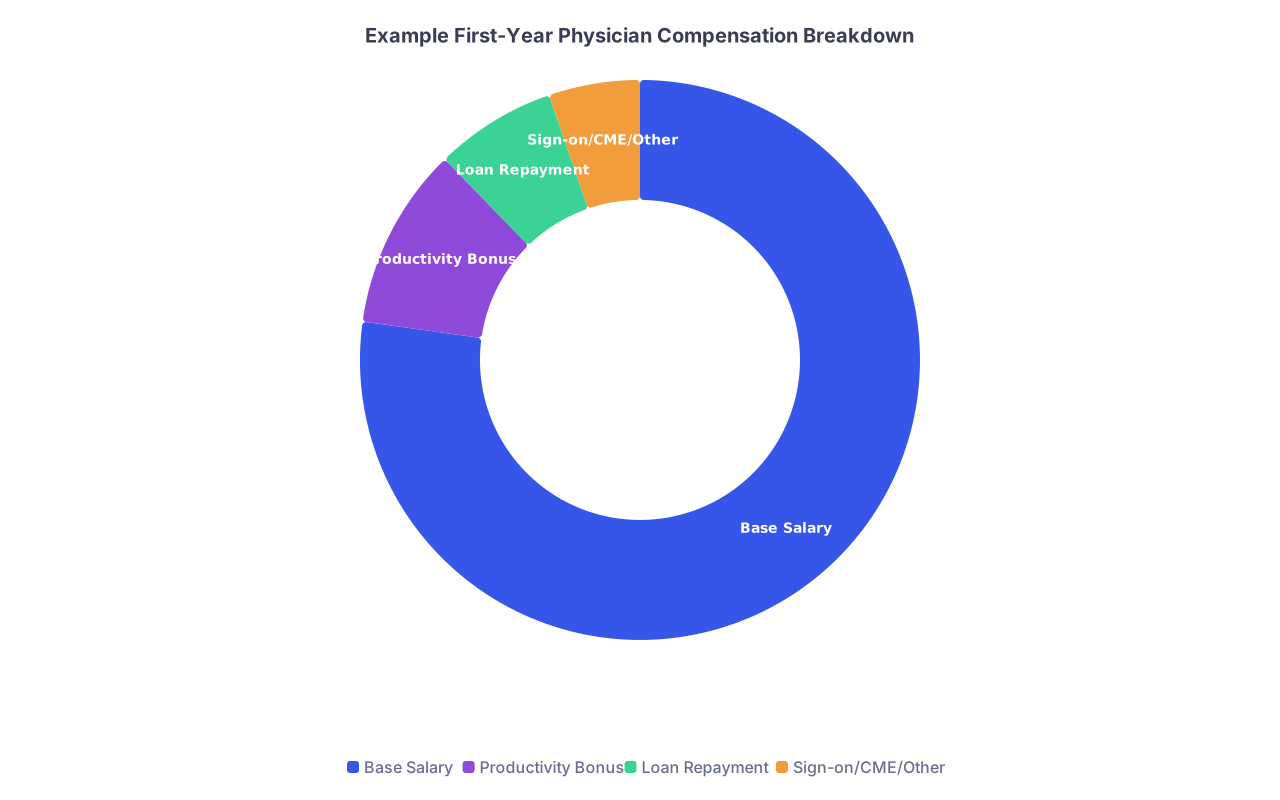
Visual Check: Where Loan Repayment Fits in Total Comp
| Category | Value |
|---|---|
| Base Salary | 220000 |
| Productivity Bonus | 30000 |
| Loan Repayment | 20000 |
| Sign-on/CME/Other | 15000 |
That $20,000 looks small next to your base. But over 3–5 years, with interest saved, it is not trivial. This is why it is worth one hard push to secure now, not ten years of regret later.
A Few Tactical Extras That Actually Help
Use their own recruitment pain as leverage.
- If they have been looking for your specialty for 18 months, say so:
“I understand it has been challenging to recruit for this role. Loan repayment would significantly increase my likelihood of staying here long term.”
- If they have been looking for your specialty for 18 months, say so:
Stay professional but firm.
- You are not “asking for a favor.”
- You are negotiating the final shape of a business deal.
Silence is part of negotiation.
- When you state your ask on a call:
- Say the number and structure.
- Then stop talking.
- Let them react. Do not automatically bargain against yourself with: “But I am flexible, or we could do less…”
- When you state your ask on a call:
Document everything.
- After any call:
- Send a short recap email:
“To summarize our conversation today, we discussed the possibility of adding an annual educational loan repayment benefit of approximately $X for Y years, tied to Z-year commitment. I appreciate you checking with leadership and look forward to further details.”
- Send a short recap email:
- After any call:
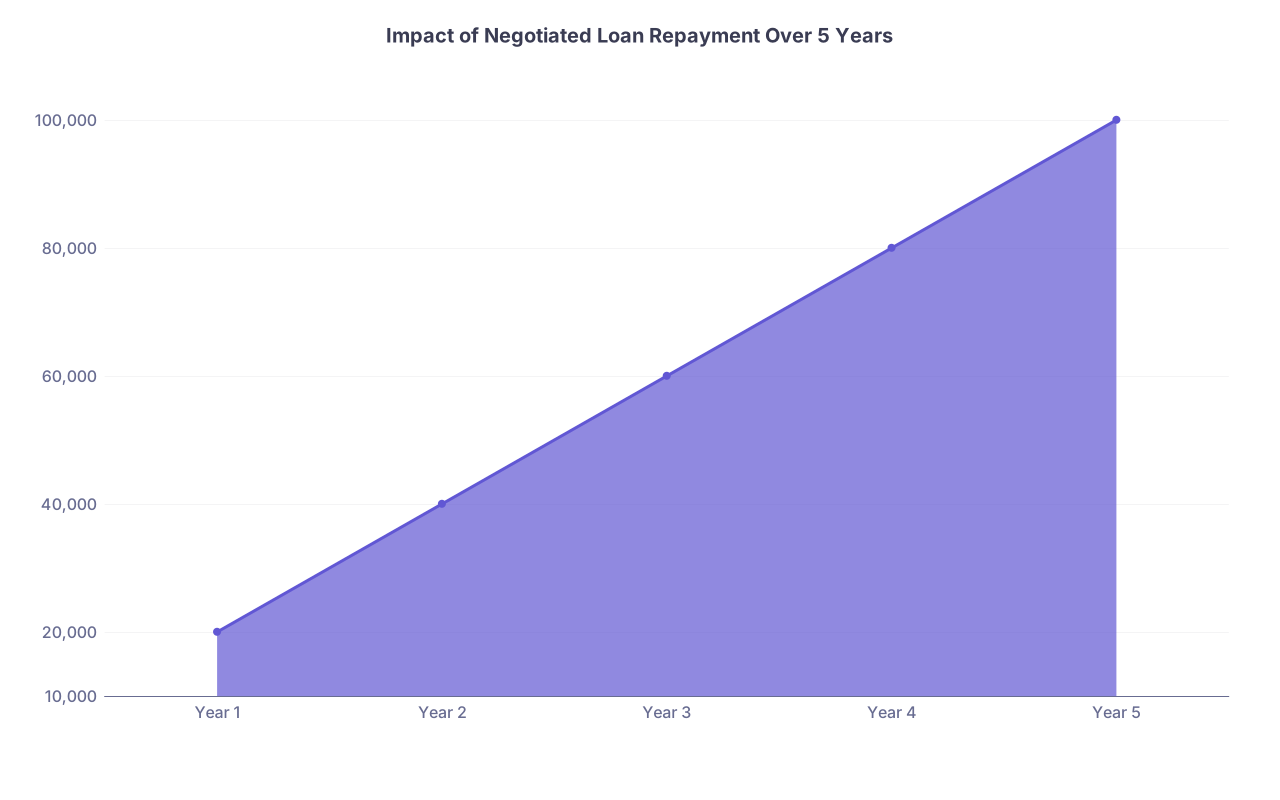
One More Visual: What Persistence Can Do Over Time
| Category | Value |
|---|---|
| Year 1 | 20000 |
| Year 2 | 40000 |
| Year 3 | 60000 |
| Year 4 | 80000 |
| Year 5 | 100000 |
That is $100,000 of loans you did not have to cover from post-tax salary if you get $20,000 per year for five years. And employers absolutely agree to that when the ask is clean and timed well.
Final Takeaways
- You can add loan repayment to an existing job offer, but only if you treat it as a structured negotiation: clear ask, specific structure, and a trade (your commitment) in return.
- The timing and framing matter as much as the amount. Bring it up before signing if possible, tie it to retention, and offer reasonable structures that your employer has likely seen before.
- Get the details in writing and protect yourself from abusive claw-backs. A solid physician contract attorney and a brief tax consult will save you from ugly surprises later.


