
The fantasy that “you can always switch specialties later without much downside” is financially dangerous. Mid-career switching can absolutely wreck—or rescue—your long-term earnings, depending on how you do it.
You’re not a resident anymore. You’ve got a mortgage, maybe daycare, maybe alimony, maybe aging parents. You can’t just “follow your passion” and hope it works out. You need numbers, timelines, and a very clear plan.
Let’s walk through how a specialty switch actually hits your lifetime income, what to watch legally and contractually, and what to do if you’re standing at the edge of that cliff right now.
1. The Real Earnings Question: “Will I Ever Catch Up?”
The core financial question is simple:
If I switch now, will my lifetime earnings be higher or lower than if I stay put?
You’re trading:
- Immediate income loss (training time + ramp-up)
- For possible:
- Higher annual income
- Longer career longevity (if you’re currently burning out)
- Better work-life balance (which indirectly affects how long you can work)
Rough example: IM hospitalist → Radiology at 40
Assumptions (ballpark, US, not academic, not coastal extremes):
Current: Hospitalist, age 40
- Income: $300k/year
- Planning to work to 65 (25 years left)
Switch: Start radiology residency at 40
- 4 years residency at say $70k average
- Attending radiologist from 44 to 65 (21 years) at $550k/year (conservative)
Now look at gross earnings:
Stay hospitalist:
- 25 years × $300k = $7.5M
Switch to radiology:
- 4 years × $70k = $280k
- 21 years × $550k = $11.55M
- Total ≈ $11.83M
Difference: about $4.3M more gross over the rest of your career.
That’s before taxes, retirement compounding, and opportunity cost. But the direction is obvious: in pure salary terms, this kind of switch can pay off.
Now flip it.
High-paying field → lower-paying, “lifestyle” field
Say you’re a 38-year-old orthopedic surgeon making $700k, and you want to switch to psychiatry.
Current: Ortho, age 38, $700k, 27 years to 65
- 27 × $700k = $18.9M
Switch: Start psych residency at 38
- 4 years at $70k = $280k
- Psych attending at 42 → 65 (23 years) at $320k
- 23 × $320k = $7.36M
- Total ≈ $7.64M
Difference: you’re giving up over $11M in future gross income. Even with burnout factored in, that is a massive financial haircut.
Is it sometimes worth it? Yes. But pretending the numbers aren’t brutal is dishonest.
2. Where You Are in Your Career Matters More Than You Think
Age and stage change everything. The same switch that’s financially smart at 34 can be dumb at 48.
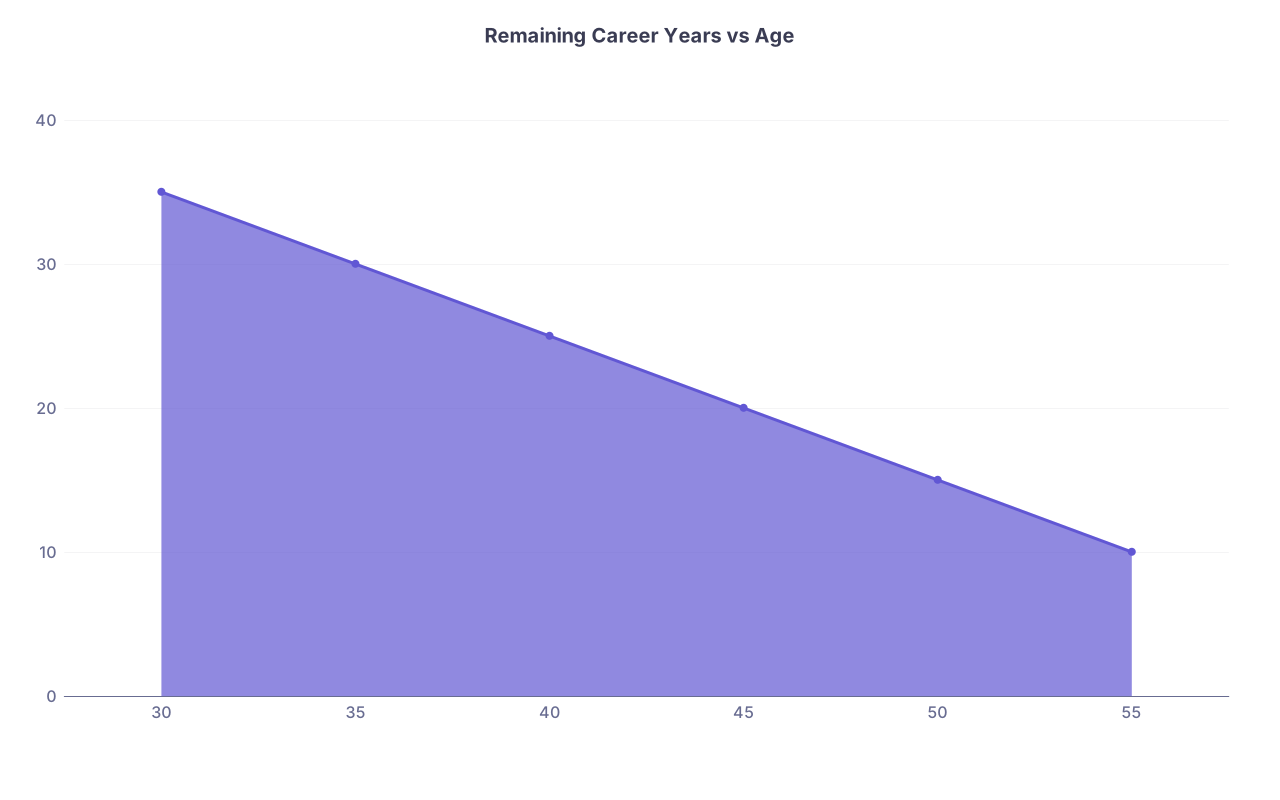
| Category | Value |
|---|---|
| 30 | 35 |
| 35 | 30 |
| 40 | 25 |
| 45 | 20 |
| 50 | 15 |
| 55 | 10 |
Here’s the pattern I see play out in real people:
Early attending (0–5 years out)
Switching is painful but possibly optimal if:- You chose badly
- Or your current field is collapsing locally (group buyouts, RVU cuts, call nightmares)
Mid-career (6–15 years out)
This is the danger zone. You’ve built a lifestyle around your current income, but:- Kids are expensive
- Loans may still be lingering
- Spouse/partner has expectations
If you switch here, the transition cost is highest. You probably have:
- Higher expenses
- Less flexibility
- More sunk-cost bias
Late career (15+ years out)
Pure financial upside of switching is small unless:- New specialty allows you to work significantly longer
- Or you move from a dying practice model to a stable one
But the time horizon is short. Switching at 55 to do a 4-year residency rarely makes comparative financial sense.
3. The Actual Financial Hit: What You Lose During the Switch
You’re not just swapping salaries. You’re also losing:
- Retirement contributions (401k, profit-sharing, defined benefit)
- Employer-paid benefits (health, disability, malpractice)
- Practice equity or buyout potential
- Bonus structures you’ve grown into
- Moving costs and licensure/board fees
Let’s break the transition into components.
A. Direct salary loss
Use a simple structure:
Lost attending income
minus
Resident/fellow income (if retraining)
= Net annual shortfall
Multiply by training years.
Example:
- Current: $400k IM cardiology
- New training: 2-year sleep fellowship at $75k
Annual shortfall = $400k - $75k = $325k
Over 2 years: $650k gross lost.
B. Retirement and compounding loss
This one hurts more than people think.
If your employer puts away $50k/year into retirement (their side) and you’re about to pause that for 4 years:
- 4 × $50k = $200k contributions lost
- Compounded over 20 years at, say, 6–7% annual return → easily $350–400k+ lost future value.
So your “4-year break” is actually more like a half-million dollar problem by the time you hit retirement.
C. Lifestyle squeeze
During training:
- Income drops dramatically
- Loan payments may need to go on income-driven plans
- Spouse might have to increase work hours
- Private school, big vacations, luxury car leases? Probably need to go.
If your fixed lifestyle is built around $500–700k, dropping to $70k–120k is not “just temporary.” It often requires:
- House downsize or HELOC
- Selling a second home
- Suspending major discretionary expenses (travel, elective remodels, etc.)
You need a 2–5 year survival budget, in writing, with your spouse/partner on board. Not vibes. Not hand-waving.
4. When a Switch Actually Protects Your Earnings
Now the flip side. Sometimes switching specialties mid-career is the smartest financial move you can make.
Here are the situations where I’ve seen it be net positive over the long run:
Scenario 1: Your current field is burning you out so badly you won’t last
ER doc at 42, fried, talking seriously about quitting medicine entirely by 50.
Option A:
Stay in EM, make $450k for 8 more miserable years, quit at 50. Total ≈ $3.6M more career income.
Option B:
Do 2-year occupational medicine fellowship at 42–44, earning $80k, then work to 65 at $300k in a lower-stress clinic job.
- Training: 2 × $80k = $160k
- Attending: 21 × $300k = $6.3M
- Total ≈ $6.46M
Option B almost doubles remaining earnings. That’s how burnout changes the math.
If you realistically wouldn’t make it to 60 in your current field, your “real” remaining career years are lower than you think. That makes a lower-paying but sustainable specialty look smarter.
Scenario 2: Toxic group / unstable practice model
- Private practice anesthesia getting hammered by corporate buyouts
- Radiology group losing contracts to telerad
- Hospitalist program cutting base pay while jacking up RVUs
Switching specialty isn’t always required here, but sometimes:
- Hospitalist → outpatient primary care with partnership track
- Anesthesia → pain management
- General surgery → wound care / clinic-based roles
The move might not increase your top-line salary, but it can:
- Stabilize income
- Increase predictability
- Reduce call and liability risk
That indirectly protects your long-term earnings by keeping you working consistently and avoiding big gaps.
Scenario 3: Subspecialization pivot within your field
Sometimes the “specialty switch” is actually: IM → cardiology, FM → sports med, anesthesia → pain.
Financially, this can be huge:
| Role | Approx Income |
|---|---|
| FM outpatient | $230k–$280k |
| Sports med (FM based) | $300k–$400k |
| IM hospitalist | $260k–$325k |
| Cardiology | $500k–$700k |
| Anesthesia | $450k–$600k |
| Pain (anesthesia) | $600k–$900k |
If you’re 35 and move from FM outpatient to sports med with a 1–2 year fellowship, you can easily make up the training loss in 3–5 attending years.
5. Legal and Contract Landmines When You Switch
Here’s where people get burned: not the residency match. The exit from their current job.
Non-competes and restrictive covenants
If you’re switching specialties and planning to stay in the same city, your current contract may block you from:
- Practicing any clinical medicine within X miles
- Working at certain hospitals or systems
- Soliciting patients or referral sources
If a hospitalist in City A wants to go do derm locally, that non-compete could still bite, depending on wording.
Common issues:
- Broad language: “any practice of medicine” vs “hospitalist medicine”
- Long durations: 1–2 years
- Large radii: 20–50 miles
You need:
- Your actual signed contract
- Reviewed by a healthcare employment attorney in your state
Not your friend who “does some contracts.” A real healthcare-focused lawyer.
Repayment clauses: bonuses, relocation, loan repayment
Look for:
- Sign-on bonuses with clawbacks if you leave before X years
- Relocation payments with prorated repayment schedules
- Hospital loan repayment programs with service commitments
If you bail early:
- You may owe $50k–$200k back
- Often due in 30–90 days after termination
This has made more than one mid-career switch impossible without:
- Refinancing
- Home equity loans
- Family support
Tail coverage
If you’re in a claims-made malpractice policy (very common in private practice), someone has to buy tail. That can be:
- 1.5–2.5 times your annual premium
- Common numbers: $40k–$150k
Sometimes your next employer will cover it. Often they won’t.
Do not resign or even threaten to resign until you know:
- Who’s contractually responsible
- Whether you can negotiate tail as part of your exit or new hire package
6. A Clean, Stepwise Way to Decide (Without Lying to Yourself)
You need a framework, not vibes. Use this.

| Step | Description |
|---|---|
| Step 1 | Unhappy in current specialty |
| Step 2 | Assess other roles in same specialty |
| Step 3 | Consider new specialty or new practice |
| Step 4 | Shadow alt roles 3-6 months |
| Step 5 | Redesign current practice |
| Step 6 | Run 20-year financial model |
| Step 7 | Review contracts and legal issues |
| Step 8 | Discuss plan with spouse and advisor |
| Step 9 | Apply for training or jobs |
| Step 10 | Rework plan or defer switch |
| Step 11 | Burnout or structural problem? |
| Step 12 | New specialty still appealing? |
| Step 13 | Numbers and life both work? |
Here’s what to actually do in each step if you’re in this situation today:
Clarify the problem
Is it:- Schedule/call
- Group politics
- Compensation model
- Clinical content of the work
Be brutally specific.
Try changing the variables within your specialty first
Examples:- EM → low-volume community shop
- Surgery → hospital employment with protected clinic time
- Hospitalist → nocturnist or day-only, or locums for higher pay/flexibility
If none of those options sound better, the specialty itself may be the issue.
Shadow the target specialty
Not just a one-day “looks nice” visit. Try for multiple days in:- Clinic
- OR/procedural time (if applicable)
- Call or after-hours workflow
You’re looking for: can you see yourself doing this exact work for 20 years?
Run a 20-year financial projection
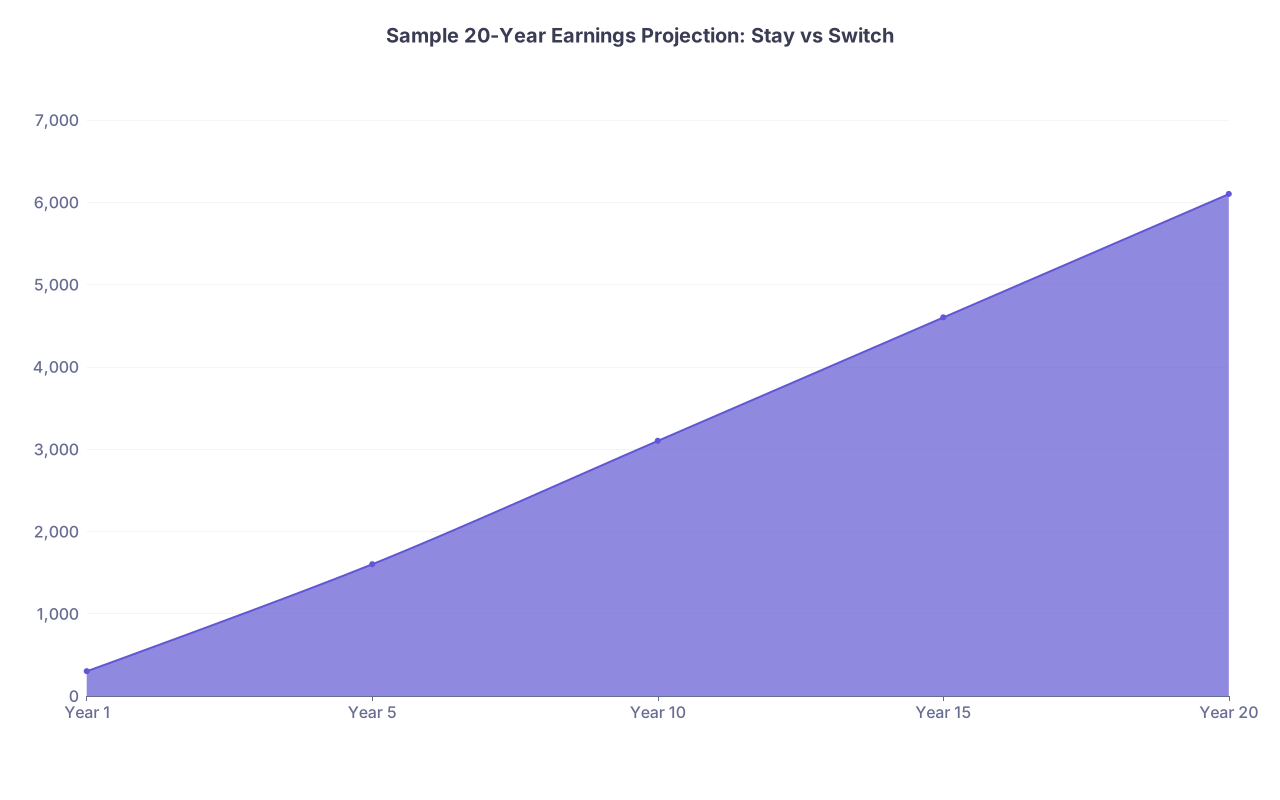
| Category | Value |
|---|---|
| Year 1 | 300 |
| Year 5 | 1600 |
| Year 10 | 3100 |
| Year 15 | 4600 |
| Year 20 | 6100 |
Very rough structure for each path:
- Annual income per year (realistic, not optimistic)
- Expected retirement contributions
- Big one-time hits (tail, repayments, moving)
- Taxes approximated (you don’t need perfection, you need direction)
You can do this in Excel or with a fee-only financial planner who works with physicians.
- Get legal review of current and potential contracts
- Non-compete enforceability
- Tail and clawbacks
- Any partnership or equity loss you’re walking away from
- Stress-test your personal life
Sit down with your spouse/partner and answer:
- Can we live on resident/fellow income (or lower income) for X years?
- What do we cut concretely?
- What if the new specialty job market softens?
If they’re not on board, that’s not a small thing. That’s a flashing red light.
7. Specialty-Switching “Profiles” and How They Typically Play Out
Different switches have different financial and legal footprints. Here’s a quick comparison.
| From → To | Financial Impact | Typical Legal/Logistical Pain |
|---|---|---|
| Primary care → Procedural | Often net positive | Moderate |
| EM → Outpatient specialty | Neutral to positive | Low–moderate |
| High-pay surgical → Psych/FP | Large negative | Moderate–high |
| Hospitalist → Radiology | Potentially positive | High (training gap) |
| Anesthesia → Pain | Often positive | Moderate |
This is not gospel, but it matches what I’ve seen in real physician lives.
8. Protecting Your Future Even If You Do Nothing Right Now
You might read all this and decide not to switch. That’s valid.
But if you’re even thinking about a specialty change, you should still:
Maximize retirement contributions now
If you later take a big income hit, you’ll be glad you front-loaded your savings.Pay down high-interest debt aggressively
Getting stuck with 10%+ interest credit cards or private loans while on resident income is misery.Keep your fixed overhead reasonable
Huge house, multiple car leases, private school for three kids—these all box you in. Flexibility is financial power.Maintain your professional network
If your current field implodes or becomes intolerable, your connections will matter more than your CV.
FAQ (Exactly 4 Questions)
1. Is it realistic to get a new residency spot in a different specialty mid-career?
Yes, but it’s competitive and program-dependent. Mid-career applicants are not unheard of, especially in fields like psych, FM, IM, pathology, and some less competitive surgical specialties. You’ll need a tight story, recent letters, and ideally some research or shadowing in that field. The main barrier isn’t age; it’s program directors wondering if you’ll actually finish and be a good cultural fit.
2. Can I switch specialties without doing a full new residency?
Sometimes. Options include:
- Transitioning into related fields (e.g., anesthesia → pain, IM → sleep, FM → urgent care) via fellowships or credentialing.
- Finding roles that are different in function but technically within your current specialty (wound care clinics, occupational health, administrative medicine).
But if you’re jumping from, say, surgery to dermatology, expect to do formal residency again.
3. How should I factor loans into a potential specialty switch?
Run two scenarios:
A) Keep current specialty, pay loans off on an aggressive timeline.
B) Switch, go onto income-driven repayment during training, and then either refinance or continue IDR/PSLF afterward.
If your loan burden is huge (e.g., $400k+), a mid-career move to a lower-paying specialty can make payoff much harder and may lock you into forgiveness strategies. You need a real repayment plan mapped to your projected income under each path.
4. What’s the first professional I should talk to if I’m serious about switching?
Three people, in this order:
- A trusted mentor or colleague in the target specialty who will be blunt with you.
- A healthcare employment attorney to review your existing contract and any non-compete/repayment issues.
- A fee-only financial planner familiar with physician incomes and training paths, to model your 10–20 year financial trajectory under “stay” vs “switch.”
Open a spreadsheet right now and create two columns: “Stay in current specialty” and “Switch.” List your next 20 years, with your best estimate of income for each path. If you actually fill that out, you’ll be ahead of 90% of physicians who are thinking about switching but too scared to put numbers on paper.