
It’s 8:47 p.m. You just finished notes from clinic, answered three “quick questions” from residents, and cleared the last inbox message. Your salary looks fine on paper, but after student loans, daycare, mortgage, and the privilege of living near a major academic center… you’re not exactly swimming in financial freedom.
You want side income. Maybe you need it. But you’re on an academic track. Promotion committees. Conflict-of-interest (COI) forms. A compliance office that loves saying “no” in multi-page PDFs.
You’re sitting there thinking: “How do I bring in extra money without getting dragged into an HR or compliance nightmare… or blowing up my promotion chances?”
Let’s walk through it like I would with a junior faculty sitting in my office after clinic, door closed, saying: “I want to do something else… but I don’t want to get fired.”
Step 1: Be Honest About Your Situation at Your Institution
Before you pick a side income, you need to know what game you’re actually playing. Not theoretically. At your institution.
Here’s the real split I’ve seen:
| Institution Type | COI Climate | Typical Flexibility |
|---|---|---|
| Big-name private academic center (think Harvard, Hopkins) | Strict, many approvals | Lower |
| Large public university with med school | Structured but negotiable | Moderate |
| Community program with academic affiliation | Looser, policy-light | Higher |
| VA-based faculty appointment | Very strict about outside work hours | Low |
If you do nothing else this week, do this:
- Pull your institution’s conflict-of-interest and outside employment policies from the intranet. Search “conflict of interest,” “moonlighting,” “outside professional activities,” or “industry relationships.”
- Find your employment contract or offer letter. Look for:
- “Outside employment”
- “Intellectual property”
- “Time commitment / full-time definition”
- “Non-compete” or “non-solicitation”
- Ask one trusted senior person who actually does outside work:
“What are people actually doing here for outside income that compliance is okay with?”
You are not trying to find the loopholes. You’re mapping the fence line so you don’t accidentally climb over it.
Typical red flags you need to know if they apply to you:
- Are you full-time clinical with a “100% effort” commitment?
- Are you paid by federal grants (K, R, T) requiring effort certification that restricts outside work?
- Does your institution claim ownership of your inventions/companies if related to medicine, data, or software?
Once you know that, you can sort ideas into 3 buckets:
- Green light: Clearly allowed (e.g., unrelated real estate)
- Yellow light: Likely allowed with disclosure/approval
- Red light: Ask first or probably no (e.g., starting a competing clinic within 10 miles)
Step 2: Know What Doesn’t Trigger Conflicts (Usually)
Let me make your life easier. There are categories of side income that almost never cause institutional drama—if you separate them cleanly from your employer.
These are your safest bets as an academic physician:
Completely non-medical businesses
Real estate, e-commerce, generic consulting (non-medical), basic online businesses, generic tech tools unrelated to your clinical or research field.Investments
Index funds, rental properties, angel investing (if not in direct conflict with your lab’s IP or your institution’s spin-outs).General education products not branded with your institution
MCAT/USMLE tutoring, generic “how to study” courses, broad productivity content. Not tied to your employer’s brand, resources, or patients.Creative work
Books, blogs, podcasts, courses on broad topics—if you’re careful with branding and IP.
Most trouble shows up when:
- You use institutional resources (data, patients, logos, resident labor, lab equipment) without formal approval.
- You enter into paid relationships with industry that overlap your research or prescribing patterns.
- You start a “side” clinical operation that competes with your employer.
So the game is simple: stack your side income toward low-conflict categories, and be very deliberate with anything medical-facing.
Step 3: Pick the Right Type of Side Income for an Academic Track
Let’s go through specific options and how they play with conflicts and time.

1. Real Estate (Rental Properties, Syndications)
Conflict risk: Very low
Time: Front-loaded, then minimal
Academic upside: None directly, but stabilizes your finances so you’re not forced into extra RVU work.
Why it works:
- Not competing with your employer.
- No overlap with patients, research, or institutional IP.
- You can disclose on COI forms as investments and move on.
Basic guardrails:
- Do not run your real estate business on hospital time or using staff.
- Keep all real estate communication and documentation off institutional email and devices.
- If you raise money from colleagues, be extremely careful with securities law and misaligned expectations.
If you’re new:
Start with one small property or a REIT/real estate fund to learn the basics without becoming a full-time landlord.
2. Med-Legal Work (Expert Witness)
Conflict risk: Moderate if badly done; manageable if structured
Time: Variable but high hourly pay
Academic upside: Builds reputation in your field; can lead to lectures, guidelines, etc.
Why institutions get nervous:
- Time away from clinical/research duties.
- Being on the “wrong side” of a high-profile case.
- Using institutional brand inappropriately (“Professor at X testified against hospital Y”).
How to do it safely:
- Clarify with your department chair: “I’m planning to do a small amount of expert witness work. What approvals do I need?”
- Use a private address and personal email. Never your institution’s logo in any report.
- Make it explicit in your CV and reports: “Title and affiliation for identification only; opinions are my own.”
- Avoid cases directly against your employer or major institutional partners.
If your chair winces when you mention med-legal, scale it small and quiet. Let your work speak for itself and avoid media-heavy cases early on.
3. Consulting & Speaking for Industry
Conflict risk: High if sloppy. This is where careers get burned.
Time: Variable. Can be lucrative.
Academic upside: Connections, funding, potential trials, advisory roles.
This is where COI offices live and breathe.
You need:
- Written contracts that go through your institution’s review process if required.
- To understand if your institution claims a cut or needs to sign off on advisory roles.
- To log and disclose every penny on annual COI reports, manuscripts, and talks.
Hard rules I’d follow:
- Do not accept “under the table” consulting without a contract.
- Do not mix “speaker’s bureau” work with being PI on related sponsored trials without explicit COI management.
- Refuse any arrangement that looks like a thinly veiled kickback (volume-based, prescriptions-based, or “consulting” that’s just reading slides and nodding).
If you want to do this long-term, pick 1–2 companies tightly aligned with your expertise and go deep, rather than 10 shallow, sketchy gigs.
4. Online Courses, Coaching, and Educational Products
Conflict risk: Low to moderate, depending on content
Time: Front-loaded build, then maintenance
Academic upside: Visibility, thought leadership, sometimes promotion credit if framed well.
Smart for academic physicians because it plays to your strengths—teaching, structuring knowledge, mentoring.
Common angles that usually clear COI cleanly:
- Study skills for med students/residents.
- Career coaching (non-program-specific).
- Skills training: presentations, writing, efficiency, wellness (avoid “therapy-like” offerings unless you’re licensed and compliant).
Lines you do not cross:
- Charging your own students/residents for required or strongly expected content.
- Using institutional slides, logos, or recorded lectures without permission.
- Repackaging grant-funded or institution-owned materials as private products.
If you build a course:
- Use your personal LLC and accounts.
- Make it optional and open, not targeted at your own trainees as a “must-have.”
- Be very clear where your institution ends and you begin.
Step 4: Keep Your Job Safe – Structural Guardrails
Forget vague advice like “communicate.” Here’s what this actually looks like as an academic physician.
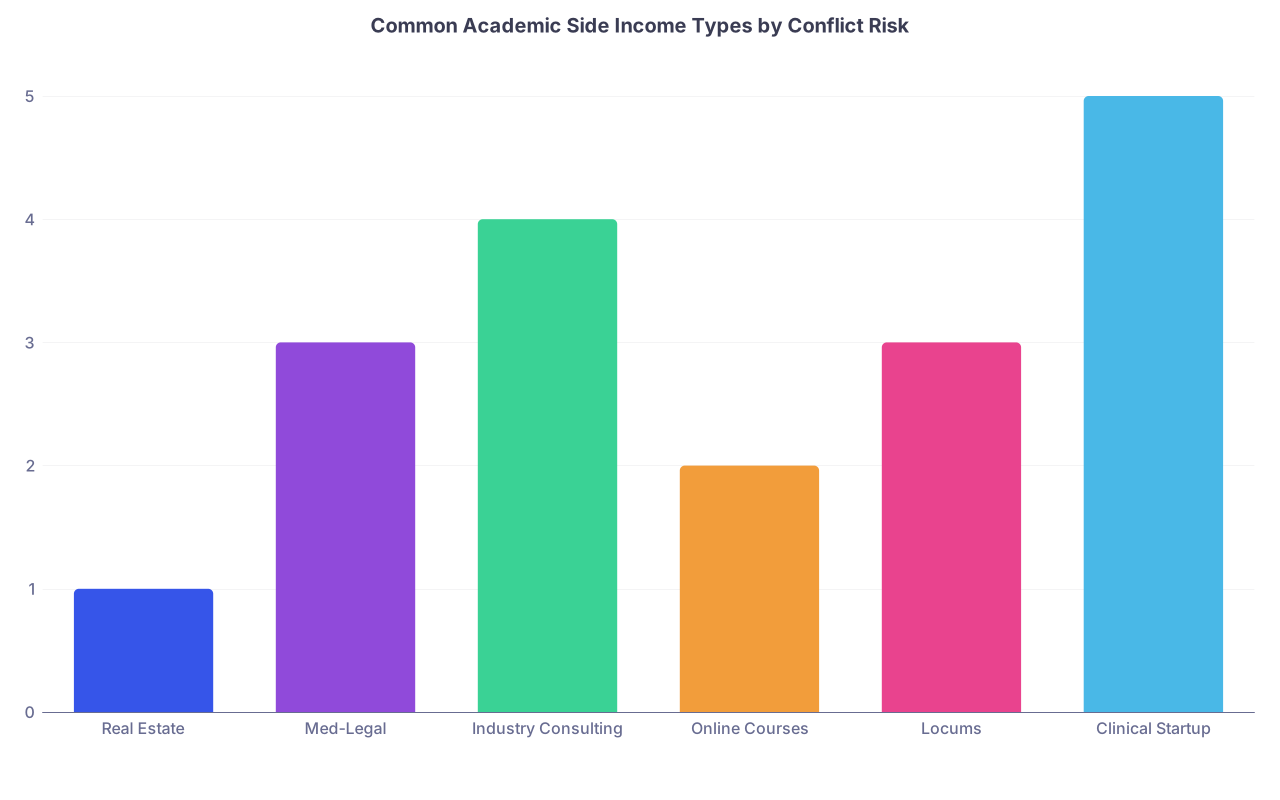
| Category | Value |
|---|---|
| Real Estate | 1 |
| Med-Legal | 3 |
| Industry Consulting | 4 |
| Online Courses | 2 |
| Locums | 3 |
| Clinical Startup | 5 |
(Scale: 1 = low risk, 5 = high risk of institutional conflict if not managed.)
Guardrail 1: Separate Everything
Different email.
Different bank accounts.
Different entity.
If you’re serious, set up:
- A separate business email (Gmail/Workspace).
- A simple LLC in your state for any business with liability (courses, consulting, med-legal; not required for just investing).
- A business bank account tied to that LLC.
Never:
- Use hospital letterhead for private work.
- Use residents/fellows/staff as unpaid help for your side business.
- Store business documents on your institution’s OneDrive/SharePoint.
Guardrail 2: Lock Down Your Time
Many institutions will let you do “outside professional activities” if they don’t interfere with your main job.
Make your life easy:
- Set explicit “side hustle hours” that do not overlap with clinics, research blocks, meetings, or teaching.
- Treat them like any other fixed commitment on your calendar.
- If anyone ever questions you, you can say: “All outside work is done evenings/weekends, never during my assigned time here.”
If you’re on grants:
- Be very careful with effort reporting. If you’re 75% research effort, you can’t then claim you’re also running a 20-hour-per-week consulting business during business hours. That’s how you end up in federal trouble, not just HR trouble.
Guardrail 3: Document and Disclose Strategically
Do not try to hide legitimate work. That’s when routine things turn into scandals.
You should:
- List outside roles in your COI disclosures every year.
- Disclose financial relationships in talks, papers, and presentations.
- Keep a folder with contracts, institutional approvals, and key emails.
But also:
- Don’t overshare half-baked ideas with compliance. Ask targeted questions: “I’m considering X. This would be entirely on my own time, with no use of institutional resources or data. Do I need a formal review or is annual COI disclosure sufficient?”
You’re looking for clear “yes/no” guidance, not inviting them to co-author your business plan.
Step 5: Match Side Income to Academic Trajectory
You’re not just trying to make money. You’re trying to not blow up your academic path in the process.
Here’s how I’d think about it based on your track:
| Academic Track | Best-Fit Side Income | Avoid / Be Careful |
|---|---|---|
| Clinician-Educator | Courses, coaching, med-legal | Owning a competing clinic |
| Physician-Scientist | Industry consulting, IP/royalties | Undisclosed equity in related startups |
| Pure Clinical Track | Real estate, med-legal, locums | Heavy time-intensive businesses |
| Admin/Leadership Track | Speaking, strategic consulting | Anything that looks like self-dealing |
If you’re early career (Assistant Professor)
You don’t have a lot of political capital yet.
Better moves:
- Low-drama: real estate, modest online course, limited med-legal.
- Side projects that feed your CV: invited talks, small advisory roles, writing.
Bad moves:
- Launching a clinical startup that competes with your own department without looping in leadership.
- Becoming “that person” who’s always gone for side gigs and misses meetings.
If you’re mid-career (Associate Professor)
You have more leverage and more to lose.
Here I like:
- Scaling what already fits: more med-legal, bigger educational products, structured consulting.
- Equity-based relationships with companies where your academic work and their needs align—properly disclosed and managed.
You might be able to negotiate:
- A reduced FTE for more outside work (0.8 FTE academic, 0.2 FTE private activities).
- Formalizing side work inside the institution (e.g., a consulting arm, CME courses).
If you’re senior (Full Professor, Section/Division Chief)
You can often write your own ticket—within reason.
- Institutional consulting centers.
- Spin-outs with tech transfer involvement.
- Large speaking and advisory portfolios that are well-managed.
But you’re also on the radar for any scandal. Over-disclose and over-document. You’re a target if something goes sideways.
Step 6: Things That Look Great but Are Actually Landmines
Let me just call out a few side “opportunities” I’ve seen academic docs regret.

“Easy” speaker bureau gigs tied to your prescribing
If the only reason they want you is because you write a lot of their drug, it will not age well on your CV or with COI.Starting a private clinic on the side within your employer’s catchment area
Unless explicitly negotiated, that’s how you end up in legal discovery with your own institution. Even if “everyone else is doing it.”Using residents or fellows to “help” with your business
If they’re not paid and it’s not their scholarly project, it’s an abuse of power. Also, it looks terrible in any complaint.Building a tech tool with institutional data but pretending it’s your own
If you used hospital data, servers, lab, or staff, there’s a strong chance your institution owns some or all of that IP. Pretending otherwise is a fast way to meet lawyers.
If something feels too slick or a little off, assume compliance will see it the same way.
Step 7: A Simple 6-Month Plan If You’re Starting from Zero
You don’t need a perfect 5-year roadmap. You need one clean move in the next 6 months.
Here’s a realistic, low-risk starter sequence:

| Step | Description |
|---|---|
| Step 1 | Month 1 - Read COI Policy |
| Step 2 | Month 1 - Talk to Senior Mentor |
| Step 3 | Month 2 - Pick One Side Income Idea |
| Step 4 | Month 2 - Set Up LLC and Accounts |
| Step 5 | Month 3-4 - Build First Product or Offer |
| Step 6 | Month 5 - Do First Paid Engagement or Sale |
| Step 7 | Month 6 - Disclose and Review Fit with Chair |
Month 1:
- Read COI/outside work policy.
- Ask one or two people actually doing side work what’s normal.
Month 2:
- Pick one lane: real estate, med-legal, small course, or simple consulting.
- Set up basic structure (LLC if needed, separate email, bank account).
Months 3–4:
- Build the first small offer: one consult package, one small course, one legal case, one small investment.
Month 5:
- Get a single paying client/customer/case/tenant. One. Prove the model.
Month 6:
- Reflect: Does this fit your time and your academic identity?
- If it does, scale. If not, pivot to a different lane—still inside your institution’s comfort zone.
FAQ (Exactly 4 Questions)
1. Do I have to tell my department chair about every dollar of side income?
No. You do need to follow your institution’s COI and outside work policies, which usually means:
- Annual COI disclosure listing categories and companies.
- Specific approvals for certain things (industry consulting, med-legal beyond a threshold, separate clinical work). For low-conflict investment income (index funds, basic real estate), you typically don’t need to announce every move to your chair. When in doubt, ask a narrow question: “Does X need prior approval or just annual COI disclosure?”
2. Can I do locums or moonlighting as an academic physician without trouble?
Often yes, but it depends on:
- Your FTE and contract language.
- Whether locums competes with your institution.
- Malpractice coverage and credentialing. Some institutions love faculty moonlighting (it boosts your income without them paying more). Others forbid external clinical work. You need explicit clarity before you sign anything. And any locums time must not break your effort commitments if you’re grant-funded.
3. What if my institution claims ownership of anything I create related to medicine?
Many do. The question is how broadly they enforce it. If you’re creating:
- A clinical app using institutional data or resources → almost certainly theirs or shared.
- A general productivity course with no institutional IP → usually yours. If you’re serious about a startup or product, involve tech transfer early—even if they’re annoying. Fighting your own institution over IP later is expensive and exhausting. Sometimes you can negotiate a shared arrangement or a formal spin-out instead of a stealth side hustle.
4. Is it safer to just avoid any medical-related side hustle and stick to real estate and index funds?
It’s simpler, yes. Purely financial plays avoid 90% of academic COI drama. But you also have expertise that can be monetized ethically and safely—med-legal, high-level consulting, education, speaking. The goal isn’t to run away from anything medical; it’s to choose things that:
- Align with your academic identity.
- Are transparently disclosed.
- Respect your institution’s boundaries and IP. If you’re risk-averse, start with low-conflict (real estate, broad courses), then add carefully chosen medical-adjacent work once you understand how your institution actually behaves, not just what the policy PDF says.
Here’s your next step:
Tonight, download your institution’s COI and outside work policies and actually read them for 20 minutes. Highlight any section that mentions “outside professional activity,” “moonlighting,” “equity,” or “intellectual property.” That’s your map. Only after you know those rules should you pick your first side income lane.