
It is 7:30 p.m. Friday. You just finished a stretch of 12s, you are half-running out of the hospital, and your bank app notification hits: loan payment, rent, and credit card all in the same week. You are doing real medicine. But your net worth is going backwards.
You have exactly two things left:
- A pair of weekend days you do not want to completely destroy.
- A nagging thought: “I need extra income, but I cannot do another 20-hour side gig that bleeds into my weekdays.”
Here is the problem you are trying to solve:
- You want more money (loan payoff, childcare, housing, savings).
- You have unpredictable hours and real cognitive fatigue.
- You cannot risk burning out and tanking residency performance.
- You need something that fits in weekends only, with clear upside and hard boundaries.
So let’s build that. Not vibes. Not “someday” consulting. A realistic, structured weekend side-hustle plan for residents.
Ground Rules: What Actually Works for Residents
If you skip this part, you will pick the wrong hustle and hate your life by October.
A good weekend-only side hustle for residents needs to pass these filters:
Schedule control
- You decide when you work: Saturday morning, Sunday evening, only post-nights, etc.
- No fixed weekly meetings that will clash with call or jeopardize your rotations.
Low startup friction
- No 6-month build before first dollar.
- You can be up and earning within 4–6 weeks, ideally sooner.
Decent hourly return
- Your time is expensive, even if your paycheck says otherwise.
- Aim for a realistic $30–$100/hour side-hustle range, not $12/hour data entry.
Limited weekday spillover
- Prep or admin ≤ 1–2 hours on weekday evenings.
- No ongoing client drama that requires midweek attention.
Low risk to your license and professionalism
- No sketchy med-spa work without proper supervision.
- No off-the-books telemedicine.
- Nothing that conflicts with your program’s moonlighting policies.
If a side hustle fails two or more of those, you are better off dropping a weekend OT shift in a moonlighting-friendly PGY year or doing nothing and protecting your sanity.
Step 1: Lock Down Your Constraints and Targets
You cannot pick a smart hustle until you know your actual constraints. Do this like a pre-op checklist, not a personality quiz.
1. Define your real time budget
Look at the next 8 weeks. Pull your call schedule. Then answer:
- How many weekend days off do you truly have? (Not post-call, not “I might sleep until 3 p.m.” Days.)
- Of those, how many hours can you work without resenting everything?
Be honest:
- PGY-1 on busy IM or surgery:
- Realistic: 4–6 hours per good weekend (and not every weekend).
- Lighter outpatient rotation / PGY-3 with more control:
- Realistic: 6–10 hours per weekend if you protect time deliberately.
Set a hard cap:
- Example: “Max 6 hours per weekend, 2 weekends a month. If I exceed that, I stop or scale back.”
2. Set a money target that is not fantasy
Decide a clear 6-month goal:
- “I want an extra $400/month to cover loan interest.”
- “I want $800/month to pay for childcare or save for a house.”
- “I want to build a $3,000 emergency fund in 6 months.”
Then translate that to required weekend income:
- $400/month → about $100/week
- $800/month → about $200/week
If you can work 6 hours per weekend, then:
- To hit $100/week → target $17/hour+ (easy with almost any decent hustle).
- To hit $200/week → target $34/hour+ (you need something more specialized or scalable).
That frames the game. You are not randomly hustling. You are trying to hit a specific number with a specific time budget.
Step 2: The Side Hustles That Actually Fit Weekends
Here are resident-tested options that meet the filters above. I will group them into three categories:
- Clinical-adjacent income (you leverage your MD brain)
- Digital / knowledge work (you build portable skills and assets)
- Hands-on / local gigs (physical, low-brain, or community based)
We will talk trade-offs, realistic earning ranges, and how to launch each in 4–6 weeks.
Option 1: Clinical-Adjacent Work You Can Do on Weekends
This is where your training counts the most. But you still have to avoid anything that risks your license or breaches program rules.
A. Legal and Insurance Medical Review (Non-Expert-Witness)
You are not testifying in court; you are doing record review, chronology building, and medical summarization for attorneys or insurers.
Typical tasks:
- Summarize ED visits and hospitalizations.
- Create clear timelines of medical events.
- Flag key clinical inflection points.
Who uses this:
- Plaintiff or defense attorneys in med-mal and personal injury.
- Disability and workers’ comp attorneys.
- Insurance firms and chart review vendors.
Why this works for weekends:
- Asynchronous work. You pick up a case, work through it on Saturday/Sunday, upload a report.
- Highly compatible with your medical knowledge.
- Paid per case or per hour.
Realistic early earnings:
- Beginner: $40–$60/hour equivalent via per-case pay.
- With experience: $75–$125/hour for more complex reviews.
How to start (4–6 week plan):
Week 1–2:
- Build a simple 2-page CV focused on your clinical training and documentation skills.
- Draft 2–3 sample anonymized case summaries using de-identified charts (ask an attending if you can use a teaching case and strip every identifier).
Week 2–3:
- Reach out to local med-mal and injury law firms (search “[City] medical malpractice attorney”) and send a short, direct email:
- Who you are (PGY-x, specialty).
- What you offer: weekend chart review/medical chronologies.
- Your turnaround time: 7–10 days.
- Ask if they already use medical reviewers and if they are open to adding you to their list.
- Reach out to local med-mal and injury law firms (search “[City] medical malpractice attorney”) and send a short, direct email:
Week 3–4:
- Apply to medical records review / legal nurse consultant style vendors; some will accept physicians.
- Example search terms: “physician medical chart review jobs remote”, “independent contractor medical record reviewer.”
Week 4–6:
- Take 1–2 small cases. Track your time.
- Your goal: produce insanely clear, organized reports that make the attorney’s life easier. That leads to repeat work.
Watch out for:
- Never provide expert opinions about standard of care unless you understand legal exposure and your institution’s policies.
- Clarify you are providing chronology and clinical explanation, not binding expert conclusions.
B. Paid Question Writing and Educational Content (Boards / Qbanks)
Yes, these jobs exist and are one of the more reasonable weekend hustles for academically inclined residents.
You write:
- Board-style multiple-choice questions.
- Explanations and rationales.
- Short educational content (study guides, case vignettes).
For:
- Commercial Qbanks.
- Small med-ed startups.
- Test prep companies.
Why this works for weekends:
- Entirely asynchronous.
- You already think in this format from shelf and board prep.
- You can batch work: write 5–10 questions in a Saturday block.
Realistic earnings:
- Per-question: $15–$40 depending on company and complexity.
- Hourly equivalent: usually $30–$80/hour once you are efficient.
How to start (4-week plan):
Week 1:
- Draft 3–5 sample questions with full explanations in your specialty (or general IM/peds/EM). Use NBME-style structure and avoid trivia.
- Put them in a clean Google Doc with headings.
Week 2:
- Search: “question writer positions”, “item writer medical”, “MCAT/USMLE content developer.”
- Apply to at least 5 companies. Attach CV and link to your samples.
Week 3–4:
- When you get a test assignment (almost all will send one), follow their style guide to the letter. If they like your trial set, you get recurring work you can schedule on weekends.
Watch out for:
- Some companies underpay (<$10 per question). Decline politely. Your time is not worth that.
- Do not reuse proprietary content across companies; treat each contract seriously.
C. Moonlighting (For Senior Residents with Permission)
If your program and specialty allow it, legit moonlighting can be a very high-yield weekend income source. Especially PGY-3+ in IM, EM, FM, psych.
Typical scenarios:
- Rural ED shifts.
- SNF / nursing home weekend rounds.
- Urgent care coverage.
- Overnight tele-psychiatry (for upper-levels with license).
Why this works for weekends:
- You are already trained to work long clinical shifts.
- You can stack one well-paid day and hit your monthly side-income goal.
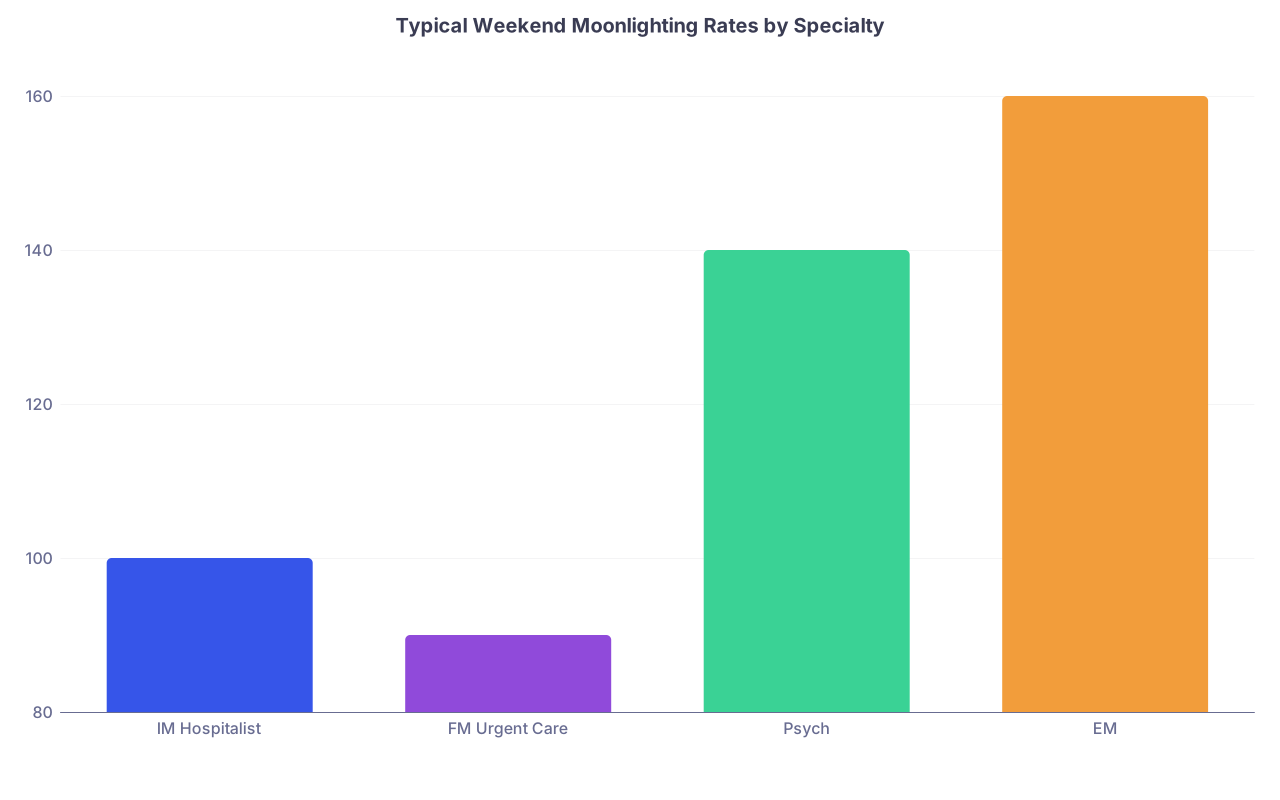
Realistic earnings:
- Wide range: $80–$200/hour depending on specialty and location.
- A single 8–12 hour shift can cover your entire monthly target.
| Category | Value |
|---|---|
| IM Hospitalist | 100 |
| FM Urgent Care | 90 |
| Psych | 140 |
| EM | 160 |
How to start (6–8 week plan):
- Check program policy: Many require written approval and have hour caps.
- Get appropriate license (full state license, not just training license) and malpractice coverage.
- Connect with:
- Hospitalist groups.
- Locums agencies.
- Community urgent cares.
This is the highest-per-hour option but comes with the highest fatigue risk. If your weekdays are brutal, adding more clinical hours can be a recipe for burnout. Do not be heroic here.
Option 2: Digital / Knowledge Work (Non-Clinical But Brain-Heavy)
This bucket builds transferable skills and income that can follow you after residency. Not all of it pays great at the start, but the ceiling is higher.
A. Freelance Medical Writing and Content Creation
Not blogging about your feelings. Paid, structured work for companies that need legit medical voices.
You produce:
- Patient education articles.
- Condition overviews.
- Short scripts for videos or social content.
- Ghostwritten physician-facing pieces.
Clients:
- Health tech startups.
- Hospital / health system marketing departments.
- Health content websites.
- Pharma and device companies (once you are more experienced).
Why this works for weekends:
- Asynchronous.
- Defined deliverables (e.g., 1,200-word piece; 2 scripts).
- You can batch research and drafting on one or two weekend days.
Realistic earnings:
- Early: $0.15–$0.30/word → ~$45–$90/hour if you are efficient.
- With experience: $0.40–$1.00/word on more specialized or higher-stakes content.
How to start (4–6 week plan):
Week 1–2: Build a mini-portfolio:
- Write 2–3 sample articles (800–1,200 words) on topics you know well. Example: “Acute heart failure: what patients actually need to know after discharge.”
- Make them plain-language, accurate, and readable.
Week 2–3: Set up a simple landing page:
- You can use a basic Carrd or Notion page.
- Include: who you are, what you write, sample links, contact email.
Week 3–4: Start outreach:
- Search “health content writer jobs remote,” “medical content specialist,” “freelance health writer.”
- Send short cold emails to:
- Health startups in your city.
- Hospital marketing teams.
- Web content agencies that list “healthcare” as a vertical.
Week 4–6:
- Take small projects first. Deliver ahead of deadline, with clean formatting and references.
Watch out for:
- Content mills paying $50 for 2,000 words. Hard pass.
- Projects with impossible deadlines. Your real job still comes first.
B. Niche Ghost Tutoring / Coaching (Boards, Admissions, Or Specific Skill)
You are not trying to become “YouTube famous.” You are doing well-targeted, high-value 1:1 or small group help.
Examples:
- Step 2/3 tutoring if you scored well.
- Specialty-specific shelf prep for MS3s.
- Med school or residency application coaching.
- Communication/OSCE coaching (role-play sessions).
Why this works for weekends:
- You can cluster sessions on one weekend day.
- Zoom-based, no commute.
- High hourly rate if you are selective.
Realistic earnings:
- One-on-one tutoring: $50–$150/hour depending on test and your track record.
- Small groups: more total income per hour.
How to start (4-week plan):
Decide your niche:
- You want to be “the IM shelf fixer” or “Step 2 CK tutor who scored 260+,” not “general tutor.”
Package clearly:
- Offer: “4-session targeted CK strategy package” rather than endless open-ended sessions.
- Clear deliverables and price.
Put up a simple info page and a Calendly for available weekend slots.
Get clients from:
- Your med school alumni groups.
- Students on your service (carefully, no pressure).
- Pre-med or med student social communities (Reddit, school groups), staying within professionalism boundaries.
Watch out for:
- You must disclose your boundaries clearly. You are not sharing copyrighted question bank content or breaching exam confidentiality.
- Do not oversell your results. People will expect miracles if you promise them.
C. Simple Digital Product: One Small, Useful Thing
Most residents do not have time to build a full-blown online business. But you can build one useful digital product that earns small, recurring income.
Examples:
- A rotation survival guide PDF for MS3s in your specialty.
- A template bundle: H&P templates, sign-out templates, patient education handouts.
- A short e-book: “Realistic Step 2 CK 6-Week Plan from a Resident.”
You sell once and deliver repeatedly.
Why this works for weekends:
- Front-loaded effort: 1–3 intense weekends to build.
- After that, it requires light maintenance and occasional promo.
- Income is small at first but can grow.
Realistic earnings:
- Very wide range, but realistically $50–$300/month for a small product that actually helps people and is reasonably marketed.
How to build in 4 weekends:
Weekend 1: Decide problem + outline
- Pick a very narrow problem: “How to survive your first IM ward month” is better than “how to be a great intern.”
- Outline 5–7 sections.
Weekend 2: Draft content
- Write fast and straightforward, not poetic.
- Aim for 20–40 pages or the equivalent.
Weekend 3: Format + sales page
- Use Canva or a Word template to create a clean PDF.
- Build a simple sales page on Gumroad or similar.
Weekend 4: Launch quietly
- Share with med students you know.
- Offer a discount or free copies to get initial reviews.
Do not expect this to cover your loans. But it can become a low-maintenance asset that incrementally helps.
Option 3: Hands-On / Local Gigs (When You Want Non-Medical Work)
Sometimes you are done using your brain by Friday. You still want money, but not more clinical thinking. That is fair.
Here you want:
- Fixed weekend slots.
- Low mental overhead.
- Reasonable hourly pay.

A. High-Tip Service Work (Yes, Seriously)
If you are in a dense urban area:
- Bartending.
- High-end restaurant server.
- Event staffing (weddings, conferences).
You might think this is “beneath” you. It is not. It can outperform a lot of low-value online work and give your brain a break.
Realistic earnings:
- Often $25–$50/hour equivalent with tips at a decent place or event.
Why this works:
- Clear shifts, no midweek obligations.
- Use your communication skills, but in a very different context.
- Physical, social, non-medical.
The downside: late nights, exhaustion, possible conflict with post-call recovery. You have to be militant about not picking up shifts before heavy weeks.
B. Weekend Exam Proctoring / Educational Center Work
Universities, testing centers, and local colleges routinely need:
- Saturday exam proctors.
- OSCE standardized patient coordinators.
- Weekend course support (check-in, simple admin).
Realistic earnings:
- Usually $18–$30/hour.
- Not amazing, but extremely low-brain and low-stress.
Why this works:
- Firm blocks of time.
- Almost zero prep.
- You can sometimes study during dead time (depends on rules).
C. Local Event Medicine / Standby Coverage (Where Allowed)
Think:
- Sports events.
- Races.
- Concerts or festivals with first-aid tents.
Depending on your training level and local regulations, you may be eligible to assist with basic first aid and triage under a supervising physician or event medical company.
Realistic earnings:
- $25–$75/hour depending on location, event, and your role.
Why this works:
- Typically weekend-heavy.
- Medicine, but slower and more controlled than the ED.
- Can sometimes count as relevant experience for future sports/EM-focused careers.
Key caution:
Get clarity on coverage, malpractice, and your exact scope. You do not freelance emergency care without a legal framework.
Protecting Yourself: Time, Burnout, and Program Politics
Before you start chasing dollars, you need a risk-management protocol for your side hustle. Residents skip this and end up miserable.
1. Hard caps: hours and income
Set two caps:
- Time cap: e.g., “Max 8 hours of side work per weekend, max 3 weekends per month.”
- Income cap for now: e.g., “When I hit $800/month consistently, I reassess whether to scale or stop.”
Why the income cap? Because some of you will keep stacking work until you crash. You are not invincible.
2. A quarterly self-check
Every 3 months, answer:
- Are my evaluations slipping? Any feedback about fatigue, attention, or attitude?
- Is my sleep trashed on a regular basis?
- Have I hit my initial financial goal, and if so, do I still need this level of side work?
If anything is trending badly, you cut back. No debate.

| Step | Description |
|---|---|
| Step 1 | Want extra income |
| Step 2 | Set 6 month money goal |
| Step 3 | Estimate weekend hours |
| Step 4 | Skip side hustle for now |
| Step 5 | Choose category |
| Step 6 | Clinical adjacent |
| Step 7 | Digital work |
| Step 8 | Local hands on |
| Step 9 | Start with medical review or Qwriting |
| Step 10 | Start with writing or tutoring |
| Step 11 | Pick 1 fixed weekend shift |
| Step 12 | Evaluate after 3 months |
| Step 13 | Reduce or stop |
| Step 14 | Continue or scale |
| Step 15 | Know monthly target |
| Step 16 | 4 or more hours free |
| Step 17 | Burnout or eval issues |
3. Program transparency (controlled, not oversharing)
You do not need to announce your Gumroad PDF to your PD. But:
- Any clinical work (moonlighting, event coverage, tele-health) should be fully disclosed and formally approved.
- Any activity that uses your MD name + credentials in public marketing needs to be consistent with your institution’s guidelines.
Where possible, phrase your side hustle as:
“I occasionally do medical content work on weekends — writing and exam questions. No patient care, fully remote.”
Clear, honest, and uninteresting from a conflict-of-interest standpoint.
Sample Action Plans Based on Your Situation
You do not need all of this. You need one clear, realistic combo that matches your bandwidth.
| Resident Profile | Time Available | Primary Hustle | Target Monthly |
|---|---|---|---|
| PGY-1 on busy wards | 4–6 hrs/month | Qbank writing | $200–$400 |
| PGY-2 IM, lighter block | 8–12 hrs/month | Med-legal review | $400–$800 |
| PGY-3 FM with moonlighting | 1 weekend shift | Urgent care moonlighting | $800–$2,000 |
| Academic-track resident | 6–8 hrs/month | Med writing + tutoring | $300–$700 |
Scenario 1: Exhausted PGY-1, hates life by Friday
- Time: 4 hours every other weekend.
- Goal: Extra $250/month to stop credit card creep.
Plan:
- Skip anything that requires meetings or marketing.
- Start with Qbank writing: 5–8 questions per weekend block.
- Add low-frequency exam proctoring on an easy month if needed.
Scenario 2: PGY-2 IM, likes cognitive work, wants $600/month
- Time: 6–8 hours per weekend, 2–3 weekends/month.
- Goal: $600–$800/month.
Plan (first 3 months):
- Launch medical record review:
- 1–2 small cases per month = ~$300–$500.
- Fill gaps with short med-writing gigs:
- 2 small articles/month = ~$300–$400.
You hit target and test which you enjoy more.
Scenario 3: PGY-3 FM allowed to moonlight
- Time: One 8–10 hour shift per month.
- Goal: $1,000/month for aggressive loan paydown.
Plan:
- Moonlighting urgent care or rural clinic: 1–2 weekend shifts.
- No other side hustles. Protect all other weekends.
Execution Checklist: Turn This Into Reality in 30 Days
You are busy. So here is a compressed launch checklist.

Week 1: Clarify and choose
- Set 6-month money target (e.g., $600/month).
- Count realistic weekend hours per month.
- Pick ONE primary hustle category:
- Clinical-adjacent (review, Qs, moonlighting)
- Digital (writing, tutoring, product)
- Local (high-tip service, proctoring)
Week 2: Build basic assets
- Update 1–2 page CV.
- Create 2–3 samples specific to your target work.
- Put up a simple info page (Notion/Carrd) if doing writing or tutoring.
Week 3: Aggressive outreach (not forever, just now)
- Send 10–20 targeted emails/applications to:
- Qbanks / med-ed companies
- Law firms / review vendors
- Health content clients
- Local exam centers or event companies
- Block 1–2 specific weekend windows for side work.
Week 4: Take first paid work
- Say yes to small, clear projects.
- Track all hours and income.
- Deliver ahead of deadline with clean formatting.
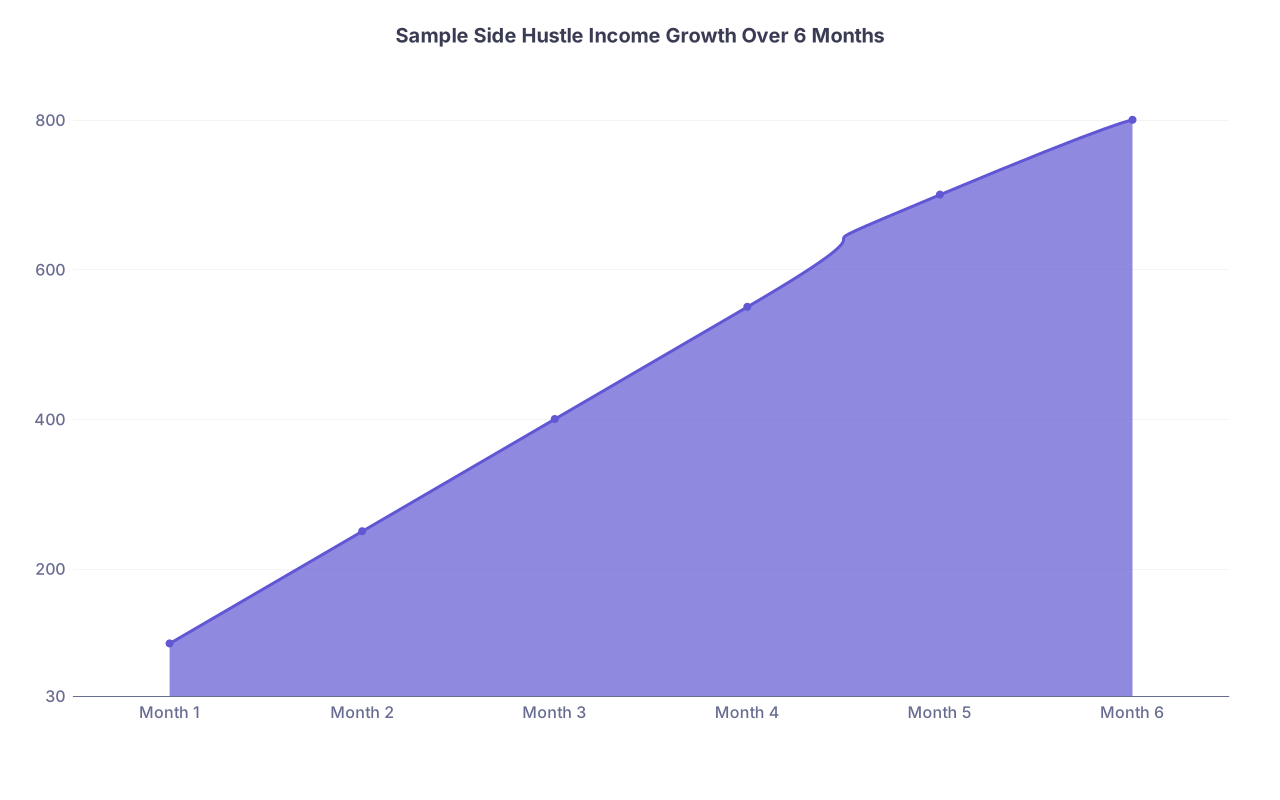
At the end of Month 1:
- If you earned anything, double down on what worked.
- If you earned nothing, refine:
- Were you too picky?
- Did you send enough outreach?
- Do your samples actually look professional?
Repeat the cycle, not the excuses.
| Category | Value |
|---|---|
| Month 1 | 100 |
| Month 2 | 250 |
| Month 3 | 400 |
| Month 4 | 550 |
| Month 5 | 700 |
| Month 6 | 800 |
Future-Proofing: How This Side Hustle Helps After Residency
This is the “future of medicine” part that is not buzzwords.
If you do this right, your weekend hustle does one of three things:
Builds a parallel professional identity
- Medical writer, educator, consultant.
- These are real career tracks, especially as clinical burnout grows.
Buys you optionality
- Extra savings now → more freedom to choose a practice you like, not just the highest salary.
Develops skills residency never teaches
- Negotiation, contracts, marketing yourself, managing your own time.

I have seen residents walk out of training with:
- A steady $1,000–$2,000/month medical writing pipeline.
- A tiny but profitable exam prep micro-brand.
- Ongoing med-legal consulting relationships.
That changes how you negotiate your first attending contract. You are not desperate. You are choosing.
Bottom Line: What You Actually Do Next
There is a lot here. Strip it down to three moves:
Pick one type of weekend hustle that matches your current bandwidth.
Clinical-adjacent (review/Qs), digital (writing/tutoring), or local (service/proctoring). One, not three.Treat it like a 30-day project, not a dream.
Build a couple of samples, send 10–20 targeted inquiries, block 1–2 weekend slots. If it does not produce a dollar in 6–8 weeks, you adjust or try a different lane.Protect your residency performance and mental health above all.
Hard caps on hours, quarterly self-check, transparent where it matters. If the hustle starts degrading your real career, you cut it back.
You are not trying to become a full-time entrepreneur. You are trying to buy a little financial breathing room and maybe plant the seed of a parallel career. Done right, a focused weekend side hustle can do exactly that—without wrecking the rest of your life.