

It’s 11:47 p.m. You just signed out from a brutal ward month, scarfed down whatever passed for dinner, and you’re now staring at your laptop “working on your side hustle.”
Your co-residents are doom-scrolling or passed out. You’re trying to build an LLC, edit a YouTube script, answer Shopify emails, and figure out whether you need a 1099 or a W-2 for the person you just “hired” on Fiverr. You tell yourself you’re building financial freedom. But your cortisol knows you’re building something else: burnout.
You’re not alone. Residents are scrambling for side income in a system that underpays, overworks, and dangles life-destroying loan balances in front of you like a threat. So yes—looking for a side hustle is rational.
The mistake is which side hustle you choose and how you chase it.
Let me be blunt: a lot of resident side hustles are garbage for your specific situation. Not morally. Mathematically. Psychologically. Physically. They look shiny on Instagram and catastrophic in real life.
This is the “do not do this” guide I wish more residents saw before they sacrificed sleep, performance, and sanity on businesses that would never pay off.
The Core Problem: You’re Trading Your Only Non-Renewable Resource
Money is replaceable. Titles are replaceable. Even career paths are somewhat replaceable.
Your brain function during training? Not replaceable. Your reputation with attendings? Not replaceable. Your ability to safely take care of patients? Definitely not replaceable.
Residents burn out chasing side hustles because they forget the basic equation:
Resident energy is already leveraged to the max. Anything you add must be extremely high-yield… or it’s a direct threat.
You’re not a corporate employee with a predictable 9–5 and weekends. You’re a person who might get codes at 3 a.m. and be expected to perform flawlessly. A side hustle that would be “reasonable” for a software engineer can flatten you.
The common mistake: picking side hustles that
– demand constant creative output
– have long, uncertain payoff timelines
– require customer support or real-time responsiveness
– add cognitive load and decision fatigue
– distract you from the one thing that compounds the most: your medical career
Let’s name some of the usual suspects.
Popular Side Hustles That Quietly Destroy Residents
Not every example is always wrong. But these categories are where I see residents burn out the fastest.
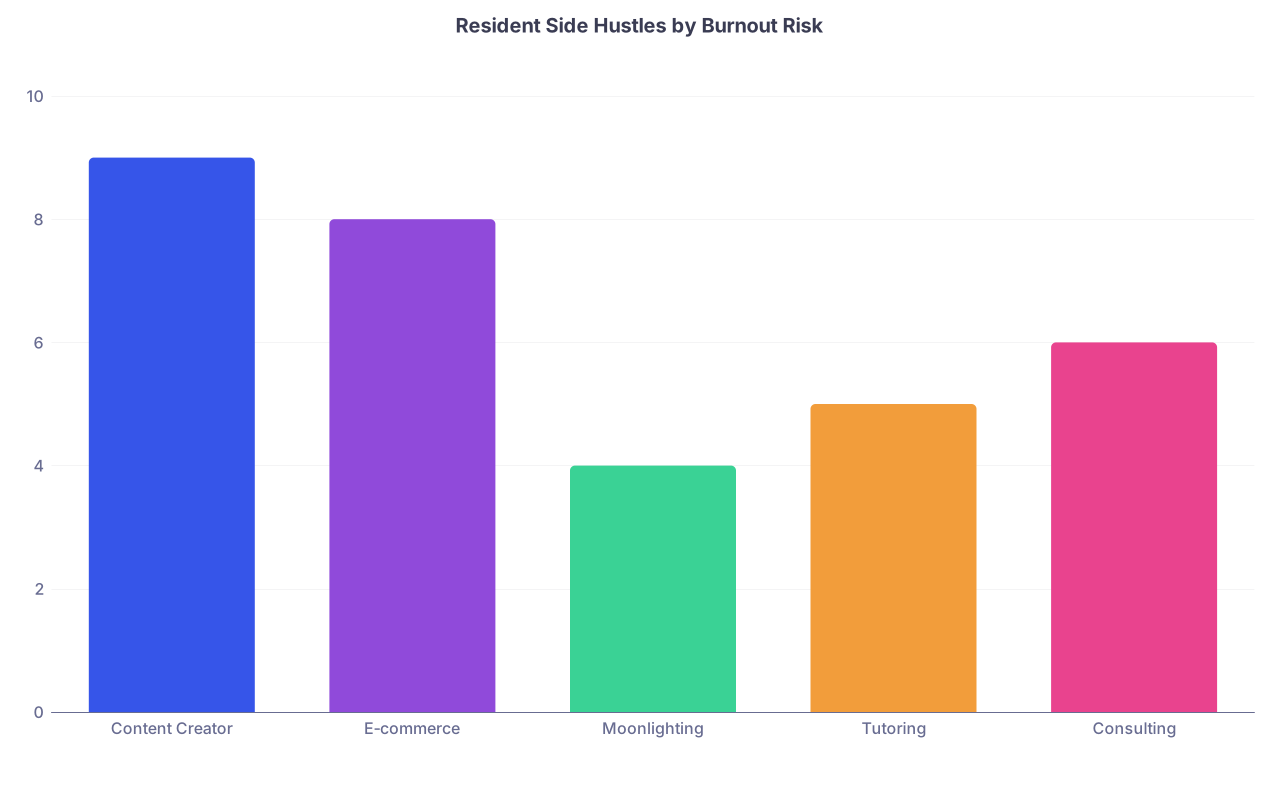
| Category | Value |
|---|---|
| Content Creator | 9 |
| E‑commerce | 8 |
| Moonlighting | 4 |
| Tutoring | 5 |
| Consulting | 6 |
1. Content Creation: The Invisible Second Residency
YouTube. Instagram. TikTok. “Medfluencer” brands. They look fun. You see doctors with brand deals, speaking gigs, and big followings.
Here’s the part you do not see:
- Filming the same 8-minute explanation 12 times
- Editing at 1 a.m. because the algorithm “rewards consistency”
- Chronic anxiety about likes, views, and “engagement”
- DMs you feel guilty ignoring
- People attacking you for advice you gave for free
For a resident, content creation is rarely:
- Predictable
- Time-bounded
- Mentally light
And the first 12–24 months? Usually awful return for the work.
The hidden burnout drivers:
- You’re constantly “on,” curating your persona
- You compare yourself to people who have a team, editor, or zero clinical responsibilities
- The dopamine cycle (post → check → refresh → anxiety) fractures your attention during precious off-hours
- Any minor social media controversy can bleed into your residency world
If you still insist on doing it, constraints are non-negotiable:
- Hard cap on time: e.g., “2 hours Sunday afternoon, nothing on weekdays”
- Batch filming and schedule posts
- Zero commitment to daily posting
If that sounds impossible “because the algorithm”… that’s the red flag. The platform is now your boss. You have two residencies.
2. E‑Commerce and Amazon FBA: Businesses Built on Panic Pings
Another classic: “I’ll start a Shopify store” or “I’ll flip stuff on Amazon FBA.”
Here’s reality: e‑commerce is an operational business. It punishes inattention.
Think about what it demands:
- Customer service emails (often angry, often urgent)
- Returns, refunds, shipping nightmares
- Inventory decisions and cash tied up in stock
- Platform rule changes you’re supposed to track
- Chargebacks and fraud disputes
Now overlay that with your call schedule.
You do not want to be answering “Where is my package???” emails between cross-cover pages. Or dealing with a fraudulent charge while you’re trying to pre-round.
The big mistake: underestimating operational overhead and time sensitivity.
You may tell yourself, “It’s mostly passive once it’s set up.” That’s usually something a YouTube guru said, not a resident with 80-hour weeks.
If the business will fall apart without hour-by-hour responsiveness, it is misaligned with residency by design.
3. Real Estate “Empires” Built on Very Little Sleep
Real estate itself isn’t the villain. But the timing and scale can be.
Residents get seduced into:
- House hacking with complex multiunit properties
- Airbnb management on top of full-time training
- Out-of-state rentals with flaky property managers
- Leveraging into multiple mortgages while barely understanding cash flow
The stress points:
- Middle-of-the-night calls for emergencies
- Sudden capital expenses (roof, HVAC, plumbing) you absolutely cannot afford
- Emotional load from tenant conflicts or vacancies
- Documentation, insurance, taxes, and loans while you’re post-call and half-conscious
Real estate can be powerful once you have:
- An attending income
- A cash cushion
- The ability to walk away from a bad deal without your life collapsing
During residency, it’s too easy to take on:
- Too much leverage
- Not enough margin for error
- Too much management responsibility
You want your first deal to be almost boring, not something that can sink you if one thing goes wrong.
The Big Blind Spot: Your Day Job Is Already a Side Hustle Waiting to Happen
Here’s what most residents miss while chasing random side hustles:
Your core medical skills can generate side income that:
- Pays dramatically more per hour
- Uses expertise you’re already building
- Looks good on a CV instead of awkward
- Doesn’t require you to become a part-time customer service rep
But residents ignore this and sprint into low-yield hustles because:
- Tech YouTubers make everything else look easier and sexier
- You’re burned by how medicine treats you, so you try to escape it entirely
- You underestimate how valuable even your “junior” clinical expertise actually is
Let me contrast the worst paths with better-aligned options.
| Type | Fit for Residents |
|---|---|
| Dropshipping store | Poor |
| High-frequency content channel | Poor |
| Local in-person tutoring | Moderate |
| Remote board exam tutoring | Good |
| Strategically chosen moonlighting | Good |
| Small-scale consulting (med-ed, apps) | Good |
Residents burn out when they ignore leverage. The right side hustle multiplies the skills and credentials you’re already earning at 3 a.m. on call. The wrong one starts you from zero in a completely different industry while you’re exhausted.
How the Wrong Side Hustle Accelerates Burnout (Faster Than Call Ever Will)
Let’s spell out the mechanics. Burnout doesn’t just “happen.” It accumulates through specific, repeated decisions that rob you of recovery and control.
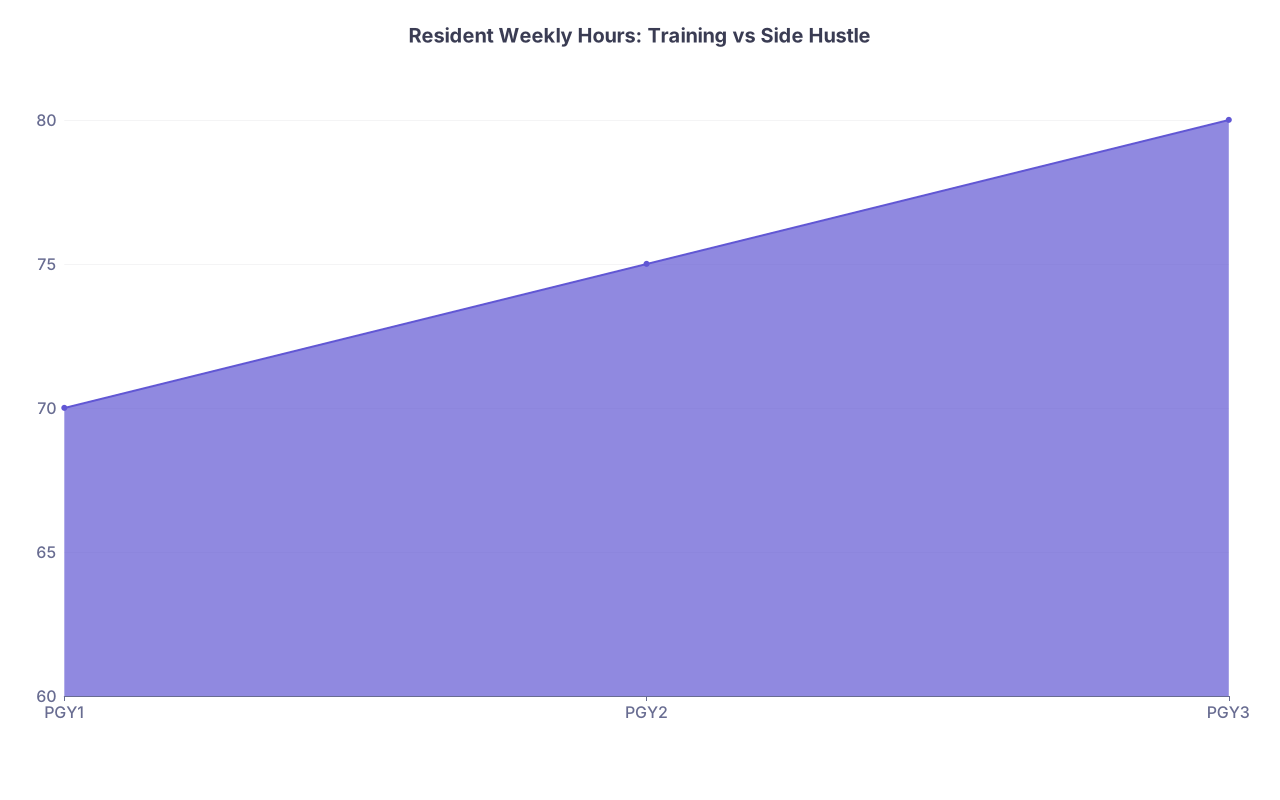
| Category | Value |
|---|---|
| PGY1 | 70 |
| PGY2 | 75 |
| PGY3 | 80 |
Now mentally add 10–20 side hustle hours to that.
1. You Sacrifice Sleep First, Then Everything Else
Side hustles rarely steal time from doom-scrolling. They steal time from:
- Sleep
- Real rest
- Exercise
- Human contact that isn’t clinical
You “just stay up an extra hour.” Then another. Then post-call days get colonized by “just one more task.” Your sleep debt becomes structural, not episodic.
This bleeds into:
- Slower reaction times on call
- Impaired judgment during complex cases
- Lower frustration tolerance with patients and staff
- Diminished learning (you read less, retain less)
Burnout loves chronic sleep deprivation. A demanding side hustle guarantees it.
2. You Add Another Boss and Another Set of Metrics
Residency already floods you with:
- Milestones
- Evaluations
- In-service scores
- Attending feedback
Then you bolt on:
- Views, likes, click-through rates
- Sales, cart abandon rates, conversion metrics
- Customer reviews, refund rates
You now have two separate performance dashboards in your head. Both nagging. Both never “done.”
You cannot live with two full-time evaluation systems and expect to feel okay.
3. You Corrode Your Sense of Control
Residents often chase side income to feel more control over their financial future. Good motive.
The wrong side hustle does the opposite:
- Algorithms change. Sales stall. Platform rules tighten.
- Arbitrary account bans or chargebacks wipe out a month’s work.
- You’re suddenly at the mercy of a platform you do not control.
So instead of medicine + autonomy, you’ve built medicine + algorithm servitude. That psychological bait-and-switch is demoralizing. Fast.
4. You Contaminate Your Only Recovery Time
This is the subtle one. Even when your side hustle isn’t physically time-consuming, it colonizes your mental space.
You’re “off,” but really:
- You’re thinking about thumbnails
- You’re stressing about an unhappy customer
- You’re recalculating ROI on a marketing spend
- You’re wondering if you should “pivot your niche”
Your brain never leaves work mode. The content of the work changed, but the pressure did not. That is not recovery. It’s just different flavored labor.
Future of Medicine, Future of Side Hustles: Don’t Misread the Trend
There’s a real shift happening. More physicians are:
- Building online brands
- Launching niche courses or communities
- Advising startups
- Creating tools for other clinicians
All good. The mistake is copying the visible part of those careers (social media, courses, brands) without understanding the timing and foundation underneath.
You’ll see an attending with:
- Established clinical credibility
- A few days a week of flexible clinical time
- Savings to cushion failed experiments
- Connections from years in the field
Then you, as a PGY-2 on Q4 call, try to do the same thing. From scratch. With no cushion.
Don’t confuse where medicine is going with what you personally should do this year. You can absolutely build toward future physician-entrepreneur roles without burning yourself out right now.
Think “set the stage,” not “launch the empire.”
What a Sane, Low-Burnout Side Hustle Looks Like for a Resident
Here’s the checklist I use when I tell residents whether a hustly idea is reasonable or a slow-motion train wreck.
A resident-friendly side hustle should:
Be time-bounded and schedulable
You can confine it to blocks: a Saturday afternoon, one evening per week. No constant pings. No emergencies.Be asynchronous
The less real-time dependence, the better. You do the work, send it off, walk away. No being “on-call” for the side gig.Pay real money per hour
If it pays less per hour than you’ll eventually earn as a moonlighting attending, it had better build durable skills or assets.Have no catastrophic downside
Worst case, you lose some time or a small amount of money. Nobody sues you, no licensing issues, no major debt.Align with either:
- Your existing medical skill set
- A high-value high-interest skill you’d want long-term (coding, data, writing, etc.)
If it fails all of that? Wrong season of life. That’s it.
Concrete Examples: Good vs Bad Choices for Residents
Let’s walk through some actual patterns I’ve seen, and why some worked and some imploded.

| Step | Description |
|---|---|
| Step 1 | Side Hustle Idea |
| Step 2 | Bad Fit for Residency |
| Step 3 | Better Fit |
| Step 4 | Needs real time responsiveness |
| Step 5 | Uses medical skills |
| Step 6 | High hourly value |
Scenario 1: The PGY-1 With a Dropshipping Store
He heard a podcast about “passive income” and launched a generic gadget store. What happened:
- Nights spent tweaking ads post-call
- Angry emails during rounds
- Constant stress over losing money on paid traffic
Result: store shut down, several thousand dollars lost, and more importantly, a wrecked first year where he was always distracted.
Mistake: Chose a low-margin, hyper-competitive business model that required constant monitoring and spending money to learn.
Scenario 2: The PGY-3 Doing Specialty Tutoring
She started tutoring for Step 1/2 and her specific specialty in-service exams:
- Set fixed weekly slots
- Raised rates as demand increased
- Used her own recent studying to create materials
Result: extra $800–1500/month, no middle-of-the-night emergencies, and actually better board performance because she stayed engaged in the material.
Why it worked: leveraged her existing expertise, time-bounded, high hourly rate, zero leverage debt.
Scenario 3: The Senior Resident Running an Airbnb
Looked great at first: “My cohost does everything!” Until:
- Pipe burst while he was on nights
- Insurance and contractor calls ate his sleep
- A nasty guest threatened legal action over a minor issue
Result: huge stress spike, near-miss on patient care after a no-sleep stretch, and a vow to never again own something that can call him at 2 a.m.
Mistake: Underestimating the “tails”—rare but brutal Airbnb catastrophes—while already in a high-risk, high-responsibility day job.
Scenario 4: The Resident Doing Small, Boring Consulting
He helped a test prep company refine question banks for his specialty:
- Asynchronous edits and feedback
- Paid by project
- Could say no during heavy rotations
Result: moderate extra income, CV-boosting experience, and a future relationship with an ed-tech company.
Why it worked: boring, asynchronous, no real-time crises, genuinely relevant to his long-term interests.
The Financial Trap: Side Hustle vs Just Being a Doctor
Here’s the math you must not ignore.
Once you’re an attending, even on the low end:
- $200–300k+ per year, sometimes much more
- Opportunity for legal moonlighting at very high hourly rates
- Locums assignments that can crush your loan principal quickly
Trying to squeeze an extra $500/month from a brutal side hustle in residency looks different when you realize you could:
- Just pick up an extra shift or two as an attending
- Or carefully negotiate your future contract
- Or choose a slightly higher-paying geography for a few years
You are not lazy or “unambitious” if you wait to scale income until you have your full earning power. You’re strategic.
Where residents go wrong:
- Over-valuing small early wins
- Under-valuing sleep, competence, and reputation
- Forgetting that one medication error or disciplinary issue can cost far more than any side hustle will ever make
Sacrificing your residency performance for pennies now is like scratching the paint on a Ferrari to save money on a car wash.
How to Avoid Burning Out on the Wrong Side Hustle
Here’s the filter I’d apply today, brutally.
Before you start or continue a side hustle, answer these without lying to yourself:
If my program director shadowed my life for a month, would I be comfortable explaining how I use my off time?
If the honest answer is “they’d be horrified,” that’s a sign.Would I still do this hustle if it never made more than $300–500/month?
If no, and it’s currently destroying your sleep, stop. You’re gambling big for tiny upside.Is my performance at work measurably worse since starting this?
Less prepared for rounds, more irritable, half-reading notes? That’s the real cost.Does this build something I want to exist in 5–10 years?
Or is it a random cash grab because someone made a TikTok about it?
If your answers are ugly, your move is simple: shrink or kill the hustle. Not after things calm down. Now.
Specific Next Step You Can Take Today
Open your calendar for the next four weeks and block out every clinical commitment you already have.
Now, in the white space that’s left, honestly mark:
- Sleep (minimum 7 hours on non-call nights)
- One block per week that’s real rest—not hustling
What’s left after that is your true, safe capacity.
Then ask: “Does my current side hustle fit inside that box without leaking into my sleep and sanity?”
If the answer is no, your side hustle is not a clever financial strategy. It’s a burnout plan.
Shrink it. Pause it. Or kill it outright. Your future earning power depends far more on you surviving residency in one piece than on whatever you’re building at midnight right now.


