
The biggest tax mistakes doctors make with international contracts happen before they ever get on the plane.
You sign the deal, you’re excited about the salary, the bonus, the housing allowance—and the tax conversation is a five‑minute afterthought. Then 18 months later you’re on WhatsApp with an accountant back home, staring at a massive unexpected tax bill, fighting with a foreign hospital HR rep who “doesn’t see the problem.”
Let’s not do that.
If you’re a physician taking (or considering) an international contract—locums in the UAE, a two‑year stint in Singapore, telemedicine from Portugal, NGO work in Kenya, academic work in the UK—here’s how to think about cross‑border tax in a way that protects you before you’re locked in.
Step 1: Figure Out Who Actually Gets to Tax You
Your first job is not to memorize tax treaties. It’s to answer two blunt questions:
- Where are you resident for tax purposes?
- Where are you actually working?
Those two answers usually drive everything else.
Tax resident vs where you work
Most countries tax residents on worldwide income and non‑residents only on income sourced there. The trap is that “resident” doesn’t always mean where you sleep most nights.
For US citizens and green card holders:
You’re taxed on worldwide income no matter where you live. You can reduce double taxation (Foreign Earned Income Exclusion, foreign tax credits), but you don’t “get away” from the IRS by moving to Dubai.
For non‑US physicians, it’s about domestic rules + tie‑breaker rules in treaties. For example:
- Canada: You can be considered resident based on significant residential ties, even if you’re abroad most of the year.
- UK: Statutory Residence Test (day counts + ties like family, home, work).
- Australia: Similar fighting over “residency,” center of life, intent.
You need to know both:
- Your home country’s rules for ceasing/keeping tax residence
- Your host country’s rules for creating tax residence or taxable presence

Here’s where the trouble starts: you can be a tax resident in Country A and still owe tax in Country B because that’s where you earned the income.
So the baseline is:
- Home country: likely taxes your worldwide income (or at least wants to).
- Host country: likely taxes income earned while you’re working there.
Your job is to use treaties, exclusions, and credits so you’re not taxed twice on the same paycheck.
Step 2: Know Which Structure You’re Actually In
International physician contracts usually fall into a few common buckets. Each one has different tax consequences.
| Structure Type | How You’re Treated | Typical Tax Angle |
|---|---|---|
| Direct employee of foreign hospital | Employee in host country | Host withholding, home country credits |
| Independent contractor to foreign entity | Self-employed/professional income | Messy PE and self-employment questions |
| Telemedicine from abroad for home-country employer | Still employee of home country | Home country withholding, host may also want tax |
| NGO/mission work | Varies (stipend vs salary) | Often taxable even if low paid |
| Academic/visiting professor | Employee or stipend | Treaty articles may help temporarily |
If the contract calls you an “independent contractor” but you only work for them, on their schedule, at their facility, under their policies—congratulations, you’re in a gray zone. Local authorities may see you as an employee. Your home country may treat you as self‑employed. That combo can be brutal.
If your contract doesn’t clearly specify:
- Employee vs contractor
- Where the services are performed
- Who withholds what, and where
you need that fixed before signing. Do not trust “Oh, we’ll sort that with HR later.”
Step 3: US Physicians Abroad – The Big Three Rules
If you’re a US citizen or green card holder, you play by different rules. I’ll focus here because a lot of international physician contracts involve US‑trained docs.
There are three main tools in your kit:
- Foreign Earned Income Exclusion (FEIE)
- Foreign tax credit (FTC)
- Totalization agreements (for Social Security‑type taxes)
1. Foreign Earned Income Exclusion (FEIE)
This lets you exclude a chunk of earned income from US tax if:
- You have a tax home in a foreign country, and
- You meet either:
- Physical Presence Test: 330 full days outside the US in a 12‑month period, or
- Bona Fide Residence Test: You’re a bona fide resident of a foreign country for an entire calendar year.
The exclusion limit adjusts annually (think roughly low‑100ks). Above that, normal US tax rules kick back in.
Important nuance: The FEIE doesn’t erase your income for all purposes. It still affects your marginal tax rate (“stacking rule”). So if you have other income (investments, US side‑gig, spouse income), your tax bill can still be ugly.
And no, FEIE does not help you with US self‑employment tax. That’s separate.
2. Foreign Tax Credit
If you’re paying significant income tax in the host country, FEIE may not be the right move. Instead, you use the foreign tax credit:
- You report your full income to the US.
- You claim a dollar‑for‑dollar credit for foreign income taxes paid, up to a limit.
In high‑tax countries (e.g., many in Europe), you may owe little or no extra US income tax once the credit applies.
The trap: using FEIE and FTC together incorrectly. People try to exclude income with FEIE and also take a credit on the same income. The IRS does not see the humor.
3. Social Security and totalization agreements
Different problem: payroll taxes.
If you’re an employee abroad, you might pay:
- US Social Security and Medicare (if still on US payroll), or
- The foreign country’s social insurance system, or
- Both, unless there’s a totalization agreement between the US and the host country.
Totalization agreements coordinate social security coverage so you’re not double‑paying for the same work. Not every country has one with the US. UAE, for instance, does not. Germany, UK, Canada do.
You need to know:
- Where your social contributions are going
- Whether you can count foreign contributions toward US benefits later
- Whether you want that or would rather keep paying into US Social Security
Step 4: Watch Time and Presence Like a Hawk
Too many physicians treat tax residency like a vibe—“I basically live in X now.” Tax authorities don’t care about vibes. They care about days, addresses, and paper trails.
You have three overlapping clocks:
- Your home country residency rules
- Your host country residency rules
- Any treaty “tie‑breaker” rules
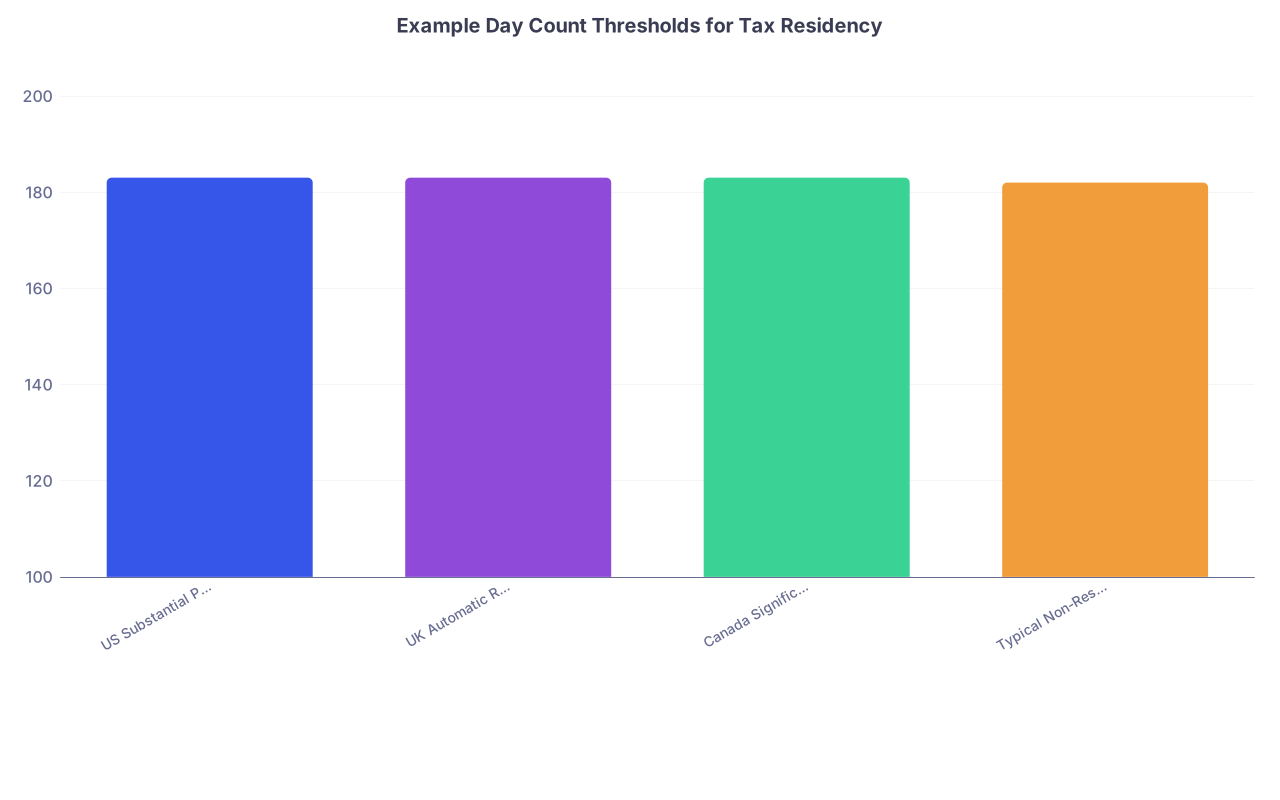
| Category | Value |
|---|---|
| US Substantial Presence | 183 |
| UK Automatic Resident | 183 |
| Canada Significant Presence | 183 |
| Typical Non-Resident Threshold | 182 |
You need a simple system to track:
- Every entry and exit from each country
- Reasonable evidence of where you actually lived (lease, utility bills)
- Where your “center of life” appears to be: family, home, primary bank, main job
Why this matters:
- For FEIE physical presence, missing 330 days by 1 day can cost you tens of thousands.
- For residency, stepping over 183 days with enough ties can make you taxable as a resident.
- For treaties, being “dual resident” requires careful tie‑breaker analysis.
Practical move: use one app, spreadsheet, or calendar category to log travel days by tax year, not academic year or contract year.
Step 5: How Telemedicine and Remote Work Complicate Everything
Here’s a scenario I keep seeing:
You’re licensed and credentialed in State X in the US. You move to Portugal (or Costa Rica, or Dubai) and keep doing US‑based telemedicine. Your employer/contractor still pays you to your US bank, still issues a 1099 or W‑2, still withholds US tax.
You think: “Great, I live abroad, so I’m an international worker now.” Not exactly.
Tax lens:
- From the US perspective: your income is US‑source, you’re working for a US entity, it’s taxable.
- From the host country perspective: you’re physically working in their territory, using their infrastructure, living there. They may treat this as local taxable income, even if the patients and employer are offshore.
Result: risk of double taxation and of having effectively created a “permanent establishment” for a US company if you’re high enough up the chain.
You must check:
- Does the host country tax remote work for foreign companies performed from their soil?
- Do they require local registration, visas tied to work type, or local taxes on that income?
- Does your US employer understand they now possibly have obligations abroad?
Do not assume, “Nobody will notice, it’s telemedicine.” Countries are catching up quickly.
Step 6: What to Negotiate Into the Contract (Before You Sign)
This is the part almost everyone ignores. If you don’t address tax issues in the contract, you’ll handle them alone—with zero leverage—later.
You want the contract to be explicit about:
Your status
Employee vs independent contractor, and in which jurisdiction.Who withholds what
- Local income tax
- Social insurance / pension
- Any mandatory health contributions
Gross vs net compensation
A “tax‑free salary” in the UAE usually means no local income tax. It does not mean you owe nothing to your home country. If you’re going to owe a ton of tax back home, you may want:- A gross‑up clause (they increase pay to offset your home‑country tax cost), or
- A tax equalization policy (they keep your net similar to home, and manage the rest).
Housing and allowances
Housing, flights, education allowances, car allowances—these are often taxable somewhere, even if the hospital markets them as “benefits.” Spell out whether these are:- Included in taxable income locally
- Reimbursed expense vs allowance
- Reported to your home tax authority
Reimbursement of professional fees
If you’re the one who will need a cross‑border tax specialist (you will), ask for an annual stipend to cover tax prep and planning in both countries. This is standard in some corporate expat packages; hospitals are slower to offer it, but they often agree if you ask before signing.
Step 7: The “Second Order” Tax Problems You’re Probably Forgetting
Your salary is not the only thing that gets screwed up when you cross borders. Once you’re abroad for more than a casual locums stretch, these start to matter:
Retirement accounts
- US docs: how your 401(k), 403(b), IRA contributions and distributions interact with foreign tax rules. Some countries tax US retirement accounts in weird ways.
- Non‑US docs: your home country pension rights vs local pension contributions. Whether you’re vesting into a system you’ll never use.
Investments
Some countries treat non‑local mutual funds and ETFs as toxic from a tax standpoint. The US has its own horrors (PFIC rules) for foreign funds.
If you start investing in local funds abroad or buy a local investment property, you can end up with reporting headaches and punitive regimes back home.
Reporting forms
For US docs especially: your reporting burden balloons once you have:
- Foreign bank accounts (FBAR)
- Foreign financial assets over certain thresholds (Form 8938)
- Ownership in foreign corporations or partnerships (Forms 5471, 8865, 8858)
- Foreign pensions or investment wrappers
Penalties for missing these forms are vicious. This is where a lot of well‑meaning international physicians get hammered—not on income tax itself, but on missed reporting.
Step 8: When to Hire Help (and What Kind)
You do not need a Big Four tax partner for a 3‑month locums stint in New Zealand paid to you as US W‑2 income, where you remain US‑resident and NZ does not tax that work. You do need help when:
- You’ll be abroad more than 6–12 months
- You’re changing tax residency status
- You’re using FEIE, FTC, or both
- You own a practice or have K‑1/partnership income
- You’re moving family, buying property, or taking foreign pensions
At minimum, aim for:
- A home‑country tax professional with real international experience (not someone who “can figure it out”)
- If needed, a host‑country accountant who understands foreign workers and physicians specifically
Ask bluntly:
- “How many physicians working abroad do you currently work with?”
- “How many US expats in [host country] do you handle?”
- “What forms and issues have you seen go wrong with doctors in my situation?”
If they pause for too long, move on.
A Simple Pre‑Departure Checklist
Before you accept that contract and book the one‑way flight, you should be able to answer, in writing, these questions:
- What country (or countries) will consider me tax resident during this contract?
- What income will be taxable in each place?
- Am I using FEIE, foreign tax credits, neither, or both?
- Who is withholding what from my pay?
- Could I owe both income tax and social contributions in two countries at once?
- Does my contract compensate me for the extra tax cost of going abroad?
- Who is preparing my returns in each country, and what will that cost?
- What reporting forms will I trigger once I have foreign accounts or assets?
If you can’t answer those, you’re gambling. Maybe it works out. Maybe three years from now you’re mailing checks you didn’t plan for.
FAQs
1. I’m a US physician going to a no‑income‑tax country (e.g., UAE, Saudi). Can I really end up paying more tax than if I’d stayed in the US?
Yes. If you earn significantly more abroad and your only tax is US tax (because the host country has no income tax), you can absolutely end up with a higher overall tax bill than if you’d taken a lower‑paying but tax‑advantaged job in the US with retirement benefits. FEIE helps only up to its limit, and it doesn’t eliminate self‑employment tax or all effects on your marginal rate. That’s why negotiating gross‑up or tax equalization can be crucial in these destinations.
2. I’m just doing a 3‑month locums assignment abroad. Do I really need to worry about cross‑border tax?
You probably won’t trigger tax residency in the host country, but you still might owe local tax on income earned there, depending on local rules and any treaty. Your home country (especially the US) still expects you to report that income. For short assignments, the main risk is double taxation if the host country withholds and you never claim a credit or treaty relief back home. You don’t need a tax PhD for 3 months, but you do need to know: will the host withhold tax, and can I claim it back or credit it?
3. The foreign hospital says they “don’t deal with US taxes” and that “it’s my problem.” Is that normal?
Unfortunately, yes. Many foreign employers are used to dealing with EU or local expats whose home tax systems are coordinate more cleanly. US tax rules are more aggressive and idiosyncratic, and many HR departments simply don’t understand them. That doesn’t excuse you from US obligations. It does mean you should assume US compliance is entirely on you and budget both money and time for specialized help. If they refuse to discuss tax equalization or gross‑up at all, factor that into whether the contract really makes financial sense.
Key points to keep in your head:
You can’t “escape” your home tax system just by changing time zones. You must know where you’re tax resident and where the work is taxed, then use the right tools—exclusions, credits, and good contracts—to avoid paying twice. And you handle all of this before you sign, not after your first year abroad when the tax man finally catches up.