
The idea that “your spouse’s small business will totally screw up your physician tax return” is wildly overstated.
It can get messy. It usually doesn’t have to be a disaster. But if you ignore it or DIY blindly, yeah, that’s how IRS horror stories happen.
Let’s walk through this like two people sitting at the table at 11:47 p.m. in March, surrounded by 1099s, W-2s, and a Schedule C you don’t really understand.
You: high-income physician, W-2 or maybe 1099.
Spouse: some kind of business – LLC, S-corp, sole prop, “tiny Etsy shop,” consulting, whatever.
Brain: “Is this going to blow up our taxes? Trigger audits? Mess up my student loan payments? Are we doing something illegal by accident?”
You’re not crazy to ask that.
1. The core fear: will their business screw up my physician taxes?
Here’s the blunt answer: your spouse’s business doesn’t make your tax life unmanageable. But it does raise the stakes for getting things wrong.
Because you’re not just “a random couple” in the IRS system. You’re a high-income household. You’re exactly the type where errors turn into big dollar problems.
The key pieces you’re probably spiraling about:
- Will their losses trigger an audit or look like a “fake business”?
- Will we pay way more tax because of their income?
- Does this mess up my student loans, PSLF, or REPAYE/SAVE payments?
- Did we screw up by choosing (or not choosing) an LLC or S-corp?
- Are we missing giant deductions or, worse, taking illegal ones?
Let me calm one thing right away: having a spouse with a business is normal. Plenty of physicians have partners who are:
- Therapists with a private practice
- Designers/consultants doing 1099 work
- Real estate agents working under a brokerage
- Online coaches, Etsy sellers, or influencers
- Owners of a small professional services LLC
The IRS sees these returns all the time: one W-2 high earner, one self-employed spouse. It’s not some exotic red-flag combo by itself.
The part that causes trouble isn’t “business exists.” It’s “business is sloppily documented” or “CPA is winging it” or “we tried TurboTax and guessed.”
2. The filing status panic: does their business force us to file a certain way?
This one freaks people out: “Do we have to* file Married Filing Jointly? Will my spouse’s messy books get me in trouble?”
You basically have three real options in the U.S.:
| Filing Status | Common Outcome |
|---|---|
| Married Filing Jointly | Usually lowest total tax |
| Married Filing Separately | Sometimes helps for loans, rare tax win |
| Head of Household | Usually not applicable if married |
Here’s the uncomfortable-but-true part: if your spouse’s business return is wrong and you file jointly, you both own that mistake. Joint and several liability. The IRS can come after either of you for the tax owed.
That’s why you feel like their business is your problem. Because it is.
But separating and filing Married Filing Separately (MFS) to “protect yourself” usually backfires. You often:
- Lose certain deductions/credits
- Pay more total federal tax
- Wreck some benefits like certain education credits, child credits, etc.
- Still don’t actually “fix” the underlying issue: bad bookkeeping or bad tax prep
The only times I’ve seen MFS genuinely make sense for physicians:
- Student loans where only one spouse has loans and repayment is based on their income alone when filing separately (older IDR plans; SAVE is more flexible but still nuanced)
- Rare state-specific or legal reasons (liability, divorce in process, etc.)
- One spouse has major unpaid IRS debt you don’t want attached to your refund
Even then, it’s a calculation exercise, not vibes. You have someone run both scenarios with real numbers, not with fear.
So, no: your spouse’s business doesn’t “force” you into some weird filing corner. But it does mean your joint return has more moving parts – and more places to screw up.
3. The audit nightmare in your head (and what actually triggers attention)
You know that low-level terror of, “If their business shows a loss, we’re going to get audited and lose everything”?
Let’s be precise.
Red flags for a spouse business that can attract attention:
- Repeated losses year after year with no real attempt at profit
- “Business expenses” that look suspiciously like lifestyle: vacations, personal meals, family car, home renovations
- No real records: no separate bank account, no receipts, no invoices
- Income that clearly doesn’t match the lifestyle (reporting $10K of income while visibly living on more)
If your spouse has:
- A separate business bank account
- Actual clients/customers
- Invoices/contracts
- An accounting system (even basic income/expense tracking)
- Real attempts to grow or maintain the business
then a loss year or two is not shocking. New practices, new consultancies, new online businesses – they often lose money at first. That’s not inherently a problem.
Where it does get risky for you as the physician is when:
- You’re in a high tax bracket,
- Their business is basically being used as a “write off everything” machine,
- And you’re signing a joint return that glorifies that fantasy.
You might not be the one buying “business flights” to Hawaii, but your name is on that 1040.
So yes, this is where you’re right to be anxious: if their business is sloppy or half-legit and you file jointly, you inherit that risk.
The fix isn’t panic. It’s: make sure the business is run like a real business on paper, not just in intention.
4. How their business actually affects your tax numbers
Let’s talk numbers, because this is usually where the stomach drop happens.
You: W-2 physician, say $280K–$450K or more.
Spouse: business net income could be anywhere from a small loss to low six figures.
What happens on your return?
- If they’re sole proprietor / single-member LLC: it hits your joint return as Schedule C income or loss. It raises or lowers your total taxable income.
- If they’re S-corp owner: they’ll get a K-1 and probably a W-2 from their own company. That all flows onto your joint 1040.
- If they’re partner in a partnership/LLC: K-1 again, with income and possibly self-employment tax aspects.
Key stress point: self-employment tax.
Physician W-2? Your employer is already doing Social Security and Medicare withholding.
Spouse self-employed? They usually owe:
- Income tax (based on your combined bracket), plus
- Self-employment tax (basically both employer and employee side of Social Security/Medicare on that business income, with some nuances)
That’s why it can feel like their “extra” $40K of income doesn’t actually feel like $40K. Because between federal, state, and SE tax, a big chunk is gone.
You might be thinking: “So their business is basically punishing us?”
Not if it’s profitable enough and done right. But yes, more income in your bracket gets taxed hard.
Where this really stings: you’re making, say, $350K as a physician, and they’re grinding in a business making $20–$30K after expenses. You feel like you’re both working like crazy, and when the tax bill shows up, it feels like their entire contribution disappeared into the IRS.
Emotionally brutal. Logically explainable. But still brutal.
5. The legal structure anxiety: LLC vs S-corp vs “we have no idea”
Here’s the part people overrate and underrate at the same time.
You overrate: “If we choose the wrong entity, we’ll be destroyed.”
You underrate: “If we ignore the details, we can create a slow-moving tax and legal mess.”
Quick reality check:
- LLC (single-member): For tax, this usually just flows to Schedule C. Liability shield may help legally, not magic for taxes.
- S-corp: Can reduce self-employment tax if set up and run correctly, but requires payroll, documentation of “reasonable salary,” and proper compliance.
- Sole proprietor: Easiest, but all profit is hit with self-employment tax; no legal separation.
Is your spouse’s business structure going to complicate your physician return? Indirectly, yes. Because:
- More complex structure = more forms: K-1s, corporate returns, payroll reports.
- More places things can go wrong: missed filings, late elections, wrong salary vs distribution mix.
The worst-case I’ve seen: spouse elects S-corp because “a guy on YouTube said it saves taxes,” doesn’t do payroll, never files the 1120-S on time, and then three years later you’re fixing a backlog with penalties. While you’re in fellowship or first attending job and have zero bandwidth for this nonsense.
Moral: your spouse doesn’t need the fanciest structure. They need one they can actually maintain correctly, with a tax pro who isn’t guessing.
6. How this all collides with loans, PSLF, and planning
This is the part that’s rarely explained clearly and hits physicians the hardest.
Your spouse’s business income can:
- Raise your Adjusted Gross Income (AGI)
- Which can raise your IDR payment if you’re on income-driven repayment (PAYE, REPAYE, SAVE, etc.)
- Which can complicate planning around PSLF or long-term forgiveness
If you’re relying on lower IDR payments during residency/fellowship, and suddenly your spouse’s business actually starts doing well, you can see:
- Payments jump
- Cash flow feel squeezed
- Emotional resentment around “Your business is making my loans more expensive”
Sometimes filing MFS can help here, but under newer rules (especially SAVE), it’s not always required to keep payments manageable. The tax vs. loans tradeoff is very specific to your numbers.
So yeah, their business doesn’t just affect your April tax bill. It affects your monthly reality when loans are involved.
7. What you should actually do (so this doesn’t turn into a disaster)
You’re probably already a little overwhelmed, so I’m not going to give you a 27-step checklist. But there are a few non-negotiables if you want to sleep at night.
Your spouse’s business needs to:
- Have a separate bank account
- Track income and expenses with some real system (even basic, like Wave, QuickBooks, or a spreadsheet that isn’t chaos)
- Keep receipts/records – digital is fine, but have them
- Be reviewed by a tax pro who understands:
- Physician income
- Self-employment and S-corps
- Your state rules
- Student loans, if that’s part of your world
And you need to:
- Actually look at the completed tax return before signing
- Ask what each big line item is
- Push back on anything that sounds like “we just write everything off” or “the IRS will never notice”
If the person preparing your taxes casually jokes about “creative deductions,” you need a different person. You’re not a random Uber driver filing a $40K return. You’re a high-income household with a side business. That’s a different risk profile.
8. Reality check: When does the spouse business become a real problem?
Your anxiety is justified when:
- The business is consistently losing money, with no clear strategy or timeline to become profitable
- Expenses are obviously personal but being pushed as business (family trips, kids’ stuff, your car that you mostly use for work)
- The entity is more complex than either of you can properly manage (S-corp with no payroll, multi-member LLC with no operating agreement, etc.)
- You’re getting letters from the IRS or state and everyone just… ignores them
- You and your spouse don’t even agree on how legit the business is
But if:
- The business is real, documented, and either profitable or realistically pointed in that direction
- You’re working with a competent CPA/EA who can explain your return in plain English
- You’re not trying to run your lifestyle through “business” deductions
then no, your spouse’s business is not going to sabotage your physician tax return.
It will add complexity. It does mean you shouldn’t DIY just because “TurboTax walked us through questions.” Those questions don’t fix bad inputs.
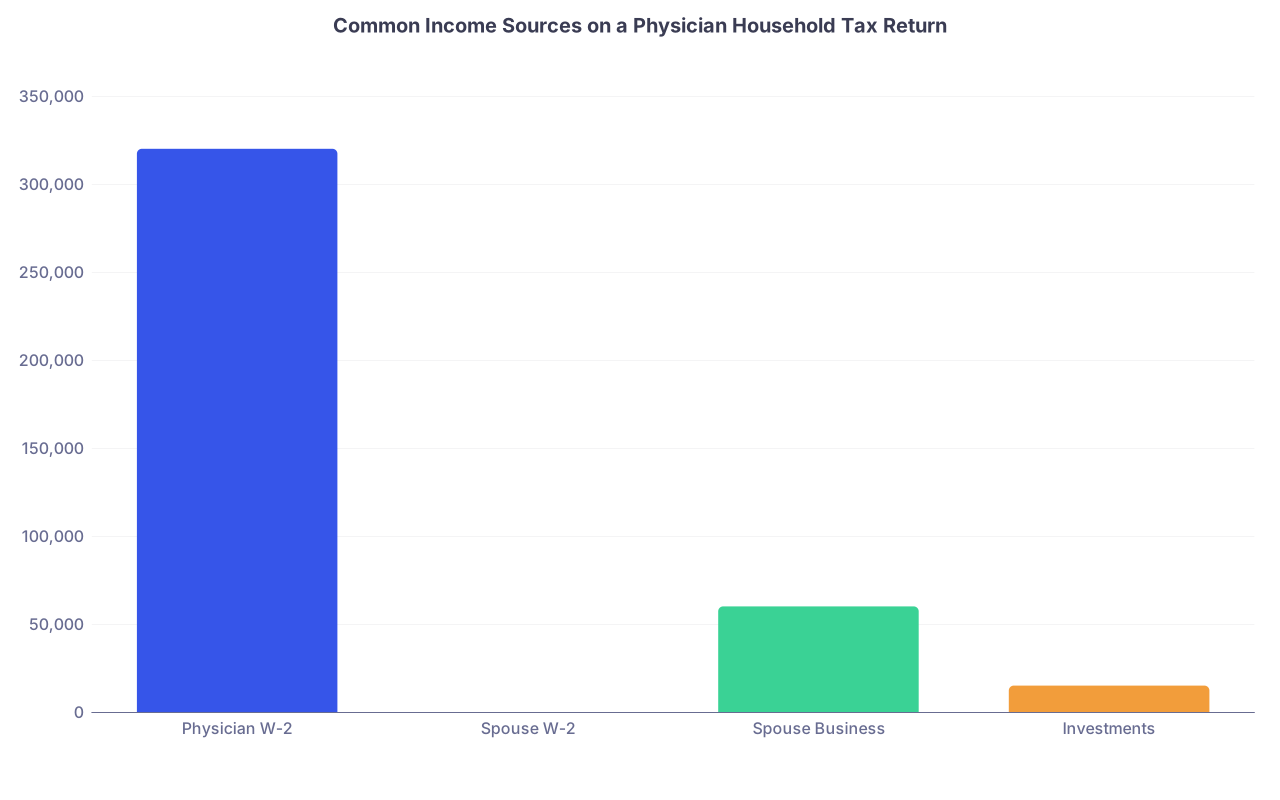
| Category | Value |
|---|---|
| Physician W-2 | 320000 |
| Spouse W-2 | 0 |
| Spouse Business | 60000 |
| Investments | 15000 |

| Step | Description |
|---|---|
| Step 1 | Physician W2 Income |
| Step 2 | Joint 1040 Return |
| Step 3 | Spouse Business Income |
| Step 4 | Schedule C or K1 |
| Step 5 | Student Loans |
| Step 6 | IDR Payment Based on AGI |

9. When to absolutely stop and get help
If any of these are true, you should stop trying to sort this in your head and have an actual tax pro look at your situation:
- You have no idea what form the business is currently using (Schedule C vs S-corp vs partnership)
- You’re in attending income territory and the business is >$20–30K net profit
- You’ve switched entities in the last couple of years
- You’re getting IRS or state notices you don’t fully understand
- You’re on PSLF or any IDR plan and your spouse’s income just jumped
And I’d specifically look for someone who either:
- Works with a lot of physicians and small business owners, or
- Has actual experience with high-income + self-employed spouse combos (ask directly; don’t be shy)
If your current person “just files what you send” and never proactively explains implications to you, that’s not good enough anymore.
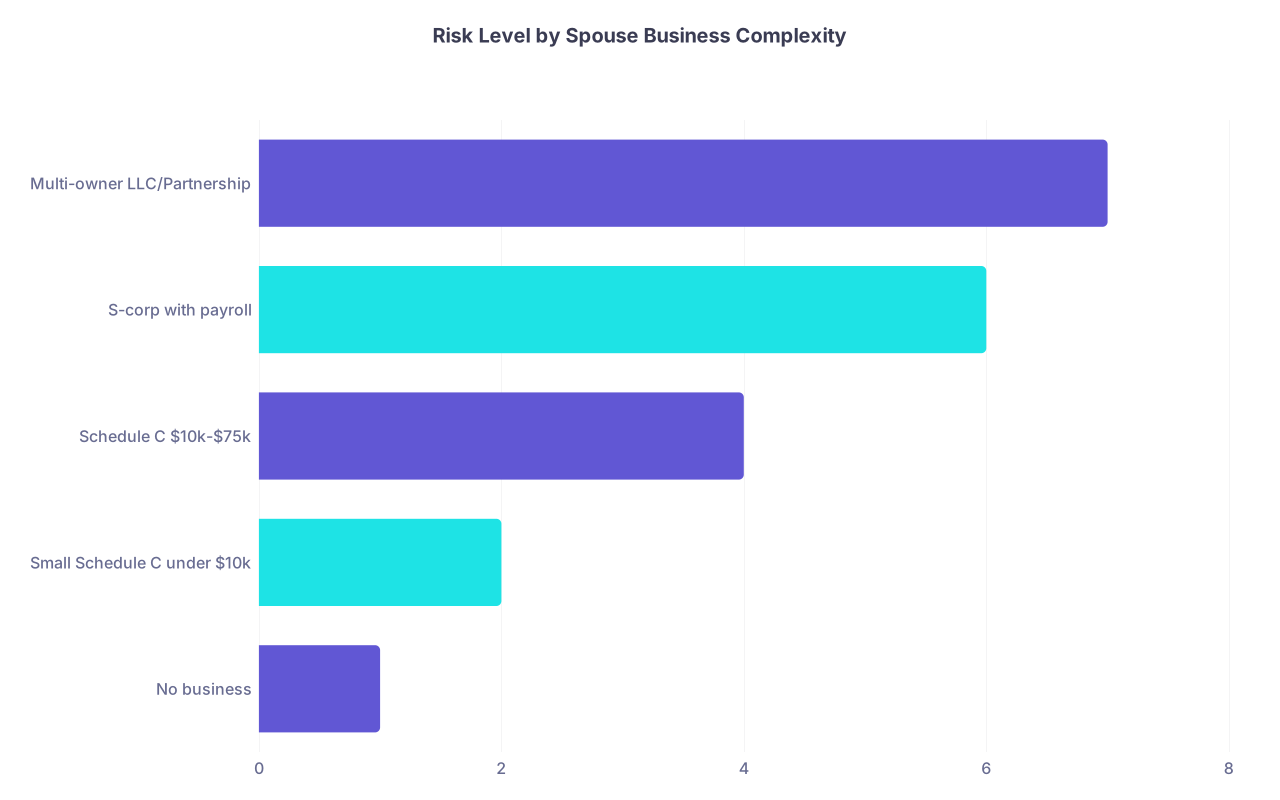
| Category | Value |
|---|---|
| No business | 1 |
| Small Schedule C under $10k | 2 |
| Schedule C $10k-$75k | 4 |
| S-corp with payroll | 6 |
| Multi-owner LLC/Partnership | 7 |

FAQ (exactly 5 questions)
1. Could my spouse’s business actually trigger an audit that pulls me in as the physician?
Yes. If you file jointly, the IRS looks at the combined return. If their business looks like a hobby with fake losses or aggressive write-offs, you’re both on the hook. That doesn’t mean an audit is likely just because a business exists. It means you shouldn’t tolerate sloppy or obviously sketchy reporting, because any fallout is shared.
2. Is it ever safer for me to file Married Filing Separately because of their business?
Emotionally, it feels safer. Mathematically, it usually isn’t. MFS often increases your total tax and kills some credits, and it doesn’t magically erase issues inside the business itself. The only time it’s even worth a serious look is when student loans or prior IRS debt make separation strategically beneficial. But that’s a calculation, not a default.
3. My spouse’s business loses money most years. Is that automatically bad for our taxes?
One or two loss years can be fine, especially for early-stage or cyclical businesses. Chronic losses, no clear plan to be profitable, and weak documentation? That’s where you start drifting into “this looks like a hobby used to generate tax losses,” and that’s a problem. If it’s constantly losing money and you’re high-income, the IRS has every reason to question it.
4. Are we missing out if my spouse with a business doesn’t have an LLC or S-corp yet?
Not necessarily. A simple sole proprietorship with clean records is often better than an S-corp done badly. S-corps can save self-employment tax, but only when: there’s enough profit, payroll is done right, and returns are filed correctly and on time. I’ve seen more damage from rushed, poorly managed S-corps than from plain Schedule C businesses.
5. What’s the single biggest mistake physician couples make with a spouse’s business and taxes?
Treating the business like “side money” that doesn’t need real systems. No separate bank account, no proper tracking, guessing at expenses, and then dumping it into TurboTax at midnight. When you’re in a high bracket, that casual approach turns into big dollar mistakes, higher audit risk, and constant anxiety. Run it like a real business on paper, even if it feels small.
Key takeaways:
Your spouse’s business doesn’t automatically wreck your physician tax return, but it absolutely raises the stakes for doing things right. Clean records and a competent tax pro matter way more than fancy entities or tricks. And if you’re losing sleep over “what if this blows up later,” that’s your sign to stop guessing and get the whole picture reviewed now, not three years and five IRS letters from now.