

The biggest tax mistakes physicians make happen in the final 12–18 months before retirement.
Not in residency. Not mid-career. Right at the finish line—when emotions are high, schedule is lighter, and people start winging it because “I’m almost done anyway.”
Do not wing this year.
You get one shot at your final working year’s tax picture. Here’s a month‑by‑month and then quarter‑by‑quarter playbook for that last 12 months before retirement, focused purely on tax optimization and cash flow timing.
12–18 Months Before Retirement: Set the Tax Battlefield
At this point you should not be fiddling with tiny deductions. You should be setting the structure.
Month 18–15: Commit to a Retirement Month and Income Picture
You cannot optimize taxes if you do not know when you’re retiring.
At this point you should:
- Pick a retirement month and stick to it (e.g., June 30 vs December 31)
- Estimate your income for:
- Final working year
- First retirement year
- Decide: full stop, partial locums, or slow glide (0.5 FTE → 0.25 FTE → none)
This matters because:
- A June retirement often gives you one very high-income year and one very low-income year.
- A December retirement gives you one final huge year and then a lower year.
For tax planning, you generally want:
- A clear low-income year right after you stop full-time work, to use:
- Roth conversions
- Capital gain harvesting
- Strategic withdrawals
So do not casually “see how you feel.” Decide the month.
Month 18–15: Build the Tax Map With a Professional
At this point you should sit with a tax-focused financial planner and a CPA—ideally someone who has actually retired physicians before, not just done 1040s.
Have them run:
- A multi‑year tax projection:
- Final working year
- First 5 retirement years
- Scenarios:
- Retire June vs December
- Roth conversions of $50k / $100k / $200k
- Social Security at 62, 67, 70
- Pension start dates if applicable
Ask explicitly:
- “In what years do I have my biggest tax opportunities?”
- “In what years am I most vulnerable to IRMAA Medicare surcharges?”
You are not guessing. You are mapping.
12 Months Before Retirement: The Tax Optimization Year Begins
Now we go month‑by‑month. Assume you retire next June. Adjust the calendar if your date is different; the sequence is what matters.
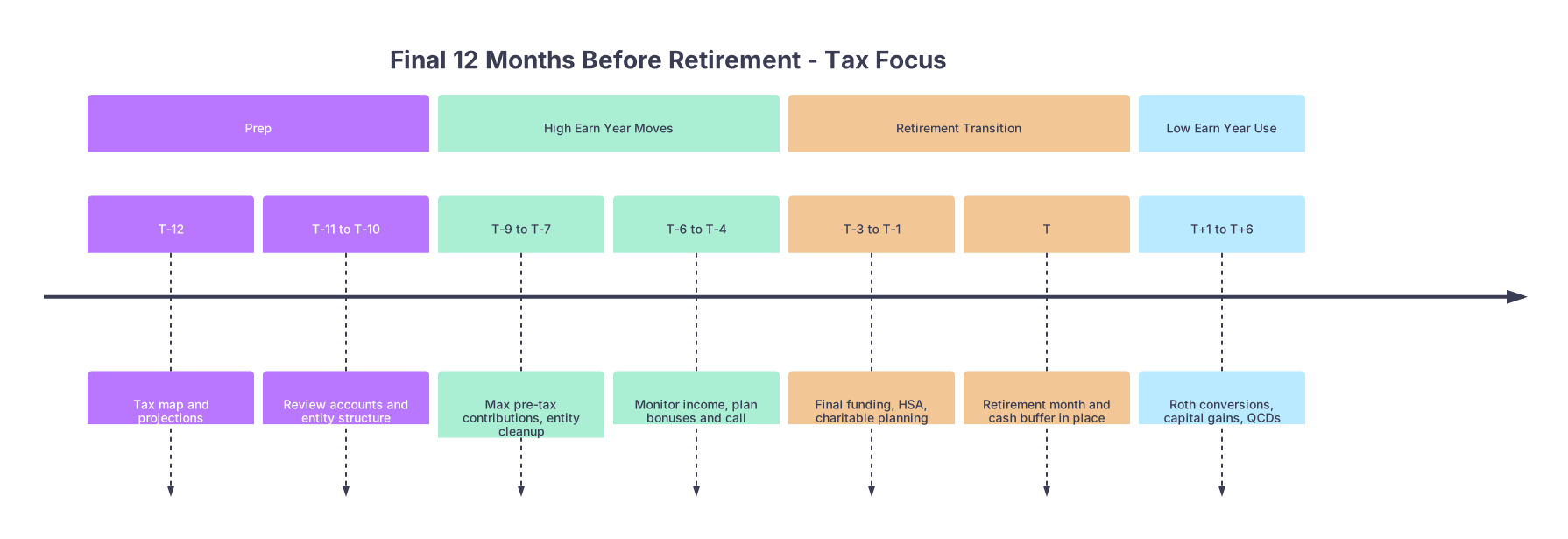
| Period | Event |
|---|---|
| Prep - T-12 | Tax map and projections |
| Prep - T-11 to T-10 | Review accounts and entity structure |
| High Earn Year Moves - T-9 to T-7 | Max pre-tax contributions, entity cleanup |
| High Earn Year Moves - T-6 to T-4 | Monitor income, plan bonuses and call |
| Retirement Transition - T-3 to T-1 | Final funding, HSA, charitable planning |
| Retirement Transition - T | Retirement month and cash buffer in place |
| Low Earn Year Use - T+1 to T+6 | Roth conversions, capital gains, QCDs |
12–10 Months Before: Clean Up Your Tax Structures
At this point you should be cataloging every account and entity that has tax consequences.
Make a simple table for yourself:
| Account Type | Typical Tax Treatment |
|---|---|
| 401(k)/403(b) | Pre-tax, ordinary income |
| 457(b) | Employer rules, OI at payout |
| Traditional IRA | Pre-tax, ordinary income |
| Roth IRA | Tax-free (after rules met) |
| Brokerage account | Capital gains/dividends |
| HSA | Tax-free for medical use |
At this point you should:
List all retirement and investment accounts
- Old hospital 403(b)s
- 401(k) from private groups
- 457(b) plans (governmental vs non‑governmental)
- Traditional/Rollover IRAs
- Roth IRAs
- HSAs
- Taxable brokerage accounts
- Any defined benefit/cash balance plans
Identify problem accounts:
- Large pre‑tax IRAs blocking the backdoor Roth (if you’re still doing it)
- Non‑governmental 457(b) with weak employer protections
- Concentrated low-basis stock in a taxable account
Decide on consolidation:
- Which 403(b)/401(k) will you roll where?
- Will you roll pre‑tax IRAs into an employer 401(k) to “clear the deck” for Roth work?
You’re trying to make your accounts simpler and more controllable before your income drops.
9–7 Months Before: Max Pre‑Tax While Income Is Highest
This is usually the last year you’re in your top bracket. Use it.
At this point you should:
Maximize employer retirement plans:
- 401(k)/403(b) employee deferrals
- 457(b) contributions if the plan is solid
- Cash balance / defined benefit plan contributions (if practice offers one)
Coordinate with your practice:
- If you’re a partner, confirm final year profit distributions and whether you can make an extra defined benefit contribution before exit.
- If you’re W‑2, confirm the employer match timing and vesting rules before you pick a retirement date.
Decide: pre‑tax vs Roth within workplace plans.
- Final high‑income year? In most cases, go pre‑tax. You’ll likely be in a lower bracket when you pull money later.
- Exception: If all your money is already pre‑tax and very little is Roth, you might intentionally do some Roth contributions even in a high-income year to diversify tax buckets. That’s strategy, not reflex.
Max out HSA contributions if you’re on a high‑deductible plan:
- Treat your HSA as a stealth retirement account. Do not spend it unless you have to.
- Keep receipts for medical expenses in a folder; you can reimburse yourself tax‑free later.
9–6 Months Before: Control Your Final Year Income
This is where most physicians accidentally blow up their bracket.
At this point you should:
For W‑2 employed physicians
- Review:
- Expected base salary
- Expected bonus (productivity, quality, signing)
- Payout timing for unused PTO or CME
Ask HR explicitly:
- “If I retire in June vs December, how are my bonuses and PTO paid and taxed?”
- “Does any deferred comp or retention bonus vest at a specific date?”
You may decide to:
- Stay a few months longer to capture a large bonus (even if it raises taxes).
- Or avoid a huge one-time payout in the same year as a practice buyout or 457(b) lump sum.
For 1099 / practice owners
At this point you should:
- Coordinate with your accountant on:
- Timing of accounts receivable
- Final year equipment purchases (Section 179 and bonus depreciation)
- Paying vs delaying expenses into next year
Let me be blunt: randomly buying a $50,000 ultrasound in December “for the write‑off” is stupid if you’re about to retire and don’t need the equipment. Tax savings are never 100%. You’re spending real dollars.
Use depreciation and expense timing strategically, not emotionally.
6–4 Months Before: Medicare, IRMAA, and Withdrawal Strategy
Physicians routinely underestimate how much Medicare IRMAA surcharges will cost them. Or they ignore the lag.
Your Medicare Part B and D premiums are based on MAGI from two years prior.
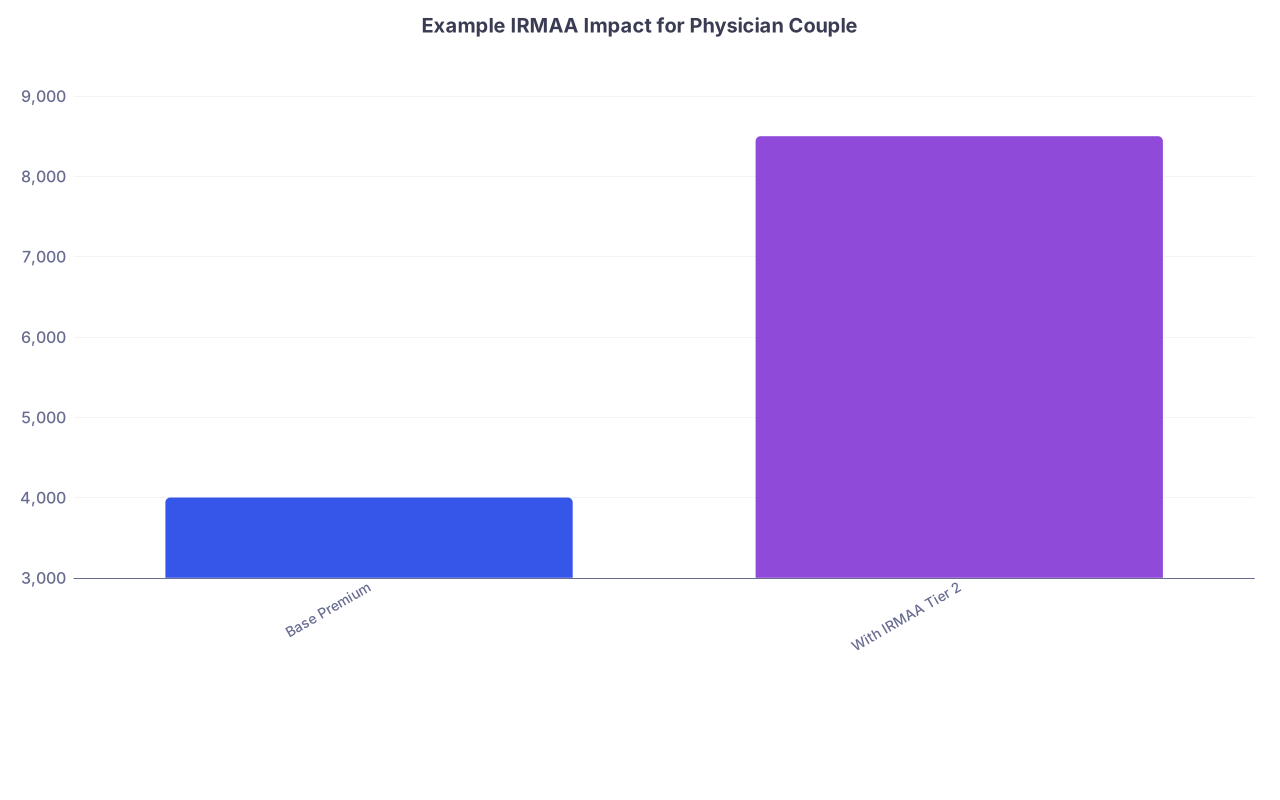
| Category | Value |
|---|---|
| Base Premium | 4000 |
| With IRMAA Tier 2 | 8500 |
Rough example for a married couple:
- Base Medicare B + D premiums: around $4,000/year (varies slightly by year)
- With higher IRMAA brackets: can jump to $8,000+ per year
At this point you should:
- Map out:
- Your income the year you turn 63 and 64 (for IRMAA at 65 and 66)
- Your expected RMDs at age 73 (under current law)
If you’re retiring around Medicare age:
- Consider:
- Roth conversions in lower-income years before 63
- Keeping your final working year’s MAGI reasonable if possible
- Avoiding large one‑time income hits (like huge Roth conversions) at age 63–64 unless the long‑term benefit outweighs IRMAA costs
You’re playing chess, not checkers. Two squares ahead, minimum.
3 Months Before Retirement: Lock In the Fine Moves
At this point you should stop changing your plan every week.
Check 1: Cash Buffer and Tax Withholding
You do not want to start retirement by selling investments in a down market just to pay taxes.
At this point you should:
- Have 6–12 months of living expenses in cash, separate from your emergency fund.
- Review and possibly adjust:
- W‑2 withholdings for the final months
- Quarterly estimated tax payments if you’re 1099
- Ask your CPA: “Given my retirement date and current year income, do I need to increase or decrease withholding/estimates to avoid penalties?”
Check 2: Charitable Giving and Bunching
If you give meaningfully to charity, your final high-income year is the last big chance for tax leverage.
Options:
Donor-Advised Fund (DAF):
- Contribute appreciated stock or cash in your final working year.
- Get a big deduction now.
- Grant to charities slowly over retirement.
Qualified Charitable Distributions (QCDs):
- If you’re 70½ or older in retirement, you’ll be able to send money directly from IRA to charity and reduce taxable income.
- Not used in the final working year, but you design your IRA balance today with this in mind.
At this point you should decide:
- Do I “bunch” 2–3 years of charitable giving into this final high‑income year?
- What appreciated positions in my taxable account should I donate instead of selling?
Retirement Month (T): Execute the Transition Cleanly
When the retirement date arrives, the goal is boring taxes, not surprises.
At this point you should:
Confirm:
- Final paycheck date
- Final bonus payment date
- Payout of PTO or other lump sums
- Last employer retirement plan contributions
Get:
- Final pay stub with year-to-date earnings and withholdings
- Statements for all 401(k)/403(b)/457(b) accounts
Do not:
- Immediately roll everything over without thought.
- Start large Roth conversions just because you “heard they’re good.”
Pause. You spent a year designing the next moves. Stick to the plan.
First 12 Months After Retirement: Use the Low-Income Window
This is where the real tax optimization usually happens.
You’ve left practice. Your earned income may be close to zero (aside from maybe small locums or consulting). That’s exactly the environment you want for the next steps.

Months T+1 to T+3: Re‑Confirm the New Reality
At this point you should:
- Update your tax projection with actuals:
- Final working year W‑2 / 1099 numbers
- Pension start amounts
- Any small consulting or locums income
- Confirm:
- Social Security start date (if already chosen)
- Planned withdrawal amount from investment accounts for living expenses
Then build a multi‑bucket withdrawal plan:
- Cash / high‑yield savings: 1 year of spending
- Taxable brokerage: dividends and selective sales
- Roth IRAs: usually saved for later
- Pre‑tax accounts: pulled strategically, not randomly
Months T+3 to T+9: Execute Roth Conversions and Capital Gain Harvesting
This is the golden window most physicians waste.
At this point you should:
Roth Conversions
- Decide your target tax bracket ceiling (e.g., fill up the 22% or 24% bracket).
- Convert from pre‑tax IRA/401(k) to Roth IRA until your projected taxable income hits that ceiling.
- Coordinate timing within the year; you can break conversions into chunks.
Capital Gain Harvesting
- In a low‑income year, your long‑term capital gains rate may be 0% up to a certain threshold.
- You can sell appreciated holdings, realize gains at low or zero rates, and then reinvest (sometimes even back into similar holdings, minding wash sale rules for losses, not gains).
QCD and Charitable Strategy (if old enough)
- If you’re 70½+ during this period, you can start QCDs from IRAs to satisfy RMDs and reduce taxable income.
- Otherwise, use the DAF you funded in your last working year to manage donations without current-year tax headache.
You want to intentionally move money from “tax‑later” to “tax‑never” buckets while your income is temporarily low.
Special Considerations for Physicians With Practice Equity
If you own equity in a group or practice, your tax planning is more complicated—and more important.
At this point (12–24 months prior) you should:
Clarify:
- Buy‑out formula and timing (lump sum vs installments)
- How goodwill vs hard assets are treated (capital gain vs ordinary income)
- Whether you’ll continue as a contractor post‑sale
Coordinate timing:
- A large practice buyout in the same year as peak clinical income can push you into top federal and state brackets.
- Sometimes you negotiate installment payments to spread taxable income.
- Sometimes, even at higher tax rates, taking a clean lump sum is worth it. But you should do that math deliberately, not reactively.
Do not let the practice accountant “handle it” without your own CPA running scenarios. I’ve seen too many physicians assume “the group has a guy” and then learn later how much control they gave up.
Quick Priority Checklist by Time Frame
Sometimes you just need the short list. Here it is.
12–18 Months Before Retirement
- Pick your retirement date (month and year)
- Build multi‑year tax projections with a CPA/financial planner
- Inventory every account and entity
- Decide on account consolidations and cleanup
9–6 Months Before
- Maximize pre‑tax and HSA contributions
- Confirm bonus, PTO, and deferred comp timing
- Coordinate business income and expenses if you’re 1099 or an owner
- Model IRMAA and RMD impacts
3 Months Before
- Lock in final year income expectations
- Adjust withholdings / estimates to avoid penalties
- Finalize charitable strategy (DAF, appreciated stock)
- Ensure 6–12 months of cash/liquid assets are ready for retirement start
First 12 Months After Retirement
- Update tax projections with actual income
- Design and start your withdrawal strategy
- Execute Roth conversions and capital gain harvesting in your low‑income window
- Review annually and adjust as tax laws and income change

Three key points to leave with:
- Your final working year and first retirement year form a matched set—plan them together, not separately.
- The biggest wins come from timing and structure (Roth conversions, gain harvesting, IRMAA planning), not hunting for tiny deductions.
- Decide early, model carefully, and then stop improvising; your tax plan should be mostly set 6–9 months before you hang up the white coat.


