

It’s the evening of Match Day. Your partner just opened their email and saw the word “Congratulations.” You…did not. Or you did not apply this cycle. Either way, they have a residency spot, and you don’t.
Now you’re sitting on the edge of the bed, scrolling your phone, half-listening as they talk about their new city, orientation dates, housing options. And in the back of your mind is one loud question:
“What the hell do I do now?”
This is exactly the situation we’re dealing with: your partner matched; you’re unmatched or not starting residency. You want to stay together geographically and professionally not implode your own career in the process.
Let’s walk through your real options. Not the fantasy ones. The actual, concrete paths I’ve seen people take that either worked or backfired.
Step 1: Get Clear On What Situation You’re Actually In
First, name your exact scenario. The details matter because your options change with each combination.
Here are the usual setups:
| Scenario Code | Your Status | Partner Status | Timing |
|---|---|---|---|
| A | Unmatched, applied | Matched PGY-1 | Same year |
| B | SOAPed into prelim | Matched categorical | Same year |
| C | Didn’t apply | Matched PGY-1 | You delayed |
| D | Reapplicant (prior no) | Partner now PGY-2+ | Staggered |
| E | Non-US or IMG status | US partner matched | Visa issues |
You’re probably in A, B, or C.
Right now, do this on paper or a note on your phone:
- Write: “Current year, partner’s program/city/specialty”
- Write: “My status: [unmatched / SOAP / no application / reapplicant]”
- Write: “My earliest realistic start date for residency: [July next year / later]”
This frames the rest. You’re planning your next 12–24 months, not your entire career.
Step 2: Decide the One Thing That Matters Most (For Now)
You can’t optimize everything at once: relationship, prestige, specialty, location, visa, money. Something has to be the primary driver.
Bluntly, couples in your situation usually fall into one of three priorities:
- “We must be in the same city. Non-negotiable.”
- “I must protect my specialty choice, even if we do distance for 1–3 years.”
- “I just need any solid path into residency; I’ll compromise on specialty/location.”
Pick one. Out loud. With your partner.
Because the worst outcomes I’ve seen happened when:
- One partner secretly prioritized proximity.
- The other secretly prioritized prestige.
- Neither said that clearly.
- They chose mushy middle options that served neither.
You don’t have to love the choice. You just have to be honest about it.
Step 3: Map Out Your Concrete Options by Scenario
Now we get specific.
Scenario A: You applied, did interviews, and didn’t match
You just went through the whole ERAS cycle and came up empty. Partner matched.
You have 4 main levers here:
- Where you live next year.
- What you do clinically.
- How you fix your application weaknesses.
- Whether you aim to reapply to the same specialty.
A1. Decide: Same city as partner or not?
If you want to be in the same city as your partner next year, these are realistic pathways:
- Research year in their city
- Non-ACGME clinical job (prelim-like, “house officer,” etc.)
- Teaching job (anatomy, physiology, etc., at a local school)
- Nonclinical but healthcare-adjacent work (industry, consulting, public health, scribing leadership)
If the partner’s program is in a large academic center (think Boston, Philly, Houston, Chicago, NYC, LA), you have better odds of finding something meaningful there. Small community program? You might have to get more creative.
If you’re willing to do long-distance for 1–2 years, your priority becomes: wherever you can construct the strongest possible reapplication.
A2. Fix the “Why I Didn’t Match” Problem
Be ruthless here. The common failure reasons:
- Low Step scores or multiple attempts
- Limited or poor-quality letters
- Weak clinical performance or professionalism flags
- Late application or too few programs applied to
- Switching to a competitive specialty without preparation
- For IMGs: visa barriers, weak USCE
You should be able to articulate in one sentence:
- “I didn’t match because ______.”
- “Next year, I’ll fix that by ______.”
If you can’t fill those blanks concretely, that’s the first job.
A3. High-Yield Options for This Coming Year
Here’s what’s actually useful (not the fluff your aunt suggests):
Research position in your or a related specialty
- Ideal if you aim for academic programs or competitive specialties.
- Aim for “80% research, 20% clinical shadowing or patient contact if possible.”
- Get at least:
- One strong letter from a known faculty member.
- Your name on poster(s), abstract(s), or paper(s).
Non-ACGME clinical positions (e.g., surgical assistant, research fellow with clinical duties, house officer)
- Great if you have decent scores but need more recent US clinical work and strong letters.
- Be careful about jobs with crazy service hours and no mentorship. Those can wreck your reapplication because you’ll be too exhausted to apply well.
Formal fellowships (like clinical/research fellowships for IMGs)
- Can be a structured way to build USCE and letters in one geographic area.
- Some hospital systems effectively recruit residents from these pools.
A targeted second application cycle while working part-time
- For some, the best move is a low-intensity job (tutoring, scribing, nonclinical role) that gives you time to:
- Rework personal statement.
- Strategize program list.
- Network with PDs/assistant PDs.
- For some, the best move is a low-intensity job (tutoring, scribing, nonclinical role) that gives you time to:
What generally doesn’t help much:
- Random short-term volunteering with no physician mentor.
- Generic non-medical jobs with zero connection to healthcare.
- Passive “studying” without producing any new letters or tangible output.
Scenario B: You SOAPed into a prelim year, partner matched categorical
You’ve got a prelim IM or surgery year. Partner has a full categorical spot.
This is both a blessing and a trap.
Advantages:
- You stay clinically active.
- You get US-based evaluations.
- You can collect fresh letters.
Risks:
- You get buried in service and don’t reapply effectively.
- You don’t line up a PGY-2 spot and waste your prelim capital.
B1. Clarify Your End Goal
Two main branches:
- You want to match categorical in the same specialty as your prelim (e.g., IM prelim → IM categorical).
- You want to switch specialties later (e.g., surgery prelim but secretly want anesthesia or radiology).
Be honest with yourself. And with at least one faculty mentor.
B2. Use the Prelim Year Strategically
Here’s how to not waste it:
- Identify one or two attendings early who seem reasonable and invested in education.
- Tell them your plan: “I’m prelim here, aiming to match categorical in X next cycle. Can I work with you closely and eventually ask for a detailed letter?”
- Crush:
- Documentation
- Reliability
- Teamwork
- Let somebody notice: “This prelim acts like a categorical resident.”
Then, by August–September, you should have:
- A strong letter from within your prelim program.
- A clear list of programs, including those in your partner’s city or region.
- A conversation with your prelim PD about:
- Whether they might have any advanced or R spots open.
- Whether they know PDs in other programs they can email personally.
This is where couples geography comes back in. If your partner’s program has your specialty and you’re not there? That’s a networking failure you can fix with outreach.
Scenario C: You didn’t apply this year; your partner did and matched
Sometimes you delayed:
- Step scores pending or low
- Personal issues
- Visa problems
- Not ready to commit to a specialty
Now your partner is locked into a city, and you’re one year behind.
You have the most freedom here, actually.
C1. Move with Them vs Stay Put
If you move with your partner to their city for the next year, your goals:
- Build local connections.
- Earn strong letters.
- Show continuity in the specialty you’ll apply for.
Think:
- Research assistant in the same hospital system.
- Clinical observer/assistant role if available.
- MPH or other degree only if it’s high-yield for your path and lets you integrate into that institution.
If you stay where you are (because of visa, finances, existing job), your priority is application strength, not proximity. You’re choosing to invest in your career first, relationship distance second. That can work, but be explicit with each other.
C2. Don’t Just Grab a Random Gap-Year Plan
If your partner is at, say, University of Pittsburgh IM and you do “general volunteering” 800 miles away with no letters or research in your chosen field, you’re leaving value on the table.
Better model:
- You: “I’m going to spend this year doing X research / Y job at Z hospital because it will give me [letters/publications/USCE] and strengthen my Y specialty app.”
- Partner: “I’ll support some distance or weird hours this year because we’re building towards both of us being residents eventually.”
Couple planning, not chaos.
Step 4: Handle the Relationship Dynamics Head-On
This part gets ignored a lot, and then people blow up six months in.
Here’s what usually happens if you avoid real conversations:
- The matched partner feels guilty for being excited.
- The unmatched partner feels ashamed and resentful.
- Both walk on eggshells.
- You fight about tiny things (dishes, texts) instead of the actual problem: massive life stress.
So you sit down and talk like adults. Ideally, twice:
- Once in the first 1–3 days post-Match.
- Again 1–2 weeks later once emotions cool a bit.
Concrete topics to cover:
Where will we live next year?
Same city? Same apartment? Commuting relationship? Long-distance?What is my main goal next year?
Reapply strongly? Work and regroup? Consider alternate paths?What do we each fear most about this setup?
- “I’m afraid you’ll resent me for having a position.”
- “I’m afraid I’ll fall behind and never catch up.”
What practical support can we give each other?
- Partner covering more rent so you can do research.
- Scheduling regular visits if long-distance.
- Blocking off time weekly to work on ERAS together.
If you skip this and just “see how it goes,” you will likely end up with avoidable conflict on top of an already hard professional year. I’ve watched good relationships crack under Match stress because they treated it like background noise instead of a major life event.
Step 5: Build a 12-Month Plan (Not a Vague Intention)
Now we make this real. One year. Not five.
Sketch it like this:
Months 1–2 (Right Now)
- Decompress from Match.
- Honestly analyze why you’re not starting residency.
- Identify 2–3 realistic job/position categories for next year.
- Reach out to:
- Faculty from your home school or prior rotations.
- Program leadership at your partner’s institution (where appropriate).
- Peers a year or two ahead who navigated something similar.
Months 3–6
- Lock in a position for the coming academic year (research, clinical job, fellowship, etc.).
- Start generating real outputs:
- Research projects
- Teaching evaluations
- Supervisor impressions
- Prepare for next application cycle:
- Draft personal statement.
- Update CV.
- Decide on specialty (and backup if applicable).
Months 7–12
- Execute the application plan aggressively:
- Submit early.
- Apply broadly enough (and to the right tier for your stats).
- Use every connection you have.
- Continue showing commitment in your current position so your letters are strong and recent.
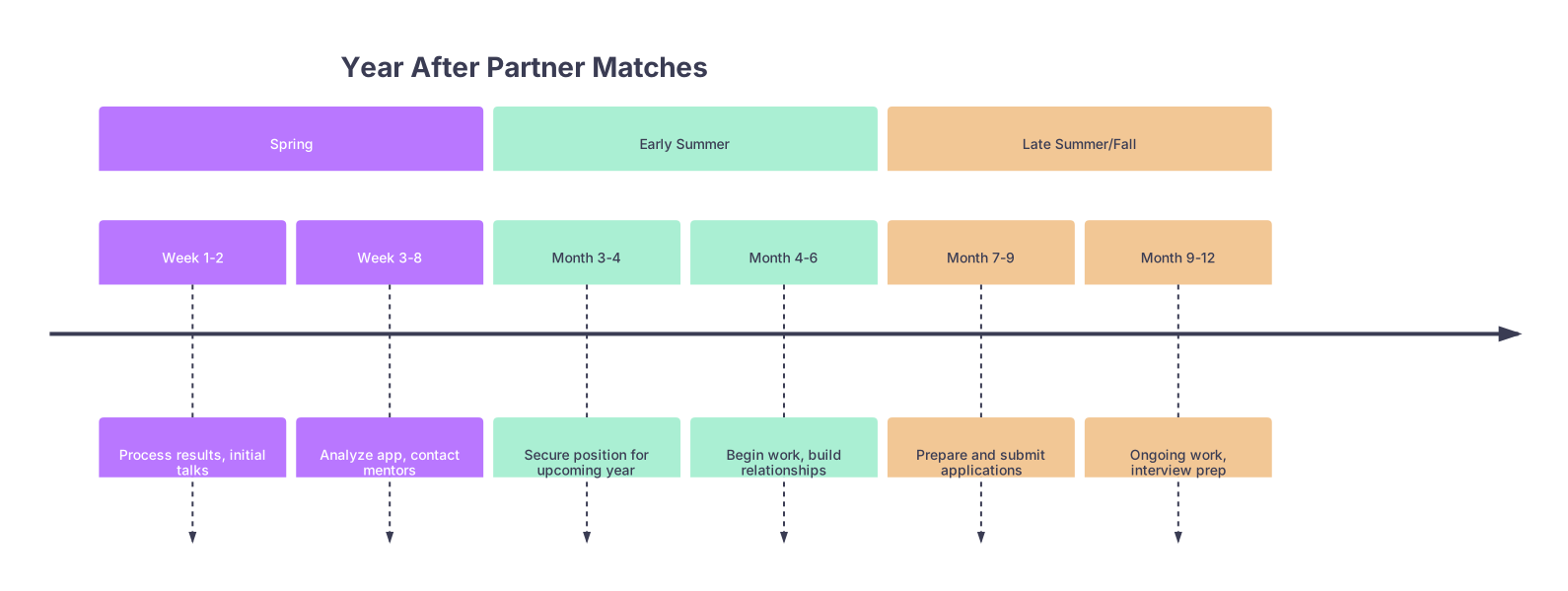
If you want a sanity check, a simple timeline helps.
| Period | Event |
|---|---|
| Spring - Week 1-2 | Process results, initial talks |
| Spring - Week 3-8 | Analyze app, contact mentors |
| Early Summer - Month 3-4 | Secure position for upcoming year |
| Early Summer - Month 4-6 | Begin work, build relationships |
| Late Summer/Fall - Month 7-9 | Prepare and submit applications |
| Late Summer/Fall - Month 9-12 | Ongoing work, interview prep |
Put that in a note. Adjust dates. Then stick to it.
Step 6: Be Strategic About Where You Reapply
If your partner is locked into a program for at least 3 years, your geography strategy matters.
Do not just spam apply blindly.
You want three geographic buckets:
Same institution as partner
- Programs at the same hospital / GME system.
- You aim for: “We like couples; we know your partner; you already live here.”
Same metropolitan area but different institution
- University program vs community program in the same city.
- Drivable distance for call nights.
Reasonable distance but still feasible for relationship
- Train ride or short flight instead of cross-country ordeal.
Then yes, maybe: 4. Wildcard programs if you need to cast a wide net for competitiveness reasons.
If your stats are marginal, your best shot might be community or mid-tier programs in your partner’s region where:
- Less applicant volume.
- More flexibility with couples if they know your story.
Step 7: Money, Licensure, and Visas (The Annoying but Real Constraints)
Three quick but important reality checks:
Money
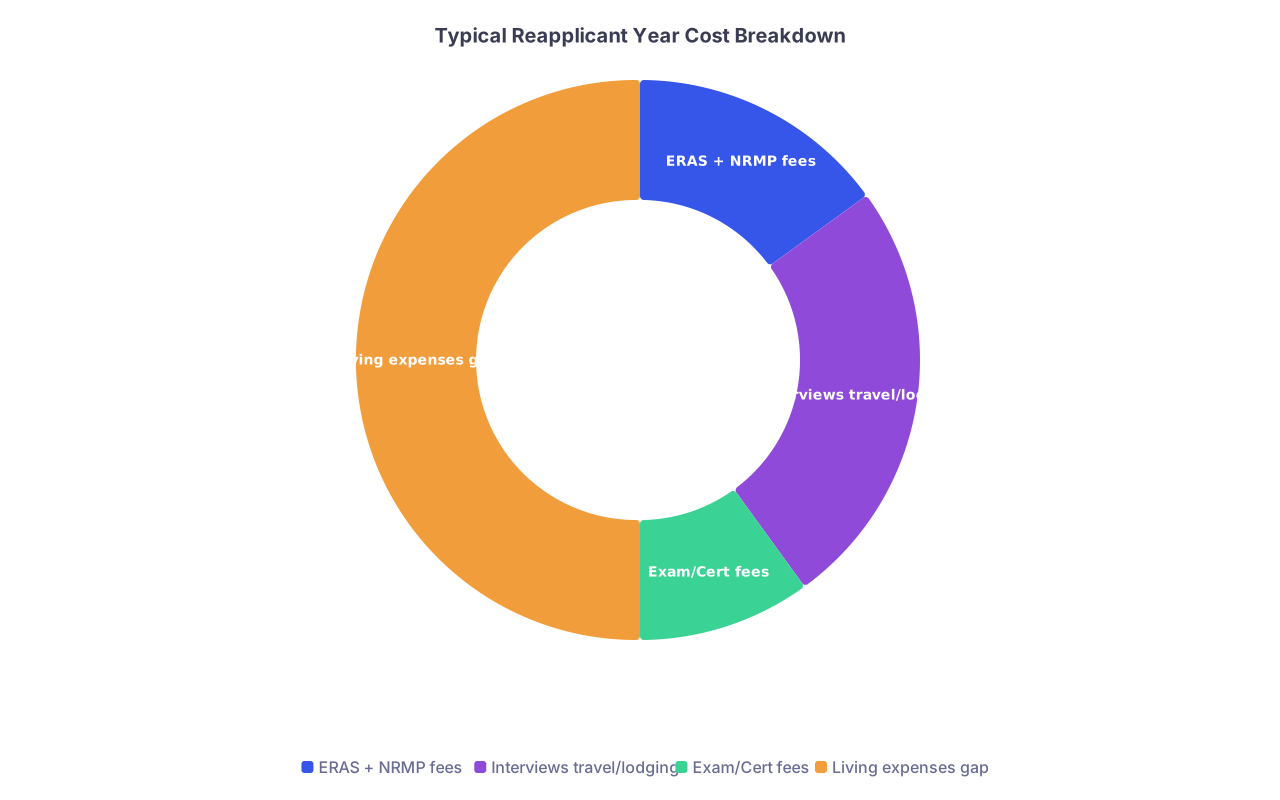
Running another application cycle plus a year out of residency is expensive. You need a rough budget:
| Category | Value |
|---|---|
| ERAS + NRMP fees | 1500 |
| Interviews travel/lodging | 2500 |
| Exam/Cert fees | 1000 |
| Living expenses gap | 5000 |
If your partner is about to start as a PGY-1 making resident salary, and you’ll be in a lower-paid role (or unpaid research), you two need a financial plan. Not just vibes.
Licensure/Certification
For non-ACGME clinical gigs, check:
- Do you need limited licensure?
- Is malpractice covered?
- Will this count as USCE for programs?
Do not assume. Ask explicitly.
Visa
If you’re an IMG or on a visa and your partner’s match is tied to J-1/H-1B:
- Talk to an immigration attorney who has done physician-specific work. Not generic.
- Some choices (where you work, what visa you choose) can lock you out of certain future paths.
Step 8: Mental Health and Identity
You probably feel like trash right now. I’ve watched high-achieving people crumble post-Match:
- “Everyone else is moving forward.”
- “I’m the weak link in this relationship.”
- “Maybe I don’t belong in medicine.”
Three things:
This is a career timing problem, not a global worth problem.
You’re in an annoying fork in the road, not a dead end.Protect your head.
Residents are already at high risk of burnout, depression, and anxiety. Unmatched graduates with a matched partner? Double hit.Use professional help if you start slipping.
- School counseling services (if recent grad).
- Physician mental health programs.
- Private therapist who works with high-achieving professionals.
And you tell your partner this explicitly:
- “I might need more emotional support than usual this year.”
- “I need you to celebrate your win and also make room for my disappointment.”
Both can co-exist.
Example Pathways (Realistic Combinations)
Sometimes concrete stories help.
Example 1: You didn’t match IM, partner matched IM at a midwest university
Plan:
- You move with them.
- You get a 1-year research job in the same department, maybe even same hospital.
- You hustle, get:
- 1–2 abstracts,
- 1 strong letter from division chief.
- Next cycle you apply IM + prelims at:
- Their program
- Other hospitals in the same city
- Reasonable radius.
- You end up at a community IM program 30 minutes away. Commutes, but same city. Relationship intact, career salvaged.
Example 2: You SOAPed into surgery prelim, partner matched Peds 3 hours away
Plan:
- You do prelim year where you are, live apart.
- You decide you’re OK switching into anesthesia or IM if surgery categorical doesn’t pan out.
- During prelim:
- You get stellar evals.
- PD sends personal emails to programs near your partner’s city.
- You match anesthesia in your partner’s city the next cycle. Different hospital, same metro. Marriage and careers both alive.
FAQs
1. Should I change specialties just to be in the same city as my partner?
Sometimes yes, sometimes no. If you were already marginal for a hyper-competitive specialty (like derm, ortho, plastics) and your partner is solidly matched for 3–5 years in one city, pivoting to a less competitive but still satisfying specialty might be the only realistic way to align geography and career. But do not jump into a specialty you actively dislike just for proximity. That solves one problem and creates a 30-year one.
2. Is doing an unpaid research year actually worth it?
It can be, if it gives you three things: a strong letter from a known faculty member, concrete output (posters, papers, abstract), and a visible connection to your chosen specialty. If it’s just you in front of a computer cleaning datasets for a year with no mentorship, no exposure, and no clear path to letters, then no, it’s not worth it. If unpaid vs paid is the only difference and the unpaid one is far stronger academically, I’d still lean toward the stronger one—if you and your partner can afford it.
3. How much should my partner be involved in my reapplication?
More than “cheering from the couch,” less than “micromanaging your specialty choice.” They’re your teammate, not your PD. Ideal roles: practical support (covering some rent, helping with logistics), emotional support (listening without fixing), and occasional reality checks (“You’re applying to 15 programs total; that’s not enough with your scores”). They should not be writing your emails, steering you into a specialty to make their life easier, or pressuring you to sacrifice your entire career blueprint for their convenience.
4. What if I’m honestly not sure I want to reapply to residency at all?
Then you pause and take that seriously. A year out of the Match with a matched partner is a stressful but actually useful moment for honest reflection. You can use this year to try adjacent careers: clinical research, industry roles, MPH, teaching. If you feel relief at the idea of leaving residency behind, explore that. Just don’t make a permanent decision in the two weeks you’re most emotionally raw. Give it 3–6 months while doing something productive.
5. What’s the biggest mistake people in my situation make?
Two tied for first: drifting and pride. Drifting = not making a concrete plan, taking a random job, and then realizing too late you built nothing useful for a reapplication. Pride = refusing to adjust specialty choice or program list to match your actual competitiveness, because “I always saw myself at a big-name program.” Your partner already matched. You don’t need to match their prestige; you need to match, period.
Today, do one thing: write down, in one sentence, why you are not starting residency this July and what your primary priority is for the next 12 months (same city as partner, protect specialty, or any solid residency path). Then send that sentence to your partner and say, “Can we sit down this week and make a plan around this?”


