
It’s Match Day afternoon. Your group chat is blowing up with “I matched my #1!!!” screenshots, Instagram is a wall of smiling couples holding up “I matched!” signs, and you’re just…staring at your email.
You matched. But it’s “Preliminary Internal Medicine – 1 year.”
No advanced spot. No categorical position. Just prelim.
Your stomach drops because now there’s this second problem: not only do you have to emotionally process this yourself, you have to tell your parents, your partner, your friends, your aunts who don’t even know what a prelim is but will somehow still be disappointed.
You’re already rehearsing the conversations in your head:
- “So…is that like…half of a residency?”
- “Wait, are you a real doctor then?”
- “Did something go wrong?”
- “Are you going to be unemployed after a year?”
And the big one:
“Did you…fail?”
Let’s walk through this like two people who both overthink everything.
First: What A Prelim Year Actually Is (And Is Not)
You already sort of know this, but the people you’re about to talk to definitely don’t. And if you’re anything like me, your brain fills knowledge gaps with worst-case scenarios.
Here’s the real version.
A preliminary year is:
- A fully accredited PGY-1 (intern) year
- Usually in Internal Medicine, Surgery, or Transitional Year
- Designed to be:
- Either the required first year before an advanced residency (like Radiology, Anesthesiology, Derm, etc.), or
- A standalone intern year while you reapply or pivot
You get a contract. A salary. A resident ID. You write notes, admit patients, get paged at 3 AM, and complain about Epic.
You are a real intern. Period.
A prelim year is not:
- A “fake” residency
- A signal that you’re incompetent
- Useless for the Match later
- Some weird half-doctor limbo where your degree doesn’t count
Honestly? A lot of very competent, very smart people match prelim-only when they:
- Applied to super competitive advanced specialties (Derm, Ortho, ENT, Rad Onc, etc.)
- Pivoted late and didn’t have time to strengthen the new application
- Had some red flag or late Step scores, and programs hedged
You’re not the “one person this happened to.” It’s common enough that programs, PDs, and advisors literally have standard advice for “What to do if you match prelim only.”
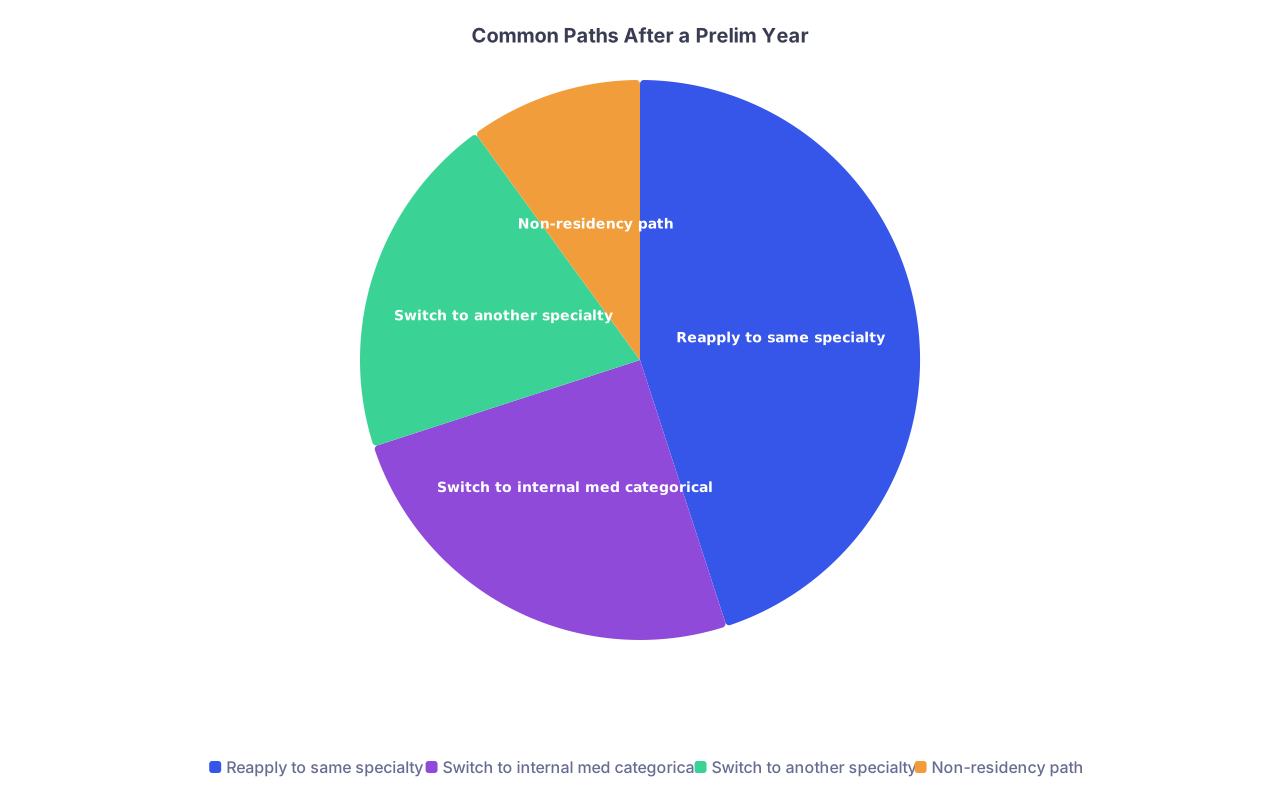
| Category | Value |
|---|---|
| Reapply to same specialty | 45 |
| Switch to internal med categorical | 25 |
| Switch to another specialty | 20 |
| Non-residency path | 10 |
So before we even talk about what to say to your family, you need to anchor yourself in this:
You matched into a real residency position.
It is not the final destination. But it is a real, legitimate step forward.
Why This Feels So Awful (You’re Not Making It Up)
You’re not overreacting. This hurts for real reasons.
- Everyone around you seems like they got the “clean” outcome: categorical or advanced + prelim lined up
- The NRMP language itself is harsh: “You are unmatched for one or more of your ranked specialties”
- Social media compresses everyone’s life into “I matched!” with zero nuance
- Medicine trains you to see everything as a binary: pass/fail, match/unmatch, success/failure
And prelim-only sits in this ugly gray space. You technically matched. But it doesn’t feel like success.
What makes telling people so stressful is you’re not just afraid of explaining it; you’re afraid that:
- They’ll see you differently as a doctor
- They’ll think you’re less capable than your classmates
- They’ll ask questions you don’t fully know how to answer yet
Also, some families are…not gentle. There’s the uncle who flexes about his business every holiday. The parent who’s been bragging to their coworkers for years about “my future surgeon.” The friend who says, “So wait, what went wrong?” in front of 10 people.
So yeah. Of course you’re anxious. This is exactly the kind of scenario that keeps people up at 2 AM spiraling.
Step 1: Get Your Own Story Straight Before You Tell Anyone
You can’t control what people ask, but you can control your script.
And yes, you need a script. Because if you go into these conversations raw—tired, emotional, unprepared—you’re going to overshare, apologize, and walk away feeling worse.
Your “story” needs 3 parts:
- What happened
- What it means now
- What happens next (at least approximately)
Here’s one example you can tweak:
“I matched into a preliminary Internal Medicine year at [Hospital]. It’s a fully accredited intern year where I’ll be working as a resident. I didn’t match into a full categorical spot this cycle, which happens with more competitive fields and tight spots.
This year will be intense, but it gives me real clinical experience and makes me more competitive to either:
- Reapply to [specialty] or
- Transition into a categorical internal medicine spot.
So it’s not the end of the road. It’s a stepping stone year.”
If you can get those three parts out of your mouth without tripping, you’re already ahead.
Say it out loud to yourself. In the mirror. To your roommate. Until it stops feeling like you’re confessing a failure and starts feeling like you’re explaining a plan.
Step 2: Decide Who Gets the Full Truth
Here’s something people don’t say enough:
You are not ethically required to give every cousin, neighbor, and Facebook acquaintance a detailed residency breakdown.
You can have tiers of information.
Inner circle (full version)
These are people who actually support you: parents (if they’re safe), partner, best friends, maybe a mentor.
They can handle the nuance:
“I matched prelim only, which means I have a solid PGY-1 year. I didn’t get a categorical/advanced spot this time. It stings, but I have a plan: I’m going to do this intern year, build my application, and reapply / pivot to X.”
They’re allowed to hear words like “disappointed” and “didn’t work out how I hoped” and “I’m going to need support.”
Outer circle (simplified version)
People who don’t need the emotional play-by-play:
“I’m starting my intern year in Internal Medicine at [Hospital] this July.”
If they push:
“It’s a 1-year preliminary position. I’ll be working as a resident, then I’ll either continue into an advanced program or transition into a categorical spot. It’s a common path for a lot of specialties.”
That’s it. They don’t get your Step scores, how many programs you ranked, or why ENT didn’t take you.
Social media (extremely filtered)
You are absolutely allowed to post something like:
“Excited to be starting my intern year in Internal Medicine at [Hospital] this July.”
No need to explain “prelim.” Most people don’t know what “categorical” means anyway.
You don’t owe the internet your vulnerability on the worst day of the year.
Step 3: Pre-empt The Confusing Questions
The questions are what you’re dreading, so let’s script some answers now.
“So are you actually a doctor?”
“Yes. I graduated med school, and this is a real residency position. I’ll be an intern seeing patients, writing notes, and working in the hospital like everyone else.”
“Did you not match?”
“I matched into a one-year preliminary spot, which is a real residency position. I didn’t match into a full 3- or 4-year categorical spot this time, which does happen—especially in competitive fields. I’ll use this year to gain experience and then either reapply or transition into a categorical spot.”
“Did something go wrong?”
(Loaded, rude, and yet they will absolutely ask this.)
“The match is extremely competitive, especially in the fields I applied to. I didn’t get a full spot this year, but I did secure an intern year, which actually puts me in a better place than if I had gone completely unmatched. Now I have clinical experience and a plan.”
“What happens after the year? Are you unemployed?”
“During this year I’ll be working closely with program leadership and mentors to secure a categorical or advanced spot for the following year. It’s a known path—lots of residents do this. I’m not just being dumped at the end.”
If anyone keeps pressing past that, it’s not because your situation is unclear. It’s because they like drama. You’re allowed to shut it down:
“It’s a lot to process right now, so I’d rather not get too deep into it. I’ll keep you posted as things solidify.”
Step 4: Handling The Emotional Landmines (Parents, Partners, Friends)
Some specific scenarios you’re probably catastrophizing about:
Your parents
They’ve been telling people “my kid is going to be a surgeon/radiologist/derm doctor” for years. Now they’re confused and maybe panicking.
Script:
“I know this isn’t the straightforward path we all imagined. I’m disappointed too. But I did match into a real residency position, which is more than a lot of people get when things don’t work out.
This prelim year is a bridge. I’ll gain experience, I’ll have faculty who can advocate for me, and we’ll reassess next year. I need you to trust that this is not the end of the story and not treat it like a disaster.”
If they start projecting their anxiety (or shame) onto you:
“I understand you’re worried, but I really need support right now instead of blame. This is hard enough as it is.”
You’re allowed to say that.
Your partner
They’re thinking about moving, finances, timing of kids, all that.
Have a slightly more practical version ready:
- Where the program is
- What your salary range will be
- Rough possibilities after the year (reapply vs. switch)
- That this might mean another round of applications, interviews, possible move
“It’s not ideal. I’m upset too. But I’ll have a job, we’ll have income, and I’ll be building toward the next step. I want us to think of this as a ‘bridge year’ rather than a failure.”
Your med school friends
Half of them barely know what prelim means either.
If you don’t want to explain everything, keep it simple:
“I’m doing a prelim medicine year at [Hospital]. I didn’t land a categorical spot this time, but I’m going to use the year to reapply / reposition.”
If they’re genuinely supportive, you can open up more later. If they’re competitive or gossipy, keep it surface-level. Protect your sanity.
Step 5: Stop Translating “Prelim Only” as “I’m Not Good Enough”
This is the part where I’m going to be blunt.
There are absolutely weaker applicants who match categorical.
There are absolutely strong applicants (high scores, AOA, research) who end up prelim-only.
The system is not a clean ranking of human worth or capability. It’s a messy puzzle of:
- Geography preferences
- Visa issues
- Interview luck
- How many spots a specialty has that year
- Random committee dynamics on a random Thursday
You know what PDs actually care about once you’re in?
- Do you show up?
- Do you own your patients?
- Do you work well with the team?
- Do you learn and improve?
Your prelim year is a year to prove those things. On the record. To faculty who have direct lines to PDs in other programs.
| Aspect | Prelim PGY-1 | Categorical PGY-1 |
|---|---|---|
| Salary | Same range | Same range |
| Responsibilities | Very similar | Very similar |
| Board eligibility | Counts as PGY-1 | Counts as PGY-1 |
| Guaranteed future | 1 year only | Full program duration |
| Application future | Reapply / transfer needed | Usually no reapplication |
The big difference is security, not legitimacy.
You’re not behind clinical skills-wise. You’re behind in emotional security and timeline certainty. That hurts. But it doesn’t define your ceiling.
Step 6: What You Can Do Today To Make This Slightly Less Terrible
You can’t fix the whole situation in 24 hours, but you can make it less chaotic.
- Draft your 2–3 sentence explanation and text it to 1–2 close people for feedback.
- Decide your “tiers”: who gets full detail vs. simple version.
- Write a short, generic message you can send to nosy people:
“I’ll be starting my intern year in Internal Medicine at [Hospital]. It’s been a whirlwind, but I’m grateful to have a solid position and I’m still figuring out details for after that.”
- Set a boundary with yourself:
“I am not going to explain my entire match outcome to anyone at [family event / group chat] today. If they press, I will say: ‘It’s a lot; I’m not ready to talk about it in depth.’”
That’s already a lot of emotional work. It counts.
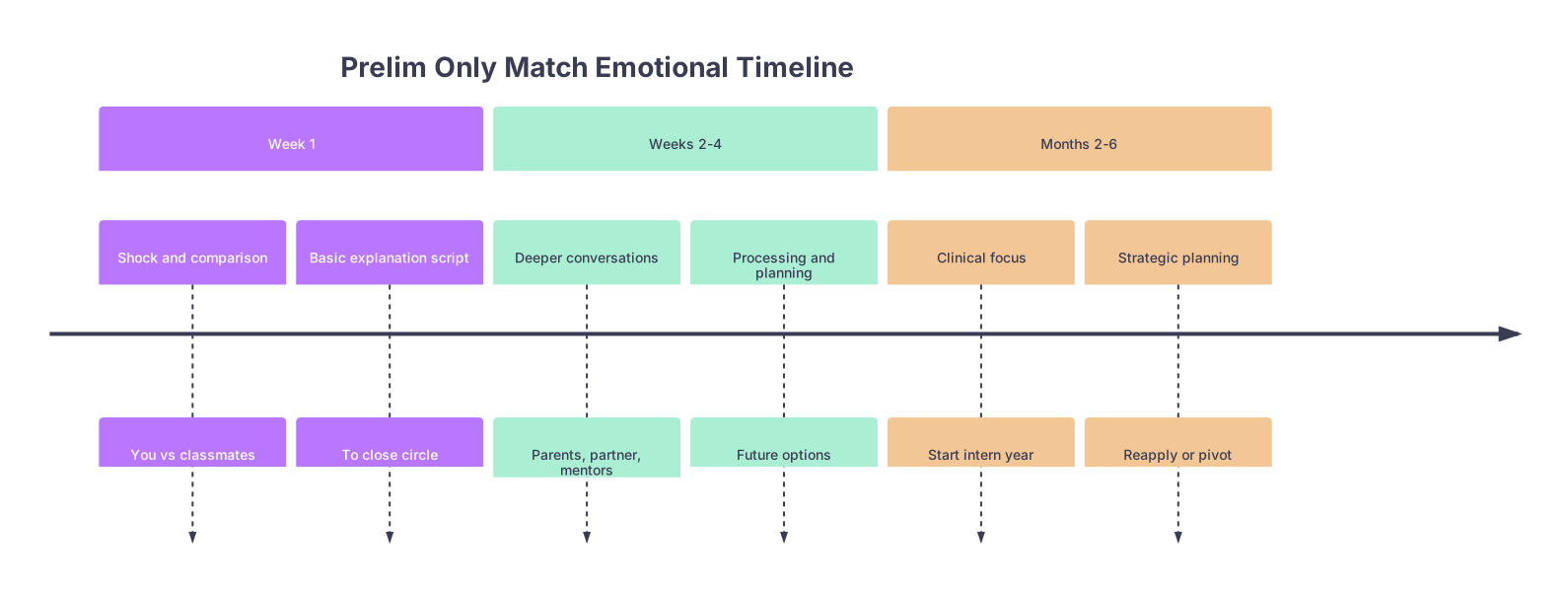
| Period | Event |
|---|---|
| Week 1 - Shock and comparison | You vs classmates |
| Week 1 - Basic explanation script | To close circle |
| Weeks 2-4 - Deeper conversations | Parents, partner, mentors |
| Weeks 2-4 - Processing and planning | Future options |
| Months 2-6 - Clinical focus | Start intern year |
| Months 2-6 - Strategic planning | Reapply or pivot |
FAQ (Exactly 4 Questions)
1. Should I even tell people it’s “prelim only,” or just say I matched Internal Medicine?
I’d be honest with your inner circle and anyone who actually understands training pathways. For everyone else, saying “I’m starting my intern year in Internal Medicine at [Hospital]” is fine. You’re not lying. You’re just not opening the door to a 30-minute explanation with someone who doesn’t get it anyway.
2. Will programs judge me for having only a prelim year when I reapply?
They’ll judge you based on what you do with that prelim year. A strong evaluation letter saying “This intern functions at the level of a categorical resident,” good teamwork, and solid performance can actually help you. I’ve seen people come back from prelim-only to land great categorical spots because they crushed that year and had PDs advocating for them.
3. How do I handle people who make it about them, like ‘I’ve been bragging about you, now I don’t know what to say’?
You call it out gently but firmly.
“Look, I get that you’re disappointed or confused, but I’m the one actually living this. What I really need right now is support, not pressure. You’re still allowed to be proud of me for becoming a doctor and starting residency.”
If they can’t pivot after that, that’s their limitation, not an indictment of you.
4. Is it even worth celebrating Match Day if I only got a prelim?
Yes. And I know that feels fake right now. But you did not go unmatched. You have a paycheck coming. You will be a doctor taking care of real patients in July. You can be sad about not getting the outcome you wanted and still mark the fact that you survived med school and landed a PGY-1. Both can be true. Even if your “celebration” is just ordering takeout and turning off your phone at 8 PM.
Open your notes app right now and write your 3-sentence explanation: what happened, what it means, and what’s next. Say it out loud once. That’s your script. You don’t have to improvise this alone.