
You’re on call as a prelim. It’s 2:17 a.m., you’ve just admitted your seventh decompensating train wreck of the night, and in between pages you suddenly realize: “I think I hate this. Like actually hate this. And I’m supposed to do a whole career based on this choice?”
Now it’s not just exhaustion. It’s panic. Because you already matched. You already told programs this is what you wanted. And now the little voice in your head keeps asking the same question on loop: What if I picked wrong? What if I hate my specialty choice during my prelim year? What happens to me then?
Let’s walk through this, step by step, like someone who’s stared at the ceiling at 3 a.m. replaying this exact scenario.
First: Is This “I Hate My Specialty”… or “I Hate Being a Prelim”?
Here’s the part nobody tells you clearly enough: a prelim year is almost designed to make you question your life choices.
Prelim IM or surgery can feel like:
- Endless scut
- Zero continuity
- The sickest patients with the least control
- The worst schedules
- The lowest “ownership” of anything
And the whole time you’re surrounded by categoricals who are like, “This is my future!” while you’re just trying not to fall asleep standing up.
You have to separate a few different things:
Do you hate the work you’re doing right now?
Floor notes, cross-cover, codes at 3 a.m., chasing consults, discharge summaries. Every specialty’s interns are miserable doing this stuff. It’s not “medicine vs surgery vs whatever” — it’s “intern year is a grind.”Do you hate the culture of your current department?
Toxic attendings, malignant seniors, unsafe staffing, constant shaming. That can make literally anything feel like the wrong specialty.Or do you hate the actual specialty you matched into or are planning to go into after prelim?
This one matters. For example:- You matched into radiology but you hate reading imaging, hate the dark room, and miss patient contact.
- You’re a prelim for anesthesia but on your OR months you’re bored, hate procedures, and the idea of the same OR day after day feels suffocating.
- You’re an IM prelim going into neurology, but every time you’re on neuro you’re counting the minutes; meanwhile, you kind of love your cardiology or ICU rotations.
Those are different problems. Every intern I’ve ever known has said “I hate this” at least once. But only some of them actually hated their specialty. Most hated being an intern, tired, underpaid, and over-paged.
So before you burn your whole career down mentally, ask yourself:
- What rotations have I actually enjoyed — even a little — this year?
- When I’m not exhausted, does my future field still feel wrong?
- Do I dislike the idea of the specialty, or just the way it’s playing out right now?
You don’t have to have a perfect answer. But you do need to start distinguishing “this year sucks” from “this field is absolutely not for me.”
How Much Trouble Am I In If I Really Did Pick Wrong?
You’re scared of the nuclear scenario:
“I hate my chosen specialty → I can’t change → I’ll be stuck for life → I’ll be miserable forever.”
I’ve watched this play out in real people. It’s not that simple or that hopeless.
Here are the hard truths and the reassuring truths, side by side:
| Reality Check | What It Means For You |
|---|---|
| It’s not easy to switch specialties | But people do it every year |
| You may lose time (gap year, extra training) | Your career is 30–40 years; 1–2 years is not fatal |
| PDs dislike flakiness | But they respect thoughtful, well-explained pivots |
| Some fields are more flexible than others | IM, FM, psych = more options; derm, ortho, plastics = tougher |
| Prelim year is real experience | It can *help* you match something else later |
You aren’t trapped forever. Ugly word, but it’s not a life sentence.
What might you actually be looking at if you really want to switch?
Reapplying to a different specialty
People do this all the time:- Prelim surgery → categorical IM
- Prelim IM → anesthesia
- Prelim medicine → radiology, neuro, EM
I’ve seen prelims match categorical spots via:- ERAS re-application for the next cycle
- Off-cycle positions that open when someone drops out or transfers
- Networking through attendings who call their friends in other departments
Losing a year or two
Yeah, it sucks. It feels catastrophic when you’re in it.
But zoom out: would you rather lose 1–2 years now or hate 20+ years of practice?Paying a personal cost
Moving again. More exams. More uncertainty. Maybe explaining to family and friends why you’re “starting over” when they thought you were “already a doctor now.”
But here’s the part your anxiety keeps suppressing:
You are not the first person to hate your specialty choice. Programs know this. PDs have seen it. They don’t love it. But they get it.
What You Can Actually Do Right Now (Instead of Spiraling)
You want concrete steps, not vague “follow your passion” nonsense. Good.
1. Collect Data, Not Just Feelings
Right now your brain is high on cortisol. It’s going to tell you extreme things:
- “I hate all of medicine.”
- “I’m not cut out to be a doctor.”
- “Everyone else is fine; I’m the only one freaking out.”
You need evidence. For 3–4 weeks, track:
- Which rotations/activities felt least awful? (Rounds? Procedures? Clinic? ICU? Consults?)
- When did time go by faster?
- Which patient interactions (if any) actually gave you a sense of “this was worth it”?
- Were there services where you didn’t dread going in, even if you were tired?
If the answer is “literally none,” that’s a different conversation — maybe about burnout, depression, or bigger life priorities. But often, even in a miserable prelim year, there are flickers of what you actually like.
2. Talk to Someone Who’s Not Going to Blow You Off
Not everyone is safe to talk to. Your fear is legit: “If I tell the wrong person I’m doubting my specialty, will they doom my career?”
Choose carefully:
- A trusted senior resident, ideally someone known to be sane and not gossipy
- A program faculty member who has a reputation for mentoring and not being punitive
- A faculty in the specialty you’re considering switching to (later phase)
What you do not start with: “I hate everything. I picked wrong. Help.”
You say: “I’m starting to think seriously about what I want long term. This year has made me question whether [specialty X] is actually the best fit. Can I ask your honest take on what options people have if they realize that during a prelim year?”
You’re not committing to anything. You’re information-gathering. That’s allowed.
If You’re Sure You Hate Your Intended Field
Let’s say this isn’t sleep deprivation talking. You’re a prelim for radiology, anesthesia, derm, whatever, and deep down you just know: I cannot do this for 30 years.
Here’s what a practical pivot might look like.
Step 1: Identify Where You Do Fit Better
Look at what you actually liked:
- Loved ICU but hated clinics? Think CCM/pulm/EM/anesthesia.
- Loved going to the OR but hated floor work? Anesthesia, maybe surgery if you can tolerate the culture at the right place.
- Liked talking to patients but hated procedural chaos? IM, FM, psych, maybe outpatient-heavy fields.
You don’t have to nail it perfectly. You just need a working hypothesis.
Step 2: Quietly Explore the New Field
You’re still a resident. You’re allowed to be curious. Do things like:
- Ask to rotate with that service if your schedule allows (e.g., EM month, neuro consults, radiology elective)
- Tell the chief resident of that service: “I’m prelim, trying to figure out if I might want to pursue this specialty in the future. Any chance I could talk to you after sign-out sometime about your path?”
You’re not asking for a letter yet. You’re building context and relationships.
Step 3: Decide Your Timeline
This is where your anxiety screams “I’ve already ruined everything.” Not true.
You usually have 3 basic options:
| Option | What It Looks Like | Pros | Cons |
|---|---|---|---|
| Reapply immediately | ERAS during your prelim year | Fastest switch | Very stressful during intern grind |
| Finish prelim, take gap year, reapply | Work, research, locums, etc. | More time, stronger app | Delays income and stability |
| Find off-cycle spot | Network, email PDs directly | Might skip gap year | Unpredictable, depends on luck |
There’s no one right choice. Real talk: a lot of people underestimate how brutal it is to reapply while doing a full prelim year. You can do it. But it’s like running a second marathon in the middle of the first one.
How Honest Can You Be With Programs?
This is the nightmare scenario in your head: you’re sitting in an interview for a different specialty and they ask, “So why are you leaving [original specialty]?” and your brain locks up.
Here’s the structure that actually works:
Own that you actively thought about the decision.
“During my prelim year, I paid attention to which parts of my clinical time felt most meaningful and sustainable for me.”Describe a pattern, not a meltdown.
“I realized I consistently felt more energized on [X service/rotation], especially when I was doing [Y type of work].”Explain what draws you toward the new specialty.
Not what you’re running away from — what you’re running toward.
“I found that I really value [continuity/procedures/critical care/diagnostic challenge/patient relationships], and that’s what led me to [new field].”Acknowledge the risk and the cost.
“I know switching directions isn’t a small thing. I’ve thought hard about this and talked with mentors. I’d rather take the time now to train in the field that fits me best than ignore what I’ve learned about myself this year.”
That sounds like a person I’d want as a resident. Not flaky. Just honest and thoughtful.
When It’s Not the Specialty — It’s Burnout
Here’s another uncomfortable truth: sometimes you don’t hate your specialty. You’re just absolutely fried.
Signs it might be burnout more than a true mismatch:
- You can’t imagine being happy in any field of medicine
- Hobbies? Gone. Sleep? Trash. Eating? Whatever’s in the vending machine.
- You feel numb with patients, not just bored or annoyed
- Things you used to enjoy pre-med school — science, people, challenge — feel gray and pointless
If that’s you, changing specialties alone won’t fix it. You’ll just bring the same exhaustion and untreated depression/anxiety into a new environment.
That doesn’t mean you’re weak. It means you’re human living in a system that grinds people down.
At minimum:
- Talk to someone about mental health (campus counseling, resident health, private therapist)
- See if you can protect even one small thing that’s just yours each week (a run, a show, a call with a friend)
- Let yourself consider medication if you’re really drowning — it’s extremely common among residents, whether we talk about it or not
You’re allowed to say, “This is too much.” That’s not a character flaw. That’s physiology.
How Programs Actually React When Residents Switch
You’re scared of being the story. The “remember that one prelim who bailed?” person.
Here’s what I’ve actually seen:
- PDs are annoyed if someone disappears with zero notice, or lies, or trashes the program publicly.
- They are much more understanding when someone:
- Does good work
- Finishes what they committed to finish
- Has a coherent, respectful explanation
- Gives reasonable notice
Most PDs have personally seen colleagues switch fields. Some have done it themselves.
Are you going to be their favorite? Probably not.
Are you going to be blacklisted forever? No.
Your reputation follows you, but so does your professionalism. If you keep showing up, taking care of patients, and not torching your bridges, you’ll be okay.
A Quiet Reframe: This Year Isn’t Wasted
Your brain says: “If I switch, I wasted all this time. Money. Sanity. My spot. Everything.”
Here’s what you actually get from a prelim year, even if you leave your planned specialty:
- You learn to handle high-acuity patients when you’re exhausted
- You internalize how a hospital actually works: nursing, consults, triage, real communication
- You become less terrified by sick people (even if you switch to a more outpatient field)
- You prove to yourself that you can survive ugly shifts, horrible nights, and still function
These are not small things.
I’ve watched former prelims who switched into completely different fields — psych, radiology, outpatient-heavy specialties — and they all say some version of:
“I’d never do that year again. But I’m glad I did it once. It made me better and less scared.”
You’re building something, even if you don’t yet know where you’re going to use it.
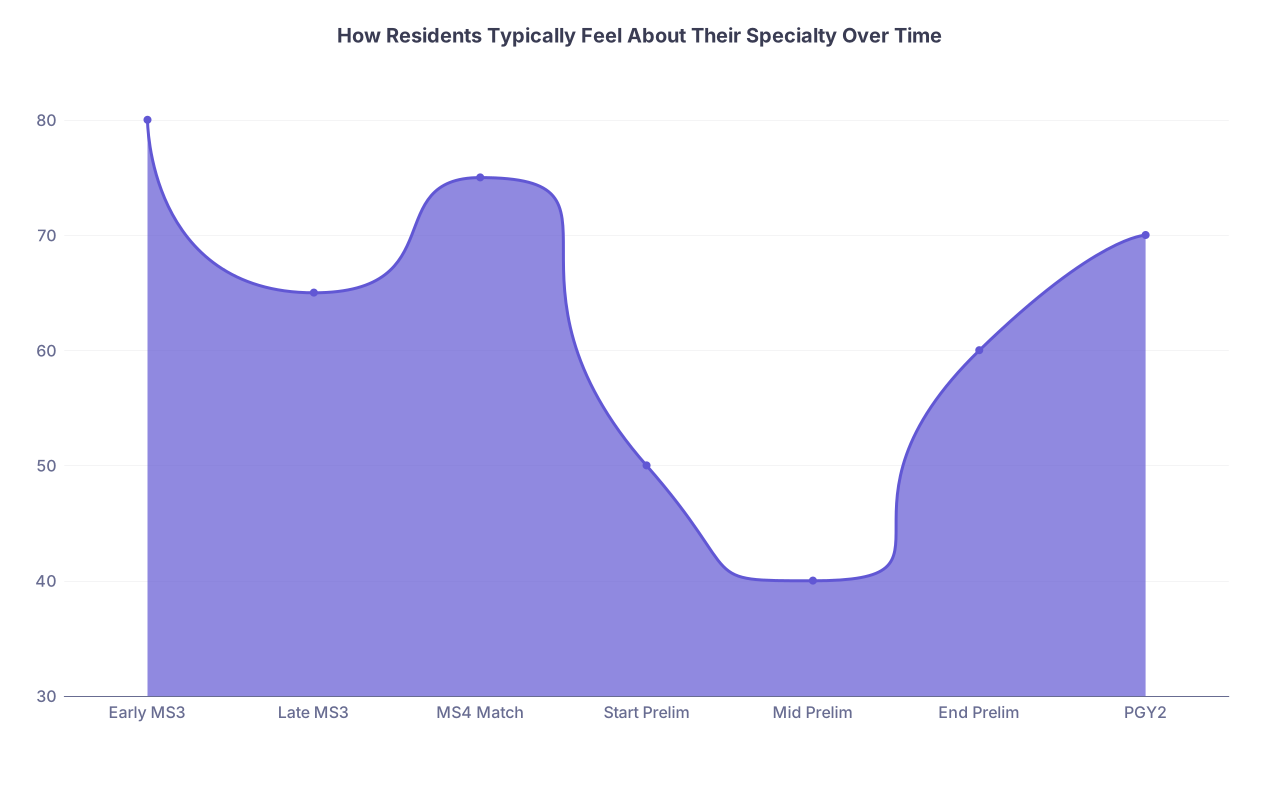
| Category | Value |
|---|---|
| Early MS3 | 80 |
| Late MS3 | 65 |
| MS4 Match | 75 |
| Start Prelim | 50 |
| Mid Prelim | 40 |
| End Prelim | 60 |
| PGY2 | 70 |

| Step | Description |
|---|---|
| Step 1 | Realize you hate your intended specialty |
| Step 2 | Address mental health and support |
| Step 3 | Identify alternative specialty |
| Step 4 | Explore via rotations and mentors |
| Step 5 | Reapply in next ERAS cycle |
| Step 6 | Finish prelim and pursue gap year or off cycle spot |
| Step 7 | Reassess feelings about specialty after stabilizing |
| Step 8 | Is it burnout or true mismatch |
| Step 9 | Apply now or later |
FAQs
1. Will programs in a new specialty hold it against me that I “failed” my first choice?
They will absolutely question it. They’d be bad PDs if they didn’t. But they’re not looking to punish you; they’re trying to figure out:
- Are you running away from something, or thoughtfully moving toward something?
- Are you going to bail on them in a year?
- Did you perform well in your prelim year, or did you crash and burn?
If your story is: decent performance, strong evaluations, clear explanation, and a believable rationale for the new field — you’re fine. Not perfect, but fine. You’re not radioactive. You’re a slightly more complicated applicant with more clinical miles on you than most interns.
2. Should I tell my current PD that I’m thinking of switching?
Not right away. Not when it’s just raw panic. Wait until:
- You’ve thought about it for more than two or three bad weeks
- You’ve talked to at least one trusted mentor outside the PD chain
- You have a sense of what specialty you might be aiming for
Then, if/when you decide to actually pursue a switch, yes — at some point you’ll probably need to loop in your PD. A surprising number will help you, especially if:
- You’ve worked hard
- You’re upfront and respectful
- You’re not trying to ditch mid-year and leave them hanging
But don’t lead with “I think I hate this field” in your first month. Your brain is still in shock.
3. Do I need to redo intern year if I switch?
Not always. It depends on:
- Your current specialty and future specialty
- ACGME rules
- How much of your prelim experience “counts” toward the new residency
For example:
- Prelim medicine → categorical IM: often much of your prelim counts; you may start as a PGY2 or repeat some time depending on the program
- Prelim surgery → EM/FM/IM: sometimes they’ll credit part of the year, sometimes you start over
- Prelim IM → radiology, anesthesia, neuro: prelim is often exactly what they want and you go straight into categorical PGY2 in the new field
Programs will tell you how they’d slot you. Worst case, you repeat. It feels awful in the moment. Long term, your patients will not care whether you did 3 or 4 years of residency. They care if you know what you’re doing.
4. What if I’m wrong again after I switch specialties?
Your brain is going to go here, of course. “What if I blow up my life twice?” Good question, harsh reality: the system has way less patience the second time. Switching once is understandable. Twice starts to look like a pattern of not being able to commit.
That’s why you don’t rush the first switch. You:
- Wait long enough to tell burnout from true mismatch
- Test-drive the new field as much as possible (shadowing, electives, talking to residents)
- Get outside help if your mood is tanked, so you’re not making the call from a place of total despair
Can people switch twice? It happens. Is it easy? No. So treat the first change like a serious, grown-up decision, not an escape hatch you’ll just keep pulling.
Years from now, you won’t remember which night you first thought, “I hate this, did I ruin my life?” You’ll remember what you did next — whether you let that fear freeze you, or used it as a signal to start paying closer attention to the kind of doctor you actually want to be.