

What do you do when every “ideal” ERAS example shows bench or clinical academic research, and your main experience is working for Pfizer, Regeneron, or some CRO running sponsored trials?
Let’s be blunt: some programs will see “industry” or “pharma” and mentally slot you as “non-traditional, maybe not academic.” That does not mean you are sunk. It means you have to frame what you did like someone who understands how residency programs think.
This is fixable. But not if you just drop “Research Assistant, XYZ Pharma” in the ERAS activities section and hope people “get it.”
Here’s how to handle this situation step by step.
Step 1: Understand what PDs actually care about
Before you touch ERAS, you need to know what problem you’re solving.
Program directors are not sitting there saying, “Was this person’s research NIH-funded, academic, and attached to a big-name PI?” They are asking:
- Can you think critically and handle data?
- Did you actually do anything, or were you a name on a spreadsheet?
- Did you stick with something long enough to produce a result?
- Are you someone who can understand and use evidence in clinical practice?
- Does this experience tell us anything about your work ethic, reliability, and communication?
If your industry or pharma gig can answer those questions with specific evidence, it is absolutely usable and sometimes a big advantage.
Where you get in trouble is when your experience sounds like:
“Industry Research Assistant – helped with clinical trials and data collection.”
That’s fluff. No one believes it or finds it compelling.
You need to translate what you actually did into things that matter to residency.
Step 2: Identify what kind of “industry research” you actually did
Not all “pharma” or “industry” research looks the same. How you frame it depends heavily on what it was.
Ask yourself:
- Was this clinical trials work? (e.g., site coordinator, CRA assistant, monitoring visits, patient recruitment)
- Was this bench / wet lab in a company setting? (e.g., compound screening, cell culture, assay development)
- Was this data / analytics / outcomes? (e.g., RWE, big data, biostatistics, HEOR)
- Was this regulatory / medical affairs / safety? (e.g., protocol writing, safety reports, literature reviews, labeling support)
Different buckets allow you to highlight different skills.

Quick translation guide: what each bucket signals to programs
| Industry Role Type | Easy Residency-Relevant Angle |
|---|---|
| Clinical Trials Work | Patient interaction, protocol adherence, documentation, teamwork with clinicians |
| Bench / Lab Research | Technical skills, hypothesis testing, troubleshooting, persistence |
| Data / Analytics | Evidence-based medicine, statistics, critical appraisal, outcomes focus |
| Regulatory / Medical Affairs | Guidelines literacy, safety mindset, literature synthesis, communication |
You’re going to use this translation aggressively in your descriptions, personal statement, and interviews.
Step 3: How to list the experience on ERAS so it doesn’t get dismissed
Let’s get concrete. Your ERAS “Experiences” and “Scholarly Activities” are where you either:
- Look like an outsider who went corporate too early, or
- Look like someone with advanced, real-world research exposure.
3.1. The position title: don’t hide that it’s industry, but don’t lead with the company brand
Wrong approach:
- “Pfizer – Research Assistant”
- “AstraZeneca – Intern”
Those tell me nothing and scream “undergrad summer job.”
Better:
- “Clinical Research Associate Intern – Phase II/III Oncology Trials (Contract Research Org)”
- “Medical Student Researcher – Real-World Evidence Team, [Company Name]”
- “Research Scientist I – Preclinical Cardiometabolic Drug Development, [Company Name]”
You’re front-loading what you did, not just the logo.
3.2. The description: concrete, outcome-focused, no corporate fluff
Bad:
“Worked on clinical trials and collaborated with a multidisciplinary team to collect data and help with patient care.”
That’s generic LinkedIn noise.
Better:
“Supported 3 Phase II/III oncology drug trials at two academic hospitals: screened charts, coordinated patient visits, completed research-specific documentation in addition to clinical records.”
“Performed data cleaning and preliminary analyses on a 4,500-patient real-world database assessing bleeding outcomes in patients on DOACs; findings contributed to internal safety review and abstract submission.”
“Optimized ELISA assay for biomarker quantification in murine models, reducing assay variability from ~22% to ~9% (CV) over three months through protocol modification and repeated validation.”
You want verbs + scope + volume + outcome.
Not “exposed to,” “helped with,” “involved in.”
Step 4: Where to put things: research vs work vs volunteer
On ERAS, you have:
- Experiences section (Work, Research, Volunteer)
- Publications/Presentations section
If your only research is industry or pharma, you’re probably wondering: is this “Research” or “Work”?
Here’s how I’d handle it:
- If your primary role was explicitly research-related (trials, lab, RWE, HEOR, etc.), list it as Research in Experiences.
- If your role was mostly something else (e.g., MA, coordinator, regular job) but you occasionally helped with research, list it as Work and describe the research component in one bullet.
Publications/posters/abstracts that came from industry projects still go under Scholarly Activities like everything else. You are not required to hide the company affiliation.
Step 5: Dealing with non-academic, proprietary, or “secret” projects
This is where many people freeze: “I did a lot, but it’s all proprietary and I cannot talk about it specifically.”
Here’s the reality: you can nearly always describe your role and skills without giving away confidential details.
An example of how to do it:
Instead of:
“Worked on a confidential Phase I oncology compound. Cannot disclose details.”
Say:
“Supported Phase I safety and dose-escalation cancer trial as study coordinator: recruited and consented participants under physician supervision, managed visit logistics, entered data into electronic case report forms, and participated in weekly safety review meetings.”
Or if you did analytics:
“Analyzed anonymized claims and EMR data for large-scale outcomes projects on cardiovascular and metabolic conditions, applying logistic regression and survival analysis to evaluate safety and hospitalization rates across treatment groups.”
You don’t need the drug name or internal code. You need to show what you, personally, did.
Step 6: Align your industry research with your target specialty
This is where you can turn “only pharma experience” into a selling point.
You need to connect:
- The content of your industry work
to - The clinical realities of your chosen specialty
Examples:
- Applying to IM / Cards and worked on SGLT2 inhibitor or anticoagulant trials:
- Emphasize your familiarity with cardiometabolic risk, safety outcomes, and guideline questions.
- Applying to Oncology and you were in an oncology-focused CRO:
- Highlight your exposure to toxicity monitoring, RECIST, clinical trial endpoints, compassionate use, etc.
- Applying to Psych and did HEOR or outcomes work on psych meds:
- Talk about your understanding of adherence, side effect burden, and quality-of-life measures.
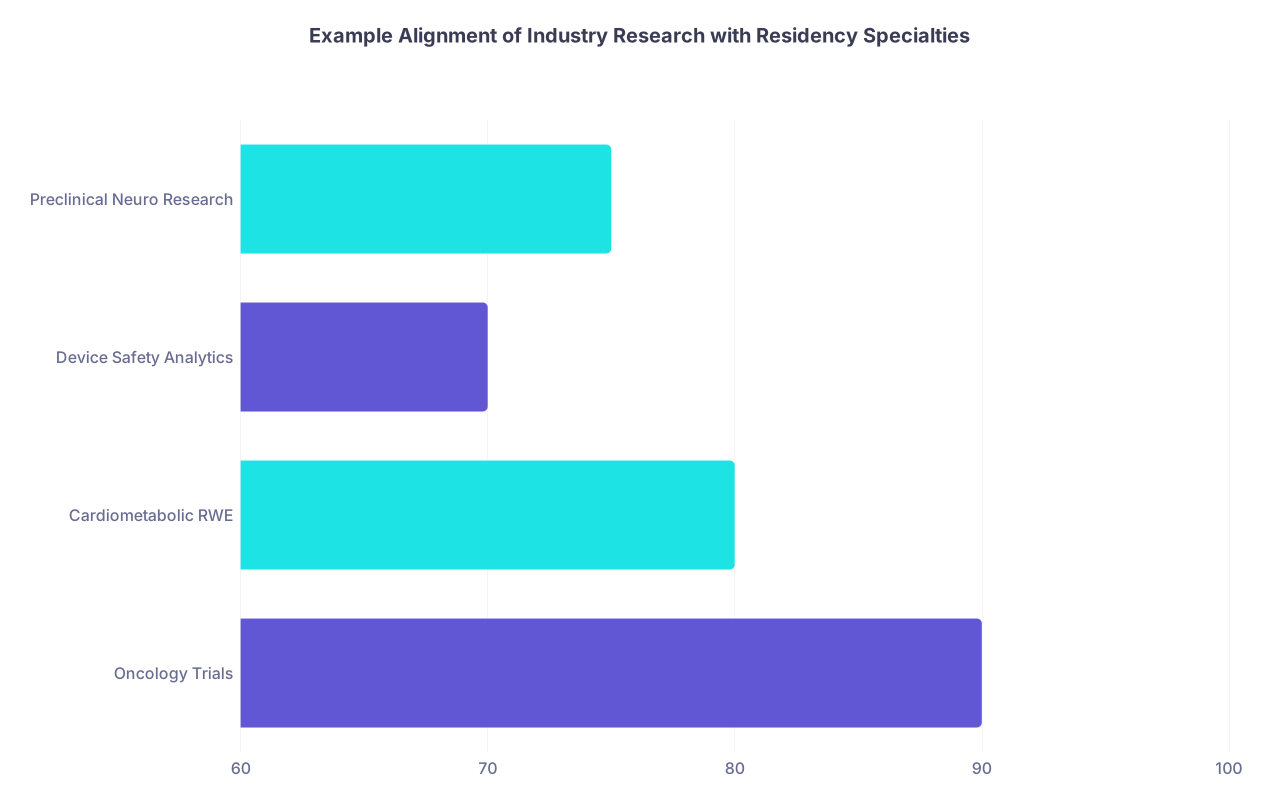
| Category | Value |
|---|---|
| Oncology Trials | 90 |
| Cardiometabolic RWE | 80 |
| Device Safety Analytics | 70 |
| Preclinical Neuro Research | 75 |
(The values here just illustrate high alignment potential; you’re essentially showing “this stuff is not random.”)
In your ERAS descriptions, you explicitly say:
“This experience deepened my interest in cardiology by exposing me to real-world challenges of balancing thrombotic and bleeding risk.”
Or:
“Working on immunotherapy trials showed me how complex toxicity management is, and pushed me toward a career where I can be on the clinical side of that decision-making.”
Do not assume they’ll connect the dots. Make it obvious.
Step 7: Writing about industry research in your personal statement
You don’t need to write “I love pharma” in your personal statement. You need to show how this experience shaped how you think as a future clinician.
Use your research not as the main character, but as a lens.
Here’s a simple structure:
Brief, specific vignette from your research work
- A patient visit in a trial
- A moment where data contradicted your assumptions
- A meeting where safety concerns changed the plan
What you actually did in that context
- Not just “I observed,” but: screened, consented, analyzed, presented
What you learned that is directly relevant to residency
- Balancing protocol vs patient reality
- Understanding adverse events
- Interpreting incomplete data
Tie to specialty
- “That experience is why I want to train in [X], where clinical decisions are increasingly dependent on complex evidence.”
Avoid the trap of writing like a corporate brochure. Words like “synergy,” “stakeholders,” “pipeline,” “portfolio,” “value proposition” — leave them out.
Step 8: How to talk about industry research in interviews without sounding like you’re leaving for pharma in 3 years
This is a real concern for PDs: “Is this person going to bounce to industry the second they get board certified?”
So you need to anticipate and manage that.
If they ask: “Why industry research?”
You might say:
“I was curious how the evidence we rely on clinically actually gets created. Working in industry clinical trials let me see the process from the inside — the good and the frustrating parts. It convinced me that if I want to influence patient care meaningfully, I need to first be an excellent clinician. That’s why residency is my priority now.”
Or:
“I like data and systems. Industry gave me tools, but I don’t want to be 2–3 steps removed from the patient forever. I want to bring that analytical perspective to the bedside.”
If they ask: “Do you see yourself going back to pharma?”
Do not say “Absolutely yes, I can’t wait to exit.” Even if you’re 80% sure you eventually will.
A safer, honest framing:
“Long term, I can see myself involved in clinical research or maybe partnering with industry in some capacity. But my first goal is to be a strong, competent clinician in [specialty]. I can’t be useful in any setting if I don’t have that foundation.”
Programs understand that some grads end up collaborating with or working in industry. They just don’t want a short-timer who’s disengaged from patient care.

| Step | Description |
|---|---|
| Step 1 | Past Industry Research |
| Step 2 | Skills & Insights Gained |
| Step 3 | Relevance to Specialty |
| Step 4 | Motivation for Clinical Training |
| Step 5 | Future Possibilities with Strong Clinical Base |
Step 9: Specific wording examples you can almost copy-paste
Use these as templates and adjust details.
ERAS Experience Entry – Clinical Trial Coordinator (Industry)
Role:
“Clinical Research Coordinator – Phase II/III Trials (Oncology)”
Description bullets:
- Coordinated 2 Phase II and 1 Phase III oncology trials at a tertiary cancer center, including chart screening, eligibility confirmation, and scheduling visits under the supervising oncologist.
- Consented >60 patients and family members using IRB-approved documents, explaining risks/benefits and answering questions in collaboration with the treating team.
- Entered and verified data in electronic case report forms, responded to sponsor queries, and participated in monitoring visits and safety calls.
- This experience strengthened my interest in hematology/oncology by highlighting the complexities of balancing trial protocols with patient-centered care.
ERAS Experience Entry – Real-World Evidence / Data Analytics
Role:
“Research Assistant – Real-World Evidence Team, [Company Name]”
Description bullets:
- Cleaned and analyzed large EMR and claims datasets (>10,000 patients) to evaluate bleeding and hospitalization outcomes among patients on direct oral anticoagulants.
- Collaborated with biostatisticians to build multivariable regression models; prepared summary tables and figures for internal review and external abstract submission.
- Conducted literature reviews on comparative effectiveness of anticoagulants to contextualize study findings and identify gaps in existing data.
- This work improved my ability to critically appraise evidence and directly informs how I think about risk stratification in internal medicine.
Step 10: Handling the “only” problem: when this is your only research
If everything you’ve ever done research-wise is industry:
Stop apologizing for it. Own it, but round it out.
Here’s what you do:
- Make the research entry on ERAS strong, concrete, and skills-focused (we already covered how).
- Use the Program Signals / Supplemental (if available) to highlight any interest in clinical research, QI, or academic activity going forward.
- Get at least one letter from someone who can comment on your analytical thinking and reliability in a research or data-focused setting — even if they are industry-based, as long as they know you well and can speak to your work ethic. Pair that with strong clinical letters.
- Look for small, fast-win projects at your medical school or hospital — a case report, a QI project, a retrospective chart review — even if they’ll never be published before ERAS. You can still list them as ongoing to show academic engagement anchored in clinical medicine.
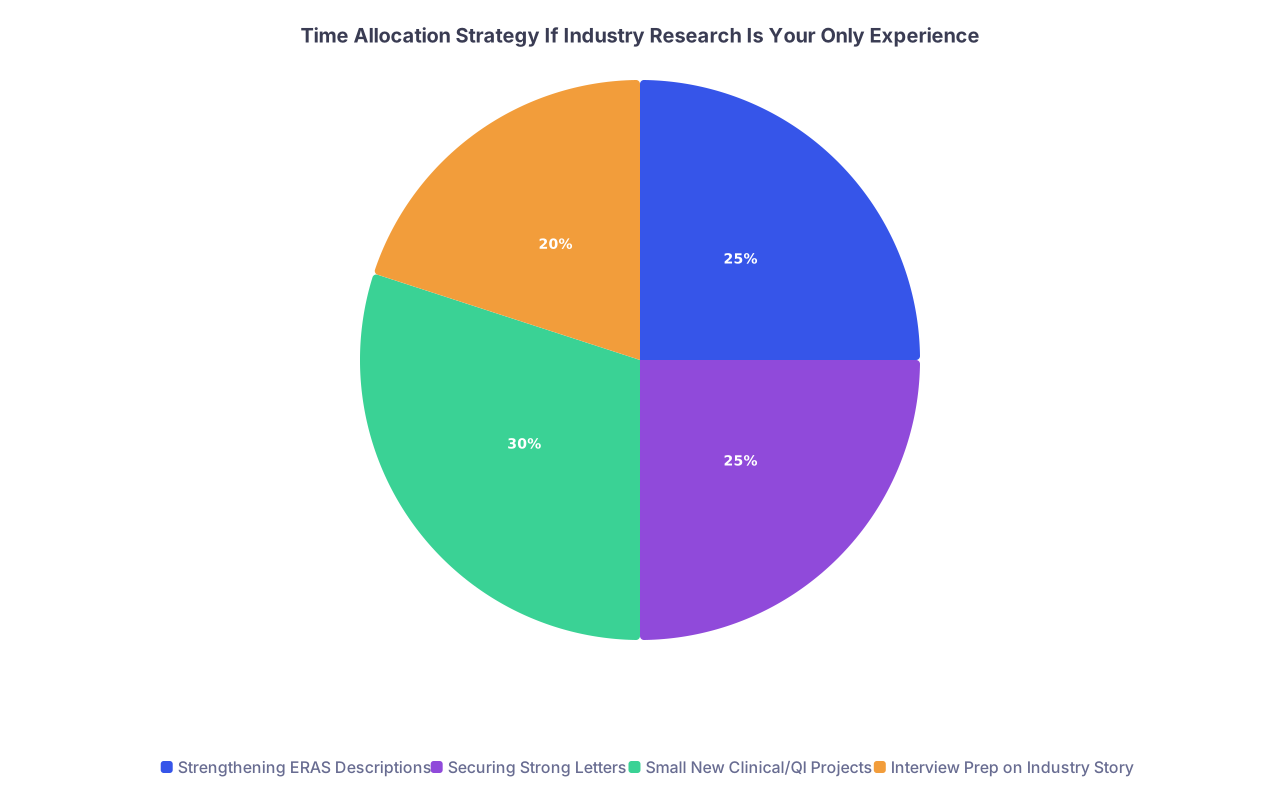
| Category | Value |
|---|---|
| Strengthening ERAS Descriptions | 25 |
| Securing Strong Letters | 25 |
| Small New Clinical/QI Projects | 30 |
| Interview Prep on Industry Story | 20 |
Do not make the mistake of trying to hide your industry background. Programs read that as weird and evasive. You’re better off saying: “Yes, I did this. Here’s how it makes me better for your residency program.”
Step 11: Red flags and what to avoid
A few ways applicants sabotage themselves with industry/pharma research:
- Writing entirely in corporate language: “stakeholders, assets, product lifecycle, value proposition.” It sounds fake in a residency context.
- Sounding like you care more about the company than patients. If your entire narrative is “helping bring products to market,” that’s a problem.
- Acting like you’re above clinical medicine now because you “understand systems and policy.” PDs want someone who will take good care of their patients at 2 a.m.
- Being vague because of “confidentiality.” You can always describe your role and skills, even if you can’t name molecules or internal programs.
If you catch yourself writing like a press release, stop. Rewrite like a human who did real work.
FAQs
1. Should I list an industry scientist or pharma MD as a letter writer on ERAS?
You can, but with conditions. They should:
- Know you well enough to talk in detail about your work, reliability, and growth.
- Comment on skills that translate to residency: critical thinking, communication, professionalism, teamwork.
Do not use an industry letter instead of a core clinical letter. Use it as a supplement. Two strong clinical letters + one industry/academic research letter can work well, especially for more academic programs.
2. I was paid well in industry. Should I mention salary, promotions, or “corporate achievements”?
No. Residency is not impressed by how much money you made or that you “aligned cross-functional business goals.” Translate those things into clinical skills:
- Collaboration = working across teams and disciplines.
- Promotion = trusted with more complex tasks and higher responsibility.
- Metrics = productivity, accuracy, quality of work.
Your focus is: “How does this show I will be a good resident?” Not “Look how fast I climbed a corporate ladder.”
3. What if my industry work was very short (one summer / a few months)? Is it even worth listing?
If you had real responsibilities and can describe them concretely, yes, list it. Just don’t overinflate. A 10-week internship can’t be sold as “deep expertise.” But you can say:
- What problems you worked on.
- What specific tools or methods you learned.
- How it shaped your thinking about evidence or your specialty.
If it was literally observing or shadowing in a corporate setting, that’s borderline. You’re better off using that space for stronger, more substantial activities.
Open your ERAS “Experiences” section right now and look at how you’ve written your industry or pharma research entry. If you replaced the company name with “University Lab,” would it still clearly show real work, specific tasks, and concrete outcomes? If not, start rewriting it line by line until it does.


