
It’s late November. You’re staring at your ERAS application and your CV.
You’ve got real research under your belt—maybe a year in a German lab, a clinical project at a big hospital in India, a public health study in Brazil, a basic science internship in Japan. You worked hard. You have data, maybe a poster, maybe even a paper. But now you’re looking at US residency programs and thinking:
“Are they even going to care about this?” “Does this count the same as US research?” “Do I tell them everything, or will it raise red flags about training standards or data quality?”
You’re not alone. I’ve watched international applicants tank strong applications by presenting overseas research the wrong way—too vague, too defensive, or too obviously trying to oversell. I’ve also seen others leverage that same “foreign” research into a clear advantage.
Let’s walk through how to be in the second group.
Step 1: Understand How Programs Actually See International Research
Before you decide how to present anything, you need to be honest about what you’re up against.
Most US residency programs mentally sort research experiences into rough tiers:
| Research Type | Initial Perception in US Programs |
|---|---|
| US, big-name lab (NIH, MGH, UCSF, etc.) | Very strong |
| US, academic center, clinical research | Strong |
| US, community hospital QI/audit | Moderate |
| International, well-known institution | Moderate to strong |
| International, unknown hospital/university | Variable, needs context |
| Solo/independent overseas projects | Skeptical unless explained well |
Your goal is simple: move your international experience as far up that perception ladder as possible.
You do that by:
- Making it legible to US faculty (clear, concrete, understandable).
- Translating what you did into US-friendly language (roles, methods, outcomes).
- Showing that you understand research rigor and ethics as they’re applied in the US.
What they’re worried about (even if they never say it outright):
- Was this “real” research, or just data entry?
- Was it supervised by someone credible?
- Were ethics and approvals handled appropriately?
- Can this person function in a US research environment?
Everything you write should quietly answer those doubts.
Step 2: Translate Your Experience into “US Research Language”
International research gets discounted when it sounds vague, inflated, or too foreign.
Do this instead: strip it down into the same structure you’d use for a project at, say, Mayo or Hopkins.
Think in this order when describing any project:
- Setting and team
- Your role
- Question and methods
- Output (abstract, poster, paper, QI changes, etc.)
- Skills you gained that matter to residency
Example: weak vs strong description.
Weak:
Observership and research in cardiology department in India. Helped with many projects and data collection.
Strong:
Clinical research trainee in the interventional cardiology department at a tertiary referral center (800-bed hospital). Independently screened patients and extracted chart data for a prospective registry of STEMI patients undergoing PCI. Contributed to database design in REDCap, performed basic statistical analysis (chi-square, logistic regression in SPSS), and co-authored an abstract presented at the 2023 ESC Congress.
Notice a few things:
- “Tertiary referral center (800-bed hospital)” gives scale.
- “Prospective registry,” “REDCap,” “logistic regression” signal you know what you’re doing.
- “Co-authored an abstract presented at [specific conference]” anchors the work in something US faculty recognize.
If your institution isn’t famous in the US, that’s fine. Give them anchors:
- 500-bed public teaching hospital
- University-affiliated cancer center
- WHO collaborating center for [x]
- National referral center for [disease]
That instantly moves your work one tier up in credibility.
Step 3: How to Enter International Research in ERAS
You’re not just telling a story—you’re filling specific boxes in ERAS. You have to play by that system’s rules.
Where to put it
Almost always, international research goes into:
- “Volunteer” or “Work” experience if it was a structured role (research assistant, trainee, fellow).
- “Publications/Presentations” if it resulted in abstracts, posters, manuscripts, or accepted submissions.
Common mistakes I see:
- Shoving everything into “publications” even if the paper never got accepted.
- Calling a 4-week shadowing stint “research fellowship.”
- Listing 10 nearly identical “projects” with no real outcomes, cluttering your application.
Rule of thumb: if it had a defined PI, ongoing meetings, and you contributed in a sustained way (several weeks/months), it can usually be 1 experience entry, with multiple outputs listed.
How to label your position
Pick a title that sounds normal in the US and describes what you actually did:
- Research Assistant
- Research Trainee
- Clinical Research Fellow (careful—this can sound more senior than it was; only use if appropriate)
- Research Intern
- Visiting Research Scholar (only if you truly had that formal designation)
Don’t invent something like “International Clinical Research Expert” because your home institution gave you a fancy certificate.
How to write the experience description
You’ve only got a few lines. Use them like this:
- 1 line: setting + mentor
- 2–3 lines: your role + methods
- 1 line: outputs/impact
Example ERAS-style entry for an overseas project:
Department of Neurology, University Hospital Cologne, Germany – Research Trainee
Worked under Dr. [Name], stroke neurologist, on a retrospective cohort study of patients receiving mechanical thrombectomy. Extracted clinical and imaging data from electronic medical records, coded variables in Excel, and assisted with multivariable regression analysis in R. Drafted sections of the manuscript and created figures for a paper submitted to Stroke (under review).
No fluff about “improved communication skills.” Save that for your personal statement or interview.
Step 4: Deal with Common Weak Spots Before Programs Question Them
Certain patterns in international research trigger skepticism. You cannot ignore them; you have to manage them.
Weak spot: No publications yet
This is very common, especially if you did only 6–12 months of research.
Do NOT inflate your work into a “published” paper if it’s not. Programs check.
Use precise status terms:
- “Manuscript in preparation”
- “Manuscript submitted to [journal]”
- “Revision under review at [journal]”
- “Abstract accepted for poster presentation at [conference]”
Never: “accepted” unless you have the acceptance. Never: “in press” unless there’s real confirmation.
Instead of apologizing for lack of publication, show process: data cleaning, analysis, draft writing, conference submission.
Weak spot: Unknown institution
If you trained at “General Hospital, X City” that nobody in the US has heard of, you compensate by:
- Clarifying the scale (bed count, teaching role, patient volume).
- Highlighting any affiliations (university, national society).
- Emphasizing standardized methods and tools (REDCap, SPSS, R, standard diagnostic criteria, etc.).
Example phrase:
Conducted research in a 600-bed university-affiliated teaching hospital that serves as a national referral center for [disease].
That gives them something to latch onto.
Weak spot: Ethics/IRB assumptions
US programs are touchy (rightly) about research ethics.
If your country doesn’t call it “IRB,” fine. Say what happened in terms they understand:
Study was approved by the institutional ethics committee at [Hospital Name].
Or:
Data collection followed hospital ethical standards and received approval from the institutional review board.
Never make them wonder if you just downloaded charts into Excel on a USB at home.
Step 5: Use Your Personal Statement Strategically (Without Turning It into a Travel Blog)
Your personal statement is not a tourism essay: “I traveled to [country] and saw [disease]. It changed my life.” Programs see 50 of those every year.
Your angle is different: “I did research abroad, and it changed how I think.”
Ways to use it:
- Tell 1 specific, research-related story that shows depth: a protocol problem, a challenging case, a cultural barrier in recruitment.
- Show how you learned something that transfers directly to US training: critical appraisal, QI mindset, working in resource-limited environments.
Strong example of integrating international research:
During my research year at a public hospital in São Paulo, we attempted to implement a sepsis bundle in the emergency department. What looked straightforward in the protocol became complicated when we realized that lactate measurements were batched and not on-demand, and many patients arrived without prior records. Working with the team, I helped redesign our data collection to capture realistic time-to-antibiotic metrics and identify where delays actually occurred. That experience taught me to respect the gap between protocol and practice—and pushed me toward a residency where I can continue quality improvement work alongside clinical care.
That reads like someone who understands systems, not just someone who wanted an “international experience.”
Step 6: Prepare for Interview Questions About Your International Research
If your application leans on international research, expect to talk about it. A lot.
Here’s what you’ll be asked, in various forms:
- “Tell me about your research in [country].”
- “What exactly was your role on that project?”
- “Why did you choose to do research abroad instead of in the US?”
- “How did this experience prepare you for residency here?”
Here’s how to not blow it:
1. Be precise about your role
If you mostly did data collection and basic analysis, say that confidently. Programs prefer honest clarity over vague claims of “leading multiple projects.”
Good answer style:
I joined the project after the protocol was written. My main responsibilities were screening charts, extracting data according to a standardized checklist, and entering it into REDCap. Once data collection was complete, I worked with the biostatistician to run descriptive analyses and create tables and figures for the manuscript.
That shows you understand research workflows and hierarchy.
2. Acknowledge limitations without trashing your own work
Every project has constraints. Be candid but not self-sabotaging.
Bad:
Honestly the data wasn’t great, and most of my work won’t get published.
Better:
The project had limitations, including incomplete records and variability in documentation across clinicians. We addressed this by defining strict inclusion criteria and performing sensitivity analyses. Whether or not the manuscript is ultimately accepted, the process taught me how to manage imperfect real-world data, which I think is directly relevant to clinical decision-making.
3. Connect it to US residency concretely
You should be able to finish this sentence in a clean way:
“Because of that research experience, I’ll bring ___ to your program.”
Examples:
- A QI mindset and comfort with metrics.
- Ability to work in multidisciplinary teams.
- Comfort with biostatistics and interpreting literature.
- Experience in resource-limited settings that sharpens clinical judgment.
If you can’t answer that, you’re just telling a story, not making a case.
Step 7: Pair International Research with One US Anchor If You Can
If at all possible, you want at least one US-based component in your application to reassure programs:
- A short US observership where you mention you discussed or presented your research.
- A US mentor (even virtual) who reviewed your manuscript or helped refine your abstract.
- A poster presented at a US or international conference commonly attended by US physicians (CHEST, ASH, AHA, RSNA, ATS, etc).
This is where you can be intentional in the year or two before applying. Think targeted steps, not impossible leaps.
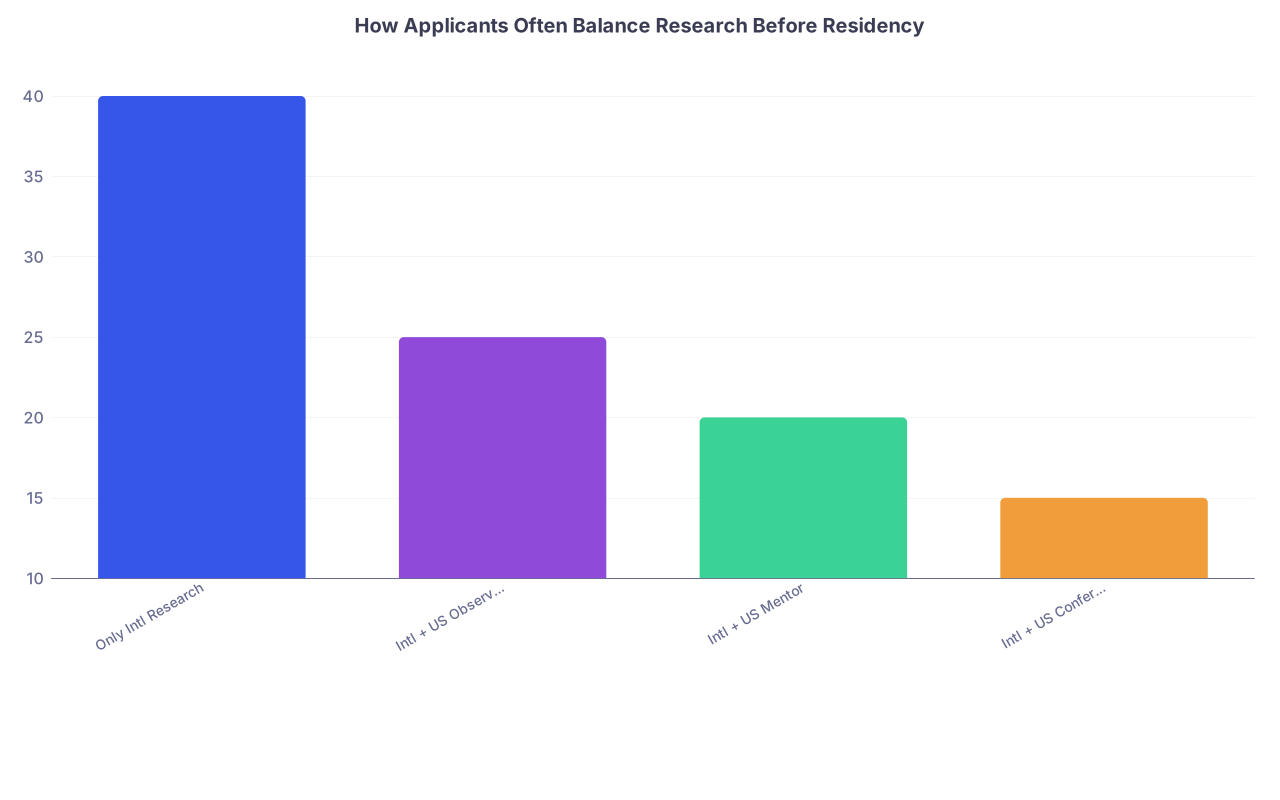
| Category | Value |
|---|---|
| Only Intl Research | 40 |
| Intl + US Observership | 25 |
| Intl + US Mentor | 20 |
| Intl + US Conference | 15 |
If you’re early in the process and still have time, aim to move yourself out of that “Only International Research” group. One well-targeted connection can shift how your entire research story is received.
Examples of “anchor” moves:
- Presenting your international work as a poster at a US conference.
- Asking a US-trained faculty member in your home country to co-mentor your project.
- Re-analyzing your international dataset under supervision from a US-based collaborator (even remotely).
Step 8: Common International Research Scenarios and How to Handle Them
Let’s get specific. Here’s how to handle a few very common situations.
Scenario 1: 1-year research fellowship in a European lab, basic science, no publication yet
How to present it:
- Emphasize methods and techniques: cell culture, PCR, Western blot, animal models, etc.
- Highlight structured mentorship, lab meetings, journal clubs.
- Be honest about status: “Manuscript in preparation,” focus on skills more than output.
Example ERAS description:
Basic science research trainee in the Department of Immunology at [University], working under Dr. [Name]. Performed cell culture, flow cytometry, and ELISA assays to investigate T-cell responses in autoimmune disease models. Presented preliminary data at internal lab meetings and contributed to figure preparation for a manuscript in preparation.
Interview angle:
- How this taught you to think mechanistically about disease.
- How managing failed experiments taught you persistence and troubleshooting—both critical for residency.
Scenario 2: Short (2–3 month) research project during an elective abroad
This is often too short to sell as a primary research credential, so you position it as:
- Exposure to a research environment.
- A launching point that informed your later interests.
- A concrete mini-project with understandable boundaries.
Example:
During a 2-month elective at [Hospital] in [Country], I joined an ongoing quality improvement project to reduce catheter-associated urinary tract infections. My contribution focused on auditing adherence to a new catheter insertion checklist over a 4-week period and presenting weekly feedback to the nursing staff. While brief, this experience introduced me to QI methods and later motivated my longer-term QI work at my home institution.
You’re not overselling; you’re linking experiences.
Scenario 3: Large number of small international projects, none very deep
Classic problem: 7–8 minor projects, no strong anchor.
Fix:
- Collapse them into 1–2 entries by theme or department.
- Name 1–2 flagship outputs (your best abstract or poster).
- Describe your overall contribution pattern rather than listing every micro-task.
Instead of:
- “Retrospective study of asthma admissions…”
- “Survey of patient satisfaction…”
- “Chart review of COPD patients…”
- “Audit of antibiotic use…”
Combine:
Clinical research assistant in the Department of Pulmonology at [Hospital], contributing to multiple retrospective chart reviews and survey-based projects on asthma, COPD, and antibiotic stewardship. Responsibilities included patient chart screening, data abstraction into standardized forms, and initial descriptive statistical analysis. Co-authored 2 abstracts presented at national conferences.
Cleaner, more believable, easier to discuss.
Step 9: Things That Quietly Kill Credibility (Don’t Do These)
A few habits make reviewers raise an eyebrow immediately:
- Listing obviously predatory or unknown “journals” with impressive-sounding names and no indexing.
- Claiming “first author” on 8–10 papers from one year, with no coherent theme or believable timeline.
- Copy-pasting identical descriptions for different projects.
- Using vague methods language: “used advanced statistical techniques” instead of saying exactly what you did.
- Overusing “significant” without any p-values or context.
If you’re unsure about a journal, check if it’s indexed in PubMed or at least has a legitimate editorial board. If it looks shady, you can still list it, but don’t lean on it as your main achievement.
Step 10: Turn Your International Background into a Strength, Not Something You Apologize For
US programs don’t dislike international research. They dislike unclear, ungrounded, or inflated research.
When you present your experience like this:
- Grounded in real roles and methods.
- Clear about setting and supervision.
- Honest about outcomes and limitations.
- Connected directly to what you’ll bring as a resident.
Then the “international” part becomes a feature, not a bug.
You’re the person who’s:
- Seen health systems other than the US.
- Worked with different resource levels.
- Collaborated across languages, cultures, and disciplines.
- Still managed to produce real, analyzable data.
That’s valuable.

| Step | Description |
|---|---|
| Step 1 | International Research Experience |
| Step 2 | Translate to US Language |
| Step 3 | Enter Correctly in ERAS |
| Step 4 | Clarify Role & Methods |
| Step 5 | Anchor with Outputs & Ethics |
| Step 6 | Prepare Interview Narratives |
| Step 7 | Connect to Residency Skills |

You’re past the point of changing where you did the work. That part’s fixed. But how you frame it? How you write it into ERAS, weave it into your personal statement, and talk about it in interviews?
That’s still wide open.
Use the time before interview season to clean up your descriptions, tighten your project summaries, and practice a few crisp, honest stories about what you did and what you learned. Once you have that, your international research stops being a question mark and starts becoming a differentiator.
With that squared away, your next job is aligning your program list and letters with the story you’re telling. How you choose programs—and who writes your letters—can either reinforce this narrative or fight it. That’s the next piece of the puzzle.


