

You are here
You’re sitting in front of ERAS, trying to explain your “research experience.”
On one side: classmates with R01‑funded labs, fancy biostats cores, multi‑center trials, and a biostatistician on speed dial.
On your side: a quality improvement project in a rural clinic with paper charts. A retrospective chart review in a safety‑net hospital where the “database” was an Excel sheet you cleaned yourself. A community survey where half the forms were filled out in pencil and smudged.
You know the work mattered. Patients got better care. Systems improved. But you’re worried it will look “weak” because you do not have survival curves, multivariable models, or “p<0.05” plastered everywhere.
Here’s the reality: programs care far more about whether you can identify a problem, design a workable project, and get something done in the real world than whether you can run a mixed‑effects model in Stata.
Your job now is to showcase impact without pretending you ran a randomized trial at the NIH.
Let’s walk through exactly how to do that.
Step 1: Reframe what “strong research” means in your context
You’re in a low‑resource setting. That’s not a bug; it’s a defining feature of the work. Own it.
Strong low‑resource research typically has three things:
- A real, clearly defined clinical or systems problem
- A feasible approach that fits the setting
- A measurable change in process or outcome — even if the stats are basic
Stop comparing yourself to the MD/PhD running a genomics project with 800 patients. Compare yourself to what was possible where you were.
If you:
- found a problem that mattered to patients or staff,
- designed a practical intervention,
- collected data with any level of rigor,
- and closed the loop with feedback or change,
that’s already better than half the “research” that lives and dies in PowerPoint.
The trick is to make that visible.
Step 2: Translate “we did stuff” into clear, lean outcomes
Programs are not expecting Kaplan‑Meier curves from a district hospital in Kenya or a FQHC without an EMR. They are expecting clarity.
Avoid this kind of vague nonsense: “Led a QI project to improve diabetes care in a rural clinic.”
Replace it with something like: “Implemented a paper‑based diabetes registry in a rural clinic (n=147 patients); within 6 months, documented A1c checks increased from 42% to 78%, and mean A1c decreased from 9.4% to 8.6%.”
That’s impact. No p‑values required.
Think in terms of:
- Before vs after percentages
- Counts (patients reached, charts reviewed, days reduced, visits avoided)
- Timeframes (over 3 months, 6 months, 1 year)
- Simple but specific outcomes (missed appointments, antibiotic guideline adherence, screening rates)
If you’re stuck, use this before/after template:
“[Intervention] in [setting] over [time]: [process metric] improved from [X%] to [Y%]; [outcome metric] changed from [A] to [B].”
If you don’t have exact numbers, that’s a problem you can sometimes fix retrospectively:
- Go back to your notebook, Excel sheet, or clinic logbooks.
- Re‑calculate a few basic metrics: counts, percentages, medians.
- Do not invent data. But do squeeze everything you can from what you honestly have.
Even basic descriptions like “screening completion increased from roughly 1 in 10 eligible patients to about 5 in 10” are better than “improved screening.”
Step 3: Use simple statistics correctly — and stop reaching for more
No one is impressed by incorrect logistic regression. Basic done well beats complex done badly.
If you had:
- a small sample (n < 100–200),
- limited variables,
- messy data collection,
then your best friends are:
- counts, percentages
- means/medians
- simple comparisons (before vs after)
Do not write:
“Performed multivariate regression analysis”
if what you actually did was compare means in Excel.
Here’s what you realistically can say for low‑resource projects:
- “Calculated baseline and post‑intervention proportions and mean values using Excel.”
- “Compared pre‑ and post‑implementation rates of [X] using simple descriptive statistics.”
- “Summarized survey responses using frequencies and percentages.”
If you did nothing more than tally: “Manually reviewed 200 charts and extracted data into Excel; calculated frequencies of missed follow‑up and antibiotic prescribing patterns.”
That’s fine. Programs know the difference between a microbiology lab and a rural clinic pharmacy.
The red flag is pretending you did advanced statistics when everyone can tell you didn’t. That screams insecurity and lack of honesty.
Step 4: Frame low‑resource constraints as design features, not excuses
Your instinct is probably to apologize: “We couldn’t randomize… sample size was small… there was no EMR…”
Stop apologizing. Start explaining design choices.
Example in an experience description: “Due to absence of EMR and limited staffing, we designed a paper registry that could be maintained by one nurse and updated weekly. We prioritized simple data elements (age, diagnosis, next visit date) to keep it sustainable after project completion.”
That signals:
- You understood constraints
- You adapted realistically
- You thought about sustainability
In an interview, you can say: “We didn’t have resources for a complex trial, so we focused on something the clinic could maintain long‑term: a simple, nurse‑driven registry and monthly feedback to providers.”
Programs like that thinking. Resource‑appropriateness is big in real medicine.
Step 5: Write your ERAS entries so they show impact, not just activity
Most people waste their Experience entries listing tasks. You’re going to write yours like a tiny results section.
Use structure. Not fluff. A simple pattern works well:
- One sentence for the problem
- One sentence for what you actually did
- One–two sentences for concrete outcomes / what changed
- Optional: one sentence on sustainability/next steps
Example — weak: “Participated in a project to reduce missed follow‑up visits at a community clinic. Helped with data collection and patient calls.”
Example — strong: “Community clinic with ~4,000 visits/year had ~30% missed follow‑up rate. Led development of a paper‑based tracking log and reminder call system; manually reviewed 300 charts and built an Excel database. Over 4 months, documented no‑show rates dropped from 29% to 18%. Handoffs and workflow sheets were adopted by clinic staff and are used independently since project completion.”
See the difference? Problem. Your specific role. Measurable impact. Sustainability.
Do that for each research/QI item.
Step 6: Fix your “scholarly output” anxiety
You’re worrying: “I don’t have a NEJM paper. Will anyone care about my little clinic project?”
Programs are looking for effort, rigor, and follow‑through. Posters and local talks count. Even if the setting was basic.
You highlight “outputs” this way:
- Local presentations: “Presented findings to clinic staff and hospital quality committee.”
- Posters: “Presented a poster at [regional meeting/institutional research day].”
- Internal reports: “Prepared a written report used by clinic leadership to secure additional nursing hours.”
- Protocols: “Co‑wrote clinic protocol for adult asthma follow‑up based on project findings.”
Do not underestimate internal presentations. If you stood up in front of anyone — nurses, department, NGO staff — treat it as scholarly dissemination. Because it is.
| Output Type | How to Phrase It Briefly |
|---|---|
| Local presentation | Presented results at clinic staff meeting |
| Poster | Poster at regional/global health conference |
| Report | Wrote report for hospital/NGO leadership |
| Protocol | Co-authored new clinic protocol |
| Teaching session | Led teaching on updated guidelines |
If you truly have zero dissemination: consider doing something now. Even a late, informal presentation to the clinic team is better than nothing — and it’s honest scholarly activity.
Step 7: Use your Personal Statement and essays strategically
You don’t need a “research‑focused” personal statement. But you should absolutely mine your low‑resource project for stories.
Pick one project and answer these clearly:
- What was broken when you arrived?
- What did you try?
- What failed first?
- What actually ended up working?
- How did this change how you think as a clinician?
Example structure:
Paragraph 1: The problem scene
“On my first day at the district hospital, I watched a nurse flip through a two‑inch stack of paper charts looking for a child who had missed a follow‑up visit…”
Paragraph 2: Your decision to act
“I realized we were losing kids with severe asthma because no one could see who had actually returned. I asked the medical director if I could try building a simple paper registry.”
Paragraph 3: The messy middle
“The first version failed — staff didn’t use it because it took too long. We cut data fields to the essentials and moved the log to the triage desk…”
Paragraph 4: The result
“Within three months, we had reduced missed follow‑ups by about a third. More importantly, the nurses felt ownership of the system…”
Paragraph 5: The lesson
“This taught me that structured thinking and small, realistic changes can shift care, even when resources are minimal. That’s the mindset I want to bring to residency.”
That’s compelling. And it fits perfectly with “research in residency applications” without you sounding like you’re trying to be a full‑time academic.
Step 8: Anticipate interview questions and hit them cleanly
If you have low‑resource research on your CV, you’re going to get some version of:
- “Tell me about your research.”
- “What was challenging about doing this in that setting?”
- “How did you measure if you were successful?”
- “What would you do differently if you repeated the project?”
Prepare one 60–90 second story per major project. Not a monologue. A tight story.
Use a stripped‑down “STAR” without saying STAR:
- Situation: 1–2 sentences
- Task: what you were trying to change
- Action: what you actually did (skip the blow‑by‑blow)
- Result: numbers + “so what”
Example:
“During my rotation at a safety‑net clinic, we noticed that only about 40% of our hypertensive patients had controlled blood pressure. I worked with a nurse and a medical assistant to design a simple paper registry and a follow‑up call script. We entered about 180 patients manually, then ran monthly printouts of those overdue for follow‑up. After four months, control rates improved from roughly 41% to 55%. It was not a randomized trial, but it changed how the clinic prioritized outreach, and they’ve kept the registry running after I left.”
If someone presses on stats, be honest: “We used simple descriptive statistics — mostly counts and percentages — because our data were limited and collected manually. The main goal was to improve care, not publish, but we documented our methods in case the clinic or future trainees wanted to expand the project.”
That answer is mature. Not defensive.
Step 9: Align your low‑resource work with the program’s interests
Programs don’t exist in a vacuum. Many love the kind of mindset low‑resource work produces: comfort with uncertainty, improvisation, systems thinking.
Tie your experience to what they care about:
- Safety‑net hospitals: emphasize working with underserved populations, chaos, limited resources.
- Academic programs: emphasize hypothesis, process, rigor, potential to scale or study further.
- Community programs: emphasize practical problem‑solving and sustainability.
When they ask, “How do you see yourself getting involved in research/quality improvement here?” you can say:
“In my previous clinic project, I learned how to start small: define one measurable target, build something the staff can actually do, and then iterate. I’d like to bring that approach to your [X] clinic — maybe around [diabetes, readmissions, transitions of care], working with your QI team to pick feasible outcomes and track them over time.”
You’re not selling fancy statistics. You’re selling a way of thinking and working.
Step 10: Clean up the optics — how it looks on paper
Cosmetics matter. Two entries can describe the same project, and one will look much more “serious” than the other.
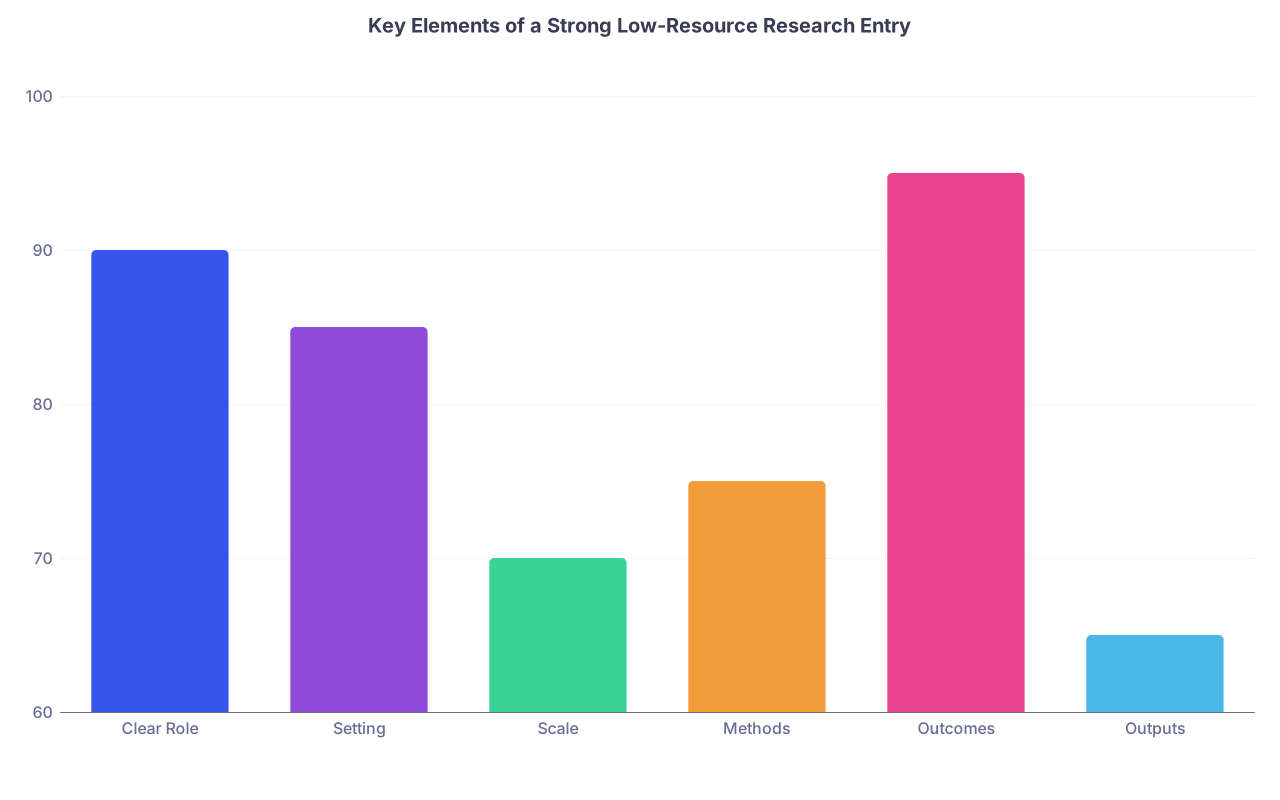
Checklist for each low‑resource research entry:
- Clear role: “Led,” “Co‑led,” “Designed,” “Analyzed,” “Implemented,” not just “Participated.”
- Setting: “rural clinic,” “district hospital,” “safety‑net ED,” not generic “clinic.”
- Scale: approximate numbers (n=63 patients; 4 nurses; 6‑month period).
- Methods: “manual chart review,” “structured questionnaire,” “paper registry”.
- Outcome: at least one number or directional change.
- Output: “Presented at…,” “Report used for…,” or “Protocol adopted by…”
| Category | Value |
|---|---|
| Clear Role | 90 |
| Setting | 85 |
| Scale | 70 |
| Methods | 75 |
| Outcomes | 95 |
| Outputs | 65 |
You don’t need all six for every line item. But if you’re hitting 4–5 of them consistently, your application ends up looking intentional and substantial.
Common traps to avoid (that I see all the time)
Trap 1: Overstating
“Designed and implemented randomized controlled trial…”
No, you didn’t. If it wasn’t randomized, don’t use those words. Programs see through this, and it undercuts your credibility.
Trap 2: Understating
“Helped with project to improve vaccination rates.”
If you built the spreadsheet, called patients, and presented results, that’s not “helped.” Claim your work accurately.
Trap 3: Hiding low‑resource context
If you had to hand‑count charts because there was no EMR, saying so actually helps. It highlights perseverance and adaptability.
Trap 4: Leaning on buzzwords with no substance
“Used advanced statistical analysis” is meaningless if you can’t describe what you did in plain English. Drop the jargon.
Trap 5: Treating QI as “not real research”
Programs don’t care what you call it. They care that you can improve care using data. Quality improvement done properly is hugely valuable.

| Step | Description |
|---|---|
| Step 1 | Notice Clinical Problem |
| Step 2 | Define Simple Measurable Goal |
| Step 3 | Design Feasible Intervention |
| Step 4 | Collect Basic Data |
| Step 5 | Analyze with Simple Stats |
| Step 6 | Present to Stakeholders |
| Step 7 | Implement Changes |
| Step 8 | Track Sustainability |


