
If Your School Has Limited Research: Creative Ways to Build a Competitive CV
Your school barely has any research, your classmates at big-name places are racking up PubMed entries, and ERAS season is getting closer. Are you already behind for residency—or is there a way to build a serious research CV from “almost nothing”?
Let me be blunt: programs do not care that “your school doesn’t have research.” They care what you did with the situation you had. Excuses read the same in every application.
The good news? You can build a legitimately competitive research CV out of a low-resource environment—if you stop waiting for someone to hand you a lab position and start engineering your own opportunities.
Here’s how.
Step 1: Understand What “Counts” As Research For Residency
Before you start scrambling, you need to know what target you’re actually aiming at.
Residency programs don’t only care about R01-level bench research. They care about evidence that you can:
- Ask a question
- Work systematically
- Finish what you start
- Produce something scholarly that outlives you (poster, paper, abstract, QI project, protocol, etc.)
Look at how ERAS actually categorizes “scholarly activity”:
| Category | Examples |
|---|---|
| Peer-reviewed | Case reports, original research, reviews |
| Non–peer-reviewed | Blogs, local newsletters, educational handouts |
| Presentations | Posters, oral talks, virtual conferences |
| QI / QA | Protocols, PDSA cycles, outcomes projects |
You’re not trying to become an NIH-funded scientist by PGY-1. You’re trying to show:
- A track record of finishing projects
- Basic research literacy
- Interest aligned with your specialty
That’s it. You can absolutely do that without a huge research powerhouse behind you.
Step 2: Audit What You Actually Have Access To
You think your school “doesn’t have research.” Sometimes that’s true. More often, nobody has mapped it for you.
Do this systematically over 1–2 weeks:
Go through your school’s website and look for:
- Department pages (IM, Surgery, Psych, etc.)
- “Publications” or “Faculty interests” sections
- Any “Research Day” or “Scholarly Activity” page
Search PubMed:
- Type:
YourMedSchoolName[Affiliation] AND last 5 years - Scroll the author list and find repeat names
- These are your potential mentors—even if nobody ever mentioned them to you
- Type:
Ask quietly effective upperclassmen:
- Not the loud ones bragging on GroupMe; the MS4 who matched Derm or Rad Onc from nowhere
- Ask: “Who actually helped you get projects done?” and “Who responds to emails?”
Look outside your med school:
- University main campus (public health, engineering, data science, psychology)
- Affiliated community hospitals
- State health departments or local health systems
Your goal isn’t to find “the perfect lab.” Your goal is to build a list of 5–10 possible people/places where research adjacent things happen and where a hungry student could plug in.
Step 3: How To Cold-Email For Research When You Have No Infrastructure
You’re at a non-research-heavy school. That means you win or lose on your cold outreach.
Most students do this badly. They send a giant paragraph about how “passionate” they are and attach a 4-page CV that shows nothing relevant.
Do this instead.
A simple, effective cold email template
Subject line examples:
- “Med student interested in [X]—willing to help with data or writing”
- “Student volunteer for ongoing projects in [specialty]”
- “Help needed on case reports / chart review? MS3 volunteer”
Body (keep this short):
Dear Dr. [Name],
I’m a [MS2/MS3] at [School], interested in [field or topic—2–5 words]. I’m looking for concrete ways to get involved in ongoing projects, especially [data extraction, chart review, case reports, or QI—pick what you can actually do].
I’ve attached a one-page CV. Briefly, I have experience with [Excel/RedCap/basic stats/writing/editing—list 1–2 real skills or courses only]. I’m reliable with deadlines and happy to start with any small role that’s useful to your team.
If you have a current project that could use another pair of hands, I’d be grateful for a brief call or to meet during your office hours.
Best,
[Name]
[School, Year]
[Phone] | [Email]
Key points:
- You ask for work, not mentorship. Mentorship may come later.
- You offer specific, unglamorous help: chart review, data entry, formatting references.
- You do not claim stats skills you don’t have. That lie collapses quickly.
Plan to send 15–20 of these. Not 3. Not 5. Twenty.
If you’re thinking “twenty is a lot,” your classmates at research-heavy schools just joined 3 projects because their advisor sent one group email. You’re playing catch-up. Act like it.
Step 4: Turn Clinical Work Into Publishable Work
You may not have a basic science lab, but you have patients. That’s more than enough.
A. Case reports and small case series
This is one of the fastest, most realistic ways to get something on your CV when infrastructure is weak.
How to do it practically:
While on rotations, keep a running list:
- Weird presentations
- Rare diseases
- Common conditions with unusual complications
- Anything where your attending says, “Huh, I’ve never seen that before.”
When you see one, say this out loud:
- “This seems unusual—has this been written up before? I’d be interested in helping with a case report if that’s feasible.”
If they bite, immediately follow up with:
- “If you’re okay with it, I can start by doing a quick literature search and outlining the case.”
Then:
- Do a thorough PubMed search that day
- Draft the structure: Introduction, Case Presentation, Discussion, Conclusion
- Offer to write the first draft within 1–2 weeks
If you do this 3–4 times across third year, usually 1–2 will actually turn into submissions. That’s already multiple PubMed entries for many specialties.
B. Chart review projects (retrospective studies)
This is your other workhorse.
What you need:
- A faculty member with an idea and data access
- IRB approval (yes, this matters)
- Some comfort with Excel or basic stats software
Your pitch to faculty can be as simple as:
“I’ve noticed we have a lot of [X cases] here. Has anyone looked at outcomes or patterns? I’d be happy to help with chart review if it’s something you’ve considered.”
If they say they don’t have time, respond with:
“If you’re open to it, I can draft a 1–2 page concept and a simple data collection sheet for you to review. If it seems feasible, we could then move to IRB.”
They bring the name, department and IRB standing. You bring sweat equity. That’s a fair trade.
Step 5: Leverage Quality Improvement Like It’s Research (Because It Is)
Small, community-focused, or non-research schools usually do have one thing: endless quality problems.
Falls, readmissions, poor follow-up, low vaccination rates, missed screenings. They’re everywhere. And almost all of them can be turned into a QI project that counts as scholarly work.
Here’s the basic QI formula:
- Identify a measurable problem.
- Measure your baseline.
- Intervene (checklist, reminder, EMR tweak, education).
- Measure again.
- Present and/or submit.
You do NOT need fancy software to get this to a publishable level. Plenty of QI reports in journals like BMJ Open Quality, Cureus, or specialty-specific QI journals come from minimal-resource environments.
Example:
- Problem: Only 60% of eligible inpatients are getting VTE prophylaxis appropriately.
- Intervention: Simple EMR reminder + brief educational session with residents.
- Outcome: VTE prophylaxis appropriateness improves to 85% over 3 months.
This becomes:
- One local presentation at hospital QI day.
- One poster at a regional or national meeting.
- A short written paper in a QI or specialty journal.
Multiply that by 2–3 projects over clerkships and you have a real QI/research story, even if your school has zero wet labs.
Step 6: Go Outside Your Institution (Yes, Really)
If your school truly has almost no research culture, you may need to create your own “home” outside.
Options most students ignore:
State public health departments:
They’re constantly doing surveillance projects, outcomes analyses, and community studies. Email an epidemiologist or program coordinator.Larger academic centers 1–2 hours away:
Ask about remote involvement. Abstract writing. Data cleaning. Systematic reviews.Online/remote collaborations:
- National specialty-specific student groups often have ongoing multi-center projects.
- Remote systematic review teams looking for screeners and data extractors.
- Professional societies with student research committees.
You do not need to physically be in their hospital 5 days a week. Plenty of work is literature-based or data-driven and can be done from your apartment at midnight.
Step 7: Use Systematic Reviews And Retrospectives As Your “Starter Drug”
If you’re at a smaller institution, randomized controlled trials aren’t on your menu. Fine.
You can still do:
- Systematic reviews
- Narrative reviews
- Book chapters
- Retrospective cohort studies
- Small educational projects (curriculum changes, flipped classroom pilots, etc.)
They’re not second-class. I’ve seen applicants match competitive specialties with strong review portfolios plus a few solid clinical abstracts.
A realistic path:
- Pick a narrow, focused topic in your intended specialty.
- Partner with a faculty member even slightly related to that topic.
- Do the grunt work:
- Define the research question clearly.
- Build a simple search strategy with a librarian if you have one.
- Screen abstracts, extract data, organize things in Excel or Covidence.
- Aim for a specialty journal that actually publishes reviews—not JAMA.
You get:
- One or two manuscripts under your belt.
- Multiple abstracts and posters as you chop the data different ways.
- Proof you can stick with a long project.
Step 8: Turn Every Project Into Multiple Line Items On Your CV
If you do one project and only get one CV line out of it, you’re doing this wrong.
From a single QI or retrospective project, you can often get:
- 1 oral presentation at your institution
- 1–2 posters at regional/specialty conferences
- 1 manuscript (even if it ends up in a lower-impact or open-access journal)
Think of each project as a tree. The trunk is the main study. The branches are:
- Abstracts
- Posters
- Talks
- Manuscripts
- Educational handouts or protocols you share locally
Programs aren’t counting only PubMed hits. They’re looking at volume and completion.
Step 9: Be Strategic About Specialty Expectations
Some specialties demand heavier research firepower. Others just want to see engagement.
Here’s a rough reality check:
| Specialty Group | Research Expectation Level |
|---|---|
| Derm, Plastics, Neurosurg, Ortho, Rad Onc | Very High |
| ENT, Urology, EM (competitive sites), Radiology | Moderate–High |
| IM, Peds, Psych, OB/GYN | Moderate |
| FM, Pathology, Neurology | Low–Moderate |
If you’re at a school with almost no research:
Going for Derm or Plastics? You probably need:
- At least 4–8 serious projects
- Multiple publications and abstracts
- Likely a dedicated research year and external mentors
Going for IM, Peds, Psych, OB/GYN?
- 2–4 good projects with real output and clear involvement is enough to be “research-strong” at many programs.
FM or community-focused fields?
- Strong QI, community projects, and a couple of publications or posters can make you stand out.
You can’t change your school. But you can align your specialty choice, your project types, and your effort level so they’re in the same galaxy.
Step 10: Manage Time So Research Doesn’t Tank Your Grades
You’re already thinking it: “How am I supposed to do all this and pass my rotations and Step exams?”
Here’s the only sustainable way: stop pretending you’ll “do research whenever I have free time.” That time does not exist.
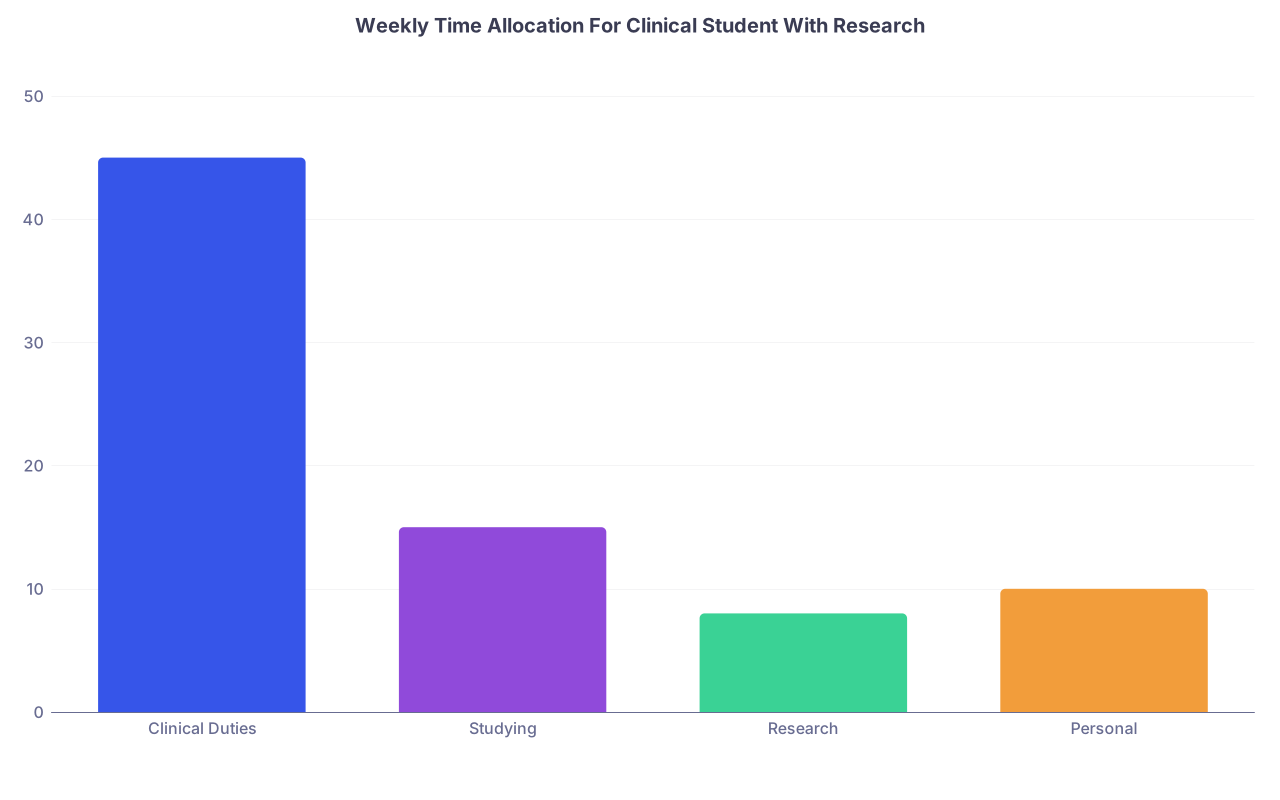
Treat research like a recurring shift, not an optional hobby.
| Category | Value |
|---|---|
| Clinical Duties | 45 |
| Studying | 15 |
| Research | 8 |
| Personal | 10 |
Practical rules that actually work:
- Cap research at 6–10 hours/week during core rotations.
- Pick 1–2 active projects at a time. Not 7.
- Have a specific “research block” (e.g., Saturday 9–1, two weeknights 7–9).
- Always know the next micro-task before you close your laptop:
- “Extract data from 10 charts”
- “Write discussion introduction”
- “Edit figures 1–2”
And don’t touch new research opportunities until you’ve moved at least one current project to the next concrete step (submission, revision, or presentation).
Step 11: Communicate Your Story Clearly In Your Application
Your school’s limitations are not the problem. Letting them define your narrative is.
When you write your personal statement or talk in interviews, your message should sound like this:
- “Our school has limited formal research infrastructure, so I took the initiative to build projects by…”
- “Because there weren’t built-in labs, I worked with clinicians to identify real clinical problems and turned them into QI and retrospective studies.”
- “I collaborated with an outside institution to participate in multi-center projects so I could see how larger research teams operate.”
What programs see in that:
- Initiative
- Resourcefulness
- Follow-through
- Ability to function without handholding
Those traits matter more to many PDs than whether you had access to a shiny lab.
Step 12: Common Mistakes Students From Low-Research Schools Make
If you avoid these, you’re already above average:
Waiting for the school to create a research program for them
- It’s not coming. Build sideways, not upward.
Saying “there was no research” in interviews
- Reads as excuse-making, not reality-based problem solving.
Hoarding projects and finishing none
- Three completed things beat eight half-baked ones every single time.
Chasing prestige journals instead of realistic targets
- You’re not Lancet’s main character right now. Get it published somewhere solid and move on.
Faking statistical or coding skills
- This backfires fast when someone asks one basic question you can’t answer.
Step 13: A Simple Action Plan For The Next 6–12 Months
Let’s translate this into an actual sequence. Assume you’re late MS2 or early MS3 with basically zero research:

| Step | Description |
|---|---|
| Step 1 | Week 1-2: Audit faculty & opportunities |
| Step 2 | Week 3-4: Send 15-20 cold emails |
| Step 3 | Month 2-3: Join 1-2 ongoing projects |
| Step 4 | Month 3-6: Generate 1 case report & 1 QI idea |
| Step 5 | Month 6-9: Submit 1 abstract & 1 manuscript |
| Step 6 | Month 9-12: Add 1 external or multi-center project |
By the end of 12 months, a realistic target CV improvement:
- 1–2 accepted or submitted manuscripts (case report, QI, review)
- 2–4 poster or oral presentations
- 1 active ongoing project with clear defined role
- A coherent story about making things happen in a low-resource setting
That puts you in a very different category than “my school didn’t have research.”
Your Next Move (Today, Not “Later”)
Open a blank document and create a simple table with three columns:
- Column 1: Potential mentor / department / outside institution
- Column 2: Type of possible project (case report, QI, review, chart review)
- Column 3: Concrete next action (email, ask on rotation, PubMed search)
Fill in at least five rows right now. Then write and send three cold emails before you close your laptop.
Not tomorrow. Today.


