

The fear that residency will wreck your relationships is not irrational. It’s logical.
You’ve seen the memes. The dark jokes. The “I lost all my friends in residency” threads. The co-resident who casually says, “Yeah, I basically didn’t see my partner for two years.” And you’re sitting there thinking: what if burnout doesn’t just make me miserable… what if it blows up everything and everyone I care about outside the hospital?
Let’s talk about that actual fear. Not the polished “work–life integration” nonsense programs put on their websites. The real, ugly what-ifs.
The Fear Underneath the Fear: “What If I Come Out Of Residency With No One Left?”
Here’s the part no one admits out loud during pre-interview dinners:
You’re not just afraid of being tired.
You’re afraid of becoming someone you don’t recognize.
Someone who:
- Snaps at their partner for asking a simple question after a 28‑hour call
- Leaves friends on “read” for weeks because the idea of talking feels like work
- Cancels on family so many times they just… stop inviting you
- Is physically there but emotionally gone, staring at a wall after shift instead of engaging
You’re scared burnout will turn you into that cold, distant resident everyone whispers about.
I’ve watched it happen. I’ve heard residents say, half-joking, “My marriage barely survived intern year,” or “I don’t even know what my friends do anymore.” They’re not exaggerating.
But here’s the part people don’t say loudly enough: the residents who kept their relationships didn’t do it by accident. It wasn’t magic. It wasn’t that their programs were “super chill.” They treated their relationships like high-risk patients: constant monitoring, early intervention, and sometimes aggressive treatment.
You can’t control everything. But you’re not powerless either.
What Burnout Actually Does To Your Relationships (And Why It Feels So Inevitable)
Burnout doesn’t just mean “tired.” It rewires how you show up with people.
Three big ways:
Emotional numbness
You spend all day seeing pain, chaos, death, fear. Your brain learns to protect you by dialing everything down. That same numbness follows you home. You sit with your partner, your sibling, your roommate…and you just feel flat. They want connection; you want silence.Energy triage
Residency forces you to ration everything: time, sleep, attention. When your battery is at 5%, even texting back “Sounds good!” feels like an exam question. So you pick the path of least resistance: you ghost, you postpone, you withdraw. It’s not that you don’t care. It’s that your brain is screaming, “Shut down or die.”Identity shrinkage
Medicine eats your identity if you let it. You stop being “the friend who loves hiking” and become “the resident who’s always on call.” When your whole sense of self is work, everything outside of work feels optional. Replaceable. Until one day you look up and realize you let people drift away.
This isn’t drama. It’s how the system is built. Residents aren’t “bad at relationships.” They’re running on fumes inside a structure that doesn’t care whether their personal life survives.
And you’re seeing that clearly, before you’ve even started. That’s not weakness. That’s early warning.
Who Actually Loses People In Residency? Patterns I Keep Seeing
Let me be blunt: people don’t lose relationships because they’re busy. They lose them because of predictable patterns that go unchallenged.
| Pattern | What It Looks Like |
|---|---|
| Silent Withdrawal | Not answering texts, “disappearing” for months |
| Defensive Exhaustion | Snapping “You don’t get it, I’m tired” to any concern |
| All-Or-Nothing Plans | Only seeing people when you have full days off |
| Guilt-Avoidance | Not reaching out because you feel bad it’s been so long |
| Secret Scorecard | Resenting friends/partner for “having it easier” |
The residents whose relationships crack often:
- Assume “the people who love me will understand” without giving them context
- Treat communication as optional instead of non-negotiable
- Wait until a partner is on the brink of leaving to take things seriously
- Believe “this is just for a few years” while acting like those years don’t matter
The ones who tend to keep people?
They’re not always happier. Many are just as burned out. But they:
- Say the quiet part out loud: “I’m scared residency will change me and us.”
- Lower the bar for connection instead of waiting for perfect free days.
- Accept that some relationships will fade—and stop chasing one-sided ones.
- Build tiny, repeatable habits that keep a pulse on important people.
Not glamorous. Not Insta-worthy. But it works more than you’d think.
Things You Can’t Control (And The Ones You Actually Can)
You can’t fix residency. You can’t fix the call schedule. You can’t fix staffing shortages, attendings who think rest is weakness, or the pager that goes off the moment you sit down to eat.
Here’s what’s mostly locked in:
- You will miss birthdays, holidays, weddings, group trips
- You will be exhausted in ways your non-med friends don’t fully understand
- You will sometimes come home with nothing left to give emotionally
- There will be days you’re a lousy partner/friend/child/sibling. Guaranteed.
But here’s the part you do have a say in:
- Whether people know what’s coming before it hits
- Whether you disappear or communicate even minimally
- Whether you treat relationships as “extras” or as core to your survival
- Whether you ask for flexibility, or just silently implode
Let me go through specific, concrete things that don’t require magical free time.
Practical Moves To Protect Your Relationships (Even When You’re Running On Empty)
1. Have The “Residency Is Going To Be Brutal” Talk Before It Starts
Uncomfortable? Yep. Necessary? Also yep.
With your partner / closest friends / family, say something like:
- “I’m honestly scared residency will swallow my life and our relationship. I don’t want that to happen, so I’d like us to talk about what ‘staying connected’ looks like on my worst weeks.”
- “I will miss things I don’t want to miss. I’m asking you not to interpret that as ‘I don’t care.’ Can we agree to tell each other when resentment starts building instead of stuffing it?”
You’re not promising perfection. You’re building realistic expectations and a plan for when (not if) things get rough.
2. Lower The Bar For What “Staying In Touch” Means
If you think “good friend/partner” = long dinners, weekend trips, deep conversations every few days, you’ll feel like you’re failing constantly.
On a 80-hour week, success might look like:
- A 30-second daily voice note to your partner
- A dumb meme in the group chat once every few days
- A “thinking of you, will call when I’m off nights” text to your parents
- A 10-minute walk-and-talk between hospital and parking lot
Is that the same as pre-med school life? No.
Is it “enough” to keep the thread alive? Often, yes.
You’re not trying to be “good.”
You’re trying to keep relationships out of cardiac arrest.
3. Build Tiny Structures So Your Brain Doesn’t Have To Remember
Burnout destroys executive function. You forget, you procrastinate, you vanish—not because you don’t care, but because your brain is fried.
So stop relying on memory.
Use stupid-simple systems:
- Calendar reminders: “Text partner after rounds,” “Call Mom Sunday 4pm,” “FaceTime best friend every other Thursday.”
- Pre-saved text templates in your notes app for brutal days:
- “On call and dead. I care about you, but I have no energy to talk. Will reach out on my next day off.”
- “Nights this week. If I ghost, it’s not you.”
- Shared calendars with your partner so they know your rotation blocks
This looks robotic. It’s actually the opposite. It’s designing your life so your caring self shows up even when your tired self wants to disappear.
4. Choose Which Relationships You’re Actually Going To Fight For
This part hurts.
You can’t maintain everyone at the level you had in college or pre-clinicals. Some friendships will naturally downgrade from “inner circle” to “people I care about but can’t invest in regularly.”
That doesn’t mean you’re a bad friend. It means you’re out of bandwidth.
So be intentional:
Pick your core 3–5 people. The ones you’d genuinely feel gutted to lose.
Decide: “These are the relationships I will protect even when I’m drowning.”
That might be:
- A partner
- 1–2 very close friends
- A parent/sibling
- Maybe a mentor or therapist
Prioritize them. Everyone else? You still show up when you can, but you don’t torture yourself for failing to maintain pre-residency levels of contact.
5. Stop Hiding How Bad It Feels (The Right Way To Vent)
Here’s where lots of residents mess up.
They come home, dump every horrible detail of their day, and their partner/family ends up:
- Overwhelmed
- Scared
- Feeling like the hospital is the enemy that “stole” you
Then you feel guilty for sharing, so you shut down entirely. Now you’re alone with it.
Better approach:
Ask first.
“Do you have space for a 5-minute vent, or should I keep it surface-level tonight?”
And give them options:
- “I need to rant and not have you fix anything.”
- “I genuinely want your advice.”
- “I don’t have words; can we just sit and watch something dumb?”
You’re protecting them and you from secondary burnout.
6. Put Actual Guardrails Around Work Intrusion (Where You Can)
No, you can’t stop pages. You can’t stop your attending from emailing at 10 pm.
You can do small things like:
- Airplane mode or Do Not Disturb for the first 30 minutes after you get home.
- Physically putting your work bag in another room when you’re “off.”
- Deciding with your partner: “No talking about work for the first 15 minutes, just reconnect as humans.”
On days off, you might commit to:
- One half-day truly unplugged (no charting, no emails, no “just catching up”)
- One micro-ritual with someone important: breakfast date, phone call, walk
Not perfect boundaries. But not zero.
The Dark Possibility: What If A Relationship Does Break?
This is the nightmare scenario looping in your head, right?
“I’ll be so burned out and absent that they’ll eventually leave, and it’ll be my fault because I chose this path.”
Sometimes, honestly, residency does expose fault lines that were already there:
- A partner who wants constant reassurance can’t handle the distance
- Friends who only see you as “the always-available one” drift when you’re not
- Family who never respected your career choice weaponize your absence
Does that mean burnout “destroyed” the relationship? Sometimes.
Sometimes it just accelerated a truth: they wanted a version of you that can’t exist in residency.
If something breaks, it will hurt. Deeply. It will confirm every fear you have about medicine taking too much.
But it will not mean:
- You’re fundamentally unlovable as a doctor
- You’ll never have stable relationships again
- You made the wrong career choice by default
I’ve seen people lose a relationship in PGY-2 and build a healthier one in PGY-4, once they knew what they needed, what they could give, and what non-negotiables they had about support and understanding.
Losing someone during residency is a trauma. It is not a prophecy.
You’re Allowed To Build A Life Now, Not “After Training”
There’s this toxic fantasy in medicine: “Once I’m done with residency/fellowship/early attending years, then I’ll have time for people.”
That’s how you wake up at 35 with money, a title, and no one you feel close to.
You can’t hit pause on relationships for 3–7 years and expect them to pick up where you left off. That’s not how humans work.
So yes, you’re tired. You’re going to be busier than anyone else you know. Your capacity will shrink.
But whatever capacity you do have? You have to spend it on something other than just survival.
Tiny things count:
- Sending a 10-second video to a friend
- Scheduling a “no cancel unless you’re literally on fire” breakfast with your partner once a month
- Letting your parents watch your life through photos, stories, call snippets
You’re not choosing between being a good doctor and a real person. You’re choosing whether you’ll accept the lie that you can just put your life on hold until training ends.
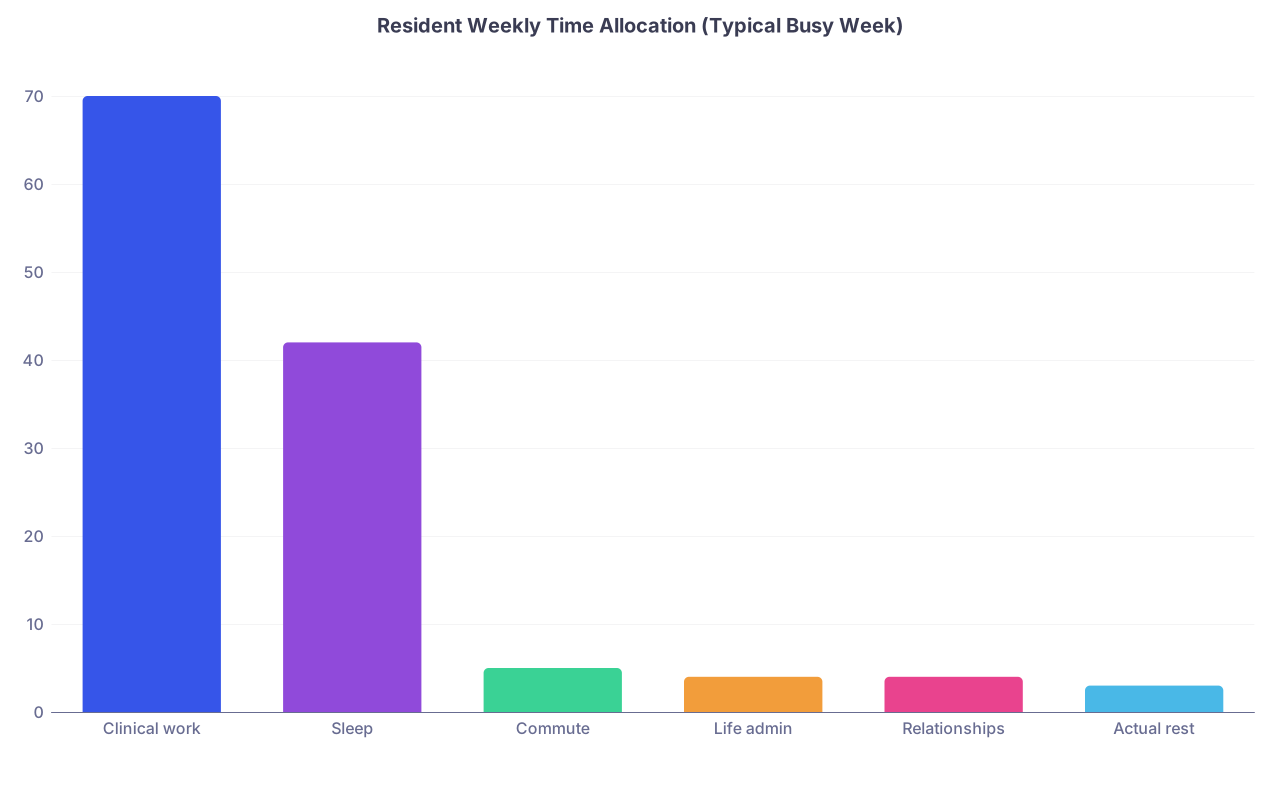
| Category | Value |
|---|---|
| Clinical work | 70 |
| Sleep | 42 |
| Commute | 5 |
| Life admin | 4 |
| Relationships | 4 |
| Actual rest | 3 |
Look at that breakdown. You’re not crazy to feel panicked. There’s almost nothing left. That’s exactly why you have to be deliberate with the tiny sliver labeled “relationships” instead of assuming they’ll maintain themselves.

| Step | Description |
|---|---|
| Step 1 | Residency Starts |
| Step 2 | Increased Hours and Fatigue |
| Step 3 | Expectations Reset |
| Step 4 | Silent Resentment |
| Step 5 | Relationships Strained but Stable |
| Step 6 | Gradual Distance |
| Step 7 | Relationship Break or Disconnection |
| Step 8 | Communicate Early? |
| Step 9 | Micro Habits Built? |
| Step 10 | Address Distance? |
You’re standing at the very top of that chart, at A. You’re already thinking about this. That alone moves you closer to D and G than you think.
FAQ – And Yes, These Are The Actual Questions Keeping You Up
1. What if my non-med friends/partner just never really “get it”?
They won’t. Not fully. And expecting perfect understanding is a trap. The goal is not “they feel exactly what I feel,” it’s “they believe me when I say it’s hard and they don’t use my exhaustion against me.” You can help by telling stories, not just complaining: “Today I had six very sick patients and ate once at 4pm. That’s the kind of day where I might sound short, even though I care about you.” If someone consistently dismisses that, that’s a compatibility problem, not a residency problem.
2. Is it selfish to focus on my career this much and ask people to ‘wait it out’?
It’s selfish and necessary and temporary. You’re entering a brutal training period where the time demands are non-negotiable. Pretending otherwise is dishonest. But there’s a difference between “please understand I can’t be as present” and “I’m entitled to your patience no matter how I act.” You’re allowed to prioritize training. You’re not entitled to people putting up with neglect forever. That’s why small, consistent efforts matter so much.
3. What if I already know I shut down under stress—am I doomed?
No. But you are at higher risk of isolating without noticing. So you need external structures: a therapist, a partner who can say, “You’re withdrawing; we need to talk,” calendar reminders to check in with people, pre-planned low-effort connections (like recurring calls). Also, tell your core people upfront: “My default under stress is to disappear. If you see that, please poke me. I’m giving you permission now.”
4. How do I tell someone I love that I’m scared residency might change how I feel about them?
You say the scary thing out loud. Something like: “I’m afraid that being constantly exhausted and stressed might make me feel distant, not just from you but from everything. I don’t want that, but I’ve seen it happen. Can we agree that if I start seeming checked out, we treat that as something we work on together, not as proof that I stopped caring?” It’s vulnerable. And yes, some people will flinch. But the ones who lean in? Those are the ones you build a life with.
Remember:
- Your fear that burnout will damage your relationships is valid, not dramatic.
- You can’t fix residency, but you can choose tiny, concrete ways to keep people close.
- The goal isn’t to avoid all strain—just to avoid silent drift into permanent disconnection.


