

Last month, I watched a resident on nights stand at the Pyxis with her badge in her hand and tears in her eyes. She whispered to no one in particular, “I think I hate this. I think I hate medicine.” Then she wiped her face, grabbed the meds, and went back into the call room like nothing happened.
That sentence has been echoing in my brain ever since. Because honestly? I’m terrified I’ll end up there too.
The Fear No One Likes To Say Out Loud
I’m scared that residency will break me.
Not “tire me out for a bit” break me. I mean shatter-my-identity, make-me-regret-the-last-decade-of-my-life break me. I’m scared I’ll wake up one day halfway through PGY-2 and realize I don’t just feel burned out — I actually hate medicine.
And if that happens, then what?
Here’s the loop that plays in my head:
- I work this hard to get into residency.
- Residency is brutally exhausting.
- I lose myself in the grind and become miserable.
- I start resenting patients, attendings, even the sound of a pager.
- And then the real horror: what if the hate doesn’t go away? What if it sticks?
Because medicine isn’t just a job. It’s the thing we’ve wrapped our entire identity around since undergrad. It’s the justification for missed birthdays, student debt, and years of uncertainty. So the idea that burnout could make me hate the very thing I sacrificed everything for? That’s the nightmare.
Let me say the piece most people dance around: yes, residency can make you feel like you hate medicine. That feeling is real. I’ve seen it. I’ve heard it directly from residents at 3 a.m. in quiet hallways.
But here’s the twist no one includes in the horror story: that “I hate medicine” feeling is often a symptom of something else. Not proof that you chose the wrong life, but proof that the environment is grinding you down past your limits.
And those are not the same thing.
Is It Burnout… Or Do I Actually Hate Medicine?
This is the part that keeps me up at night. How do you even tell the difference?
Because what if I convince myself “It’s just burnout” when actually I just don’t like being a doctor?
This is how I’ve started to sort it out in my head.
When it’s burnout, people often say variations of:
- “I still care about my patients, but I have nothing left to give.”
- “I used to love this. I don’t even recognize myself right now.”
- “If I could just sleep / get a break / not be constantly behind, I might actually enjoy this again.”
When it’s more of a deep-life-misalignment, it sounds more like:
- “I never actually liked this; I just liked being good at school.”
- “If I magically had no loans and could quit today, I’d walk and never look back.”
- “I don’t want a different version of medicine. I want out of medicine, period.”
The problem is residency muddies everything. Lack of sleep, constant pressure, subtle (and not-so-subtle) shaming, endless EMR clicks — it’s like trying to figure out if you like running while you’re sprinting uphill in the rain wearing ankle weights.
Honestly? I don’t think residency is a fair test of whether you “truly” like medicine.
But I do think there are clues. For example:
| Signal | Points More Toward |
|---|---|
| You miss who you *were* before training | Burnout |
| You resent the *system* more than patients | Burnout |
| You’ve *never* felt joy in clinical work | Misalignment |
| You fantasize about a different *kind* of medical career | Burnout |
| Your dream life contains zero medicine in any form | Misalignment |
None of this is a perfect algorithm. But it at least stops my brain from jumping straight to: “If I’m miserable, that means I hate medicine forever and my whole life is a mistake.”
The Worst-Case Scenario Spiral (And What Actually Happens)
My brain likes worst-case scenarios, so here’s the story it tells:
- I start residency and get crushed.
- I burn out so hard that I emotionally detach.
- The detachment turns into disgust.
- I decide: I hate medicine.
- I can’t leave because of loans, time already invested, and fear.
- So I stay. Miserable. For decades.
This is the version that makes my chest tight at 2 a.m.
But when I actually look at what happens to real people, the outcomes look more like this:
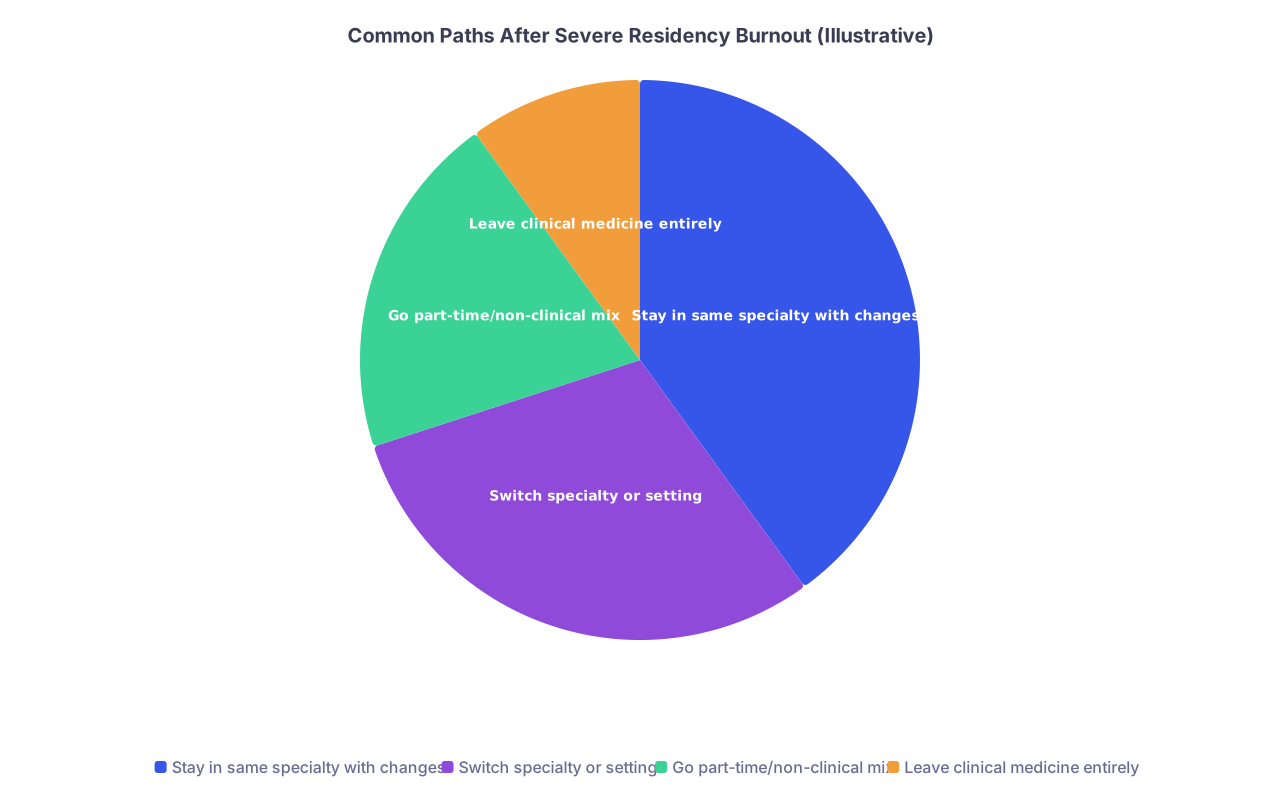
| Category | Value |
|---|---|
| Stay in same specialty with changes | 40 |
| Switch specialty or setting | 30 |
| Go part-time/non-clinical mix | 20 |
| Leave clinical medicine entirely | 10 |
Again, that’s illustrative, not hard data — but it mirrors what I keep hearing from residents and attendings:
- Some stay in their field but change hospitals, shifts, or scope. And suddenly don’t hate their lives.
- Some switch specialties (surgery to anesthesia, IM to derm, EM to outpatient primary care, etc.).
- Some go into hybrid roles — part clinical, part admin/teaching/industry.
- A smaller group leaves clinical medicine, but even they don’t all “hate medicine.” They hate doing it the way the system demands.
So that doomsday version where you burn out, hate medicine, and are trapped forever? It’s not the only path. Not even the most common.
Is it possible to get stuck? Yes. People do. Especially when shame and money and fear keep them frozen.
But there are more exits and side doors in this maze than we’re told as students.
What If I Start Hating Medicine During Residency?
This is the specific fear: not some vague future. The moment you wake up and think, “I hate this. I hate all of it.”
Here’s what I’ve seen people do that actually helps, vs what just prolongs the misery.
1. They admit it to one safe person
Not to their PD on day one. Not to a random attending who calls them “soft.” Just one person who won’t judge them for saying, “I think I hate this.”
Sometimes it’s:
- A co-resident on the same rotation who’s clearly struggling too.
- A therapist (yes, many programs have confidential counseling; yes, people actually use it).
- A friend outside medicine who doesn’t romanticize this career.
The point isn’t to fix it overnight. It’s to stop carrying the “I hate medicine” thought like it’s a dirty secret that proves you’re unfit.
2. They separate “medicine” from “this particular garbage setup”
I’ve heard versions of:
“I love talking to patients. I hate clicking orders until midnight.”
“I like procedures. I hate documentation audits and RVUs.”
“I enjoy thinking through complex diagnoses. I hate getting scolded over throughput.”
If what you actually hate is:
- Unsafe staffing
- Toxic call schedules
- Attendings who humiliate instead of teach
- Endless bureaucratic nonsense
…that’s not “I hate medicine.” That’s “this system is abusive.” And abusive systems make people feel like they hate things they actually care about.
3. They run tiny experiments, not life-destroying decisions
The residents who eventually feel better don’t start with: “I’m quitting and going to law school next week.”
They start smaller:
- Requesting certain rotations or avoiding the ones that consistently wreck them (if possible).
- Asking for a mentor outside their program or specialty.
- Trying a research project, teaching role, QI committee, or wellness committee to see if another angle on medicine feels different.
- Taking their one golden day off and doing something non-medical on purpose, just to see how that feels.
Those tiny experiments are how people realize:
“Oh. I don’t hate medicine as much as I hate 28-hour calls with no food.”
Does Burnout Actually Make People Hate Medicine Long-Term?
Here’s where my brain is brutal: “What if the burnout rewires my brain? What if once I associate medicine with suffering, the love never comes back?”
Here’s the uncomfortable but honest answer:
For some people, yes — the association sticks. They never want to come back to full-time clinical work. They do something else and don’t look back.
But for a huge number of people, the exact opposite happens:
- They leave a toxic environment, and suddenly their mood, empathy, and interest come back.
- They cut down from 1.2 FTE to 0.8, and suddenly they can breathe — and like their job again.
- They switch from malignant inpatient hellscape to outpatient or a different hospital and think, “Oh, there you are — the version of me who actually likes medicine.”
Not everyone recovers in the same way. But the pattern I see most is this:
Your relationship with medicine is flexible. Not fixed.
Burnout doesn’t mean you ruined it forever. It does mean your brain is trying to protect you from an environment that feels like a prolonged threat. Sometimes that protection sounds like apathy. Sometimes it sounds like “I hate this.”
The feeling is real. But it’s not always the final verdict.
What Can I Do Now, Before Residency, To Protect Myself?
I wish someone had been brutally honest about this stuff way earlier. Not just, “Do self-care.” That’s useless when you’re drowning.
Here’s what I’m trying to do now, as a terrified future resident, to at least lessen the odds of full-on “I hate medicine” burnout:
Get specific about what I actually like in medicine.
Not vague “helping people” nonsense. I write down:- I like complex problem-solving.
- I like longitudinal relationships more than quick one-and-done encounters.
- I hate being screamed at in chaotic environments (so maybe EM isn’t for me).
That list becomes a compass later when I’m tempted to stay in a setting that erodes everything I value.
Ask residents the real questions, not the brochure ones.
Not: “Do you like your program?”
More like:- “How often do you go home on time?”
- “When you’re struggling, who actually has your back?”
- “Have you ever thought about quitting? What stopped you?”
Normalize the idea that leaving or pivoting is not ultimate failure.
I remind myself, repeatedly, that:- Changing specialties is a thing people do.
- Moving to another hospital is a thing people do.
- Going part-time, doing telemed, non-clinical roles, industry, public health — all real paths.
It doesn’t erase the fear. But it does loosen that trapped feeling.
Plan for future me like I know she’ll hit a wall.
Because she will. Everyone does.That looks like:
- Saving as much as possible during any slightly better-paid phases to give future me options.
- Keeping a list of “people I can be ugly-honest with” in my phone.
- Writing myself a note now about why I wanted this, so if everything goes dark, I have something to revisit that isn’t filtered through exhaustion.
A Quiet Truth: You’re Allowed To Change Your Mind
The thing no one wants to admit out loud: you’re allowed to get into medicine and decide it’s not what you want for your whole life.
You’re allowed to:
- Love medicine as a concept but hate being on the front lines.
- Realize you like the science more than the patient care.
- Decide your mental health, family, or sanity matter more than staying in a role that’s killing you.
That doesn’t make you weak. It makes you human in a system that often runs on inhuman expectations.
At the same time, you’re also allowed to:
- Go through a horrifying burnout phase…
- Say “I hate medicine” a hundred times in your head…
- And then later, in a healthier environment with more support, remember that you actually do care — and find your way back.
Both stories exist. I’ve seen both.
So if you take nothing else from this: feeling like you hate medicine at some point does not automatically mean you picked the wrong life. It often means the current version of this life is unsustainable.

| Step | Description |
|---|---|
| Step 1 | Residency |
| Step 2 | Continue in current path |
| Step 3 | Question career |
| Step 4 | Change job or setting |
| Step 5 | Explore new roles |
| Step 6 | Improved relationship with work |
| Step 7 | Non clinical or new specialty |
| Step 8 | Stay in medicine in new form |
| Step 9 | Severe burnout? |
| Step 10 | Hate medicine or system? |
FAQ: The Questions That Keep Me Up At Night
1. What if I invest all this time and money and then realize in residency that I truly hate medicine?
This is the nuclear fear. If that happens, you still have options. People transition to non-clinical roles (industry, consulting, informatics, public health, medical writing), often leveraging their MD/DO even without finishing residency. Is it simple? No. Are there financial and emotional consequences? Yes. But you are not shackled to 30 years of misery. There are people who’ve walked away or pivoted and are okay — even relieved. The sunk cost is real, but it doesn’t mean you’re required to keep paying with your mental health.
2. How do I know if I’m just tired vs truly burned out and starting to hate medicine?
Exhaustion alone isn’t the whole story. Burnout usually shows up as a combo of three things: emotional exhaustion, depersonalization (“I don’t care, everyone is annoying”), and a sense of reduced accomplishment (“nothing I do matters, and I’m bad at this”). If you start dreading every shift, feeling numb or hostile toward patients, and losing any sense of purpose or pride — that’s more than “a rough week.” At that point, you need actual intervention: schedule changes if possible, therapy, time off, and honest conversations. Waiting for it to magically improve while doing the exact same thing rarely works.
3. What if I don’t feel “called” to medicine anymore — is that a sign I chose wrong?
The “calling” narrative is overrated and, honestly, kind of harmful. Passion naturally fluctuates, especially under chronic stress. You may not wake up every day thinking, “I’m so honored to serve.” Sometimes you just show up and do your job. Losing the romanticized feeling doesn’t automatically mean you chose wrong. The real question is: in a reasonable, humane setup, can you see yourself feeling okay — not ecstatic, just okay — doing this most days? If the answer is a hard no even when you imagine better conditions, that’s when it’s worth thinking about deeper misalignment.
4. Can changing specialties actually fix the “I hate medicine” feeling, or is that just denial?
I’ve watched people go from “I hate medicine” in one specialty to “This is sustainable” in another. Surgery to anesthesia. EM to outpatient FM. IM inpatient to palliative or hospice. Sometimes they didn’t hate medicine; they hated their fit in that version of medicine. Is switching specialties a magic bullet? No. Every field has tradeoffs. But it’s absolutely not denial to consider whether your temperament, values, and energy match the path you’re on. Staying in a specialty that’s slowly killing you out of pride is not more noble than changing course.
5. What’s one concrete thing I can do now to protect myself from future burnout making me hate medicine?
Make a brutally honest, private document (literally a note in your phone) with three sections:
- “Things I love or am curious about in medicine”
- “Things I strongly dislike and want to limit if possible”
- “Non-negotiables for my mental health and life outside work”
Keep it. Revisit it once a year. When you’re choosing a specialty, a job, or even a rotation, check against that list. It won’t prevent every bad situation — this system is still rough — but it gives future you a written record from a clearer head, so you’re not making huge life decisions only from a place of exhaustion and despair.
Open a blank note right now and start that three-section list. Don’t overthink it. Just write whatever comes out. Future you, somewhere in a hospital hallway at 3 a.m., might really need to hear from the version of you who’s not underwater yet.


