

What actually happens to your eval when you tell your attending, “I can’t pick up that shift”?
Let me give you the bottom line first: yes, you can say no to extra shifts without tanking your evaluation — if you do it strategically, selectively, and like a professional instead of a martyr or a flake.
Residents get trapped here all the time. You’re exhausted, you’re already at 78–80 hours, someone asks you to “help out” one more night, and in your head you’re thinking:
- If I say yes, I may actually make a serious mistake.
- If I say no, I might be labeled “not a team player.”
Here’s how to walk that line without setting yourself on fire or sabotaging your eval.
How Attendings Actually Think About Extra Shifts
Most attendings are not keeping a spreadsheet of “extra shifts picked up.” They’re watching patterns and attitude.
I’ve seen written evals that literally say things like:
- “Always willing to help, but knows limits.”
- “Frequently declines additional coverage; occasionally appears disengaged.”
- “Team player, picked up multiple extra calls on tough blocks.”
They’re looking at three things:
- Reliability – Do you show up for what you’re scheduled for, on time, prepared?
- Professionalism – When you say no, is it thoughtful and honest, or abrupt and inflexible?
- Pattern – Are you the person who sometimes says no for good reasons, or always finds a reason not to help?
If you say no occasionally, with a clear rationale and good communication, most reasonable attendings won’t penalize you. They may not even remember the “no.” What they do remember is the resident who vanishes when anything gets hard.
When Saying No Is Absolutely Appropriate (And Smart)
There are situations where saying no is not only OK; it’s the correct professional move.
Here are scenarios where you should feel comfortable drawing a line.
- You’re at or over work-hour limits
If taking an extra shift will clearly violate duty hour rules (80-hour average over 4 weeks, inadequate time off, etc.), you have both an ethical and regulatory reason to say no.
Sample language:
“I’d like to help, but this would push my work hours over the 80-hour limit for this week. I’m already tracking around 78. I don’t think I can safely take more right now.”
- You’re not safe — fatigue, illness, impairment
If you’re so tired you’re missing basic orders, have been sick with a fever, or you’re emotionally at the end of your rope, adding an extra 12 hours is not heroic. It’s dangerous.
“I’m honestly not in a safe place to work an additional shift. I’m already worried about my performance on my current schedule.”
- You have required educational commitments
Mandatory clinic, conferences you’re being evaluated on, a critical procedure opportunity that’s part of your milestones. You don’t skip those for extra service unless program leadership explicitly approves.
“I’m scheduled for my continuity clinic/required procedure session that day. I can’t miss that without clearing it with the program.”
- Family emergency or serious personal situation
You don’t need to disclose every detail, but a real crisis is a real reason.
“I have a significant family situation that I’m already coordinating coverage around. I’m not able to add extra shifts right now.”
If you’re saying no mostly in these categories, your evaluations are not the problem. If anything, you’re showing judgment.
When Saying No Will Start to Hurt You
Now the other side. I’ve watched residents quietly dig themselves into a hole because of how and when they refused extra work.
Patterns that will eventually show up on evaluations:
- Automatic no to everything
If every extra call, every request to stay late, every weekend trade is met with a reflexive “I can’t,” expect the words “not a team player,” “rigid,” or “limited flexibility” to appear in written feedback.
- Saying no but then your co-resident clearly suffers
If you say no to helping with a cross-cover shift and your co-intern ends up covering 3 services alone, people notice. They may not call you out to your face. They will mention it in your eval.
- You’re visibly clock-watching
If your pattern is: sign-out aggressively at 4:59 pm, never stay a minute late, never help with a sick admission as the clock hits “end of shift,” and you also refuse extra shifts — that combination reads as minimal effort.
- You say no for vague or weak reasons
“I just have a lot going on,” “I’m trying to protect my wellness,” “I’m really trying to keep weekends free” — those might be emotionally true, but professionally, they sound soft if repeated often.
Again: it’s about pattern. One “no” is nothing. Ten “no’s” with visible ripple effects will show up on your evaluation under Professionalism and Teamwork.
How to Say No Without Being Labeled “Difficult”
The wording matters. A lot. Here’s how to decline like an adult your seniors want to work with again.
1. Acknowledge the need
Show you understand the situation is hard, not just your schedule.
“I know the service is really stretched this month…”
2. State your limit clearly and briefly
You don’t need your life story. One or two lines that anchor your no in safety, duty hours, or a real constraint.
“…I’m already at 79 hours this week and have a 24-hour call tomorrow.”
“…I’ve had two 24s in 3 days and I’m honestly not safe to add more right now.”
3. Offer some alternative help if you reasonably can
You’re not obligated to, but it softens the no.
“I can’t take an entire shift, but I could help for the first 4 hours to get new admissions stabilized.”
“I can’t cover that night, but I’m willing to swap to help next weekend if someone needs it.”
4. Close it professionally
“If there’s another way I can help that doesn’t push duty hours, let me know.”
Put that together:
“I know nights are really short-staffed this week. I’m already at 79 hours and on a 24 tomorrow, so I can’t safely take a full extra night without violating duty hours. I could help for the first few hours of the evening if that’s useful, but I can’t do the whole shift. Let me know if there’s another way I can support the team.”
That kind of “no” virtually never triggers a negative eval comment in a sane program.

| Step | Description |
|---|---|
| Step 1 | Asked to work extra shift |
| Step 2 | Say no with clear reason |
| Step 3 | Consider saying no this time |
| Step 4 | Consider saying yes |
| Step 5 | Safe and within duty hours |
| Step 6 | Personal capacity ok |
| Step 7 | Pattern of saying yes |
Strategic Rules of Thumb: When to Say Yes vs No
You do not need to become the “yes to everything” resident. That’s how people end up crying in stairwells and making dangerous mistakes. What you need is a strategy.
Here’s a simple framework:
Protect your baselines first
- Sleep: if you’re routinely under 5 hours between shifts, extra work is a bad idea.
- Duty hours: don’t casually “fudge” these. ACGME violations aren’t a badge of honor.
- Core rotations/education: continuity clinic, essential OR days, mandatory didactics.
Say yes selectively when:
- You’re on a lighter rotation and genuinely have capacity.
- You haven’t helped much lately and this is a big need (sick call, surge).
- It gives you something you actually want: procedures, autonomy, goodwill with a program director who notices who steps up.
Say no (or partial yes) when:
- You’re on a malignant rotation already at 80 hours.
- You’re emotionally or physically on the edge.
- The request is chronic (every week) rather than rare.
Think of it like a budget. You have limited “extra shift” capital. Spend it in ways that actually matter — not just because someone can’t plan a schedule.
| Situation | Saying No Impact |
|---|---|
| Over 80 hours last 2 weeks | Reasonable, usually neutral |
| On elective, < 60 hours, stable team | Risky if pattern is frequent |
| True illness or major fatigue | Reasonable, safety-focused |
| Co-resident repeatedly covers for you | Risky, seen as unfair |
| Rare sick-call request | Risky to refuse without cause |
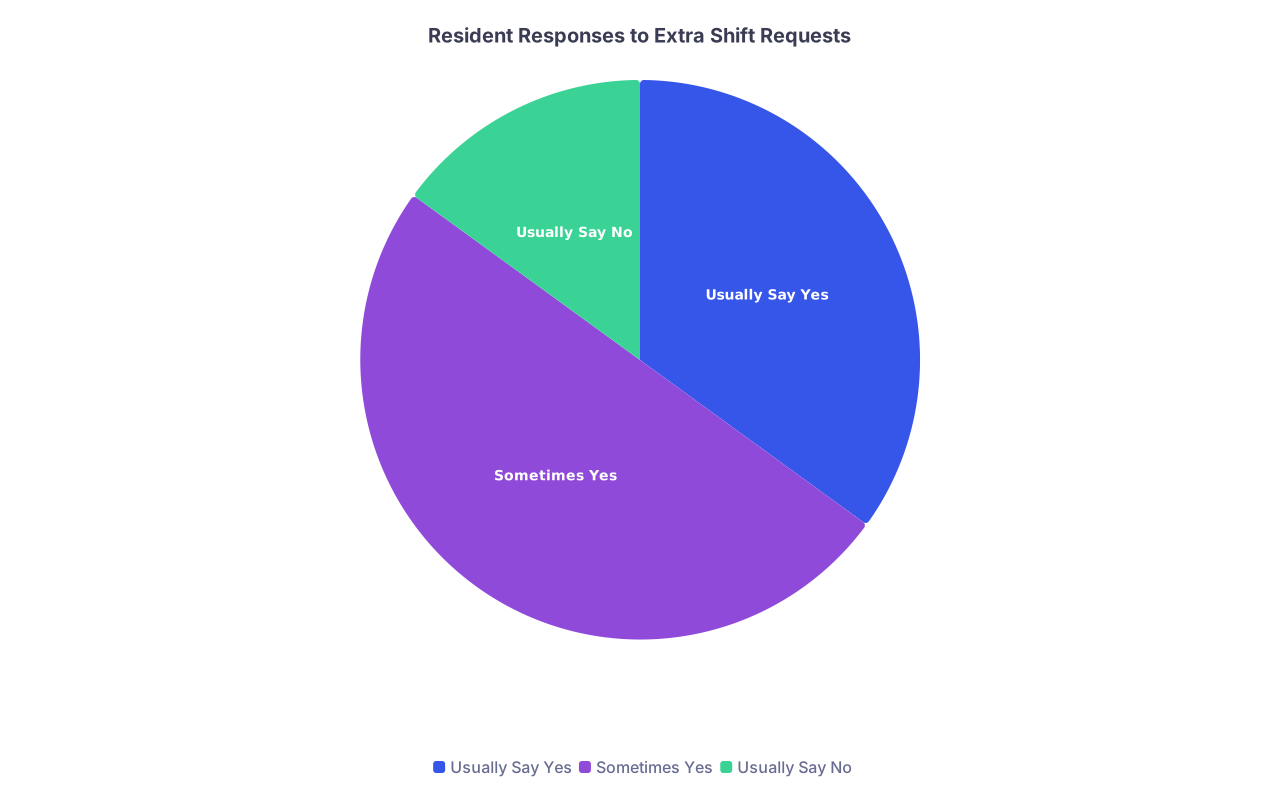
| Category | Value |
|---|---|
| Usually Say Yes | 35 |
| Sometimes Yes | 50 |
| Usually Say No | 15 |
How This Shows Up on Your Evaluation Form
Look at a typical residency evaluation. You’ll see sections like:
- Professionalism
- Interpersonal and Communication Skills
- Systems-based Practice / Teamwork
- Reliability / Initiative
Your extra shift behavior bleeds into those.
Positive comments tend to look like:
- “Steps up during busy times, reliable and willing to help.”
- “Shows good insight into personal limits; declines extra work when unsafe.”
- “Team player, picked up an extra weekend night during surge.”
Negative comments I’ve actually seen:
- “Frequently unavailable when service is short-staffed.”
- “Rigid about schedule; does not consistently assist when team is overwhelmed.”
- “Seems more focused on leaving on time than patient care or team needs.”
Notice: none of these mention one specific “no.” They’re about your pattern and perceived attitude.
So your job is to:
- Avoid a pattern that looks like you’re never available.
- Make your reasons clear when you do say no, so it reads as thoughtful judgment, not apathy.
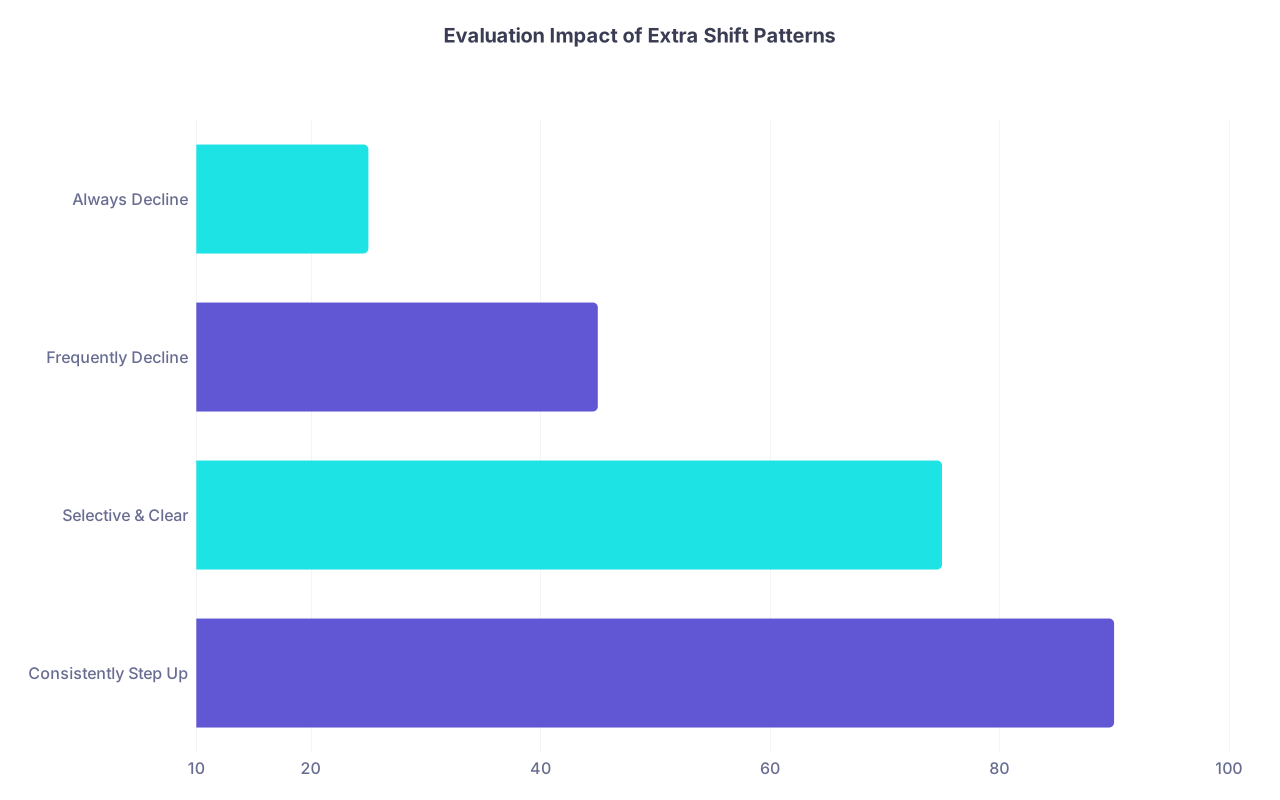
| Category | Value |
|---|---|
| Consistently Step Up | 90 |
| Selective & Clear | 75 |
| Frequently Decline | 45 |
| Always Decline | 25 |
How to Pre-empt Problems With Your Program Leadership
If you’re chronically at the limit or anticipate you can’t take any extra coverage for a while, get in front of it. Don’t just keep saying no in the dark.
You can say to your chief or PD:
“I’m finding that I’m consistently at 80 hours on this block, and I’ve had to say no to a couple of extra shift requests. I wanted you to be aware I’m not trying to avoid work; I’m honestly just maxed out and trying to be safe and within duty hours.”
This does two things:
- Signals honesty and insight.
- Gives them a chance to adjust schedules or expectations.
Residents who quietly drown and then suddenly blow up (“This place is abusive, I’ve been working 95 hours!”) often get labeled as “unprofessional” partly because they never raised a clear signal earlier.
You don’t need to be dramatic. Calm, factual, and early beats explosive and late.

Handling Malignant or Guilt-Trip Culture
Some programs — let’s be blunt — have a toxic attitude toward boundaries. Comments like:
- “In my day we did 120 hours; you’ll be fine.”
- “Everyone is tired; we still show up.”
- “If you can’t hack an extra 12, maybe this specialty isn’t for you.”
Here’s how to survive that without wrecking yourself:
Stick to objective reasons
- “This will break duty hours.”
- “I’m currently too fatigued to be safe.”
- “I’m under active care for [briefly named condition] and have been advised not to extend shifts beyond my current schedule.”
Document repeat pressure to violate rules
- Quietly keep a log: dates, hours, who asked, your response.
- If things go south, you have specific data, not vibes.
Find your sane attendings / chiefs
- There are usually 1–2 people in every program who actually get it. Run your wording by them. Ask for backup on particularly unreasonable requests.
And remember: an attending who punishes you for not breaking duty hours or working unsafely is in the wrong. Full stop. That’s not “tough training.” That’s bad medicine.

Quick Scripts You Can Actually Use
Here are ready-made phrases for common scenarios.
You’re near duty-hour limits:
“I checked my hours, and I’m already at 78 for this week. Taking that extra shift will push me over the 80-hour limit. I can help for a few hours early in the shift if that’s useful, but I can’t take the entire block.”
You’re too fatigued to be safe:
“I’m concerned I’m not safe to work another 12 hours. I’ve had three very long days in a row and I’m already seeing it affect my performance. I don’t think it’s responsible for me to pick up this shift.”
You want to help but not take the whole thing:
“I can’t cover the entire night, but I could come in from 5–9 pm to help with admits and get people tucked in. Would that still be helpful?”
You’re protecting a key personal/medical commitment (without oversharing):
“I have a non-flexible personal medical commitment that day and won’t be able to work an additional shift. I’ve made sure my scheduled duties are covered, but I can’t add more that day.”
Use them as templates. Change the words to sound like you, but keep the structure: acknowledge → reason → boundary → optional small offer.

Key Takeaways
- You can say no to extra shifts without trashing your evaluation — if your reasons are safety-, duty-hour-, or education-based and you communicate clearly.
- What hurts you is not an occasional “no,” but a consistent pattern of refusing to help with no clear rationale while your co-residents visibly carry the load.
- Treat extra shifts like a limited resource: protect your baseline, say yes selectively, and when you say no, do it like a professional, not like a ghost.
FAQ (Exactly 7 Questions)
1. Will saying no to an extra shift automatically show up as “not a team player” on my eval?
No. One or a few well-explained refusals will not usually hurt you. Evaluations focus on patterns. If you reliably show up for scheduled work, help during busy times, and occasionally say no for good reasons, most faculty see that as good judgment, not selfishness.
2. Should I ever lie and say I’m sick just to avoid an extra shift?
Do not. Faking illness damages trust and can backfire badly if discovered. It’s better to be honest: “I’m too fatigued to be safe,” or “I’m already at duty-hour limits,” than to fabricate a medical excuse. Once you’re labeled dishonest, that follows you.
3. How often is it “safe” to say no before it starts to affect how people see me?
There isn’t a magic number. Generally, if you usually help when the team is truly in trouble, and you only say no when you’re maxed out or unsafe, you’re fine. If co-residents start complaining that you never help or always find a reason to avoid extra work, then expect it to show up indirectly in evaluations.
4. What if my co-residents keep picking up extra shifts and I feel pressured to match them?
You’re not obligated to match the most masochistic person in your class. Some people choose to work more; some have fewer outside responsibilities. Focus on being reliable, safe, and reasonably helpful. If the comparison is bothering you, talk to a chief or trusted attending rather than silently overscheduling yourself.
5. Can I refuse extra shifts during a research or elective block without looking lazy?
Yes, especially if you’re actually doing research or academic work. But if your elective is light, you’re rarely around, and you still refuse all extra help, that can look bad. A compromise is to pick up an occasional shift on an elective month — not because you “owe” it, but to build goodwill and experience.
6. What if a senior pushes me to violate duty hours and says “we just won’t report it”?
That’s a red flag. You should decline and anchor your refusal in policy and safety: “I’m not comfortable violating duty hours or underreporting them. I’m already near the cap.” If this keeps happening, quietly document it and bring it to a chief or PD. ACGME rules exist for a reason, and ignoring them can put your program at risk.
7. How do I handle it when I've already said no a few times and now feel guilty about saying no again?
Guilt is common, but it’s not a safe scheduling tool. Look at the facts: your hours, your fatigue, your other obligations. If you’re still at your limit, you can say: “I know I’ve had to say no a few times lately; I’m genuinely at capacity right now. I don’t want to commit to something I can’t do safely.” If things feel chronic, bring it up with leadership so you’re not dealing with this alone.


