

The residency system was not built for introverts. It was built for coverage.
If you’re an introvert dreading constant call, handoffs, and being “on” with the team all day, you’re not fragile. You’re outnumbered. And if you try to power through residency using the same social energy rules as your extroverted co-residents, you’ll burn out fast.
Let’s talk about how to survive this without becoming the bitter R3 who hides in the call room and snaps at nurses.
Step 1: Be Honest About What’s Actually Draining You
Do not start with “I hate people.” That’s lazy self-diagnosis.
Introverted residents usually get drained by specific patterns, not by human beings existing. Figure out your particular mix:
Common introvert drains in residency:
- Back-to-back social encounters with no reset (prerounds → work rounds → family meetings → sign-out)
- Constant interruptions: “Can I just ask you a quick question?” every three minutes
- Feeling watched: attending on your shoulder all day, group pre-rounds, bedside presentations
- Unstructured team time: hanging in the workroom making small talk, forced lunches, “team bonding”
- Call shifts with no mental privacy: crowded call room, cross-cover phone ringing nonstop, residents chatting loudly at 2 a.m.
- Being put on the spot: pimping, presentations, family questions when you just walked in the room
You need to know which pieces hit you hardest so you can be strategic instead of just “tired all the time.”
Quick self-check:
- You feel more exhausted after “easy” social days than after hard but focused clinical days.
- You fantasize about call shifts where you’re the only one on instead of being paired with a chatty co-resident.
- Rounds drain you more than procedures or notes.
- The worst part of clinic day is not patients. It’s precepting room small talk and constant check-ins.
If most of that sounds familiar, you don’t need a personality change. You need a plan.
Step 2: Rebuild Your Energy Budget Around Reality, Not Fantasy
Your life is currently structured around:
- Required team time
- Required call
- Required presence in shared spaces
You’re not opting out of that. What you can do is stop pretending your recovery needs are optional.
Think of your energy like work-hour rules. There are hard caps. If you break them for 3–4 days in a row, you pay.
Build a Weekly Energy Map
Do this once, on paper or in a notes app.
Look at your next 7 days. Mark:
- Call nights
- Long days (q4 call, night float, 12+ hr ED shifts)
- Conference-heavy days
- Clinic days (if they feel more or less draining)
Label each day:
- Red = guaranteed high social drain (rounds + call, rounds + meetings, ED + sign-out chaos)
- Yellow = moderate (rounds only, clinic only)
- Green = lighter social load (shorter days, post-call, consult rotations with roaming time)
For each red day, pre-plan:
- One protected decompression block (15–30 min, solo, no work chat)
- One “bare minimum social” decision (where you won’t use extra social energy trying to be charming)
This isn’t about becoming antisocial. It’s choosing where you’ll not expend extra energy.
Step 3: Control the Controllables in Call and Team Time
You can’t cancel call. You can absolutely design how you move through it.
On Call: Create Micro-Privacy
You will not get a full hour of solitude. But you can get 3–5 minute pockets that add up.
Concrete moves:
Own the physical space
On night float or 24-hour call, claim a corner:- Far end of the call room
- Empty family conference room when not in use
- Quiet alcove near radiology or the back of the ICU
Leave your stuff there. That’s your “reset station.”
Use “I need to check on a patient” to step away
When the workroom turns into social hour and your brain starts buzzing: “I’m going to check in on 15-08 and finish those notes there.”
Then actually go. Five minutes walking plus five minutes of quiet note-writing can reset you.Bound your availability without being a jerk
Example phrases:- “I’m going to step away for 10 minutes to finish this note. Page me if something urgent comes up.”
- “I can help with that in a bit, I just need to get these orders in first.”
You’re not refusing. You’re sequencing.
Scripted responses for chatty co-residents at 3 a.m.
If you’re stuck with the extrovert who wants to debrief their entire life at 2:30 a.m.:- “Hey, I really like talking with you, but if I don’t close my eyes for 20 minutes I’m going to be useless at 5. Can we pause?”
It feels blunt. It’s still polite. And easier than slow-burning resentment.
- “Hey, I really like talking with you, but if I don’t close my eyes for 20 minutes I’m going to be useless at 5. Can we pause?”
During Team Time: Shape Your Role
Most teams naturally assign roles:
- The talker / storyteller
- The logistics person
- The human checklist
- The explainer/educator
As an introvert, you’re usually better off leaning into roles that don’t require constant social output.
Options that work well:
The data hawk
You’re the one who always has the up-to-date vitals, meds, and labs.- Before rounds: quickly scan vitals, I/Os, labs.
- On rounds: speak when there’s something factual and useful to add.
You’re participating without having to narrate feelings all the time.
The anticipator
You quietly think 2–3 steps ahead.- “He’s on day 5 of ceftriaxone, we probably need to think about narrowing today.”
- “If this K is real and not hemolyzed, we’ll need to repeat and start treatment.”
The closer during family meetings
You’re not the big talker. You’re the person who summarizes next steps clearly at the end:- “To recap what we’re doing today…”
That’s one focused contribution, not a full social performance.
- “To recap what we’re doing today…”
You don’t need to force yourself into being “the social glue” of the team. Pick one lane where you add clear value and stick to it.
Step 4: Protect Solo Time Without Looking Like a Ghost
Here’s the tension: you need alone time, but you also don’t want to be the “weird antisocial resident.”
You can manage both with predictable patterns. People tolerate what they expect.
Establish a Consistent “Disappear and Return” Rhythm
Example pattern on a medicine ward day:
- 6:00–7:00 – Preround, write quick notes, mostly solo
- 7:00–9:30 – Work rounds with team
- 9:30–10:00 – “I’m going to put in orders and finish my notes in the ICU workroom, page me if you need me.”
- 10:00–noon – Follow-ups, pages, check-ins. Present to attending as needed.
- Noon–12:30 – Conference
- 12:30–12:50 – Solo lunch in quiet space or walk outside
- 12:50–5:00 – Afternoon tasks, touch base with team, discharge prep
From the outside, you’re not vanishing randomly. You’re rotating between team presence and focused solo work.
Key phrases that make this socially acceptable:
- “I concentrate better if I put in orders in a quieter spot—page me if something comes up.”
- “I’m going to grab 10 minutes to eat and then I’ll circle back about dispo plans.”
- “I’ll work on those discharges from the computer bank on 7. I’ll come find you when they’re ready.”
You’re telling people:
- Where you’re going
- That they can contact you
- When you’ll reappear
That’s the difference between “quietly responsible” and “MIA.”
Step 5: Use Structure to Replace Constant Ad-Lib Socializing
Introverts usually dislike unstructured team time more than structured interactions. You might be totally fine in a 30-minute family meeting where your role is clear, but wiped out by an aimless 30-minute hang in the workroom.
So you turn unstructured into structured.
During Downtime on Call
Let’s say it’s 11 p.m., and things are semi-quiet. You have two residents in the call room, both half-chatting, half-scrolling.
Options that won’t label you “rude”:
Suggest a time-bound activity:
- “I’m going to do 30 minutes of board questions and then try to nap. Anyone want to join for questions?”
After 30 minutes: headphones in, eyes closed. The social part had a clear start and end.
- “I’m going to do 30 minutes of board questions and then try to nap. Anyone want to join for questions?”
Propose a group break:
- “I’m going to walk down to the cafeteria and grab something. Anyone need anything?”
You’re social on the walk. Then you can pull back after.
- “I’m going to walk down to the cafeteria and grab something. Anyone need anything?”
With the Day Team
When your team tries to morph into a full-time social club:
Join for part of lunch, then peel off:
- “I’ll come sit for 10–15, then I need to return a couple calls and finish notes.”
Ten minutes of small talk is survivable. Sixty might not be.
- “I’ll come sit for 10–15, then I need to return a couple calls and finish notes.”
Show up to the big social stuff occasionally and on your own terms:
- Show face at a team happy hour for 45 minutes, then go home.
- Say, “I’m not staying late but wanted to stop by and say hi.”
That counters the “they never come to anything” narrative.
You’re not required to be everyone’s best friend. Show up enough that people know you like them. Then leave before your social battery hits zero.
Step 6: Train People How to Work With You (Without Saying “I’m an Introvert”)
You actually can tell people, “I’m pretty introverted, so I sometimes step away to recharge.” Plenty of residents do. But if that feels too vulnerable, you can do the stealth version.
Set Communication Preferences Early
With co-residents, interns, and even your attending:
- “I’m on top of my pages; text is usually the fastest way to get me if I step away from the workroom.”
- “When I’m not in the room I’m usually just somewhere quieter putting orders in. Always fine to page if you need something.”
- “I tend to focus better when I’m working solo for a bit, but I’ll check in with you every couple hours.”
This says: I’m not disappearing. I’m just not glued to the workroom chairs.
With Nurses and Consultants
Nurses hate residents who vanish and don’t answer pages. That’s not introversion, that’s unreliability. Do not be that person.
Balance it this way:
- Always answer pages promptly, even if it’s:
- “Got it, I’ll be there in 5–10 minutes.”
- Occasionally stop by the unit once or twice a day just to say:
- “Anything you’re worried about on our patients right now?”
That two-minute check-in buys you a huge amount of goodwill when you’re not always physically around.
- “Anything you’re worried about on our patients right now?”
Consultants:
- Be clear and concise on the phone.
- When they see you in person, one or two sentences of normal human interaction is enough:
“Thanks for seeing him. Let me know if you need anything from our side.”
You don’t have to sell your personality. Just avoid the stone-faced monosyllabic wall.
Step 7: Manage Pimping, Rounds, and “Being On” Without Melting
A lot of introverts don’t mind knowledge. They mind being put on public display every five minutes.
You can’t kill pimping, but you can lower the temperature.
Before Rounds
Look at each patient and ask yourself:
- What is the one thing the attending is likely to push on? (antibiotic choice, ICU transfer, discharge criteria)
Have one sentence prepared. Just one.
- What is the one thing the attending is likely to push on? (antibiotic choice, ICU transfer, discharge criteria)
Write 1–2 tiny bullets in your note you can glance at:
- “DC likely tomorrow if afebrile, stable on RA.”
- “Broad abx narrowed after cultures negative.”
When you have that sentence ready, being called on feels less like a surprise attack.
During Rounds
If you know the answer but hate blurting it out:
- Wait a beat, then speak in a complete sentence:
- “I think we’re treating MSSA, so cefazolin would be reasonable.”
That’s better than one-word responses and puts you in control of your tone.
- “I think we’re treating MSSA, so cefazolin would be reasonable.”
- Wait a beat, then speak in a complete sentence:
If your mind goes blank:
- “I’m not sure off the top of my head—I’d like to look that up after rounds.”
This is a perfectly adult response. You do not have to perform instant encyclopedic recall.
- “I’m not sure off the top of my head—I’d like to look that up after rounds.”
After Rounds
Introverts often do their best thinking after the pressure is gone.
Use that:
- Jot down 1–2 things that came up that you want to read for 5–10 mins later.
- Do the reading.
- Next day, you’re the one who can say, “I looked that up yesterday; here’s what I found.”
Now you look engaged and thoughtful, not quiet and checked-out.
Step 8: Design Recovery That Actually Works (Not Just Scrolling)
This is where a lot of introverts shoot themselves in the foot. You drag yourself home after a brutal call, collapse onto the couch, and scroll Instagram/TikTok/Reddit for three hours.
That is not recovery. That’s sedation.
You need deliberate recovery: activities that give you back a sense of autonomy and quiet.
For introverted residents, the most reliable options are:
- Solo physical movement: short runs, walks around the block, yoga, bodyweight workouts at home
- Deep single-tasking: cooking one real meal, reading 10 pages of a book, building something, cleaning one room
- Low-input entertainment: music with no lyrics, podcasts, quiet shows with no chaos
What usually doesn’t help:
- Endless group chats
- Loud bars after a 28-hour call (you know this. your co-resident may not.)
- Background TV + phone doomscrolling until 1 a.m.
Set minimums instead of ideals:
- “After call, I will shower, eat something warm, and sit in quiet for 10 minutes.”
- “On non-call nights, I will walk outside for 10 minutes before I sit on my couch.”
It sounds small. It adds up.
Step 9: Make Strategic Choices About Rotations and Scheduling
You can’t control everything, but you have more say than you think—especially after PGY-1.
General truths:
- High social drain: inpatient medicine wards, surgery services with giant teams, ED, L&D, busy ICUs, family meetings-heavy services (heme/onc, palliative)
- Lower social drain (relatively): radiology electives, pathology, consult services with lots of roaming, research blocks, clinics where you move independently between rooms
When given a choice:
- Space out your most draining, high-call months. Do not stack ICU → wards → ED → nights if you can help it.
- Place a quieter elective after your worst block. Not before.
- For continuity clinic, if they ask about schedule preferences, pick sessions that don’t follow your most intense call nights when possible.
Example block planning logic:
- If PGY-2 schedule asks for your input:
- Don’t do “July: wards, August: ICU, September: nights” unless you want to watch your soul leave your body.
- Better: “July: wards, August: consults, September: ICU, October: elective.”
Step 10: Decide What You Actually Want Long-Term
You’re not just surviving residency. You’re gathering data to build a career that doesn’t crush you.
Pay attention to:
- Which rotations set your brain on fire (in a good way) even if they’re long
- Which work patterns feel sustainable versus soul-sucking
If, as an introvert, you find:
- You love one-on-one patient work but hate giant team dynamics → outpatient-heavy specialties, small-group practices, or consult services where you roam independently might fit better.
- You enjoy procedures in a controlled setting more than rapid-fire floor decisions with 20 interruptions → procedural specialties or OR-based fields may actually be better for you than a pager-heavy floor role.
- You like thinking deeply without constant interruptions → consider academic roles, subspecialties with more clinic and planned admissions, or jobs with fewer in-house call shifts.
Residency is a lab. Not a prison. Use it.
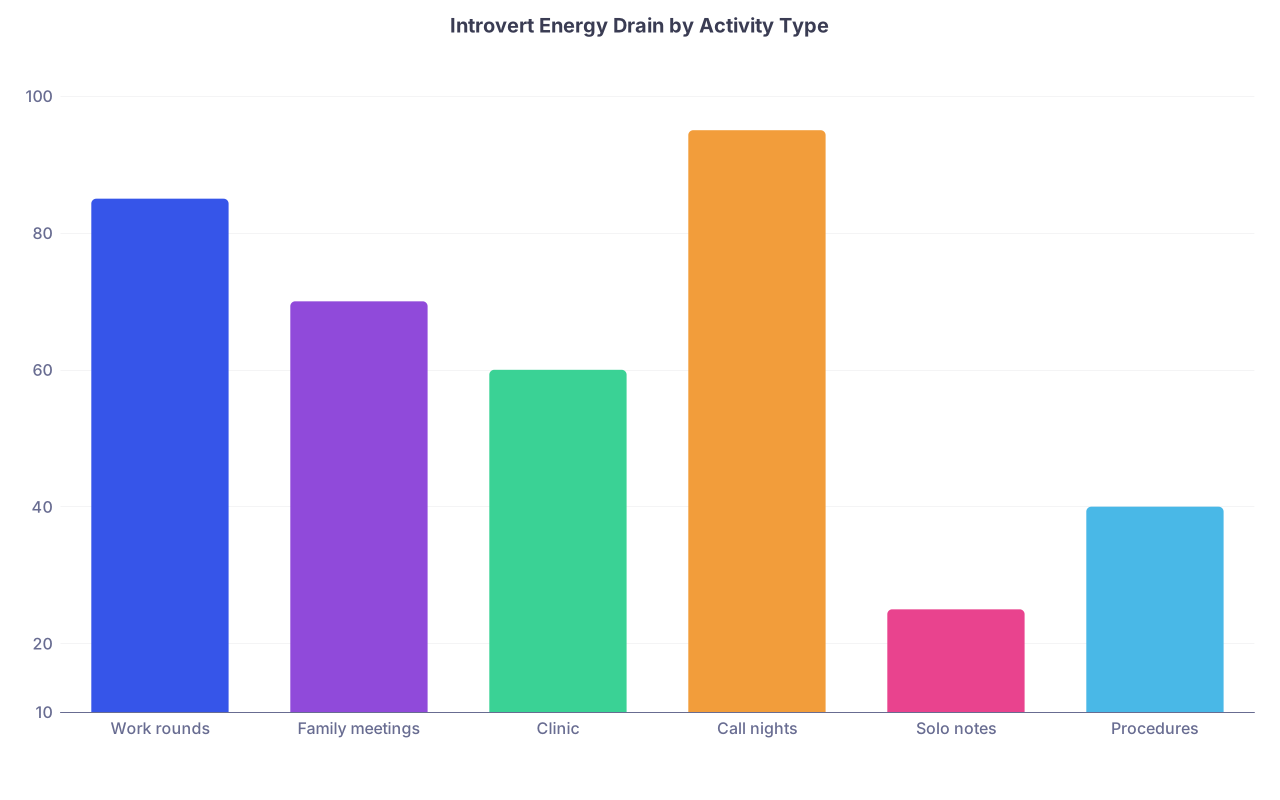
| Category | Value |
|---|---|
| Work rounds | 85 |
| Family meetings | 70 |
| Clinic | 60 |
| Call nights | 95 |
| Solo notes | 25 |
| Procedures | 40 |

| Step | Description |
|---|---|
| Step 1 | Arrive early solo prerounds |
| Step 2 | Team work rounds |
| Step 3 | Short solo orders and notes block |
| Step 4 | Follow up tasks and pages |
| Step 5 | Conference with team |
| Step 6 | Solo lunch or quiet walk |
| Step 7 | Afternoon tasks and check ins |
| Step 8 | Brief social time or sign out |
| Step 9 | Deliberate recovery at home |
The Bottom Line
If you’re an introvert in residency dreading constant call and team time, you’re not broken and you’re not doomed. You’re just running a different operating system in a hospital built for 24/7 group projects.
Three things to remember:
- Stop pretending you have infinite social energy. Build your week like an energy budget: plan micro-breaks, solo blocks, and real recovery.
- Shape your role on the team and your physical presence. Be reliable, responsive, and periodically visible—but unapologetic about stepping into quiet spaces to think and work.
- Use residency as data, not just endurance. Pay attention to what drains you and what doesn’t. Then aim your future job toward the version of medicine you can practice for 30 years, not just survive for 3.


