

The biggest lie about becoming a senior resident is that your life gets “easier.” It does not. Your workload shifts. Your hours do not.
You stop doing scut. You start carrying responsibility. And that transition blindsides a lot of people.
Below is a chronological guide to your first year stepping up from intern to senior—month by month, then zooming into critical weeks and days. At each point, I will tell you what should already be solid, what needs to change, and what traps to avoid.
Big Picture: What Actually Changes When You Become Senior
At the moment you become a senior, three things shift:
- You stop being the default “do-er” and become the “decider.”
- Your physical workload goes down; your cognitive and emotional workload goes way up.
- Your hours on paper stay almost identical. Your recovery time feels very different.
The misleading part: your schedule template might look the same.
| Role | Main Work Type | Primary Stressor |
|---|---|---|
| Intern | Task execution | Volume of pages/tasks |
| Senior | Decision + oversight | Responsibility + risk |
| Both | Same shift length | Fatigue and burnout |
Your day stops being “how do I finish this list” and becomes “how do I keep this whole system from falling apart while teaching, protecting my interns, and not missing anything dangerous.”
Three Months Before You Start Senior Year: Quiet Preparation
At this point you should be in the back half of your intern year, not yet the “official” senior, but you already know it is coming.
Month -3: Start Thinking Like a Senior
You are still an intern. But start acting like a junior senior.
At this point you should:
Shadow your current seniors’ brains, not just their orders.
- When they change the plan, ask: “What made you switch?”
- When they escalate to ICU, ask: “What were the red flags for you?”
Pre-practice triage on call.
- When multiple pages come in, mentally prioritize: “If I were the senior, I would do A, then B, then C.”
Build your “must-not-miss” mental lists:
- Chest pain → kill list: ACS, PE, dissection, tension pneumo.
- Abdominal pain → rupture, obstruction, ischemia, ectopic.
- Fever → sepsis, meningitis, neutropenic fever.
These are not academic lists. These are “I will be legally and morally responsible” lists.
Month -2: Learn to Run the List
Now you focus on flow.
At this point you should:
Ask your senior to let you run one or two morning rounds per week.
- You present plans, call on each intern, and keep things moving.
- You time yourself. Can you get through 12–18 patients efficiently?
Practice concise communication:
- 30-second updates per patient: overnight events, today’s priority, dispo plan.
- Your job as senior is to keep the team mentally oriented.
Watch how your senior handles:
- Conflicting attendings.
- Angry families.
- Weak interns or students who are drowning.
You are absorbing scripts and posture. How they sit during a family meeting. How long they pause before answering a question they do not like.
Month -1: Systems and Safety Nets
This is where you set up guardrails for your future self.
At this point you should:
Build templates:
- Admission H&P phrases.
- ICU transfer notes.
- Discharge instructions for your top 5 diagnoses.
List your personal “rules”:
- When I always call ICU.
- When I always call attending overnight.
- When I always repeat vitals, labs, or imaging.
-
- “What were the 2–3 worst nights of your first senior year, and what caused them?”
- Write these down. Then design checklists to avoid them.
Month 0: The Switch – Your First Senior Block
This month will set the tone. You cannot afford to just “figure it out as you go” here.
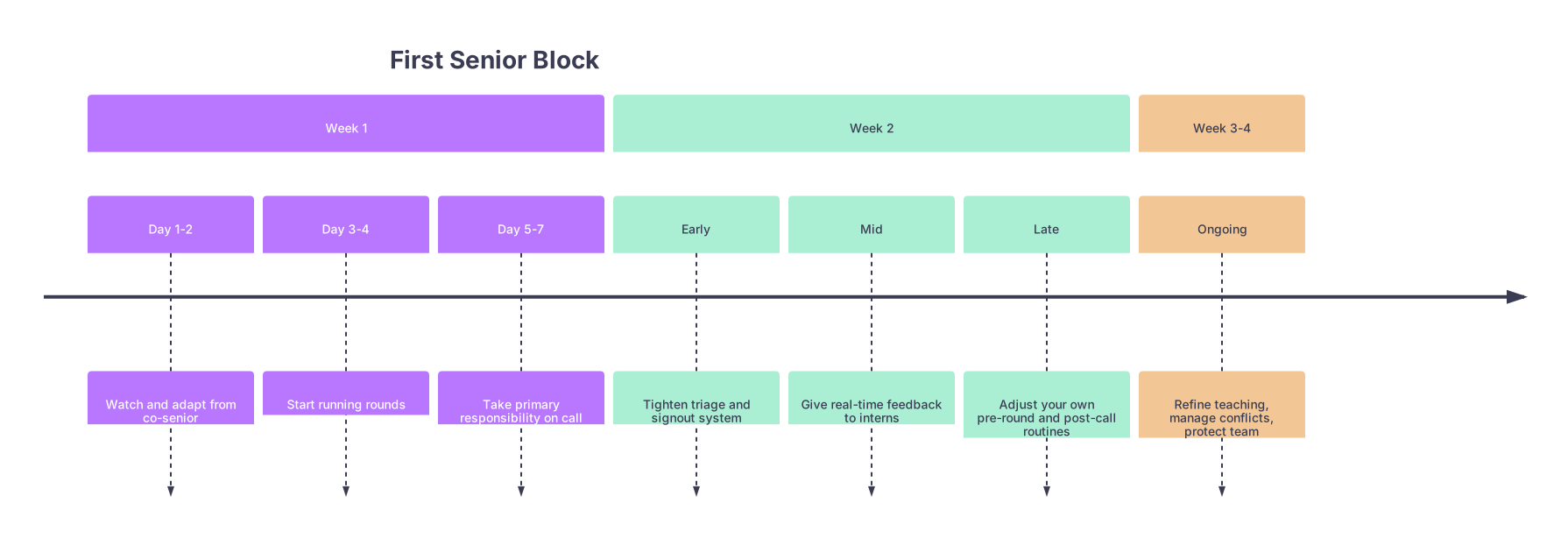
| Period | Event |
|---|---|
| Week 1 - Day 1-2 | Watch and adapt from co-senior |
| Week 1 - Day 3-4 | Start running rounds |
| Week 1 - Day 5-7 | Take primary responsibility on call |
| Week 2 - Early | Tighten triage and signout system |
| Week 2 - Mid | Give real-time feedback to interns |
| Week 2 - Late | Adjust your own pre-round and post-call routines |
| Week 3-4 - Ongoing | Refine teaching, manage conflicts, protect team |
Week 1: Controlled Chaos
At this point you should:
Take over the structure of the day immediately:
- Set exact times: pre-round start, team rounds, afternoon touch-base.
- Dictate how sign-out will work. Where, when, and in what format.
Keep clinical decisions collaborative in the first few days:
- “Let’s think through this” with your attending, not “I already decided.”
- Use your co-senior (if you have one) as a sounding board, not a crutch.
Start your “senior log”:
- Quick bullets of tough cases, mistakes, near-misses.
- You review it weekly. This is how you get better fast.
Your hours will feel longer this week even if they are the same on paper. Cognitive load does that.
Week 2: Triage and Tightening
By now, basic operations should not be a disaster. Time to refine.
At this point you should:
Lock in your triage sequence when new admissions and pages hit at the same time:
- Scan vitals and chief complaints for danger.
- Identify any “right now” problems: hypotension, AMS, respiratory distress.
- Delegate safely: who can your interns see first, what can the nurse try immediately.
Standardize sign-out:
- One consistent structure: ID / active problems / overnight watch items / task list.
- Hard stop on vague sign-outs like “kind of sick, just keep an eye.”
Start giving micro-feedback to interns:
- 60 seconds after a task or note: “Next time, lead with X. Cut Y.”
- Do not wait for formal evaluations. You do not have time for that fiction.
Week 3–4: Owning the Role
By the end of the first block, your biggest enemy is inconsistency.
At this point you should:
Have clear “non-negotiables”:
- No patient leaves without updated med list and follow-up.
- No cross-cover patient accepted without at least one clean, updated problem list.
- No intern leaving post-call with unresolved critical lab or unclear plan.
Protect your interns’ sleep and sanity, even if yours suffers slightly:
- You take the borderline admissions late at night.
- You front-load your work earlier in the day so you are not dumping late tasks on them.
Start doing real teaching:
- One 5–10 minute topic per day, anchored to an actual patient.
- Example: “You admitted a GI bleed? Quick run-through on risk scores and transfusion thresholds.”
Your hours are the same. The shift feels different because the weight is on your shoulders now, not above you.
Months 1–3 as Senior: Stabilizing While the Hours Stay Heavy
Once the novelty wears off, the grind begins. This is where many seniors burn out or harden in bad ways.
Month 1: Fix Your Daily Rhythm
At this point you should:
Have a repeatable daily schedule:
- 06:00–07:00: Pre-round chart review and triage overnight events.
- 07:00–08:00: Touch base with interns, clarify priorities.
- 08:00–11:00: Team rounds, targeted teaching.
- 11:00–14:00: Discharges and procedures.
- 14:00–17:00: New admissions, problem cases, family updates.
Set one personal non-negotiable per workday:
- One real meal.
- 5–10 minutes of quiet alone in a stairwell or call room.
- Brief movement: stairs instead of elevator for a few floors.
Sounds trivial. It is not. Those tiny anchors keep you from being reckless post-call.

Month 2: Getting Comfortable Saying “No”
Your danger now is over-accommodation. Nurses, consultants, administration, even other residents—everyone wants something.
At this point you should:
Start practicing clean boundaries:
- “We cannot safely accept another admission until we dispo two.”
- “This does not need to be done at 2 AM. We will address it in the morning.”
- “I hear you; I disagree. Here is the plan.”
Protect your team from pointless work:
- Ask: “Will this change management today?” before ordering extra tests at 4 PM.
- Push back on redundant documentation that adds zero clinical value.
Accept that some people will think you are “less nice” than you were as an intern.
That is fine. You are responsible now, not performing.
Month 3: Pattern Recognition and Anticipation
By this point, you should be seeing the same scenarios recur. Good. That is where you gain speed without cutting corners.
At this point you should:
Build standard workups and plans in your head:
- The septic patient pathway.
- The CHF exacerbation routine.
- The “confused elderly patient at night” algorithm.
Anticipate badness half a day early:
- “This patient will probably crump tonight unless we do X this afternoon.”
- “This dispo is fragile; let us fix the social or medication issues before 3 PM.”
Use your night shifts to sharpen your instincts:
- Every time you see someone in trouble overnight, ask: “What did we miss at 2 PM that could have made this less chaotic?”
Months 4–8: Teaching, Delegating, and Not Becoming Cynical
This is mid-senior-year. You are no longer new. People start looking to you as the “standard.”

Month 4–5: Level Up Your Teaching
At this point you should:
Move from “mini-lectures” to bedside coaching:
- Let interns present to patients.
- Debrief outside the room: “Try saying it this way next time.”
Tie teaching directly to survival:
- How to write a safe sign-out.
- How to quickly assess if someone is unstable without over-testing.
Use repetition:
- If you find yourself giving the same feedback three times, make it a formal teaching point for the whole team.
Month 6: Delegation Without Abandonment
Now you fight the urge to either do everything yourself or abdicate too much.
At this point you should:
Deliberately let interns struggle a bit—but not drown:
- Let them call consults themselves, then listen to how they did.
- Let them propose plans before you correct them.
Keep “ultimate tasks” for yourself:
- First critical family meeting.
- First time breaking bad news for a new intern (you lead, they watch, then they co-lead next time).
Avoid the lazy senior move:
- Hiding in the workroom while your interns run around.
If they are slammed, you are slammed. You help.
- Hiding in the workroom while your interns run around.
Month 7–8: Emotional Load Management
This is the hidden cost of being senior: you absorb everyone’s stress.
At this point you should:
Create debrief habits:
- After a code or bad outcome: 5–10 minutes with the team.
- “What went well, what would we change, what are you carrying from this?”
Watch your own warning signs:
- Short fuse with nurses.
- Rolling eyes when a patient asks a “basic” question.
- Dreading every shift, even the lighter ones.
Use your days off with intent:
- At least one day with zero medical content. No notes. No reading. No texts about cases.
The hours on the schedule have not changed. Your emotional output has.
Months 9–12: Transitioning From “Senior” to “True Upper-Level”
At this point in the year, you are no longer just surviving. Or you should not be.
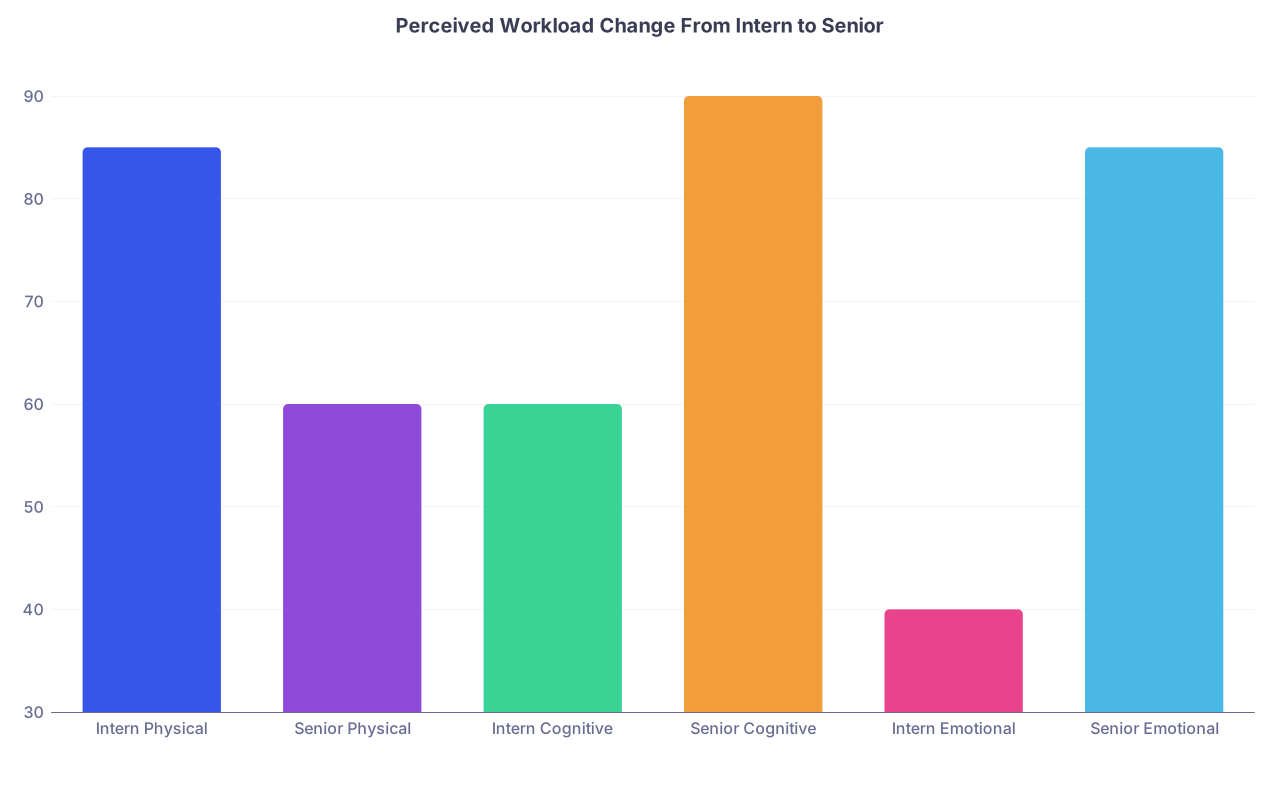
| Category | Value |
|---|---|
| Intern Physical | 85 |
| Senior Physical | 60 |
| Intern Cognitive | 60 |
| Senior Cognitive | 90 |
| Intern Emotional | 40 |
| Senior Emotional | 85 |
Month 9–10: Mentoring New Seniors
You start noticing the new seniors making the same mistakes you made.
At this point you should:
Offer specific tips, not vague encouragement:
- “For overnight triage, I batch pages every 10 minutes unless it is urgent.”
- “Make your sign-out list reflect how your brain actually thinks—sort by risk, not room number.”
Model how to handle attendings:
- When attendings are wrong or unrealistic: show how to respectfully push back.
- When attendings are great: show how to partner with them for teaching.
Month 11–12: Setting the Standard You Wish You Had
Last quarter of the year. This is your chance to define what “a good senior” means in your program.
At this point you should:
Decide on your legacy behaviors:
- Maybe it is ironclad: no one leaves post-call with unsafe work left.
- Maybe it is a culture of honest, blunt, but fair feedback.
Start helping interns and juniors think about their senior year:
- “Start paying attention now to how seniors handle conflict.”
- “Keep a list of situations that scare you. Those are what you will work on before you are in charge.”
Audit yourself:
- Ask a couple of interns for anonymous, real feedback: “What did I do that helped? What made things harder?”
- You will not love everything you hear. That is the point.
Micro-Timeline: A Typical Senior Call Night
You already know the hours. Let us break down how the work shifts inside those hours.

| Step | Description |
|---|---|
| Step 1 | Pre-call briefing |
| Step 2 | Early evening admits |
| Step 3 | Peak pages and cross cover |
| Step 4 | Night admissions and rapid responses |
| Step 5 | Pre-morning sign-out stabilization |
| Step 6 | Post-call handoff and quick debrief |
16:00–17:00 – Pre-call
At this point you should:
- Know your sickest cross-cover patients by name and room.
- Touch base with day teams: “Who are you worried about tonight, and why?”
- Set expectations with your intern(s): how pages will be split, when to wake you, how to escalate.
17:00–22:00 – Front-Loaded Chaos
At this point you should:
Aggressively stabilize known problems early:
- That borderline CHF? Diuresis and close monitoring before midnight.
- Unclear abdominal pain? At least an initial workup launched.
Triage hard:
- Sick > new > annoying.
- You will be tempted to let “annoying” stuff eat 90 minutes. Do not.
22:00–04:00 – Cognitive Fatigue Zone
At this point you should:
Slow down your thinking, not your response time:
- Double-check orders.
- Re-read allergies.
- Re-scan vitals before sending someone back to the floor.
Use structured mental checklists for rapid evals:
- Airway, breathing, circulation, mental status, basic labs if indicated.
04:00–07:00 – Pre-Morning Stabilization
At this point you should:
- Clean up active fires by 05:30–06:00 if possible.
- Start forming your narrative for sign-out:
- What changed overnight.
- Why you made each major decision.
- What needs follow-up.
You leave as tired as you did as an intern. Difference is, now if something went wrong, it was your call.
FAQ (Exactly 2 Questions)
Q1: How do I know if I am doing “enough” as a senior when the hours feel the same but the stress is higher?
You are doing enough when: your patients are safe, your interns are not chronically drowning, and you can explain every major clinical decision you made overnight. Not in perfect textbook language, but in clear reasoning. If you routinely leave with unresolved critical labs, interns in tears, or attendings confused about your plans, something needs to change. Ask for targeted feedback from someone you trust: “Am I missing anything big? What would you change about how I run the team?”
Q2: Is it normal to miss the simplicity of being an intern?
Yes. Intern year is brutal physically, but psychologically simpler. You are told what to do. As a senior, you carry risk and ambiguity all the time, and no one praises you for the disasters you prevented. Missing intern simplicity is normal; wanting to stay in that role forever is not. The goal is to grow into the discomfort—acknowledge the weight, build systems to manage it, and remember that this shift in workload, on the same hours, is exactly what turns you into a real physician rather than a task robot.
Key points:
- Your hours do not get better as a senior; only the type of work changes—from doing tasks to owning decisions.
- Prepare early, set clear systems in your first month, and relentlessly refine triage, sign-out, and teaching as the year goes on.
- Protect your team, protect your patients, and build small, consistent habits that let you survive the same hours with a heavier load.


