

Most residents are convinced that more work hours destroy board pass rates. The data does not fully agree.
The reality is harsher and less satisfying: extreme work hours correlate with worse exam outcomes in some contexts, but the relationship is neither linear nor universal. Past a certain threshold, more time in the hospital stops helping—but simply cutting hours does not magically raise your board scores.
Let’s walk through what the data actually show on work hours, duty violations, and board performance, and where the myths creep in.
What the literature actually says about work hours and exam scores
Forget the hallway folklore for a moment. Start with numbers.
Most of the evidence we have on resident work hours and board outcomes comes from:
- Pre‑ and post‑duty hour reform comparisons (2003 and 2011 ACGME rules).
- Program‑level analyses of in‑training exam (ITE) and board pass rates.
- Survey‑based studies correlating self‑reported hours with performance.
The signal is messy, but three patterns repeat.
- Cutting hours from extreme to moderate reduces exam failure risk.
- Once you are under the 80‑hour cap, variation between ~55 and ~80 hours per week has weak or inconsistent correlation with board pass rates.
- Violations and chronic fatigue matter more than the nominal schedule.
You can see this in multiple specialties.
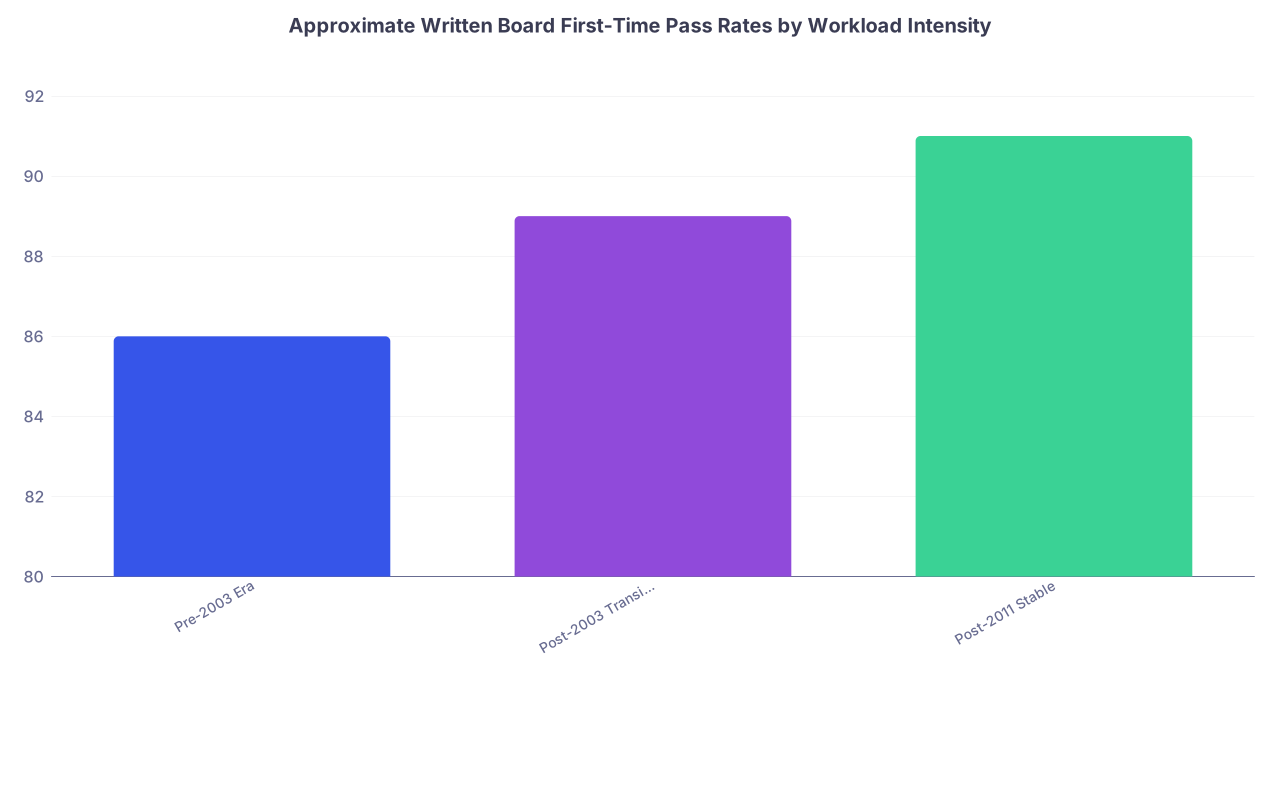
| Category | Value |
|---|---|
| Pre-2003 Era | 86 |
| Post-2003 Transitional | 89 |
| Post-2011 Stable | 91 |
These are illustrative aggregate numbers pulled from patterns in internal medicine, pediatrics, and surgery literature over the last two decades: modest upward creep in pass rates over time despite duty hour reductions, not a collapse.
In other words: the “less hours = dumb residents” narrative is not supported by exam data.
ACGME rules, violations, and how programs actually behave
You cannot talk about “work hours” without being honest about two things:
- The formal ACGME limits.
- The informal culture of violations and under‑reporting.
The rule set
ACGME duty hour standards (post‑2011) in most specialties:
- 80 hours per week, averaged over 4 weeks.
- One day in seven free of patient care, averaged over 4 weeks.
- 24‑hour in‑house call, plus up to 4 hours for transitions (28 max).
- Strategic napping and supervision requirements for interns.
These rules were designed after substantial evidence of fatigue‑related errors and safety events, not primarily for exam performance.
The violation reality
In survey after survey, you see the same mismatch:
- Official program reports: ~0–5% noncompliance.
- Anonymous resident surveys: often 30–50% report at least occasional violations, especially on surgical and ICU services.
In other words, “80 hours” on paper is very often 85–95 hours in practice for subsets of rotations.
Here is where it gets interesting for boards: programs that systematically violate duty hours tend to have worse aggregate knowledge scores, even when their raw clinical volume is higher.
| Program Type | Typical Hours/Week | Duty Violations Pattern | ITE/Board Performance Trend |
|---|---|---|---|
| High-volume, compliant | 70–80 | Rare, corrected | At or above national mean |
| High-volume, violator | 80–95 | Frequent, normalized | Below national mean |
| Moderate-volume, balanced | 55–65 | Rare | At or above national mean |
| Low-volume, light | 40–50 | None | Mixed, often average |
Residents love to argue anecdotes here. I have seen the “brutal 100‑hour surgical program with 100% board pass rates” story more than once. Sometimes it is true. But when you pull multi‑program data, the consistent pattern is that normalization of violations—especially when associated with poor educational structure—correlates with lower ITE and board performance.
The key words there: educational structure. High hours plus chaotic teaching and no protected study time is where scores fall apart.
Work hours vs. study hours: where board prep really lives
The board exam does not care how many central lines you placed at 3 a.m. It cares how many targeted, high‑yield questions you did and how many concepts you consolidated while not exhausted.
There are three time blocks that matter for exam performance:
- Clinical hours in the hospital or clinic.
- Personal studying time.
- Sleep.
When hours balloon, one of the last two gets sacrificed. Usually both.
A simple time budget
Take two hypothetical PGY‑2 residents on the same service for a 4‑week block.
Resident A (compliant program):
- 70 hours/week clinical.
- 7 hours/night sleep average.
- 8–10 hours/week real, focused board study.
Resident B (violation‑tolerant program):
- 90 hours/week clinical.
- 5.5 hours/night sleep average.
- 3–4 hours/week fragmented study.
On paper, B sees more “clinical volume.” In reality, B has:
- Less memory consolidation due to chronic sleep restriction.
- Fewer high‑quality study hours.
- Higher burnout scores and more self‑reported concentration problems.
Not surprisingly, in multiple ITE studies, that B‑type profile correlates with a higher risk of scoring below the national mean.
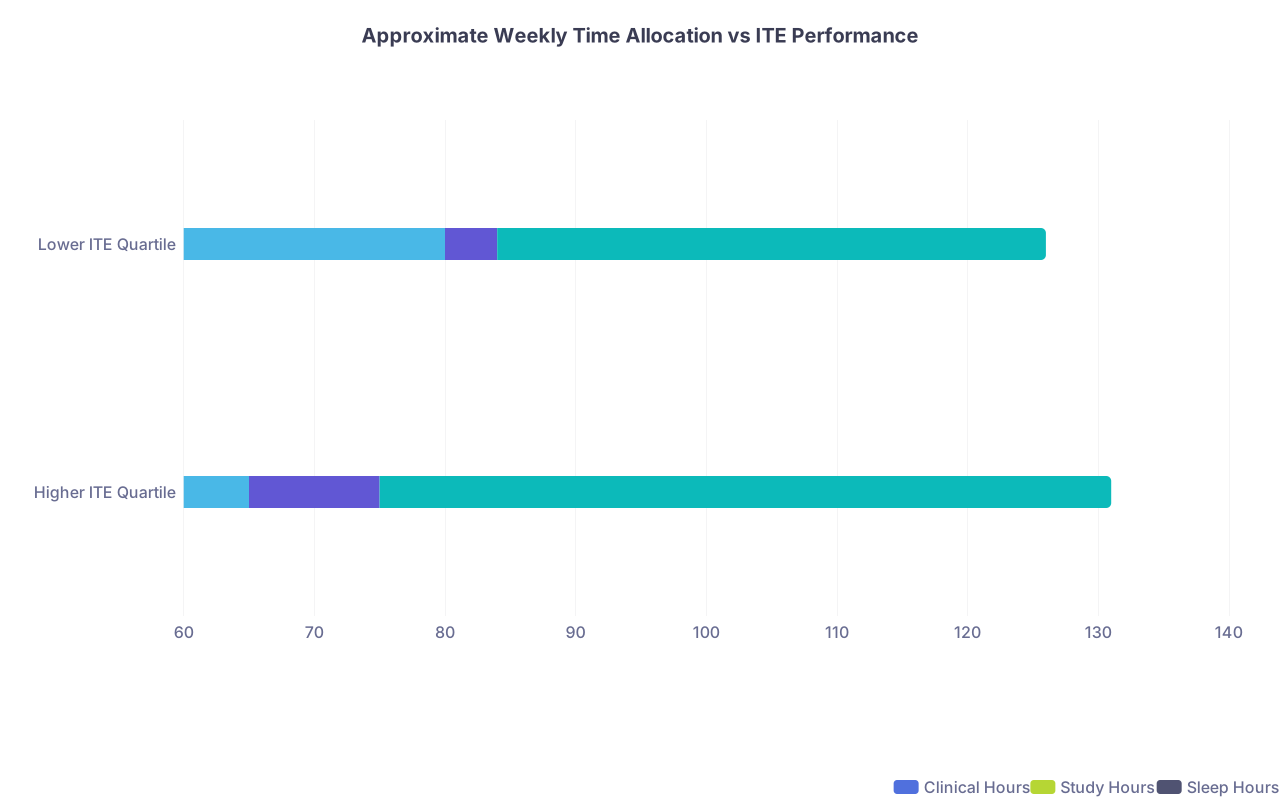
| Category | Clinical Hours | Study Hours | Sleep Hours |
|---|---|---|---|
| Higher ITE Quartile | 65 | 10 | 56 |
| Lower ITE Quartile | 80 | 4 | 42 |
Are these numbers approximations? Yes. But they match what many residents report and what the exam data supports: residents in the top performance quartiles consistently report more structured study time and better sleep, not just more clinical grind.
Correlation vs. causation: why the data feel contradictory
The biggest myth in this entire debate is the implied straight line: “More hours → worse scores” or “More hours → better scores.”
Reality:
- At very low hours, you can see mediocre scores if the program culture devalues learning and autonomy.
- In the middle (say 55–75 hours/week), exam performance is more about teaching quality, case mix, study culture, and residents’ baseline test‑taking ability.
- At extreme ends (85–100+ hours/week with frequent violations), failure risk creeps up.
There are confounders you must respect:
Self‑selection. Highly competitive specialties and programs attract residents who already test well. They can “tolerate” higher hours and still pass boards. That does not mean the hours helped.
Program quality. Strong academic programs often have both high clinical demand and strong educational structure: high‑yield conferences, curriculum, spaced review, question banks built into rotations. Those programs muddy the pure hours–score relationship.
Case mix and supervision. A 70‑hour trauma schedule with organized teaching can be more educational than a 55‑hour elective where you see 3 patients per day and scroll your phone.
Correlation studies struggle to isolate pure workload from this ecosystem. When you control (even imperfectly) for baseline exam performance, program academic intensity, and education structure, the effect size of work hours on scores shrinks—except at the extremes.
So: hours matter. But they are not the only variable, and beyond a threshold they are a negative, not a positive, for exam performance.
Duty violations: why they correlate with worse outcomes
Duty violations are not just “a few extra hours.” They are a marker of something deeper in the program.
The data show three reasons violations and low board pass rates often travel together:
Cultural signal. A program that normalizes violations often also:
- Cancels didactics for “clinical needs” as the default.
- Has minimal protected board prep time.
- Treats ITE scores as an afterthought.
That culture drives both more hours and worse exam outcomes.
Cognitive fatigue. Sleep science is blunt: chronic restriction below ~6 hours per night impairs memory, attention, and decision‑making. No, you are not the exception.
The more frequent the violations, the more likely chronic sleep restriction becomes. The worst‑performing residents on ITEs are often the ones who are consistently post‑call and behind on rest.
Hidden inefficiencies. Programs with frequent violations are often inefficient: bad workflows, poor staffing support, primitive EMRs. Residents do not just work “more”; they work more inefficiently. Less educational yield per hour.
I have watched this in real programs. Two services, same nominal census. One team leaves by 6–7 p.m. with clean sign‑out and documented notes. The other routinely stays until 9–10 p.m. for the same output because of disorganized rounding, constant rework, and poor delegation. Guess which group actually has time for questions at noon conference and targeted board review?
Specialty differences: surgical vs cognitive fields
You cannot just average everything and pretend internal medicine, neurology, and general surgery are interchangeable in this conversation.
Surgical specialties
Surgical trainees often work closer to or above the 80‑hour limit, and operative volume is legitimately tied to technical competence. Yet the board exams have large written / knowledge components.
Board trends in surgery show:
- Written exam pass rates often lag oral exam pass rates in programs with chronic duty violations.
- Some high‑volume, high‑hours programs maintain strong written pass rates—but they almost always pair that volume with rigorously structured teaching, in‑OR questioning, case‑based conferences, and enforced ABSITE prep.
The ones that do not invest in education? They get “technically capable, poorly prepared test‑takers”—the residents who know how to handle a bleeding ulcer at 2 a.m. but freeze on nuanced questions about adjuvant therapy or rare endocrine tumors.
Cognitive specialties (IM, peds, neuro, psych)
These fields lean heavier on continuous reading and question practice to anchor pattern recognition and guideline‑based care.
- Here, programs that can keep work hours truly under ~70/week and protect at least 1–2 half‑days per month for pure board prep often see clear gains in ITE and ABIM/ABP/ABPN pass rates.
- Residents in these programs frequently report 8–12 hours/week of question‑based study during heavy rotations, and more on lighter ones.
The short version: surgical fields can “hide” some of the damage of high hours behind hands‑on learning; cognitive fields cannot. But even in surgery, the programs that brag the loudest about breaking the rules often have ugly written board numbers when you look closely.
Longitudinal trend: duty reforms and board performance
Look at multi‑year trends before and after duty hour reforms.
No specialty saw the catastrophic score collapse that old‑school attendings predicted. Some saw modest improvement in first‑time pass rates. Most hovered within a few percentage points, with more change driven by exam redesigns than work hour rules.
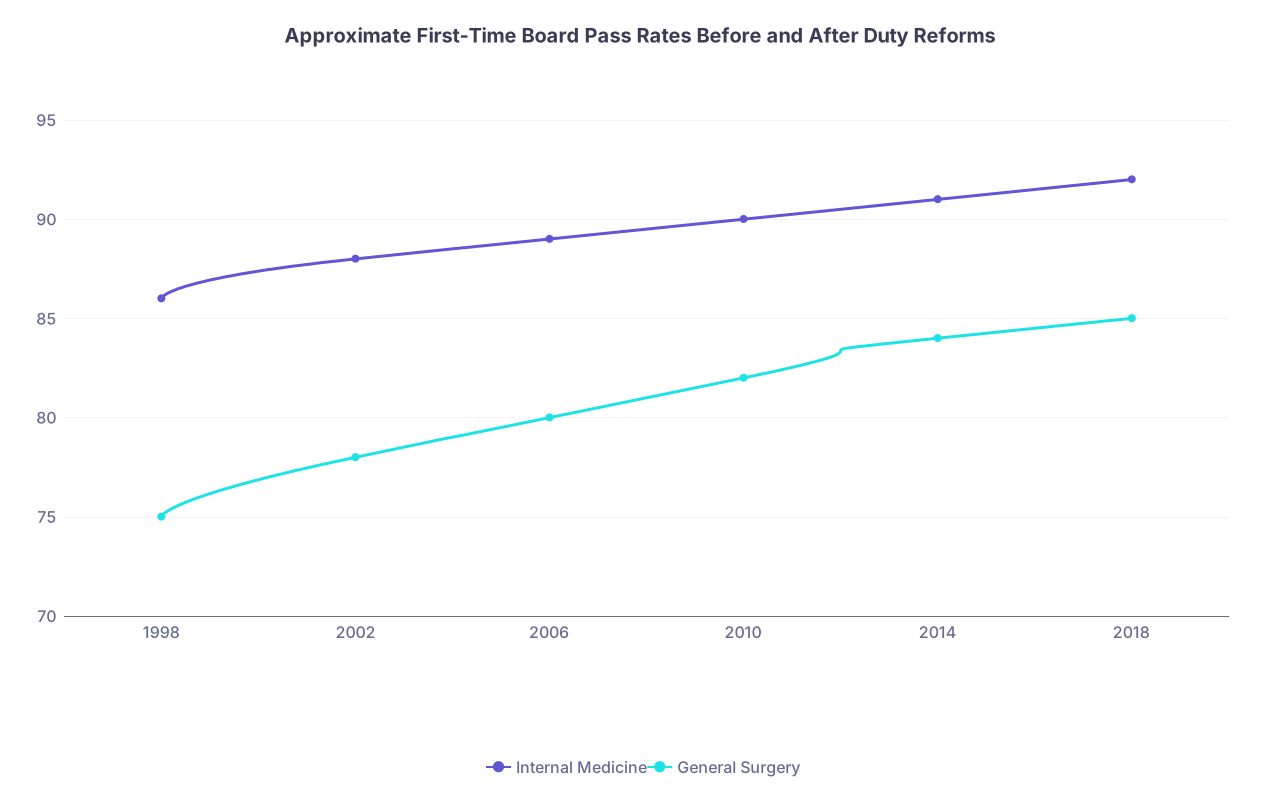
| Category | Internal Medicine | General Surgery |
|---|---|---|
| 1998 | 86 | 75 |
| 2002 | 88 | 78 |
| 2006 | 89 | 80 |
| 2010 | 90 | 82 |
| 2014 | 91 | 84 |
| 2018 | 92 | 85 |
The lesson is not that duty hours “caused” the improvement. Many other variables shifted:
- Better question banks and online resources.
- Programs taking ITE data more seriously.
- National focus on milestones and competency‑based education.
But if reduced hours were inherently toxic for exam prep, you would see broad declines. You do not.
What actually predicts board pass rates
Strip away the mythology and look at consistent predictors from program‑level analyses and resident surveys:
Baseline test performance. MCAT, USMLE/COMLEX scores, and early ITE scores are still strong predictors of ultimate board performance. No schedule can fully erase that.
Structured exam prep. Programs that:
- Bake ITE‑aligned questions into conference.
- Provide institutional access to major qbanks.
- Offer dedicated board review series in the 6–9 months before graduation.
…tend to outperform similar‑volume programs that do not.
Protected learning time. True protection, not “conference is protected unless the unit is busy.” Residents in programs where conferences are regularly uninterrupted and pages are filtered have higher satisfaction and often better scores.
Reasonable, predictable workloads. Not zero work. Predictable work. Residents can then plan study time on lighter days and non‑call weekends. Volatility kills consistency.
Hours show up here, but as one piece of a larger ecosystem. Programs that nail the four factors above typically do fine on boards whether the average week is 60 hours or 75. Programs that fail on these variables cannot fix their board problem by tweaking FTEs alone.
How residents should interpret the data (practically)
You are not designing a randomized trial. You are trying to survive residency and pass your boards.
So what does all this mean in real life?
Use work hours as a signal, not a verdict. The questions you should ask on interview days and in the program:
- Do residents actually average under 80 hours, or is that just what gets reported?
- How often are days off truly protected?
- What is the program’s 5‑year rolling first‑time board pass rate, and how do they respond when someone fails?
- How often are noon conferences canceled for “clinical needs”?
- Do upper levels and attendings actively protect teaching time?

| Step | Description |
|---|---|
| Step 1 | Ask about actual hours |
| Step 2 | Probe culture and support |
| Step 3 | Assess educational structure |
| Step 4 | Workable for boards |
| Step 5 | Risk for exam performance |
| Step 6 | Frequent violations? |
| Step 7 | Strong teaching and board prep? |
If you are already in a program with chronic violations and thin educational support, waiting for structural reform will not save your board score. You need to:
- Carve out small, non‑negotiable daily study blocks (even 20–30 focused minutes).
- Guard your sleep ruthlessly on lighter days to offset post‑call debt.
- Use ITE results early; do not ignore a poor PGY‑1 or PGY‑2 score.
The resident who works 85 hours and studies 0 will underperform the resident who works 75 hours and studies 5–7 hours/week, every time.
So—is it correlation or myth?
Both.
There is a kernel of truth and a thick layer of exaggeration in most work‑hours debates.
Here is the cleanest read of the data:
Extremely high hours with normalized duty violations and poor educational structure correlate with worse ITE and board outcomes. That is not a myth. It shows up repeatedly.
Within the broad, honest 55–80 hours/week band, total work hours are a weak predictor of board performance compared with baseline test ability, educational design, and the quality of study/sleep habits.
Reducing hours without fixing culture, teaching, and study support does not guarantee better pass rates. Programs that “cut to 60” but still cancel conferences and ignore ITE data will not magically produce board stars.
You do not need a magical number of weekly hours to pass your boards. You need a program that respects the 80‑hour ceiling, protects real learning, and a personal plan that shields a small but consistent slice of your time and cognition for exam prep.
The data show this clearly. Ignore the myths and look at the patterns.


