
Do I Have to Celebrate Match Day If I Feel Disappointed Inside?
What are you supposed to do when everyone around you is screaming, crying, and popping champagne on Match Day… and you kind of want to throw up?
Here’s the blunt answer:
No, you do not have to celebrate Match Day if you feel disappointed inside.
But you do have to survive it. And there are smarter and dumber ways to do that.
Let me walk you through the options, the psychology, and the scripts you can actually use.
1. You’re Not Crazy: Mixed Feelings on Match Day Are Normal
Match Day is sold as this perfect movie scene: envelopes, cheering, hugs, photos with your class banner. Reality is messier.
Common real reactions I’ve seen:
- “I matched, but not at my top 5. I feel like I failed.”
- “I’m happy I matched at all, but I’m embarrassed to say where.”
- “I feel nothing. Just numb and exhausted.”
- “Everyone else seems euphoric; I just want to go home.”
There are three truths you need to hold at the same time:
- Matching at all is a big deal. It means you get to be a physician.
- You’re allowed to be disappointed by the details: location, program, specialty change, rank number.
- Your feelings may not match the script everyone expects. That’s okay. Forced gratitude is not mental health.
So no, you don’t owe anyone a performance.
But you live in a real social world: classmates, family, faculty, social media. So the real question is:
How do you move through Match Day without destroying yourself or your relationships?
2. Do You Have to Celebrate Publicly? Short Answer: No.
Let’s split this into groups: school, family, and social media.
A. At your school’s ceremony
Do you have to:
- Show up?
- Open the envelope on stage?
- Take a “We Matched!” group photo?
No, you don’t have to do any of it.
But there are trade‑offs.
Here’s the clean way to think about it:
| Option | Upside | Downside |
|---|---|---|
| Full ceremony, full participation | Social support, closure | Emotional overload, faking |
| Ceremony but stay low-key | Presence, some space | Mild questions/comments |
| Skip ceremony entirely | Emotional protection | Curious peers, explanations |
If you’re deeply disappointed, I usually recommend the middle option:
- Go, but don’t put yourself front and center.
- Open your envelope privately or at your table, not on stage.
- Step out if you need a break; nobody will be tracking your every movement.
You can also tell the admin team ahead of time:
“I’ll be there, but I prefer not to be on stage or in publicity photos.” Most student affairs offices are used to this. You’re not the first.
B. With your family
This is where people get trapped. The script is:
- Parents flying in
- Dinner reservations
- Group photos
- “We’re so proud of you!” on loop
If you’re dreading performing happiness for them, set expectations early and clearly.
Sample script you can send before Match:
“I’m glad you’re excited for Match Day. I just want to be honest that whatever the outcome, I might have complicated feelings. Please don’t expect a big celebration or lots of photos from me. I may be quiet, and that doesn’t mean I’m ungrateful.”
After you match, if you’re disappointed:
“I’m thankful I matched and that I’ll be a doctor, but I’m also sad it’s not where I hoped. I need some time to process. I’d really appreciate support without pressure to be super excited right now.”
You don’t owe them a performance. You owe them honesty and basic respect. That’s it.
C. On social media
This one’s easy: you are under zero obligation to post anything on Match Day.
No story, no grid post, no “dream program” caption if that’s not true.
You can post later, when you’re ready, with a neutral tone:
“Matched into [specialty] at [program]. Grateful for the opportunity and for everyone who helped me get here.”
That’s it. No ranking. No “#1 choice” lie. No essay.
Or you choose radio silence. You’re allowed to keep parts of your life offline.
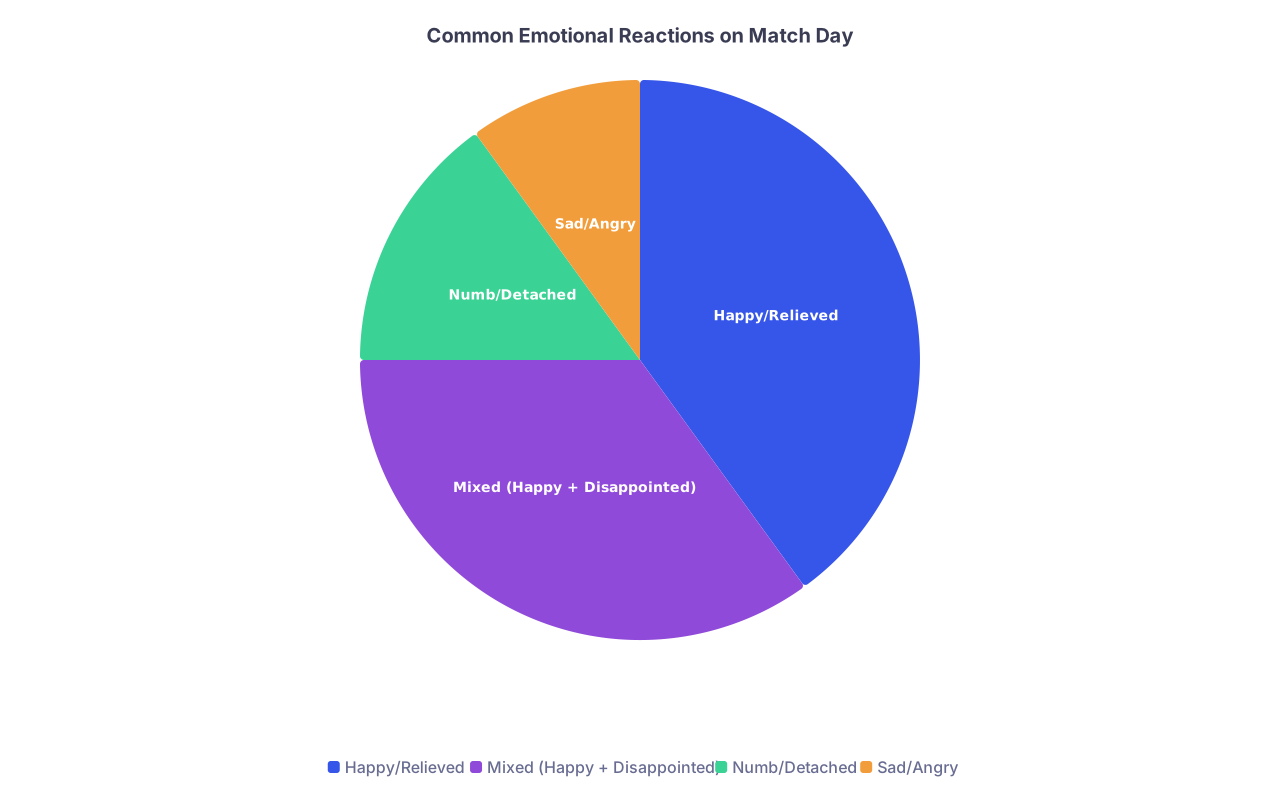
| Category | Value |
|---|---|
| Happy/Relieved | 40 |
| Mixed (Happy + Disappointed) | 35 |
| Numb/Detached | 15 |
| Sad/Angry | 10 |
3. How to Handle the “Congratulations!” When You Feel Like Crying
Here’s the practical problem: people will congratulate you. A lot. Even if you look miserable.
You need a few stock phrases ready so you don’t freeze or overshare when you’re raw.
When you’re disappointed but matched
Use language that’s honest but bounded.
To classmates:
- “Yeah, I matched. Mixed feelings, but I’m processing.”
- “I’m grateful to have a spot. It wasn’t exactly what I wanted, but I’ll make the most of it.”
- “Thanks. I’m still wrapping my head around it.”
To faculty:
- “I matched into [specialty] at [program]. I’m grateful to be training and also adjusting to the news.”
- “It wasn’t as high on my list as I’d hoped, but I’m committed to working hard there.”
To family:
- “Yes, I matched. I know that’s huge. I’m also sad it’s not where I pictured myself. I’ll need a few days.”
Notice the pattern: acknowledge, hint at complexity, set a boundary. You don’t have to unpack your soul in the middle of a banquet hall.
When someone probes too much
Some people can’t stop themselves:
- “Was it your first choice?”
- “Oh… did you want to be closer to home?”
- “What number was it on your list?”
You’re allowed to shut that down.
Responses you can use:
- “I’m trying not to focus on the list right now. I’m just adjusting to the news.”
- “I’d rather not get into the ranking details, but I appreciate you asking.”
- “Honestly, that’s a longer conversation for another day.”
Say it once, then change the subject or walk away. You’re allowed to protect yourself.

4. What If You Feel Guilty for Not Being Excited?
This is common: “Who am I to be upset when others didn’t match at all?”
Here’s the hierarchy your brain might be running:
- “I matched but not where I want”
- “Someone else didn’t match at all”
- “Therefore I have no right to be upset.”
That’s not how emotions work.
Two things can be true:
- You can feel grateful you matched.
- You can feel grief that your specific dream did not happen.
Gratitude does not erase grief. If you force that, you just add shame on top of disappointment.
What you should do:
- Acknowledge your disappointment privately. Name it clearly.
- Don’t compare your pain to others as a way to disqualify it.
- Also hold a realistic perspective: you still get to train as a physician, which is not nothing.
Your job isn’t to rank whose feelings are “allowed.”
Your job is to process your own without dumping them on classmates who are in a worse spot.
So be careful where you vent. It’s one thing to say “I’m disappointed” in a small trusted circle. It’s another to loudly complain in front of someone who just SOAPed into a backup specialty or didn’t match at all.

| Step | Description |
|---|---|
| Step 1 | Match Result |
| Step 2 | Celebrate openly |
| Step 3 | Mixed or disappointed |
| Step 4 | Attend low key |
| Step 5 | Skip and protect energy |
| Step 6 | Talk to trusted support |
| Step 7 | Plan next steps |
| Step 8 | Happy with result? |
| Step 9 | Able to attend ceremony? |
5. If You’re Deeply Disappointed: What To Do In the First 72 Hours
There’s a difference between “not my top choice” and “this feels like a life derailment.”
If you’re in the second category, you need structure.
Step 1: Don’t make big decisions immediately
Do not:
- Email the program director with your full unfiltered disappointment.
- Announce to everyone “I’m going to switch specialties” on Day 1.
- Post anything bitter online.
Give yourself a minimum 48–72 hours. Your brain is in acute grief and comparison mode. It’s not a good decision‑maker.
Step 2: Limit exposure to the highlight reel
If Instagram is making you feel worse, delete the app for a week. Seriously.
You already know the posts you’ll see:
- “Beyond thrilled to have matched at my #1 dream program!!”
- Perfect couples in coordinated outfits holding envelopes.
You’re not obligated to consume content that’s stabbing you.
Step 3: Have one honest conversation with someone who gets it
Not your aunt. Not the classmate who matched at Hopkins and wants to “help you feel better.”
Talk to:
- A mentor in your specialty who’s been through this.
- A resident who trained at a “non‑prestige” program and still built a good career.
- A therapist who works with med students/residents.
Ask them specific questions:
- “What can I realistically expect from a resident experience at a program like this?”
- “What options have you seen people create for themselves from a less‑competitive start?”
- “What would you focus on in PGY‑1 if you were me?”
You’re trying to upgrade from “catastrophe narrative” to “realistic plan.”
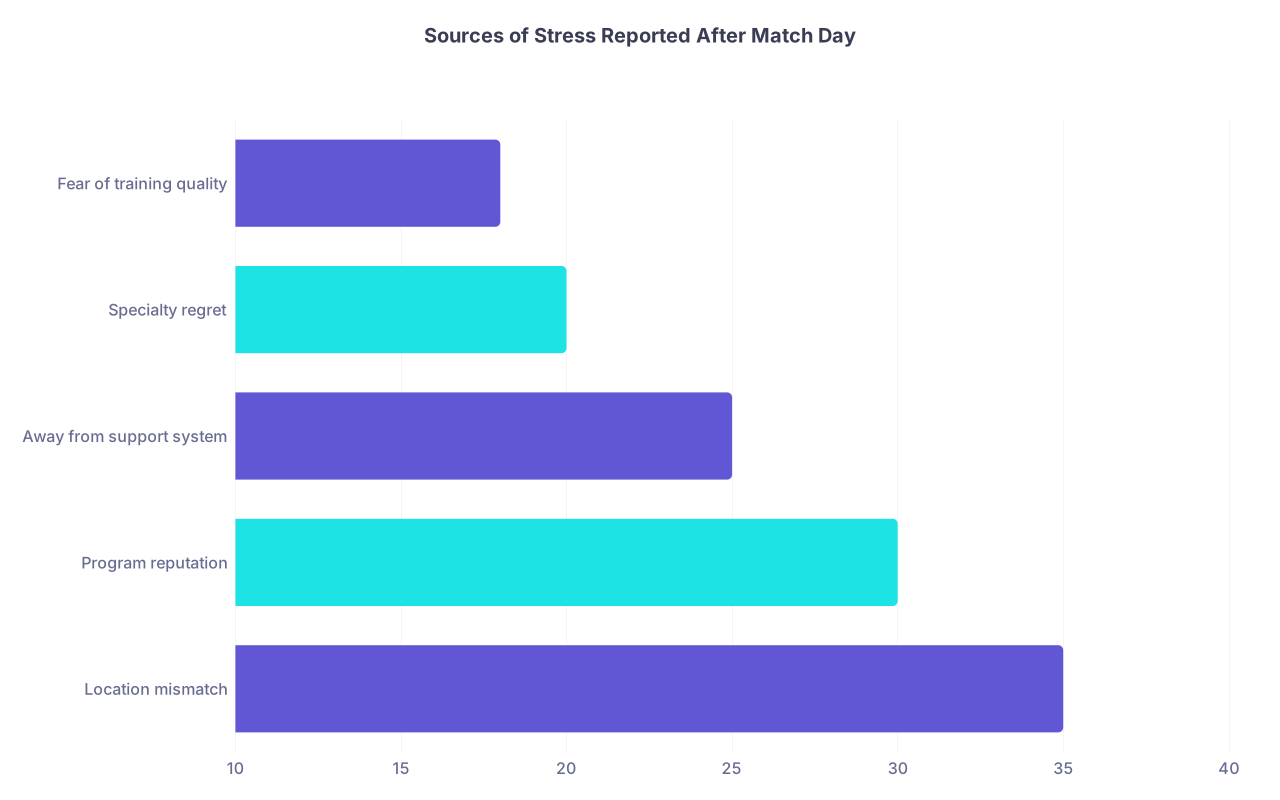
| Category | Value |
|---|---|
| Location mismatch | 35 |
| Program reputation | 30 |
| Away from support system | 25 |
| Specialty regret | 20 |
| Fear of training quality | 18 |
6. Reframing Without Gaslighting Yourself
I’m not going to insult you with “Everything happens for a reason.” Sometimes it doesn’t. Sometimes you just got less than you deserved.
But there is a practical reframe that’s true:
Residency is not the final verdict on your career. It’s the first real stage.
Things you still control:
- How hard you work once you get there.
- The relationships you build with faculty and co‑residents.
- Whether you seek research, fellowships, or niche expertise.
- How you advocate for yourself if the program actually is toxic or unsafe.
I’ve seen:
- A resident at a community internal medicine program match GI at a major academic center because he produced solid research and had outstanding letters.
- An “unimpressive” general surgery match turn into a trauma fellowship and a dream job at a Level 1 center.
- A FM resident in a rural program build a sports medicine niche and end up working with college teams.
No, not everyone “overcomes” a bad match. But you’re not stuck in status‑forever mode either.
The point: You do not have to celebrate Match Day to still build a good career off the result.

7. Concrete Strategies for Getting Through the Day Itself
If Match Day is upcoming and you already know you’re vulnerable, plan it like a procedure.
Pick from this menu:
Decide your attendance level
- Ceremony + small group after
- Ceremony only
- Skip entirely and meet 1–2 close friends later
Pre‑write your text to family
Have a short template ready to send, like:
“I matched into [specialty] at [program]. I’ll call later once I’ve had time to process.”Set a time limit for the event
Tell yourself: “I’m staying for 60 minutes. Then I can leave, no explanations.”Identify 1–2 safe people in the room
Tell them in advance:
“I might need to step outside for a bit. Can I text you if I need a quick reset?”Plan your exit evening
No big group stuff. A quiet dinner, a walk, Netflix, journaling. Whatever helps you decompress instead of doom‑scrolling other people’s photos.
You’re not trying to make Match Day magical. You’re trying to make it survivable.
FAQ: Match Day When You’re Disappointed
1. Is it disrespectful not to be excited if I matched but others did not?
No. You are allowed your own internal experience. What would be disrespectful is loudly complaining in front of someone who’s devastated, or treating your match as a disaster when they have none. Respect their pain by being thoughtful about where and how you express your disappointment, but don’t gaslight your own emotions.
2. Should I tell people it wasn’t my top choice?
Usually, keep it vague in public and specific in private. Publicly: “I’m grateful to have matched into [specialty] at [program].” Privately, with trusted friends or mentors: “It wasn’t near the top of my list, and I’m struggling with that.” You don’t need to disclose rank numbers to anyone unless there’s a clear reason.
3. What if my family wants a huge celebration and I just can’t?
Set expectations early. Tell them: “I love that you’re excited, but I might not be in a big party mood. I’d prefer something low‑key.” If they still go overboard, you’re allowed to step away when needed. Take breaks, go for a walk, or call a friend who gets it. You’re not responsible for maintaining other people’s fantasy of your experience.
4. I’m embarrassed by my program name. Do I have to post it online?
No. You do not owe the internet a Match Day post. If you do post, you can keep it neutral and simple: “Matched into [specialty]. Excited to start residency this summer.” You can share the specific program only with people you trust. The idea that you must market every step of your career online is nonsense.
5. How long is it “normal” to feel disappointed after Match Day?
For many people, the disappointment is sharp for a few days, then becomes background noise over a few weeks as logistics and next steps take over. If you’re still feeling heavy grief, anxiety, or hopelessness for more than 2–4 weeks, or it’s affecting sleep, appetite, or functioning, talk to a therapist or physician. That’s not weakness. That’s maintenance.
6. What’s one thing I can focus on now that will actually help my future, even if I hate my match result?
Build one strong mentoring relationship in your matched specialty or at your future program. Not 10. One. Someone who can advise you, open doors, and write real letters. That single relationship will matter more for your future opportunities than any Match Day photo or fake celebration.
Open your calendar for Match Week and block two hours the evening of Match Day for yourself. No events. No obligations. Protect that time now so you have space to feel whatever you feel—without an audience.