
It’s the Monday of Match Week. You just opened that email: “We are sorry, you did not match to any position.” Your stomach drops. You know you’re going into SOAP. And on top of that, your brain starts spinning:
“I ranked 15 programs higher than this place last year…
Should I email those programs now and tell them I didn’t match there?
Does that help me reapply later? Am I supposed to do something?”
Here’s the direct answer.
Short answer: No, don’t email programs just to say you didn’t match there
Let me be blunt: emailing programs you ranked higher just to announce “I didn’t match at your program” is:
- Not expected
- Not helpful
- Sometimes mildly awkward
- And in SOAP week, a waste of emotional energy
Programs already know where you matched. They just don’t see your full list.
More precisely:
- They know whether you matched to their program (obviously).
- They do not get a notification that you “almost matched,” “ranked them #1,” or “ranked them higher than where you’re going.”
- Once rank lists are certified and submitted, that cycle is over. No post‑hoc note from you changes anything.
So no, you don’t need to – and shouldn’t – blast emails to programs saying you ranked them higher but didn’t match there.
But there are a few smart things you can do instead, especially if you’re planning to reapply.
Let’s break it down.
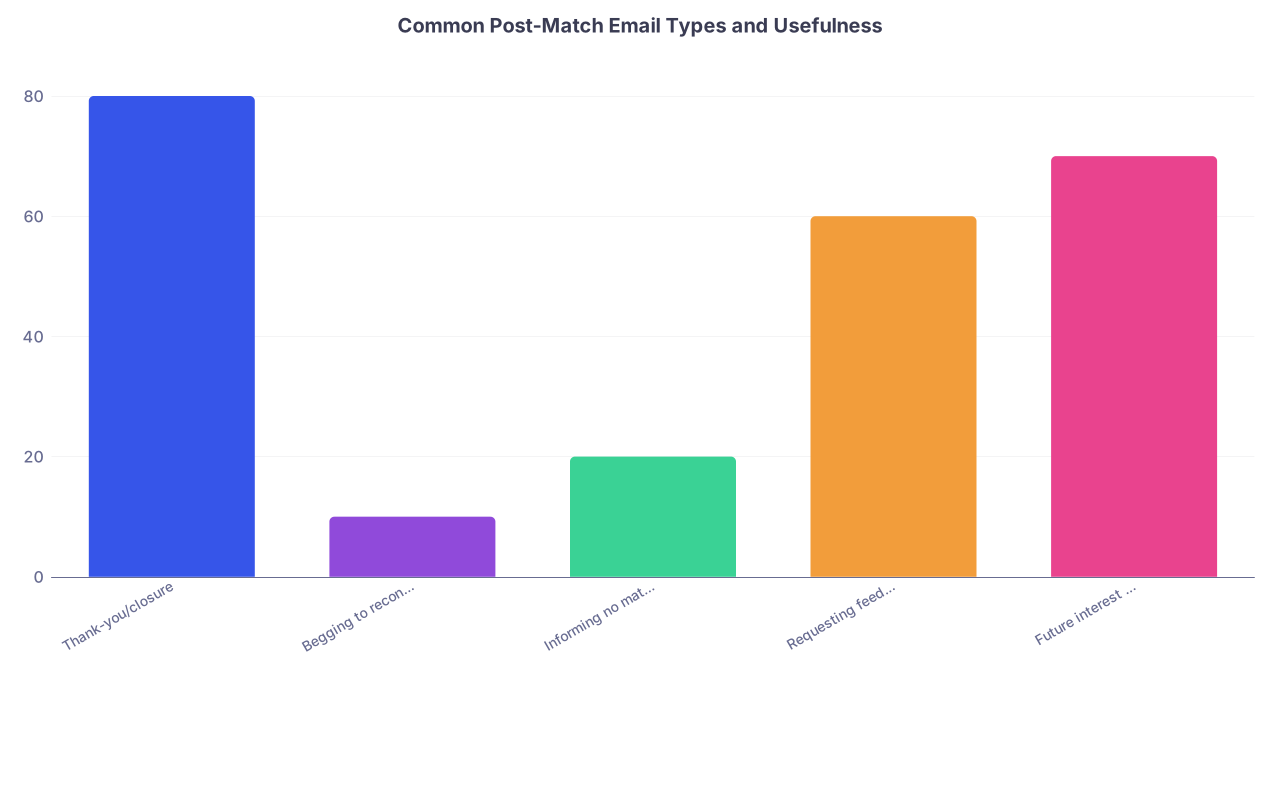
| Category | Value |
|---|---|
| Thank-you/closure | 80 |
| Begging to reconsider | 10 |
| Informing no match | 20 |
| Requesting feedback | 60 |
| Future interest email | 70 |
(Values represent relative usefulness on a 0–100 scale based on how often they’re appropriate/helpful.)
What actually happens after you don’t match
You feel like you should “do something.” Programs feel… nothing. Because for them, the cycle is done.
Here’s what’s going on behind the scenes:
- Programs get their match lists from NRMP Friday before Match Week (or close to it).
- They see a roster of matched residents. That’s it.
- They do not see where unmatched applicants went or didn’t go.
- Once Match results drop, PDs are focused on: onboarding their incoming class, or scrambling to fill unfilled spots in SOAP.
Your email saying “I didn’t match at your program” doesn’t help them with any of that.
What might be reasonable is a version of:
- Thank you / closure
- Future interest signal (for next cycle)
- Thoughtful request for feedback
But timing and wording matter a lot.
When should you email a program after not matching?
There are three different situations. Don’t mix them up.
1. During SOAP week
During SOAP, programs are buried. Screens up, spreadsheets open, committee on Zoom, trying to fill positions fast under time pressure.
What programs do NOT want during SOAP:
- “I ranked you high, can you reconsider me outside SOAP?”
- “I didn’t match anywhere, can I get a position with you off‑cycle?”
- “I know SOAP is going, but I wanted to explain my personal story in detail…”
Those are dead on arrival.
What’s appropriate during SOAP:
- Communication through official SOAP channels only (ERAS, Thalamus/Interview platform if they use it, designated contact info in NRMP/ERAS SOAP instructions).
- If a program reaches out to you, respond quickly and professionally. That’s it.
Don’t cold-email programs just to say you didn’t match or to ask them to “consider you outside SOAP.” They’re not allowed to do a side deal while SOAP is active.
2. Right after Match Week (1–2 weeks later)
Once SOAP is over and the dust settles, this is a more reasonable time to send targeted, short, professional emails to a small number of programs you’re seriously considering reapplying to.
Key word: targeted. Not 60 programs. Maybe 5–15.
Situations where an email makes sense:
- You interviewed there, had good rapport, and are strongly considering reapplying.
- You have a real connection (home program, significant rotation, mentor connection).
- You’re planning a gap year or transition that directly strengthens your application in that specialty.
In those cases, your email should not be: “I didn’t match at your program.”
It should be: “I appreciated interviewing with you, I unfortunately did not match this cycle, here’s my plan, and I’m interested in reapplying.”
We’ll do wording examples later.
3. Months later, when you’re building next cycle’s strategy
This is where thoughtful, intentional contact can help.
You might:
- Ask about opportunities: prelim year, research year, observership, post‑match research job.
- Reconnect with PDs or faculty you know well.
- Get realistic feedback, if anyone is willing to give it.
Again, the focus is forward: what you’re doing next, not the fact that you didn’t match at their program.

| Step | Description |
|---|---|
| Step 1 | No Match Email Monday |
| Step 2 | Focus on SOAP Applications Only |
| Step 3 | Plan Reapply or Alternate Path |
| Step 4 | Do Not Cold Email Programs |
| Step 5 | Complete SOAP Week |
| Step 6 | 1-2 Week Pause |
| Step 7 | Email Select Programs After SOAP |
| Step 8 | Explore New Specialty or Gap Year |
| Step 9 | SOAP Eligible |
| Step 10 | Reapply to Same Specialty |
What should your email actually say?
Let’s get concrete. You don’t need poetry; you need clean, grown‑up communication.
What NOT to send
Don’t send this:
Subject: I ranked your program #1
Dear Program Director,
I wanted to let you know that I ranked your program #1 this year but unfortunately did not match. I was very disappointed, as your program is my dream program. If there is any way for you to reconsider my application, I would be very grateful.Sincerely,
[Name]
Why this is bad:
- Mentions what’s now irrelevant (your rank number).
- Sounds needy and backward‑looking.
- Implies they did something wrong by not ranking you higher.
- Asks for something they literally cannot do after the Match.
A reasonable “future interest” email (after Match Week)
Use something like this 1–2 weeks after Match if you’re planning to reapply:
Subject: Thank you and future interest – [Your Name], [Specialty] Applicant
Dear Dr. [Last Name],
I greatly appreciated the opportunity to interview with [Program Name] during this year’s Match cycle. I especially valued [1 specific thing: the resident panel, your description of X curriculum, the culture you described around Y].
Unfortunately, I did not match this cycle. I plan to strengthen my application and reapply to [Specialty] for the upcoming Match. I’ll be [brief plan: completing a prelim medicine year at X, working in a research position in Y, pursuing additional clinical experience, etc.].
I remain very interested in [Program Name] and would be grateful to be considered again in the next application cycle. If you have any brief advice about how I might improve my application for your program specifically, I would welcome it.
Thank you again for your time and for the opportunity to interview this year.
Best regards,
[Full Name]
[Current status – e.g., MS4 at X / Grad of Y / Prelim IM at Z]
AAMC ID: [optional but helpful]
Notice what this email does:
- Acknowledges the interview and their time.
- Briefly states you did not match (no drama).
- Immediately pivots to: here’s my plan, I’m improving.
- Signals interest in reapplying.
- Asks politely for advice, not favors.
That’s the right tone.
Should you tell them where you ended up (if you SOAP or take a prelim)?
If you SOAP into a prelim or another specialty, or take a noncategorical year, programs often appreciate context. Briefly.
Good: “I will be completing a preliminary medicine year at [Hospital].”
Too much: paragraph‑long explanations about why SOAP went poorly, family drama, why your score doesn’t reflect your abilities, etc.
Programs don’t need the full autobiography. They need enough info to understand where you’ll be and what you’ll be doing when you reapply.
| Situation | Email? | Focus of Email |
|---|---|---|
| Monday–Thursday of SOAP | No | Use SOAP channels only |
| 1–2 weeks after Match, interviewed there | Yes (selectively) | Thanks, future interest, brief plan |
| No interview, no connection | Usually no | Low yield, often ignored |
| Planning to reapply to same specialty | Yes (key programs) | Reapply plan, possible feedback |
| Changing specialties entirely | Maybe | Clarify transition, new interest |
What about asking for feedback?
This is the one semi‑useful reason to reach out.
Reality check:
- Some PDs will never give individual feedback.
- Some will give very generic feedback.
- A minority will give blunt, honest, incredibly valuable guidance.
You don’t lose much by politely asking once. Just don’t push.
Example line you can include (as in the email above):
“If you have any brief advice about how I might improve my application for your program specifically, I would welcome it.”
If they respond with something helpful—fantastic.
If they don’t respond—drop it. Don’t send a follow‑up guilt trip.

Special situations
Let’s hit a few edge cases people worry about.
“They told me on interview day I’d be ranked to match. Should I email them about not matching?”
No. Not to say “you said I’d match and I didn’t.”
If you want to maintain a relationship and maybe reapply there, treat it like the standard future‑interest email:
- Thank them.
- Say you didn’t match this cycle.
- Outline your plan.
- Express interest in being considered again.
Do not accuse them of misleading you or ask what happened with your rank. Rank lists are complex and committee‑based. Those half‑promises are always fuzzy.
“I matched somewhere but not at my top program. Should I email my #1 anyway?”
You matched. Good. Close that chapter and focus on the program that actually committed to you.
Do not email your #1 to say “I ranked you higher but matched elsewhere.” That just makes you look confused about how commitment works.
A normal thank‑you email right after the interview season is fine. After Match, you owe your attention to the program you matched to.
“I’m worried they’ll think I didn’t like them because I ranked them lower.”
They don’t see your rank list. They don’t know where you ranked them.
What they know:
- They ranked you somewhere on their list.
- The algorithm didn’t pair you with them.
That’s it. You don’t need to “correct the record” or reassure them that you ranked them high.
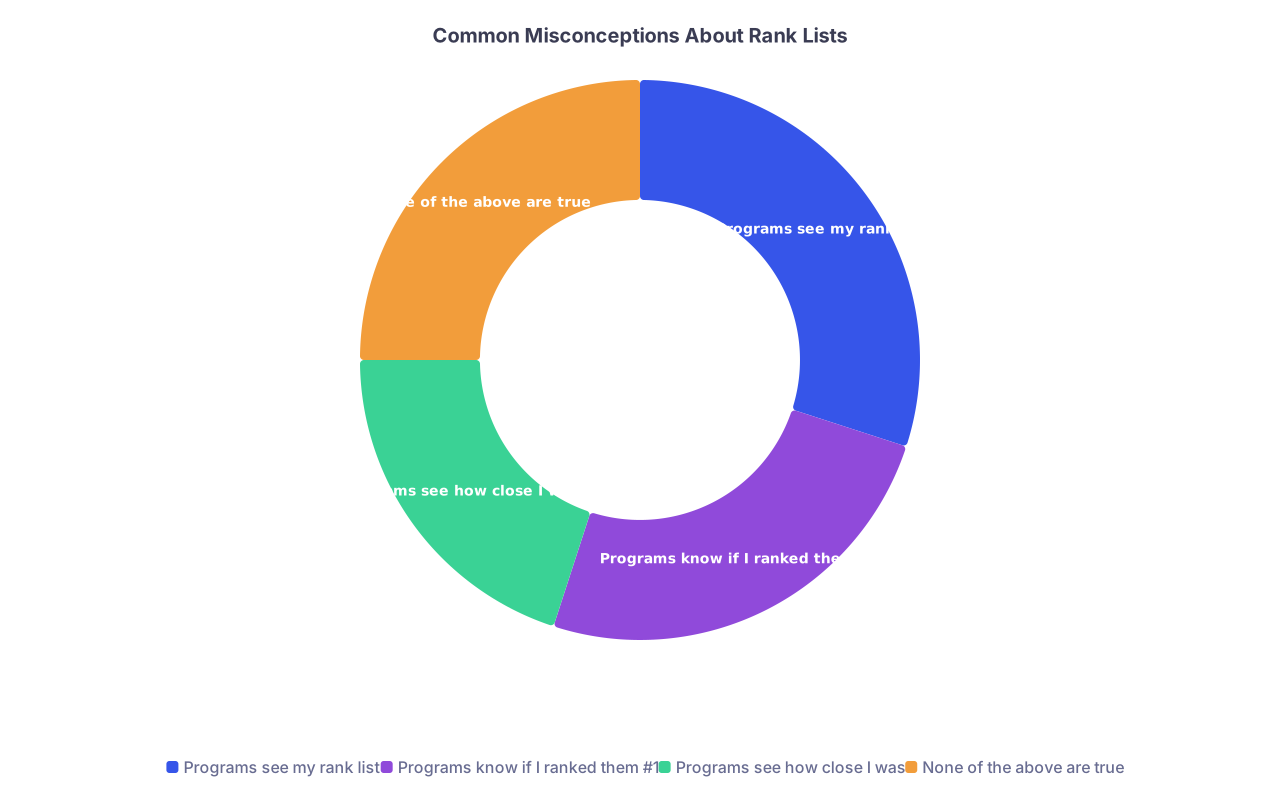
| Category | Value |
|---|---|
| Programs see my rank list | 30 |
| Programs know if I ranked them #1 | 25 |
| Programs see how close I was | 20 |
| None of the above are true | 25 |
How many programs should you email?
If you don’t match and plan to reapply, I’d cap it roughly like this:
- 5–10 programs where you interviewed and realistically want to be.
- Maybe up to ~15 if you genuinely had strong ties or meaningful contact.
Blasting the entire specialty with a generic “I didn’t match” template is spammy and useless.
Think like this:
- Would I be happy to train there?
- Did I have at least one real touchpoint (interview, away rotation, virtual event, faculty connection)?
- Can I say something specific and honest in 1–2 sentences about why I liked their program?
If no to all three—skip the email.

Bottom line: what you should actually do
You’re under a lot of stress. So here’s the filtered list of what’s actually worth your time.
During SOAP
- Don’t email programs to say you didn’t match there.
- Focus 100% on SOAP applications, documents, and rapid responses.
Right after SOAP/Match
- Take a breath. Process the loss.
- Decide: reapply same specialty, switch specialties, or take another path.
If you’re reapplying
- Pick a targeted list of programs (5–15) you genuinely care about.
- Send short, professional emails: thanks, didn’t match, here’s my plan, still interested.
- Ask politely for brief feedback. Accept if they ignore it.
Stop trying to rewrite last cycle
- Don’t talk about where you ranked programs.
- Don’t ask them to “reconsider” you outside the Match.
- Don’t send apology/overshare emails explaining every detail of your failure.
Focus on the only things that move the needle: stronger application, better scores (if relevant), better letters, more clinical depth, and a clear, credible story for why you’re still a strong fit for that specialty.
FAQ (7 questions)
1. Should I email programs I ranked higher just to tell them I didn’t match there?
No. That email by itself offers them nothing and doesn’t help you. If you reach out, it should be to thank them, explain briefly that you’ll be reapplying, and outline your plan—not just to announce that you didn’t match.
2. Can emailing programs after not matching hurt me for next year?
If you’re professional and concise, no. What hurts you is emotional, accusatory, or needy emails (“you said I’d be ranked highly,” “please reconsider me,” etc.). Programs remember drama. They also remember maturity. Keep it calm and forward‑looking.
3. Is it okay to tell a program I ranked them #1?
Don’t bother. They can’t verify it, it doesn’t change anything, and it often reads as manipulative or awkward. Just say you were impressed by X, you enjoyed your interview, and you’d like to be considered again.
4. Should I email programs during SOAP to ask for a spot?
No, unless they contacted you first and gave you a specific way to respond. During SOAP, you should use only official channels (ERAS/SOAP procedures). Cold emails asking for positions outside SOAP are ignored at best and can be seen as unprofessional.
5. If I SOAP into a prelim year, should I tell programs I’m reapplying to?
Yes, briefly. Something like: “I’ll be completing a preliminary internal medicine year at [Hospital] and plan to reapply to [Specialty] in the upcoming cycle.” That context helps them understand your path and timeline.
6. How soon after Match should I email programs about reapplying?
Wait until at least the week after Match Week. Give programs space to finish SOAP and move on. Somewhere in the 1–3 weeks after Match is reasonable for a short, future‑oriented email to selected programs.
7. What if no one replies to my post‑match emails?
That’s normal. Many PDs are too busy or have policies against individual feedback. Don’t take silence as a black mark against you. Use input from mentors, your dean’s office, and people who do respond, then focus on improving your application rather than chasing replies.
Key things to walk away with:
- Don’t email programs just to say you didn’t match there. It doesn’t help.
- If you reapply, send short, targeted, forward‑looking emails to a limited number of programs after Match Week.
- Put most of your energy into strengthening your next application, not trying to re‑litigate last year’s rank list.