
The “Ranked You to Match” email is one of the most overhyped, least reliable signals in the entire residency process.
If you’re treating it like a preview of Match Day, you’re doing it wrong.
Programs have figured out that a carefully crafted, warm-sounding message calms anxious applicants, boosts their ranking love, and costs the program absolutely nothing. Meanwhile, applicants read it like a binding contract carved into stone tablets by NRMP itself.
Let me be blunt: that email rarely tells you what you think it does.
The Big Myth: “Ranked to Match” = “I Matched There”
The myth goes like this:
- Program emails you: “We ranked you to match.”
- You exhale. You mentally move to that city. You start window‑shopping apartments.
- You assume it means you’re basically in, unless something bizarre happens.
Reality check.
“Ranked to match” could mean:
- You’re ranked high enough that, assuming your rank list is consistent, the algorithm will likely land you there.
But it could also mean:
- You’re somewhere in the top third.
- Or you’re in the matchable region if you rank them high and others don’t displace you.
- Or it’s pure, vague flattery that means almost nothing numerically.
Most of the time, you have absolutely no idea which of those you are.
Programs don’t send you an email that says: “Ranked #3 out of 120,” with a link to their list. They say stuff like:
“We consider you among our most competitive candidates and have ranked you to match.”
or
“We’ll be thrilled if you match with us in March. You’d be an excellent fit.”
Sounds specific. It isn’t.
What “Ranked to Match” Actually Signals
Here’s what it usually means, stripped of the nice adjectives:
- You cleared their cutoff for “we’d be happy with this person.”
- They probably put you in a range they consider realistically matchable.
- They want to influence your rank list, without giving away real data.
That’s it.
Could it mean you’re #1–3? Sure. Could you still fail to match there? Also yes, if you:
- Rank another program higher and match there instead.
- Or their top section fills with people who ranked them #1, pushing you out.
Most people badly misunderstand how often those “love letters” fail to materialize into actual matches.
What the NRMP Rules Actually Say (And Why Programs Dance Around Them)
Let’s talk rules, because this is where people get downright confused.
NRMP has explicit policies about communications between programs and applicants. The short version:
- No one can ask you how you’re ranking them.
- No one can demand you rank them first.
- No one can make guarantees or “promises” of a match.
Programs know this. So they’ve developed a coded language that tiptoes up to the line without crossing it.
Phrases you’ll see:
- “Ranked to match”
- “We will rank you very highly”
- “We sincerely hope you will be joining us”
- “You are one of our top candidates”
Notice what they’re not saying:
- “We will rank you #2”
- “If you rank us #1, you are guaranteed to match here.”
The first set is legally safe, emotionally loaded, and factually ambiguous. Perfect for a program that wants to nudge you up your own rank list without making an enforceable promise.
Why Programs Send These Emails At All
Not out of kindness. Not mainly.
They send them because psychology works:
- Applicants usually reciprocate “affection” from programs.
- If you feel wanted, you’re more likely to rank them higher.
- That can improve programs’ chances of getting the people they like, especially in competitive cycles.
Programs are playing a game of probabilities. A warm email bumps their odds—at zero cost. So they send them. A lot.
What the Data and Patterns Actually Show
You won’t find an NRMP table labeled “Percentage of ‘ranked to match’ emails that were total BS.” But we can still piece together what’s going on from Match data, NRMP surveys, and actual observed behavior.
Let’s ground this:
- NRMP’s Program Director Survey consistently shows that most programs rank 2–3 times as many applicants as they have spots, often more.
- Many programs send “we will rank you highly”–type messages to far more people than they can realistically match.
So mathematically, the majority of “highly ranked” applicants at a program will not match there. They’ll either:
- Match somewhere they ranked higher, or
- Get pushed out if others rank that program higher.
To make it very concrete:
| Metric | Number |
|---|---|
| Categorical IM positions | 20 |
| Applicants ranked | 200 |
| Top-tier “we love you” pool | 60 |
| Actual matched from that 60 | 20 |
All 60 might get some version of “you’re among our top candidates” or “ranked to match.” Only a third will ever actually train there.
The email still wasn’t technically false. Just strategically incomplete.
Why Your Brain Overvalues That Email
The problem isn’t only the message. It’s your brain.
You’re stressed, sleep-deprived, financially and emotionally invested. By the time late January hits, you’ve:
- Spent thousands on ERAS and flights.
- Told family you interviewed at [Prestige Program].
- Lived months in limbo.
Then—ping. Email from a PD saying they “ranked you to match.”
Your brain does the rest:
- Confirmation bias: “I knew I killed that interview; this proves it.”
- Anchoring: You fixate on that one program as your likely landing spot.
- Emotional reasoning: “They said they want me, so I’m probably going there.”
I’ve seen people start learning the local DMV rules, hunting Zillow, even joining Facebook groups for interns at a program based on one enthusiastic message.
And then Match Day hits, and their envelope says something else. Sometimes a program they ranked higher. Sometimes lower. Sometimes a completely different city.
The email didn’t lie. But you filled in all the blanks with certainty that never existed.
How the Match Algorithm Actually Treats That Email
This part is crucial: the algorithm doesn’t see your emails. At all.
The algorithm doesn’t care if:
- The PD wrote you three paragraphs or nothing.
- A chief resident called you “a great fit.”
- You wrote them back “I’m ranking you #1.”
What the algorithm sees:
- Your rank list.
- Their rank list.
And that’s it.
So the only way that “ranked to match” email influences your fate is if it changes how you rank programs.
If you bump a program to #1 because of one flattering line, you might indeed end up there. Not because they promised anything. Because you voluntarily centered your entire list on them.
That might be a good outcome. Or a very stupid one if you actually preferred somewhere else.
The Dangerous Behavior That Email Can Trigger
This is where I stop being polite: some of you let these emails sabotage your rank list.
I’ve seen actual disaster scenarios:
- A student loved Program A, liked Program B.
- Program B sends “ranked you to match” message. Program A sends nothing.
- Student panics: “Maybe A doesn’t want me.” Moves B above A.
- Match Day: they land at B, spend three years regretting not trusting themselves.
Or worse:
- Applicant gets 2–3 warm emails and assumes they’re “safe.”
- They aggressively shorten their rank list.
- They end up in SOAP because the “safe” love notes didn’t translate into actual matches.
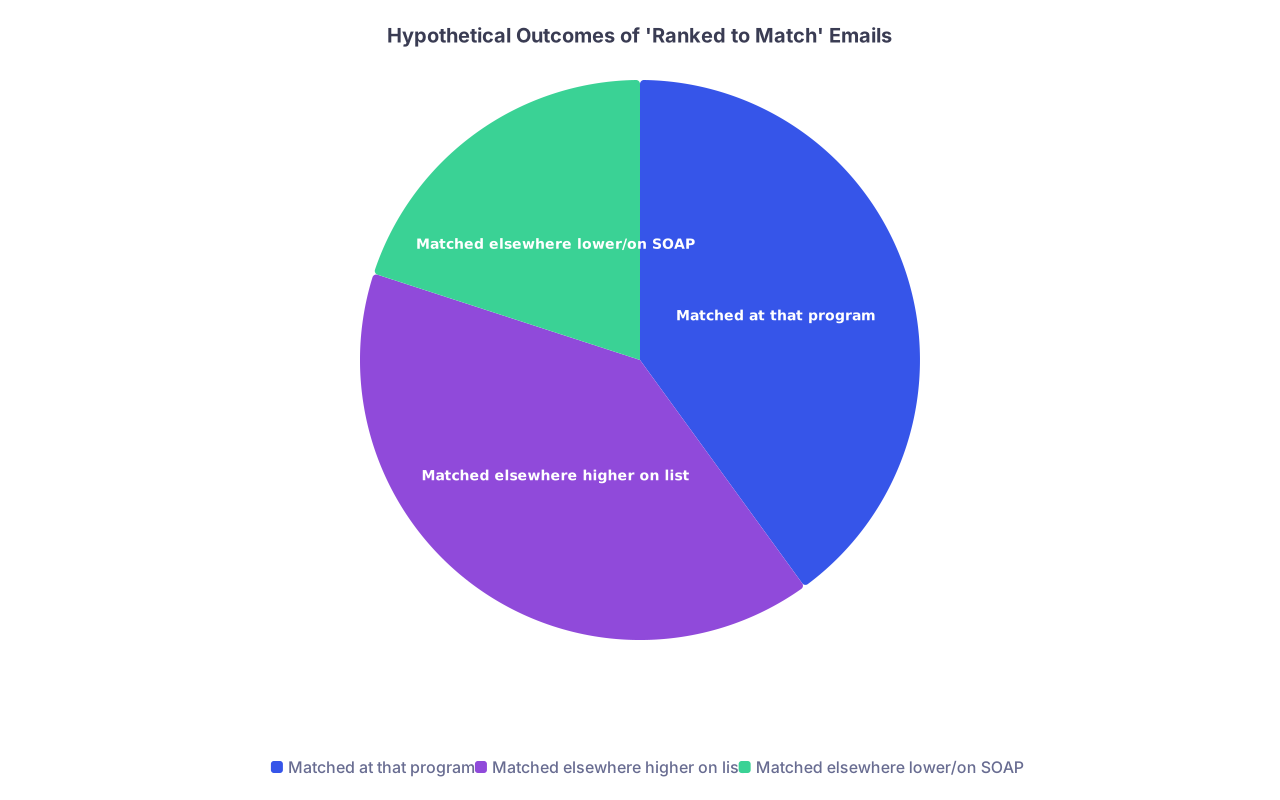
| Category | Value |
|---|---|
| Matched at that program | 40 |
| Matched elsewhere higher on list | 40 |
| Matched elsewhere lower/on SOAP | 20 |
Those values are hypothetical, but the pattern is real: a big chunk of people with those emails do NOT end up at that program. Many never should have expected to.
How You Should Interpret “Ranked to Match”
Here’s the sane interpretation protocol.
When you get that email, mentally translate it to:
“We like you enough to rank you in a range that might realistically match, if things break a certain way. We hope you like us too.”
That’s all.
From that framing, here’s what you do with it:
Acknowledge it, don’t worship it.
It’s a mildly positive signal. Nothing more.Do NOT change your top preference just because of it.
If Program X is your true #1, leave it there—even if they ghost you completely and Program Y floods you with affection.Use it as a tiebreaker only at the margins.
If you’re truly 50/50 between two places, a genuine, personalized note from a program can break a tie. Emphasis on tie.Assume it’s non‑binding fluff until proven otherwise.
If it doesn’t include specific, grounded references to your interview day or your application, and sounds generic, treat it like marketing copy.
What Actually Predicts Match Day Outcomes Better Than Emails
You want prediction? Look at structure and behavior, not flattery.
Here’s what historically predicts your Match outcome far better than “ranked to match” language:
- How many programs you ranked. Short rank lists are the true disaster vector.
- How competitive your specialty + your stats are. A solid internal medicine applicant with 14 programs ranked? Very likely to match somewhere. A borderline ENT applicant with 6 programs? Much higher risk.
- Where you placed programs on your list. The algorithm is applicant-favoring. If you ranked a place #1, and they ranked you anywhere in a matchable region, your odds are already quite good.
| Factor | Predictive Power |
|---|---|
| Length of your rank list | Strong |
| Competitiveness of specialty | Strong |
| Your relative application strength | Strong |
| “Ranked to match” emails | Weak |
| Generic post-interview contact | Very weak |
If you want something to obsess over, obsess over your rank order and list length—not whether the PD loved your thank-you note enough to email back.
How to Emotionally Survive the Mixed Signals
You’ll get a weird mix:
- Some programs: nothing. Radio silence.
- Some: generic “thanks for interviewing, good luck!”
- Some: “we enjoyed meeting you” boilerplate.
- One or two: “ranked to match” or “we will rank you highly.”
Here’s the grown‑up way to handle it:
Silence doesn’t mean rejection.
Many excellent programs have strict “no post‑interview communication” policies. They play it clean. They still rank you. They still match you. They just don’t flirt by email.Flattery doesn’t equal commitment.
A buttered‑up mass email is not more real than a silent but honest program.Anchor on your actual experience.
Go back to your notes:- Who did you vibe with?
- Who treated residents like humans, not work units?
- Whose curriculum, location, and culture fit your life?
Write your rank list as if you’d never seen your inbox.
If you had zero post‑interview communication, how would you order your programs? Start from that list. Only then consider whether any authentic personal outreach slightly shifts your ties.
A Quick Reality Check on Match Day
Match Week will fully expose the illusion around these emails.
You’ll hear stories like:
- “They told me I was ranked to match and I ended up at my #3.”
- “My favorite program never contacted me—and I matched there.”
- “The only program that sent me a love letter? I didn’t match there or even anywhere close.”
And quietly, you’ll also hear:
- “I changed my list because of one email and kind of regret it.”
You do not want to be in that last group.

How to Actually Prepare For Match Day (Without Email Delusions)
If the category here is “Preparing for the Residency Match Day,” then preparation looks like this—not decoding email tea leaves:
- Build a rank list that reflects true preference, not flattery.
- Make it long enough to be safe for your specialty and competitiveness.
- Accept the inherent uncertainty: you won’t “know” where you’re going until the envelope opens.
- Emotionally rehearse multiple outcomes: top choice, mid‑list, lower‑list. So you’re not shattered if your fantasy doesn’t happen.

| Step | Description |
|---|---|
| Step 1 | Start Rank List |
| Step 2 | Choose top preference |
| Step 3 | Note but ignore for now |
| Step 4 | Continue ranking |
| Step 5 | Complete list by true preference |
| Step 6 | Use fit and communication as minor tiebreaker |
| Step 7 | Finalize list |
| Step 8 | Post interview emails? |
| Step 9 | Ties between programs? |

The Bottom Line: What You Should Actually Remember
Strip away the mythology. You’re left with this:
- “Ranked you to match” is a vague, strategic, non‑binding signal. Mildly positive, rarely predictive.
- Your rank list—not your inbox—drives your Match result. The algorithm only sees the lists.
- Build your list by genuine preference, assume every email is 80% PR, and you’ll avoid the biggest self‑inflicted Match regrets.
Believe the algorithm. Not the flattery.