
The most dangerous thing about the Couples Match isn’t the algorithm. It’s the stories people tell about it.
Every year I hear the same nonsense whispered in hallways and blasted in GroupMe chats: “The algorithm favors couples.” “If you couple, you’ll both end up unmatched if one of you is weaker.” “Just rank everything together and it’ll find you something.” All confidently delivered by people who have never once opened the NRMP’s matching algorithm description.
Let’s fix that.
The Couples Match is powerful, but it’s not magic. It can’t create positions that don’t exist. It doesn’t “reward love.” And it definitely does not “sacrifice” one partner to save the other. It does exactly what it’s programmed to do: honor your joint rank preferences as much as the available positions allow.
If you want to survive Match Day as a couple with your sanity intact, you need to understand what the algorithm really does under the hood—and where you’re inventing hope or fear out of thin air.
Myth #1: “Couples Match gives us an advantage over single applicants”
No, it does not. The algorithm doesn’t see “romantic commitment.” It sees two ERAS IDs linked together with a joint rank list. That’s it.
Here’s how it actually works, stripped of the romantic marketing:
- Each of you is evaluated independently by each program, based only on your application and their rank order list.
- The Couples Match only kicks in once you’ve already been ranked high enough by programs to be tentatively placed there.
- Then the algorithm tries to fit you into pairs of positions consistent with your joint list.
In other words: any “advantage” comes from your planning, not from the algorithm blessing couples.
Programs don’t get a popup that says “These two are a couple, please treat them special.” They see your file. They rank you—or not. Then the algorithm decides whether there’s a pair of spots that match your list.
Look at it this way: a strong single applicant can be matched at any program that ranks them high enough and has an open spot. A strong couples applicant needs two compatible spots to line up in ways that both meet the joint preferences and are open at the same time. That’s harder, not easier.
So if anyone tells you, “Couples Match will help you get better programs,” you can safely ignore their strategic advice. They’re starting from a false premise.
Myth #2: “If we couple, one weak partner will drag the other down”
This one’s more subtle. There is a tradeoff, but it’s not the doomsday scenario people like to dramatize.
Here’s the truth: the algorithm tries to honor your joint preferences, not rescue each person independently. That means:
- It will happily pass up a great solo option for Partner A if it can’t find a compatible pair for A and B that is ranked higher on the joint list.
- It does not “force” A to drop to low-tier programs just to drag B along.
- It also does not automatically sacrifice B so A can land “the best possible” place.
The outcome depends on how you build your list.
Imagine this simple example:
You two rank:
- (A: BigName Hospital, B: BigName Hospital)
- (A: BigName Hospital, B: Mid-Tier Hospital)
- (A: Mid-Tier Hospital, B: Mid-Tier Hospital)
- (A: BigName Hospital, B: No Match)
- (A: No Match, B: BigName Hospital)
The algorithm goes down this list in order, checking what’s actually available based on how programs ranked you. If pair #1 isn’t possible, it tries #2, and so on. It never says, “Well A is strong, so let’s bump A way down just to keep B somewhere.” It just follows your list.
What does happen is this: a superstar applicant tying themselves to a very weak applicant reduces the superstar’s solo upside—if they choose to. Because they’re voluntarily saying, “I will prioritize being together over maximizing individual program prestige.” That’s not being “dragged down.” That’s making a tradeoff.
You have tools the horror stories conveniently omit:
- You can include “one matches / one doesn’t” options late on the list if being together is more important than both matching at all costs.
- You can include geographically close but different-tier programs that still work for both.
- You can decide how far down you’re willing to go as a pair before you let the stronger candidate fly solo.
The algorithm is not pushing anyone down. It’s just blindly obeying the priorities you encoded.
Myth #3: “If we rank enough random combinations, the algorithm will find something”
This is the lazy strategy dressed up as optimism: “Let’s rank every city and program combo; the algorithm will work it out.”
No, it won’t. The algorithm can’t create positions, can’t change how programs ranked you, and can’t make a 2-spot combo out of thin air in a place where only one of you is desirable.
If one of you is ranked well by Program X and the other is ranked very low or not at all, pairing those programs over and over on your list doesn’t magically increase your odds. You’re just cluttering your rank order with fantasies.
Look at how often couples make this mistake: they build a 200+ pair rank list stuffed with permutations like (A at Mega Academic Center, B at Literally Any Program In The State). Sounds thorough. In practice, half of those combos are mathematically impossible because B was never ranked at those places, or vice versa.
Here’s what data and experience actually support:
- Depth is good only when the pairs are plausible.
- “Spray and pray” pair ranking does nothing if you were never ranked by those programs.
- Real safety comes from realistic, geographically flexible, specialty-aware pairing, not sheer volume.
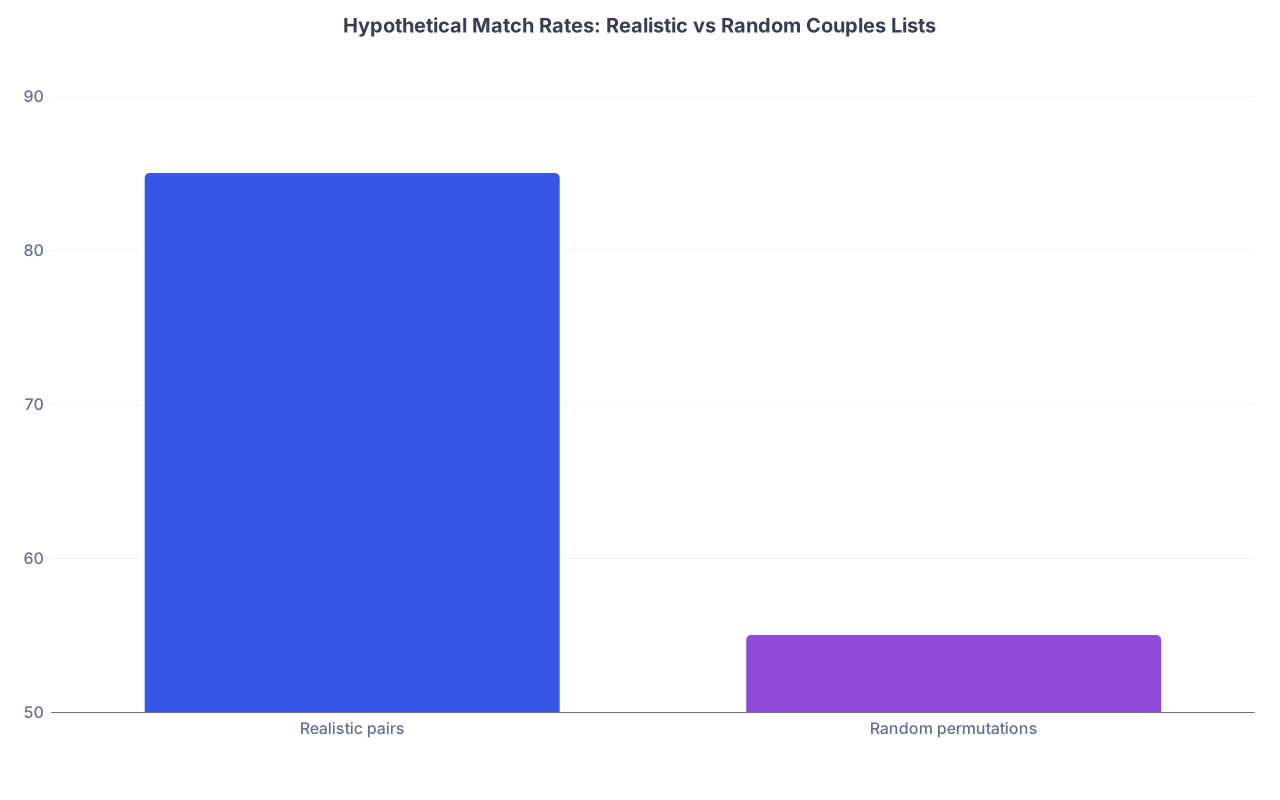
| Category | Value |
|---|---|
| Realistic pairs | 85 |
| Random permutations | 55 |
This is a hypothetical illustration, but the principle mirrors what PDs quietly say: couples who understand their competitiveness and build grounded lists tend to do fine. The ones who believe the algorithm is a wish machine don’t.
Myth #4: “The algorithm will keep us in the same city unless it has no choice”
This is flatly wrong—and dangerous, because it makes people lazy about their lists.
The algorithm does not “prefer” close geography. It doesn’t know what “same city” means. It doesn’t know you have a lease, kids, or one car. All it sees are pairs of programs you fed it, in the exact order you ranked them.
That means:
- If you only rank pairs in the same city, you’re basically saying, “We would rather go unmatched than live in different cities this year.”
- If you rank some same-city pairs above different-city pairs, then you’re saying, “Same city first, but we’d rather be apart than unmatched.”
- If you don’t include different-city options at all, the algorithm will not infer that you’d be open to them. It will just stop when it runs out of valid pairs.
Couples get burned by this every year. They tell themselves, “We’ll surely get some combo in City X; we interviewed at 10 places between us.” Then it turns out that the specific pairs they ranked were never actually simultaneously available for both partners in the right positions.
Meanwhile, another couple in the same year ranks:
- Same-hospital options at the top.
- Same-city but different-hospital options in the middle.
- Neighboring-city options further down.
- And, finally, one-matches/one-doesn’t or long-distance temporary options at the bottom.
Guess which couple has more actual outcomes the algorithm can work with.
The algorithm is obedient, not protective. If you don’t explicitly rank long-distance or non-ideal geographic pairs, it will never place you into them “for your own good.”
Myth #5: “Couples Match massively increases your risk of going unmatched”
This one’s mostly overstated. There is added risk if you handle it badly, but the algorithm itself isn’t out to punish couples.
A few realities:
- The NRMP’s own data have consistently shown that the majority of couples match somewhere. The match rate for couples isn’t catastrophically lower than for single applicants, especially when you adjust for competitiveness and specialty choice.
- The risk spike happens in two situations:
- Both partners are reaching too high for their actual competitiveness.
- The couple refuses to rank realistic but less sexy fallbacks (different cities, mix of program tiers, prelim + advanced combos, etc.).
Where things go off the rails is not the algorithm. It’s ego and magical thinking.
Here’s a simplified comparison of how strategy shifts risk:
| Scenario | Relative Unmatch Risk |
|---|---|
| Realistic list, broad geography | Low |
| Overreaching list, same city only | High |
| One strong, one average, flexible | Moderate |
| Both weak, very rigid preferences | Very High |
Notice what changes the risk: your strategy, not some secret couples penalty in the software.
The cold truth: if both of you are weak applicants in very competitive specialties and you insist on the same five coastal cities, yes, Couples Match is risky. Not because you “coupled,” but because your plan is detached from reality.
Myth #6: “We should never rank ‘one matches / one doesn’t’—that’s basically giving up”
This is the taboo nobody wants to talk about until February, when panic hits.
Ranking “one matches / one doesn’t” options doesn’t mean you’re hoping for that outcome. It means you’re acknowledging that not matching at all is often worse than being apart for a year.
The algorithm is perfectly capable of handling this. A pair like:
- (A: Solid Mid-Tier IM, B: No Match)
- (A: No Match, B: Solid Mid-Tier Peds)
…tells the system: “If we can’t land somewhere together above this on the list, then let at least one of us land somewhere decent rather than both be jobless.”
The fear is emotional, not logical: “What if I match and they don’t?” But the inverse question is uglier: what if neither of you match, and now both of you are scrambling in SOAP or taking an unplanned research year—even though one of you absolutely could have matched?
From the algorithm’s perspective, these options just widen the safety net. It will always try to match you to higher-ranked togetherness options first. It ignores the “one matches” lines until every together pair above has failed.
If you’re both reasonably competitive and have a deep, sane list, you may never need these. But pretending the scenario doesn’t exist doesn’t protect you from it. It just removes one of your last safety valves.
Myth #7: “The algorithm will place us at the best possible programs for our combined profile”
No. It will place you at the highest-ranked pair on your list that is actually available. That’s it.
Notice what’s missing from that sentence:
- It does not check whether there’s a “better” combination for each of you independently.
- It does not try to solve for “total couple happiness” in some complex optimization sense.
- It does not rerun scenarios to see if swapping one partner would dramatically improve outcomes while keeping the other stable.
The deferred acceptance algorithm (which the NRMP uses a variant of) is applicant-optimal given your rank list. It gives you the best outcome you’ve told it to aim for. If your list is dumb or unbalanced, it will faithfully carry out a dumb or unbalanced plan.
I’ve seen couples rank something like:
- (A: Dream, B: Reach)
- (A: Dream, B: Wild Reach)
- (A: Dream, B: Overshoot)
- (A: Dream, B: Underranked Strong Program)
- (A: Very Solid, B: Very Solid)
And then be surprised when they end up unmatched or much lower than they “expected.” The problem wasn’t the algorithm. It was refusing to listen to what PDs, mentors, and actual interview behavior were screaming at them: those top pairs relied on unrealistic assumptions about where B was ranked.
The algorithm can’t “balance” this. It just grinds through your list from top to bottom, checking what’s feasible.
If you want a rational outcome, you have to build a rational list.
A Quick Reality Check on What the Algorithm Actually Does
If you strip away the folklore, the Couples Match algorithm does three core things for you:
- It links your applications so you’re treated as a pair when it considers where to place you.
- It honors your exact ranking of program pairs in strict order, without emotion or bias.
- It evaluates whether both of you can simultaneously occupy the two slots in a given pair given how programs ranked you and everyone else.
That’s it. No mercy. No malice. Just logic.
You supply the realism, humility, and self-awareness. Or you don’t—and you live with whatever your rank list tells the system to do.
Final Takeaways
Three things to keep in your head when the myths start flying in February:
- The algorithm doesn’t favor or punish couples; it simply follows your joint rank list and the programs’ rankings with zero judgment.
- Most of the supposed “risks” and “advantages” come from how you build that list—your competitiveness, geographic flexibility, and willingness to include unsexy but realistic options.
- If you treat the algorithm like a wish-fulfillment engine instead of a cold, rule-following machine, you’re not being romantic. You’re being reckless.