
The obsession with “academic vs community” programs is wildly overblown. For most residents, it matters far less than you think—and a lot less than Reddit wants you to believe.
Let me be very clear up front: matching at a community program does not doom you to a second‑tier career, and matching at an academic powerhouse does not guarantee you one. The data, the match outcomes, and the people actually in practice all say the same thing. The prestige narrative is louder than ever. It’s also wrong in all the ways that matter long‑term.
You’re not choosing destiny. You’re choosing a training environment with specific trade‑offs. And too many applicants are optimizing for the wrong things.
How We Got Here: The Prestige Myth Factory
Every cycle I watch the same movie play out.
MS3 on medicine: “The fellow said if I want cards I have to be at a big academic place.”
Small group whispering after lecture: “Community programs are for people who couldn’t match academic.”
Random PD at a mid‑tier academic program on interview day: “Our residents match anywhere they want.”
Then you go on SDN or Reddit and see program tiers—“top”, “mid”, “low”, “community only”—like everyone collectively forgot that 80–90% of practicing physicians didn’t train at a “top 10” anything.
Here’s what’s actually going on:
Residents and fellows at big places often over-generalize from their own path.
“I did X, therefore everyone should do X.” Survivorship bias with a white coat.Programs market themselves like brands.
“We’re academic, we have NIH funding, we produce leaders.” Sounds good on a brochure. Tells you almost nothing about how well they’ll train you.Students are terrified and cling to simple heuristics.
Academic = good. Community = bad. Easy story. False story.
If you remember nothing else, remember this: “Academic vs community” is a lazy label that hides more than it reveals. The actual outcomes depend on what you want, what the program actually offers, and what you do once you get there.
What The Data Actually Shows (Not the Hype)
No one publishes “academic vs community” outcomes in the neat way anxious MS4s want. But we do have a few things:
- NRMP Program Director Surveys
- Fellowship match data by residency
- Bread‑and‑butter board pass rates
- Research productivity and case logs
When you put them together, the picture is not “academic or die”.
Let’s simplify with something concrete—fellowship placement from different types of IM programs as an example. This is stylized but representative of patterns I keep seeing when I look at real departmental match lists:
| Program Type | % Graduates Doing Fellowship | Typical Fellowship Level |
|---|---|---|
| Top‑tier academic IM | 60–70% | Mix of top 20 / regional / home |
| Solid mid‑tier academic IM | 40–60% | Mostly regional / home |
| Strong community IM w/ fellows | 30–50% | Regional, sometimes big‑name |
| Pure community IM, no fellows | 10–30% | Mostly regional / niche |
What this doesn’t say:
- “Community = no fellowship”
- “Top‑tier academic = automatic top‑tier fellowship”
What it actually implies:
- Yes, it’s easier on average to land a highly competitive fellowship from a well‑known academic program, especially if it has that fellowship in‑house.
- But strong community programs with fellows regularly send people to academic fellowships.
- A motivated resident with research, strong letters, and a PD who goes to bat for them can absolutely “punch up.”
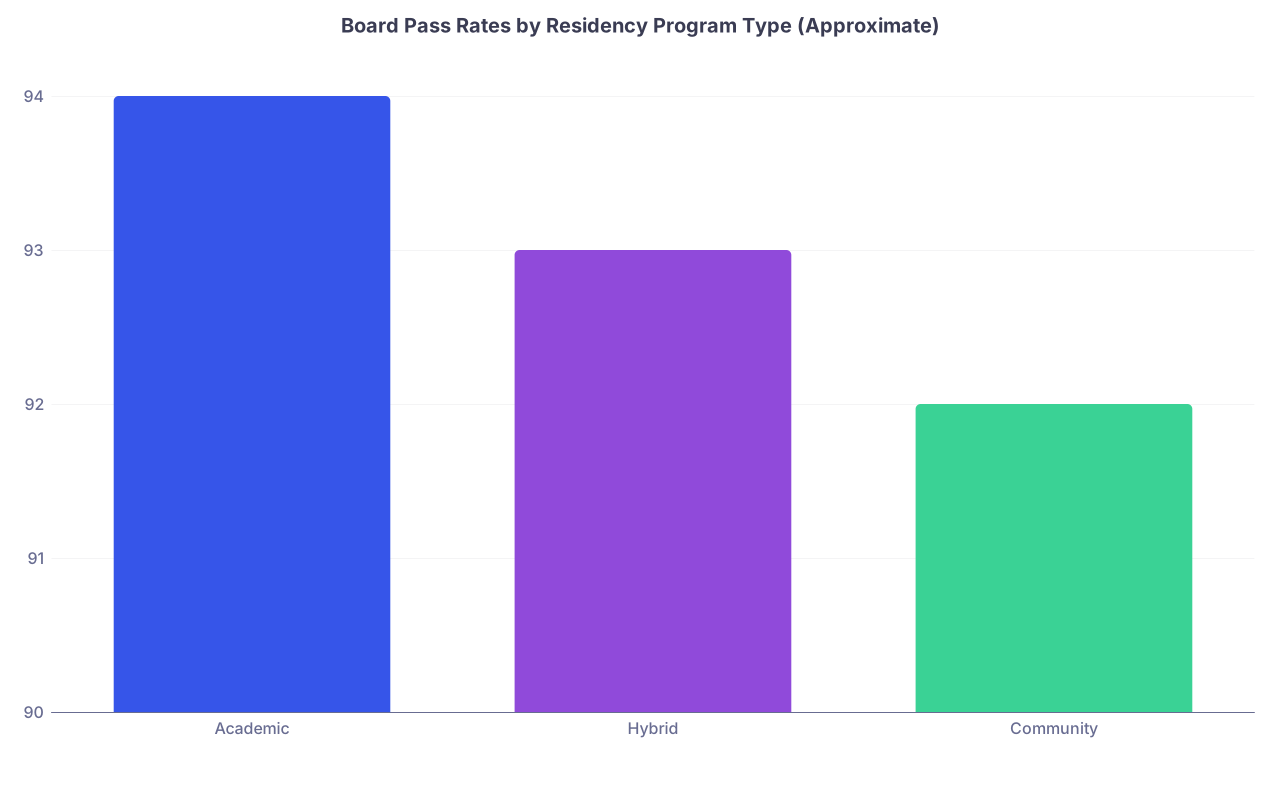
| Category | Value |
|---|---|
| Academic | 94 |
| Hybrid | 93 |
| Community | 92 |
Board pass rates for accredited programs? Usually clustered tightly in the 90%+ range, regardless of “academic” or “community”. That’s not destiny. That’s basically noise.
And here’s the part no one markets: your own variance dwarfs the program type.
The difference between a top 25% resident and a bottom 25% resident within the same program is enormous. The difference between an average resident at a “top” academic program and a star resident at a strong community program? I’d bet on the star ten times out of ten.
What Actually Changes Between Academic and Community
There are real differences between typical academic and community environments. They just aren’t moral judgments. They’re structural.
Academic programs: what they really give you
Stripped of the marketing, academic residencies usually mean:
- More subspecialty exposure and in‑house fellowships.
- Easier access to research infrastructure (IRB, statisticians, someone who knows how to get a project published without reinventing the wheel).
- Heavier presence of fellows, and sometimes less primary autonomy for residents on certain services.
- Bigger name on the CV—helpful, not magical.
You know what else they often mean? More bureaucracy. Slower decisions. Layers of hierarchy. I’ve watched PGY‑2s at brand‑name institutions begging for procedure opportunities while fellows did all the interesting stuff.
Community programs: what they really give you
Good community programs often have:
- More hands‑on autonomy earlier. You become the person who actually does the lumbar puncture, not the person who calls the fellow.
- High patient volume with fewer “zebra” cases but excellent bread‑and‑butter exposure.
- Less built‑in research, but more willingness to let you run a QI project or retrospective chart review if you push for it.
- Attendings who are clinicians first, researchers second (or not at all).
And yes, there are weak community programs that underperform. Just like there are academic programs coasting on a thirty‑year‑old reputation while their inpatient service is a mess and their residents quietly transfer out.
The label doesn’t protect you from dysfunction.
Fellowship and Career Goals: When Prestige Actually Matters
Here’s where nuance comes in. Sometimes, academic pedigree does matter. Just not in the simplistic “academic vs community” way people repeat without thinking.
If any of these are true for you, program reputation and research opportunities should be higher on your priority list:
- You already know you want a hyper‑competitive subspecialty at a “top tier” place (peds heme/onc at St. Jude, advanced heart failure at a major transplant center, elite surgical fellowships).
- You want a heavily academic career—R01‑chasing, K‑award trajectory, major research expectations.
- You care a lot about being at a place where everyone around you is publishing, presenting, and networking constantly.
In those cases, it’s not that a community program is impossible. It’s that you’re making your life harder if you choose a program where no one in the last 10 years has done what you’re trying to do.
But notice what I just said: look at actual outcomes, not the label.
If a “community” EM program consistently sends 2–3 residents per year into tox, ultrasound, or critical care fellowships at good academic centers, that’s real data. If an “academic” IM program hasn’t sent anyone to competitive cards or GI fellowships in years, the brand name on the hospital doesn’t fix that.
This is where most applicants screw up: they assume the category predicts the outcome. It doesn’t. The track record does.
The Parts of Training That Actually Shape Your Future
Here’s the boring, unsexy truth: your development as a physician comes down to a handful of factors that cut across the academic‑community divide.
Autonomy and responsibility
Do you get to make real decisions with appropriate supervision, or are you a cog copying orders? I’ve seen community grads who function like junior attendings by PGY‑3 and academic grads who still feel like glorified clerks.Case volume and mix
Are you seeing enough patients, with enough diversity, to be confident on day one of independent practice? The “perfect” academic program with low volume and overprotected residents can leave you undercooked.Mentorship that actually exists
Not the brochure list of 50 faculty “interested in mentoring”. The 2–3 attendings who know you well enough to write letters that glow instead of recite your CV.Support for your goals
That means explicit: “You want cards? Here’s what our last three cards fellows did. Here are the attendings who will help you get there. Here’s our history of placement.” Lots of programs talk a big game. Very few back it with data.Well-being and burnout
You can survive anything for three to seven years. But you won’t do your best work in a toxic culture that chews up residents. Some “prestige” programs are notorious for this, and people still line up to go there because… brand.
You want destiny? Those five things come closer than the “academic vs community” sticker on the door.
How To Judge Programs Without Falling for the Trap
Let’s get concrete. Say you’re holding two IM interviews:
- Academic university program in a mid‑sized city.
- Community hospital system with a “university affiliated” line on the website.
Both tell you, “We support all career paths.” Useless sentence. Everyone says it.
Here’s what you actually ask and look for:
“Can I see the last 3–5 years of fellowship and job placement for your graduates?”
If they hesitate, hand‑wave, or only talk about one superstar from 2016, that’s a red flag. Strong programs love to brag with specifics.“How many residents in the last few years have gone into X specialty?”
Listen for numbers and names, not adjectives. “Oh yeah, lots of people do that” is not an answer.“If I want research, what would that actually look like here?”
At an academic place, you should hear actual project types, faculty names, and expectations. At a community place, you want at least some path that doesn’t involve you reinventing academic medicine from scratch.“Who are the go‑to mentors for [your interest]?”
You’re listening for “Dr. Y has mentored A, B, and C—let me put you in touch; they matched at [fellowships/programs].”
Then watch what residents say when they’re not in the formal Q&A circle. I’ve heard:
- “If you want GI here, you basically have to be the top one or two residents in the class. It’s possible, but you have to start early.”
- “We’re ‘academic’ on paper but no one here really cares about research. People who try to do research get frustrated.”
- “We’re community but admin is very supportive of residents presenting at national conferences. They paid for 4 of us to go last year.”
All of that is vastly more predictive of your future than the academic/community checkbox.
The Credibility Problem: Big Names Don’t Always Mean Better Training
People hate hearing this, but some of the “prestige” programs are coasting.
I’ve seen:
- Big‑name surgical programs with horrific operative autonomy because of fellow saturation. Residents spend years retracting while the fellow and attending do the real case.
- Brand‑name IM programs where residents get destroyed with scut, cross‑cover 60+ patients at night, and have faculty too busy writing grants to teach.
- “Ivy”‑adjacent programs with toxic cultures where residents keep smiling for the Instagram account but quietly warn students away off‑camera.
And I’ve seen:
- Community EM programs producing absolute beasts in the ED—docs who can run three resuscitations at once because they had to in training.
- Community FM programs where grads are running full‑scope practices with OB, procedures, and inpatient medicine while some academic FM grads feel nervous managing diabetics without help.
Academic branding predicts prestige signaling. It does not reliably predict competence, wellness, or your happiness. Those come from the day‑to‑day reality on the ground.
Stop Treating Match Outcome Like a Personality Test
The last piece of this trap is psychological.
Students treat match day like a referendum on their worth. Academic = “I’m good.” Community = “I failed.” That mindset is poison. It pushes people to rank places they’d hate working at just to feel validated by a name. Then they’re three months into PGY‑1, miserable, and stuck.
I’ve watched:
- A student crushed because they matched their #4 “community” program instead of a coastal academic name—then end up as one of the strongest graduates in that region, with their pick of jobs and a fellowship offer.
- A student ecstatic about matching “top‑tier” out of state—who then quietly tried to transfer after PGY‑1 because the hours, culture, and lack of autonomy were brutal.
You are not your match letter.
You’re what you do with the training you get.

If You Remember Nothing Else
Three points, stripped of all the noise:
Academic vs community is not destiny. It’s a shorthand for environment, not a prophecy. Outcomes depend far more on the program’s actual track record and what you do as a resident than the label on the website.
Look at evidence, not branding. Ask for fellowship and job placement lists. Probe for real mentorship, research pathways, autonomy, and culture. Believe data over logos.
Optimize for fit and growth, not ego. The “less prestigious” program where you get volume, support, and responsibility will beat the fancy name that burns you out and sidelines you. Every time.
Avoid the prestige trap. Choose the place that will make you the best version of the physician you actually want to be—not the one that looks best in your group chat screenshot on match day.