
Does a Rough Match Day Predict Burnout? Separating Fear from Facts
What if Match Day goes badly—partial match, SOAP chaos, backup specialty—does that doom you to burnout and misery in residency?
Let me be blunt: this fear is everywhere. I hear versions of it constantly:
- “If I have to SOAP, I’ll never be happy in residency.”
- “Not matching my top choice city means I’ll burn out.”
- “If I switch into a backup specialty last-minute, I’m setting myself up for regret.”
Emotionally? Understandable. Factually? Mostly wrong.
Match Day is a huge emotional spike. But burnout is a slow-burn, multi-factor process. You’re confusing a storm with the climate.
Let’s dismantle the biggest myth first.
Myth: A Bad Match Day = Inevitable Burnout
Here’s the story students tell themselves: “People who have a smooth match are fine. People who SOAP, get their 8th choice, or end up in their backup specialty are destined for burnout.”
That’s not what the data says.
Most burnout research in residents and attendings doesn’t even measure how Match Day went.
They look at things like:
- Work hours and schedule control
- Sleep deprivation
- Mistreatment and toxic culture
- Documentation burden, EMR nonsense
- Loss of autonomy and misalignment with values
- Under-support, poor supervision, unsafe staffing
Notice what’s missing? “Order on the rank list where you matched.”
What studies actually show
Take large studies of resident burnout—EM residents, IM, surgery, OB/GYN. The consistent predictors are:
- High workload / poor work-life integration
- Lack of control over schedule
- Institutional support (or lack thereof)
- Feeling undervalued or disrespected
- Depression/anxiety history, personality factors (perfectionism, low self-compassion)
Match Day drama is…not on the list.
Does that mean Match Day doesn’t matter at all? No. It matters in indirect ways:
- It can influence where you train → which can influence workload, culture, support.
- It can change specialty → which changes lifestyle and stress profile.
- It can impact your story you tell yourself about your career → which absolutely affects burnout risk.
But the simplistic cause-and-effect—“rough Match Day → inevitable burnout”—is a myth.
What Actually Predicts Burnout (And How Match Day Fits In)
If you want a grown-up, data-based view, think of burnout as the end result of a bunch of interacting variables. Match Day is one tiny piece.
1. Environment beats moment
Residents in malignant, chaotic programs burn out at far higher rates than those in supportive, structured ones—even in the same specialty, similar hours.
What matters:
- Psychological safety: can you ask dumb questions without getting shredded?
- Support: do seniors/attendings help when you’re drowning or just say “figure it out”?
- Fairness: are evaluations, schedules, and opportunities reasonably equitable?
- Learning culture: is the focus on growth, or on humiliation and blame?
Did your Match Day go sideways and you ended up at your #12 in a city you hated? That’s not ideal. But if #12 has a sane program culture, it may still beat a “dream city” malignant residency.
People dramatically overestimate geography and prestige, and underestimate day-to-day culture.
2. Specialty places a bigger bet than the specific Match Day outcome
If we’re talking about meaningful, long-term burnout risk, specialty choice matters much more than whether you matched your #1 vs #6 vs SOAP.
Some specialties have:
- Higher baseline burnout (EM, neurology, surgery often come up)
- More chaotic schedules (EM, surgery, OB)
- More “moral injury” exposure (critical care, oncology)
Now here’s the twist: some people are happier long term because Match Day “forced” a backup specialty that actually fits them better as humans.
I’ve seen:
- A mildly introverted student who failed to match derm, SOAPed into IM, later became a heme/onc attending and told me, “Dodged a bullet. I actually like talking to patients.”
- A student who didn’t match ortho and went into anesthesia, now with a stable schedule and high satisfaction while many of his ortho friends are miserable but feel stuck.
Your imagination of a specialty at 25 is not a flawless predictor of satisfaction at 40.
3. Personal narrative is dangerously underrated
Here’s where Match Day does matter, and not because of the program name on your badge.
What really bites is the narrative you build in your head:
- Version A: “I didn’t match well. I’m a failure. I’m trapped in a second-rate life.”
- Version B: “Match was brutal, but I landed somewhere solid. I can still build the career I want, just along a different path.”
Same objective outcome. Completely different burnout trajectories.
Shame, rumination, and constant comparison are accelerants for burnout. The research on self-compassion and physician mental health is surprisingly strong. People who can be decent to themselves when they stumble do better over time.
Match Day ego injuries hurt. But whether you salt the wound daily for three years—that’s where the damage really comes from.
Harsh Reality: Who’s Actually at Higher Risk After a Rough Match
Let’s be very clear: a rough Match Day can increase burnout risk. Just not for the cartoon reasons you hear on Reddit.
People at higher risk after a difficult match are usually in one (or more) of these groups:
You never actually processed the grief.
You slapped on a smile, said “I’m grateful I matched at all,” and moved on. Except you didn’t. You buried anger, shame, and disappointment. It leaks out later as cynicism, disengagement, or passive-aggressive bitterness.You truly ended up in a terrible fit.
Example: high-sensory, anxious person forced into EM or surgery via SOAP with no real exploration or consent. Or someone with strong outpatient/relationship orientation thrown into a high-acuity ICU-heavy setting they despise.You were already on shaky ground mentally.
Prior major depression, anxiety disorders, trauma, thin support network. A brutal Match amplifies this. Not because Match Day is magical, but because it’s a big stressor layered on an already fragile foundation.You’re trapped in the comparison loop.
You’re the one doom-scrolling Instagram on Match Day + 1, watching your classmates at “dream programs” and using that feed as a daily self-attack. That drip of envy and resentment is corrosive.
None of this is fate. But pretending this stuff does not matter is just as wrong as saying Match Day seals your destiny.
What the Data Supports: Key Predictors Side by Side
Let’s pin this down a bit more concretely.
| Factor | Strength of Evidence for Burnout Risk |
|---|---|
| Work hours / workload | Strong |
| Program culture / mistreatment | Strong |
| Sleep deprivation | Strong |
| Pre-existing depression/anxiety | Strong |
| Specialty choice characteristics | Moderate–Strong |
| Geographic location | Weak–Moderate |
| Matched rank position (#1 vs #6) | Weak |
Notice where “rough Match Day” actually lives: in matched rank position and maybe geographic location. Those are not nothing. But they are not destiny.
SOAP, Backup Specialties, and “Settling”: What Actually Happens
The most catastrophized scenario: not matching, then SOAPing into something “you never wanted.”
I’ve tracked a decent number of these stories over years. The outcomes are more mixed—and less catastrophic—than students expect.
Common real-world patterns
- Initial months: grief, embarrassment, anger, identity hit.
- 6–12 months in: either “This isn’t so bad” or “Yeah, this really isn’t for me.”
- 3–5 years out: far more variation than you’d think.
I’ve seen SOAPed residents who:
- Fell in love with the specialty once they stopped comparing it to their fantasy one.
- Used the residency as a launchpad into fellowships that actually aligned with their original interest (e.g., SOAP into IM, eventually palliative care, addiction medicine, cards, critical care, etc.).
- Finished, decided “this isn’t me,” and re-trained or pivoted careers—painful, but not life-ruining.
And yes, I’ve also seen people who stayed bitter for years. Not because of the SOAP per se, but because they never updated the story in their head from “I got screwed” to “Now what can I build from here?”
What You Should Focus On Now (Before Match Day)
If you’re pre-Match or pre-SOAP and spiraling, here’s the uncomfortable truth: you can’t control the exact line on the NRMP results screen. You can absolutely influence your burnout risk anyway.
Focus on variables that matter long term:
- Rank list based on fit and culture, not just name and city. Ask residents real questions: “Who leaves? Why?” “Who has your back on your worst days?”
- Be honest about specialty strengths and your personality. If you hate chaos, constant codes, and night shifts, maybe don’t hinge your identity on EM or trauma surgery.
- Build a support network outside Instagram-flex medicine—friends, family, mentors who aren’t impressed only by big-name programs.
You’re not picking a fairytale. You’re picking a work environment you’ll live in 60–80 hours a week.
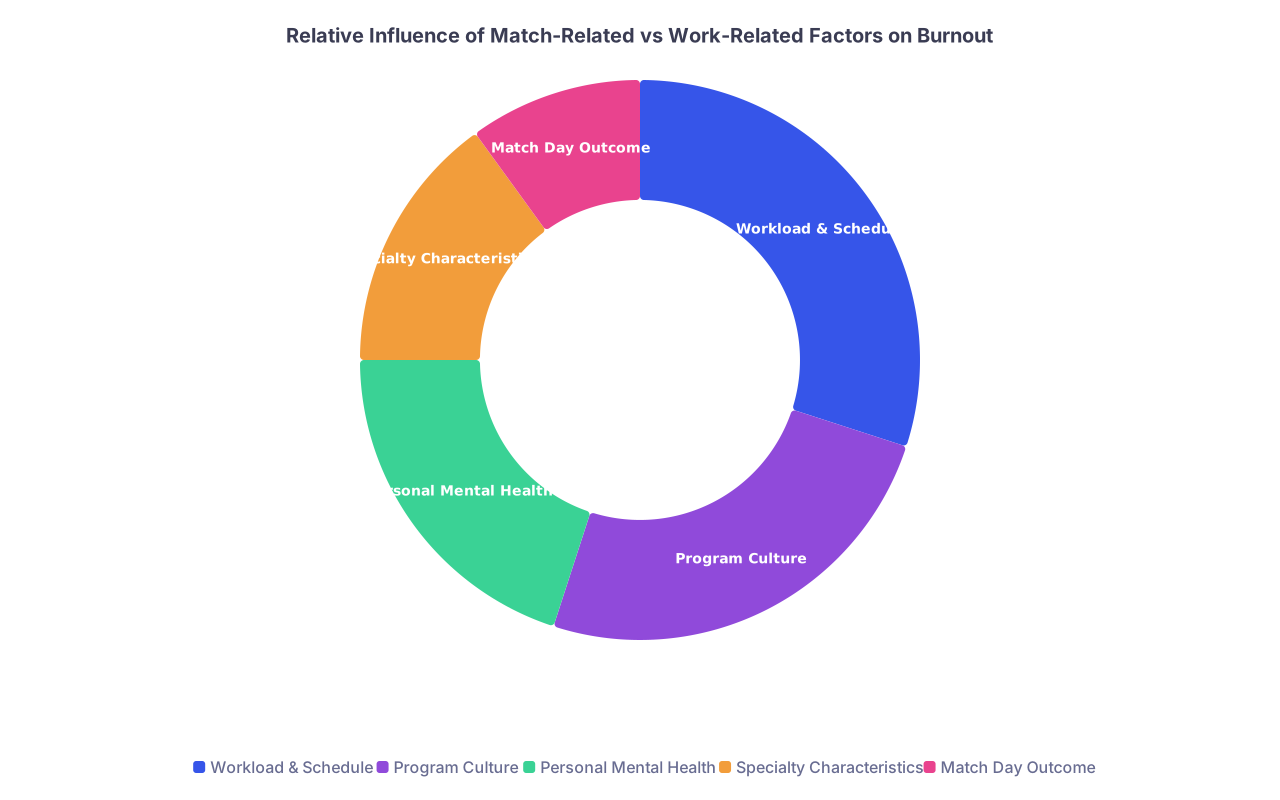
| Category | Value |
|---|---|
| Workload & Schedule | 30 |
| Program Culture | 25 |
| Personal Mental Health | 20 |
| Specialty Characteristics | 15 |
| Match Day Outcome | 10 |
Those numbers aren’t exact; they’re conceptual. But they’re a more accurate mental model than “Match Day or bust.”
If Match Day Already Went Badly: How Not to Make It Worse
Let’s say the damage is done. You SOAPed. You matched far down your list. You’re staring at a program brochure for a city you swore you’d never live in.
Fine. Reality check time.
Here’s what actually helps prevent this from snowballing into burnout:
Name the loss. Actually grieve it.
Yes, you’re allowed to be upset. About not matching your top choice, about losing a certain imagined life. What derails people is demanding that they skip grief and jump straight to “gratitude.” You can be grateful and sad.Separate “this is not what I wanted” from “this is doomed.”
Both are stories. The first is just accurate. The second is a prediction disguised as a fact. And a bad one.Gather real data on your actual program.
Not rumors. Ask current residents candidly about:- Call schedule and backup
- How leadership responds when things go wrong
- How many residents leave or change paths
Some people discover their “disappointing” program is…quietly solid.
Start shaping the experience early.
Residents who stay afloat after tough matches are usually the ones who:- Find at least one decent mentor early
- Carve out a micro-identity (research niche, teaching, advocacy, QI project)
- Define some boundary (sleep, therapy, exercise, faith, whatever)
You’re not choosing between “perfect match” and “burnout.” You’re working with less-than-ideal cards, which is frankly a core skill of being a physician.
One More Uncomfortable Truth: Prestige Myths Feed Burnout
There’s a hidden engine behind a lot of this anxiety: prestige worship.
The idea that:
- Top-5 program → happy career
- Mid-tier or community program → compromised future, higher burnout
This is fantasy. I’ve met utterly burned-out attendings from brand-name programs and deeply content ones from community places you’ve never heard of.
What does happen is this: If you believe prestige = worth, and you did not match “prestige,” you walk into residency already convinced you’re behind. That belief will tear at you for years if you don’t kill it.
Success in medicine is more path-dependent than brand-dependent:
- Are you in a setting where you can get decent letters, skills, and opportunities?
- Do you show up reliably, learn fast, not be toxic?
- Can you advocate for yourself when you need something?
Those traits travel. The program name doesn’t do the work for you.

| Step | Description |
|---|---|
| Step 1 | Match Day Outcome |
| Step 2 | Shame and comparison |
| Step 3 | Adaptation mindset |
| Step 4 | Less engagement and support seeking |
| Step 5 | Higher burnout risk |
| Step 6 | Seek mentors and support |
| Step 7 | Meaningful work and boundaries |
| Step 8 | Lower burnout risk |
| Step 9 | How do you interpret it |
That fork—how you interpret what happened—is more powerful than the exact content of the email you got on Match Day morning.
FAQs
1. If I SOAP into a specialty I never considered, should I plan to reapply immediately?
Not automatically. Sit with it. Learn about the specialty from people who actually practice it, not your panicked classmates. If after a year you still feel persistent misfit—values, day-to-day work, long-term lifestyle—then talk with trusted mentors about reapplying or pivoting. Knee-jerk reapplications from a place of shame usually go poorly.
2. Does matching at a community program increase my burnout risk compared to an academic center?
Not inherently. Some community programs have better culture, saner workloads, and more support than big-name academic hospitals with malignant norms. Burnout tracks more with workload, autonomy, and culture than with whether the place has a med school attached. Look at reality, not labels.
3. I matched my #1 program but I’m still terrified of burnout. Is that irrational?
No. Burnout isn’t “for people who didn’t match well.” It’s a systems problem that affects residents across the spectrum, including golden-child, top-program types. Your fear is a signal: be intentional about boundaries, relationships, and mental health from day one instead of believing a strong Match insulates you.
4. How long should I give a “disappointing” residency before deciding I made a mistake?
Usually at least 6–12 months, unless the program is clearly unsafe or overtly abusive. The first few months of any intern year are rough, even at dream programs. Once you’re a bit more competent, less overwhelmed, and have a sense of the culture, you can better judge: is this general residency pain, or true fundamental misalignment?
Key points:
- A rough Match Day does not predict burnout; it just changes some of the variables you’ll manage.
- Environment, workload, mental health, and narrative matter far more than whether you matched #1 or SOAPed.
- You still have enormous power—before and after Match Day—to shape your trajectory away from burnout and toward a career that’s actually livable.