
62% of residents are not in the specialty they initially named as their “top choice” in MS2–MS3 surveys.
Yet every March, I hear the same line in hallways and group chats: “If I don’t match into my dream specialty, my career is over.”
No. It isn’t. And the data does not support that fear-driven myth.
Let me be blunt: matching outside your dream specialty can close some doors, but it does not “ruin” your future options. The problem is that students hear the most extreme stories and assume they’re universal. The neurosurgery PGY‑2 who could not lateral over anywhere. The derm hopeful who ended up in a prelim transition and then… vanished. Those stories exist. But they’re the exception, not the base rate.
Let’s walk through what actually happens to people who do not land their first-choice specialty — and what pathways still exist.
What Actually Happens After an “Off-Target” Match
Every year, thousands of people match into something other than what they initially wanted.
NRMP and AAMC surveys of graduating students show that many change their intended specialty multiple times between MS1 and Match Day. And a big chunk of those who don’t get their first choice still go on to careers they are satisfied with.
Here’s the uncomfortable truth: the people screaming that “you’ll be trapped forever” are usually either:
- In ultra-competitive fields with extremely narrow windows (plastic surgery, derm, neurosurgery), or
- Repeating high-anxiety folk wisdom they heard from someone else and never checked against reality.
The real landscape is more nuanced.
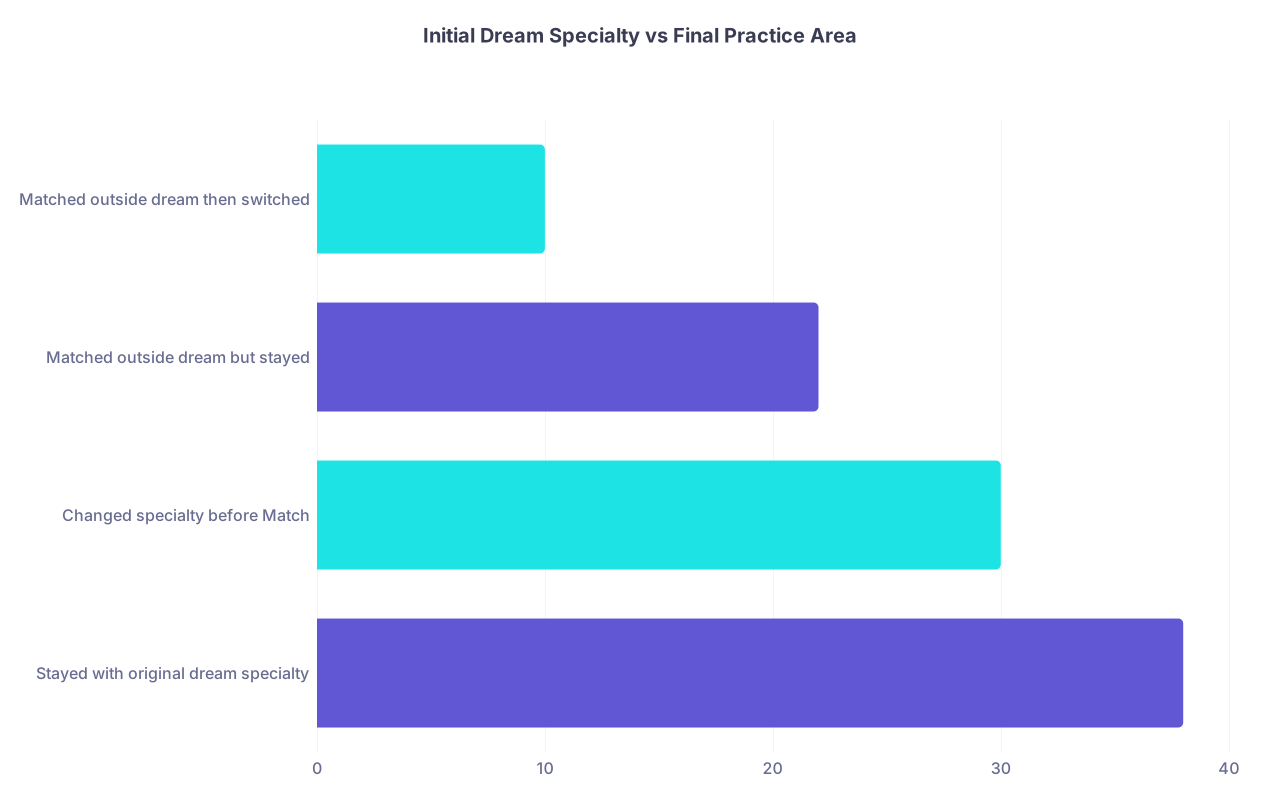
| Category | Value |
|---|---|
| Stayed with original dream specialty | 38 |
| Changed specialty before Match | 30 |
| Matched outside dream but stayed | 22 |
| Matched outside dream then switched | 10 |
Those numbers are approximate from longitudinal survey and workforce data, but the shape is consistent across multiple studies: a substantial minority end up switching specialties either before or after residency starts. And their careers are not “ruined.” They’re practicing physicians, some in very competitive fellowships.
The key distinction you need to understand is this:
You’re not choosing “dream vs ruined life.” You’re choosing between:
- “straight path into one specific field,” versus
- “more complex path that may include detours, extra years, and some risk — but still very much alive options.”
Myths vs Data: Are You “Locked Forever” Once You Match?
Let’s dissect the big myth: “Once you match into X, you are stuck in X forever.”
Wrong. But also… it depends.
There are three different situations people conflate:
- Switching specialties during or after a categorical residency
- Using one specialty to springboard into another via fellowship
- Being in a transitional or prelim year and trying again
Those are not the same thing, and the probabilities are different for each.
1. Switching Residencies: Hard, But Absolutely Happens
Residents do switch programs and specialties. I’ve watched:
- An anesthesia resident move into radiology
- A general surgery PGY‑2 switch to anesthesiology
- An internal medicine resident move into neurology
Is it common? No. Is it possible? Very much yes.
Residents who successfully switch usually have three things:
- Strong performance (solid in-training scores, good clinical evals)
- Clear documented interest in the target specialty (electives, research, mentorship)
- A program director willing to help, not sabotage
Programs sometimes even prefer a PGY‑2+ switcher because:
- They’re already battle-tested in the hospital system
- They require fewer “socialization” resources
- They often have proven work ethic and maturity
The main constraint is spots. There are not that many open PGY‑2+ positions in any given year. So this route is possible, but not something you should count on as a primary plan. Think of it as a real but narrow door.
2. “Backdoor” Paths Through Fellowships
This is where people are shockingly misinformed.
You’ll hear, “If you don’t match neurology, just do psych and then a neuro fellowship,” or “Can’t get EM? Do IM then ICU and work in the ED.”
Most of that advice is garbage.
Some specialties have legitimate secondary pathways; others really do not. Here’s a simplified reality check:
| Goal Field | More Realistic Indirect Path | Mostly Unrealistic Path |
|---|---|---|
| Cardiology | IM → Cardiology fellowship | Anything not IM |
| GI | IM → GI fellowship | FM → GI (rare, almost dead) |
| PICU | Peds → PICU fellowship | EM → PICU (rare, niche) |
| Pain Med | Anes / PM&R / Neuro / Psych | IM only (possible but harder) |
| EM | EM direct match, rarely FM/IM→EM | “ICU then EM” fantasy |
Notice the pattern: subspecialties that are structurally built as fellowships from a “core” specialty (cards, GI, heme/onc, critical care, rheum, allergy, etc.) leave you with real options even if you don’t match your dream subspecialty first time around.
On the other hand, ultra-competitive core specialties with tiny positions per year (derm, plastics, neurosurgery, ENT, urology, ophtho) are much harder to backdoor into. Once you’re on a totally different track, lateral movement is rare and painful.
So if your “dream specialty” is already a fellowship-based field, not matching it on round one is usually a setback, not a death sentence. You can:
- Match into the core (IM for cards, GI, heme/onc, etc.)
- Build a serious fellowship application from inside
- Re-apply later with a much stronger story
That is not fantasy. That’s standard practice.
3. Transitional/Prelim Years Then Reapply
If you matched a prelim medicine or surgery year but not the advanced specialty you wanted (say, anesthesia, radiology, derm), are you sunk? No.
Plenty of people:
- Do a prelim year
- Network, get fresh letters, reapply
- Match their target specialty the second time
Is it stressful? Absolutely. Do some people end up in limbo or scrambling into things they do not love? Yes. I’m not sugarcoating that.
But the binary framing — “hit your dream on first try or life ruined” — is just wrong. A prelim year often increases your matchability because programs can see your actual performance as a physician, not just as a student.
The “Dream” vs “Good Life” Problem
Another overlooked piece: your 24-year-old idea of a “dream specialty” is based on:
- A few rotations
- What residents on Reddit are screaming about
- Lifestyle rumors in the lounge
- How much you enjoyed (or hated) that attending who took you for coffee
Longitudinal data from multiple countries shows that job satisfaction among physicians is not cleanly predicted by specialty choice alone. It’s more associated with:
- Autonomy
- Practice environment
- Workload control
- Supportive colleagues
- Geographic fit (being near family, decent schools, etc.)
You know what barely moves the needle once you’re 15 years out? Whether you picked GI vs Cards. Or EM vs IM-hospitalist.
I have watched:
- A devastated near-derm-miss who ended up in IM, did rheumatology, now happily running a mixed clinic in a mid-sized city, never wants derm anymore
- A “failed ortho” who matched general surgery, then trauma/critical care — now the person everyone calls when things are on fire, and loves it
- Several former “I must be in EM” students who ended up in FM or IM and are quietly very glad they did, given EM’s current market chaos
Matching outside your dream can reveal that your dream wasn’t actually about the work. It was about lifestyle narratives, money myths, or prestige chasing.
Does that mean you’ll automatically be happy anywhere? No. Some mismatches are real. But this idea that only one narrow specialty leads to a good life is fantasy.
When Matching Outside Your Dream Does Close Doors
Let me not be pollyanna about this. There are real losses.
If your dream is:
- Dermatology
- Plastic surgery
- Neurosurgery
- ENT
- Ophthalmology
- Integrated vascular or CT surgery
…then not matching these on first pass can seriously limit chances of ever doing them. People occasionally retool via research years, second matches, or lateral transfers, but the denominators are large and the success stories are few.
Even there, though, “ruin” is overstated.
You may lose the field, but you do not lose:
- The ability to make good money
- The ability to have a life outside work
- The ability to find intellectually heavy, procedure-heavy, or whatever-heavy work you crave
I’ve seen a would-be neurosurgeon end up doing IR via radiology. A would-be plastic surgeon thriving in hand surgery through ortho. These are not consolation prizes. They’re excellent careers that scratched similar itches.
What does get harder the further you go:
- Switching to something with a totally different training structure
- Getting into very small fellowships from “non-traditional” bases
- Undoing geographic or family commitments built around your first match
So yes, some doors narrow or close.
But “narrower field of options” is not the same as “ruined life.”
The One Variable You Actually Control: How You Respond
Here’s what the data and real-life outcomes consistently show:
Your reaction to an off-target match predicts your eventual satisfaction more than the specific field you land in.
I’ve seen two archetypes:
The “My life is over, I’m trapped” narrative
They:- Do the bare minimum
- Stay bitter
- Don’t seek mentors or new opportunities
- Keep living in an alternate universe where they should have been in something else
Unsurprisingly, they confirm their own story: “See? I hate this.”
The “This is not what I planned, but I’ll play the hell out of this hand” narrative
They:- Ask honestly: “What do I like and not like here?”
- Hunt for niches within the specialty they enjoy (procedures, inpatient vs outpatient, academic vs community)
- If they still want to switch, treat their current position as a launch pad — stack research, letters, networking, solid performance
These people either end up loving their original “backup” specialty or credibly pivot.
And programs pay attention. A PGY‑1 who crushes it in IM and says, “I’m interested in cards, here’s the work I’m doing,” gets real mentorship. The sulking “I wanted ortho” intern who acts checked out? Doors close fast.
What You Should Actually Be Doing Before and After Match Day
Before Match Day:
- Stop talking about specialties like soulmates. You’re picking a domain of problems and patients to spend a few decades with. Not a magical identity.
- Look hard at second-choice fields. Not as scraps, but as serious candidates with different pros/cons — research, lifestyle, job markets.
- Be honest with yourself about competitiveness. If your scores and application put you in the bottom quartile for derm, maybe “derm or bust” is actually “bust.”
After Match Day, if you didn’t land your dream:
- Give yourself 48–72 hours to feel whatever you feel. Anger, grief, embarrassment — all of it. Then stop catastrophizing.
- Learn your new specialty for what it is, not what you assume. Talk to seniors who actually like it. Not just the angry ones.
- Decide: am I going to commit fully to this path, or am I going to spend the next 1–2 years building a real, data-backed plan to try to switch or subspecialize?
Either choice can be rational. Half-committing to both is what wrecks people.
So, Does Matching Outside Your Dream Specialty Ruin Future Options?
No. It changes them.
Some doors close, especially for tiny, ultra-competitive surgical or lifestyle specialties. Many doors remain wide open, particularly if your dream was a fellowship-based field. And new doors appear — ones you didn’t even know existed when you were an MS3 worshiping at the altar of some Reddit-fueled dream.
The three key truths to keep in your head:
- You are not “locked forever” by a single Match result, but later moves become progressively harder, rarer, and more dependent on your performance and attitude.
- A huge chunk of long-term career satisfaction comes from factors you can influence in almost any specialty: autonomy, colleagues, practice setup, and boundaries.
- What ruins careers is usually not missing a dream specialty. It is responding to that miss with bitterness, passivity, or denial instead of a clear-eyed new plan.
Match Day feels like a verdict. It is not. It is just your starting position on the board. What you do with it still matters more than where you land.