Matching low on your rank list is not a tragedy. It is a story you have to grow into. The myth is that it’s a life sentence.
That myth needs to die.
Every March I hear the same whispered line in hallways and group chats: “They matched at #12… they’re screwed.” As if the NRMP algorithm secretly punishes you for not going to your dream program. As if #1 on your list automatically means career gold and #8 means you’ll be a mediocre doctor forever.
The data simply do not support that.
Let’s pull this apart.
The Ranking Myth: Lower Match = Lower Career Ceiling
The dominant narrative goes something like this:
Top of your list = best fit, best training, best networking, best fellowship.
Bottom of your list = you settled, you’re behind, you’ll always be playing catch-up.
That sounds tidy. It’s also wrong in three specific ways.
- Your rank list is not an objective quality scale.
- Outcomes depend far more on you than on small differences between reasonably similar programs.
- “Low on your list” usually means “still in a range of acceptable options you chose,” not “dumpster fire.”
Let’s start with how much rank order even matters in the first place.
| Category | Value |
|---|---|
| 1st | 45 |
| 2nd | 20 |
| 3rd | 10 |
| 4th-5th | 12 |
| 6th-10th | 8 |
| 11th+ | 5 |
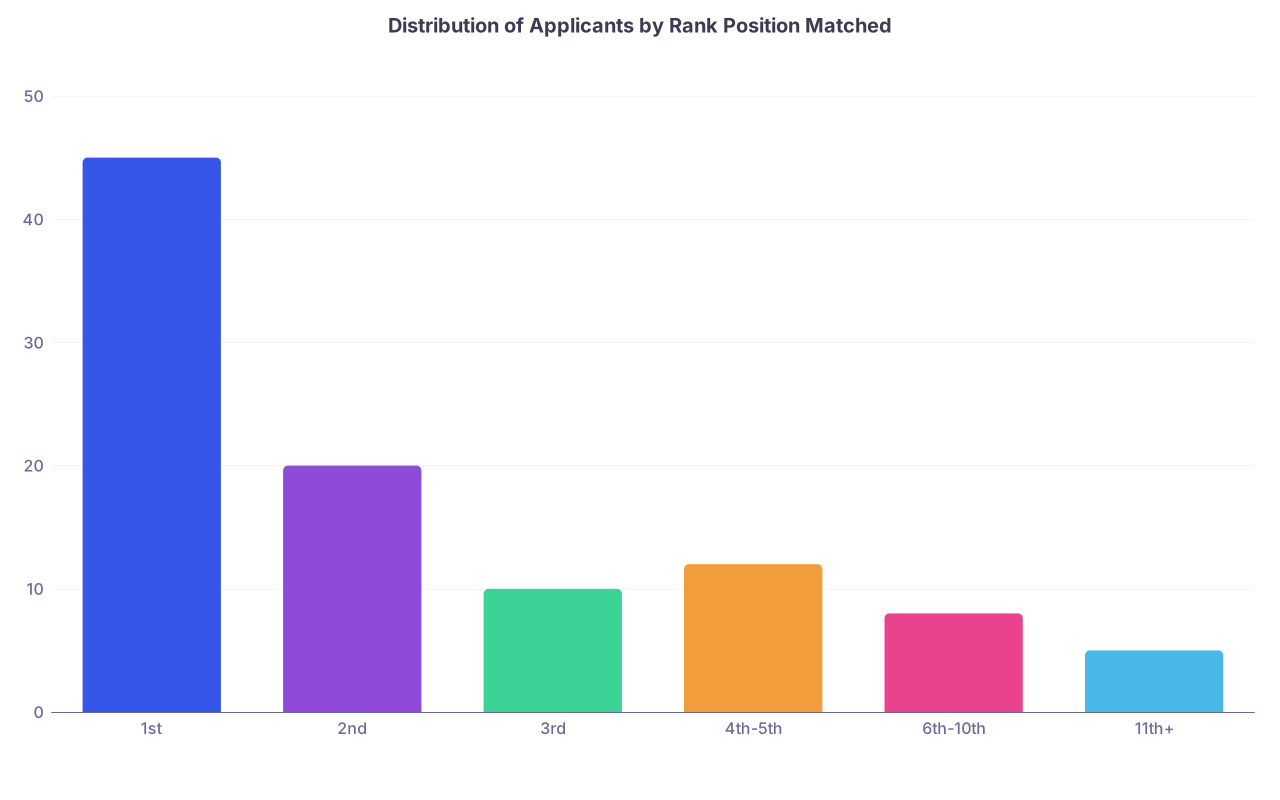
That rough pattern matches years of NRMP data: a big chunk match at or near the top of their list, then it tapers off. But look at the tail. A non-trivial number of people match at 6th–10th, or lower. Every year. They do not collectively become worse doctors.
Here’s the uncomfortable truth: your personal rank list is built on incomplete information, emotional noise, and 15-minute faculty conversations. You probably visited each program for what—8 hours? 10 if they fed you dinner?
You saw the best version of that place on its best-behaved day.
The difference between your #3 and #9 is often:
- Who smiled at you on interview day
- How tired you were during the pre-interview dinner
- Whether a senior resident said, “We have great fellowship placement” in a confident tone
That’s nowhere near enough granularity to declare your #3 objectively superior to your #9 for the next 3–7 years of your life.
But the panic comes from somewhere deeper: fear that being “lower ranked” means you will now be a weaker applicant for fellowship or jobs. Let’s look at what actually moves the needle.
What Actually Predicts Fellowship and Career Outcomes
Program name does matter at the extremes. Matching dermatology at UCSF vs a tiny, brand-new community program? Yes, that difference is real for certain doors.
But we’re not talking about that edge case. Most people stressing about “I matched at #8” made a list of schools that were all reasonably solid.
Inside that normal tier, outcomes splinter much more by resident performance than by minor variation in program prestige.
If you look at what fellowship directors and employers say (and yes, they’ve actually been surveyed), it’s the same shortlist over and over:
- Objective clinical performance (evaluations, letters)
- Reputation of your specific faculty letter writers
- Research productivity if you’re going academic or competitive fellowship
- How convincingly you show up in interviews and recommendation letters
- Board scores and in-training exam patterns (for some fields)
Your exact rank position where you matched? Nobody asks.
To make this less abstract, think about the residents you’ve seen:
- The star who matched at their “safety” program after an unlucky interview season. They still crushed research, took on leadership roles, and matched GI or Cards at a major academic center.
- The resident who matched at a “dream” big-name place and then coasted—mediocre evaluations, no real mentorship, burned-out, ended up in a perfectly fine but unremarkable job.
I’ve seen both. Multiple times.
To drive home how much the individual can outrun the program label, here’s a simplified comparison.
| Factor | Impact on Future Opportunities |
|---|---|
| Clinical performance evals | Very high |
| Strength of letters | Very high |
| Resident initiative / ownership | Very high |
| Research output (field-dependent) | Moderate–high |
| Program overall prestige | Low–moderate in mid-tier |
That’s not opinion. That lines up with survey data from fellowship directors in IM, anesthesia, surgery, and others. When they rank importance, program name is there—but not at the top.
Where you land on your list is mostly a psychological label, not an objective measure of “ceiling.”
The Real Effects of Matching Low: It’s Mostly Emotional, Not Structural
Matching low on your list hits like a gut punch because it violates the story you were already telling yourself.
You’d mentally moved into that city. Imagined the badge. Stalked the program’s Instagram. Told your parents, “I’ll probably end up at X.”
Then the screen shows you Y.
I’ve watched that play out in real time on Match Day. One student hugging friends, then slipping into a stairwell alone to cry because they weren’t going to their top 3. Another quietly saying, “I matched, but…” and trailing off. You know the rest of that sentence.
Here’s what is actually happening in that moment:
- Loss of a fantasy, not objective evidence your career is worse
- Social comparison—“they got their #1, I didn’t”
- Catastrophic thinking: “If I didn’t get my top choice now, I’ll always be behind”
The problem is not that matching at #8 is inherently bad. The problem is that you attached status and self-worth to the top of your list.
That doesn’t mean the disappointment is fake. It’s very real. But conflating “this hurts” with “this ruins my trajectory” is the exact myth that punishes people for years.
Where the emotional fallout can become structural is if you respond badly:
- You withdraw, sulk, and stay half-attached to your “what if” program
- You treat your PGY-1 year as something happening to you instead of something you’re actively shaping
- You show up as bitter, which residents and faculty notice fast
That’s how a lower-ranked match can become self-fulfilling. Not because of the program. Because you observed a loss and then kept re-losing it in your head for months instead of engaging.
What the Data Say About “Second-Tier” Programs
Let’s talk concretely. Suppose you ranked like this for internal medicine:
- Big-name coastal academic powerhouse
- Famous Midwest university
- Regional academic center with good subspecialties
4–10. Mix of solid university-affiliated and larger community programs
11+. Small community or more rural programs
And you matched at #9.
Your brain tells you: I dropped from “academic-track, fellowship guaranteed” to “middle-of-nowhere, no one will know me.” Reality usually looks more like this:
- You’re at a program with ACGME accreditation, program requirements, and a defined curriculum
- They send a couple people to fellowship each year, a couple to hospitalist jobs, a couple to primary care
- You have attendings who trained at big-name places scattered across your faculty—people who can write real letters
- Their fellowship match list includes at least a few recognizable names over the last 5–10 years
If you’re curious, almost every program has this data visible if you dig. Look at their website. Ask current residents. Check where their alumni went.
| Category | Academic Fellowships | Community Fellowships | Hospitalist/Other |
|---|---|---|---|
| Big-name Univ | 60 | 20 | 20 |
| Regional Univ | 40 | 30 | 30 |
| Large Community | 25 | 35 | 40 |
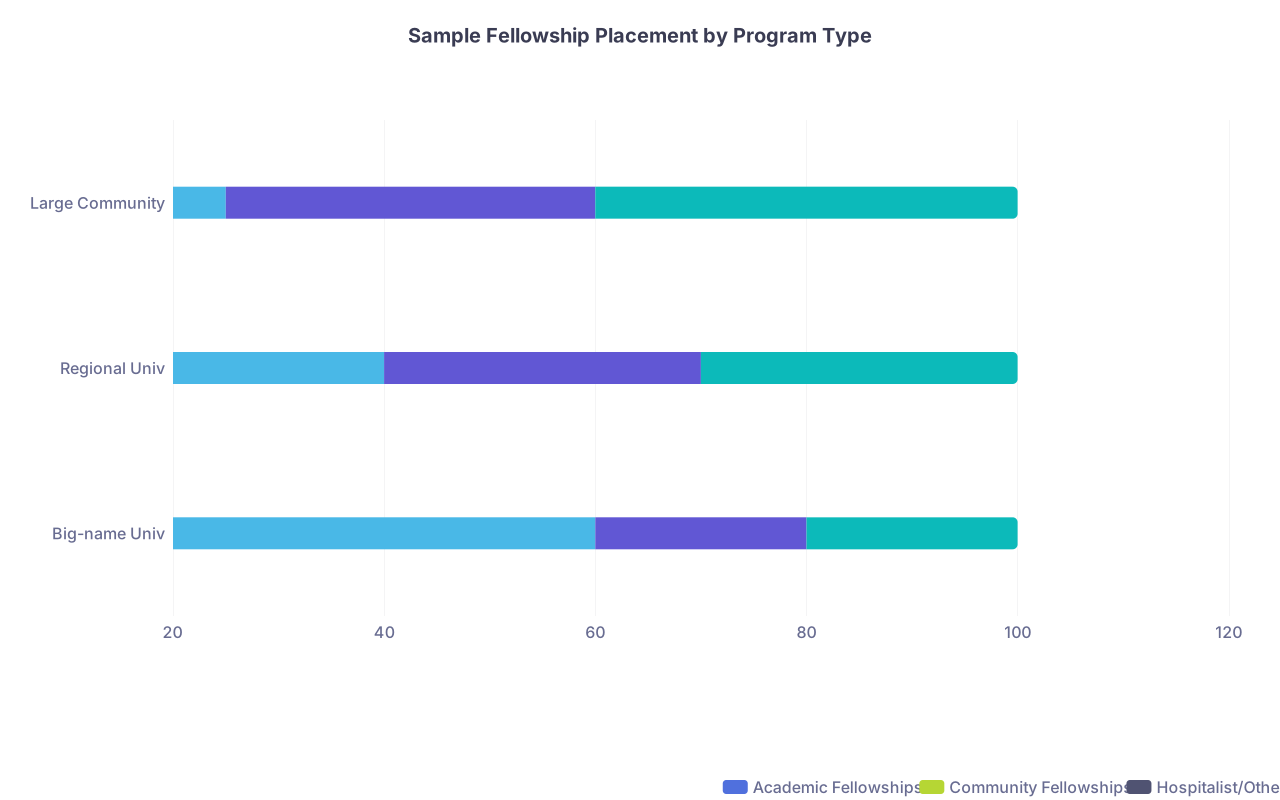
See the pattern? Yes, top-university programs produce more academic fellows. But regional universities and large community programs also send people to both academic and community fellowships. Not zero. Not rare. Just requiring more individual initiative.
The spread isn’t “door open vs door closed.” It’s “door opens automatically vs you needing to knock with stronger letters and maybe some research.”
If you show up to a solid “lower-ranked” program and:
- Ask early, “Who here is good at getting residents into cardiology/critical care/etc.?”
- Attach yourself to the faculty who actually mentor
- Say yes to the right projects (not every QI busywork, but real outcomes or publications)
- Aim for strong rotation evals early and often
you can absolutely match competitive fellowships from programs that were #8 on your list. That’s not theoretical. Cardiology, GI, heme/onc fellows come out of these places every year.
The program doesn’t doom you. Your passivity would.
How to Turn a “Low” Match into a Strong Launchpad
Let’s move from theory to practice. You matched “lower than you hoped.” Now what.
1. Give yourself 48–72 hours to be disappointed—then cut it off
You’re human. You cared. You’re allowed to feel it.
But set a time box in your head: “I get to be mad/sad/dazed for three days. Then I start acting like this is my program.”
This sounds trivial. It isn’t. Residents who decide to show up aligned with their new reality adapt faster, integrate better, and get more chances simply because they’re not radiating resentment.
2. Make a 1-page reality check on your program
Not vibes. Data.
- How many residents per year?
- How many go into fellowship vs hospitalist vs other?
- Any recent matches into your field of interest?
- What hospitals do they rotate at? Patient volume? ICU exposure?
- Who are the fellowship or department leaders? Where did they train?
Write it down. You’ll usually discover this “lower” program is not some wasteland. It’s just less branded.

3. Identify 2–3 potential mentors before you start
Every program has deadweight faculty and quietly powerful ones.
Find the latter. How?
- Email residents and ask: “Who here really advocates for residents going into X?”
- Look up faculty on PubMed/Google Scholar—who’s publishing in your area or at least active?
- Scan leadership roles: PD, APDs, division chiefs—they often have broad networks.
You don’t need 10 mentors. Two who actually care will beat ten who vaguely remember your name.
4. Crush your first 6–9 months clinically
Residents who match lower sometimes overcompensate in exactly the right way: they treat PGY-1 as their audition year.
Do not overcomplicate this. Attendings and senior residents remember:
- Who is prepared on pre-rounds
- Who follows through reliably
- Who is curious and teachable, not defensive
The evaluations from those rotations become the backbone of your future letters. I’ve seen fellowship PDs say, “This letter is so strong, I don’t care that the program isn’t top-tier.”
5. Use the “chip on your shoulder” intelligently
There’s a productive version of “I’ll prove you all wrong”—and a destructive one.
Productive: “I didn’t end up where I thought I would, so I’m going to squeeze every ounce of value out of this place.”
Destructive: “This program isn’t good enough for me; I’m just here until I can escape.”
Guess which one makes people want to help you.
The Match Algorithm Isn’t a Judgment of Your Worth
One last myth to kill: matching low isn’t some verdict from the universe on your value as a trainee.
The algorithm is simple and cold. It:
- Gives priority to applicant preferences
- Considers program rank lists
- Resolves conflicts in a way that maximizes applicants’ highest possible choice under constraints
That’s it. It doesn’t “like” other people more than you. It doesn’t know which programs you’d thrive in. It’s just matching supply and demand with imperfect inputs.

| Step | Description |
|---|---|
| Step 1 | You submit rank list |
| Step 2 | Programs submit rank lists |
| Step 3 | Algorithm runs |
| Step 4 | You placed higher on list |
| Step 5 | You placed at best available option |
| Step 6 | Match result |
| Step 7 | Seat available at higher ranked program? |
I’ve seen people who matched at #1 and later say, “Honestly, I picked wrong.” I’ve seen people who matched at #7 and say, “I can’t imagine having trained anywhere else.”
Humans are terrible forecasters of what will actually make us satisfied five years from now. You built a rank list with the brain you had then, under uncertainty. That’s not a sacred document. It’s a snapshot of your preferences at one stressed-out point in time.
When Matching Low Does Require Extra Strategy
There are a few edge cases where matching low really does raise the difficulty setting. Let’s be precise about those instead of fear-mongering.
- You’re in a brand-new program with no graduates yet
- You’re at a very small community site with minimal research infrastructure but you want a hyper-competitive academic fellowship
- Your program has known serious problems: repeated ACGME citations, chronic unfilled positions, high attrition
In those situations, pretending everything is equal would be dishonest. You will have to work harder to build a track record that travels.
But harder is not impossible.
It means:
- Seeking external research collaborations (multi-center, virtual, or through old mentors from med school)
- Presenting at regional or national meetings to get on fellowship directors’ radar directly
- Leveraging away rotations or electives at bigger centers in PGY-2 or PGY-3
- Being strategic about board exam performance and in-training scores
People from rougher starting points succeed every year because they act like entrepreneurs instead of consumers. They build what their program doesn’t automatically hand them.
What You’ll Actually Remember Later
Years down the line, what lingers is not “I matched at #7.”
It’s things like:
- The senior who stayed late to walk you through your first true septic shock patient
- The attending who told you, “I will back you for any fellowship, because I trust you with sick patients”
- The co-resident who covered your shift when your family had an emergency
- The first time you independently handled a code and realized, “I’m a real doctor now”
Those moments happen at #1 programs and #12 programs. They’re orthogonal to the number on your list.

Your job is not to keep obsessively grading the path you’re on. Your job is to walk it well enough that by the time fellowship or job applications come around, people who’ve worked with you say some version of: “I want more doctors like this.”
Matching low on your list does not doom that outcome. Not even close.
Years from now, you will not be replaying the moment you saw which line your name landed on. You’ll be busy training the next group of residents who think their Match number defines them—and you’ll know, from experience, that they’re wrong.